It sometimes happens that a number of writing projects need to be completed at the same time, and that’s exactly what’s happened over the last week.
Some of these are self-imposed, like two job applications and writing a private blog entry for a closed group. But the others have been opportunities like supporting a funding application for an Edinburgh poetry organisation, and an invitation to write a public blog post for Creative Dundee.
This deluge has been a prime lesson in prioritising, some pieces due on sequential dates. I’m making headway, with only the Creative Dundee post still outstanding, but at the time of writing, I haven’t been given a definite submission date.
It does, however, pay to hit a deadline. Just yesterday, I heard I’ve had a piece selected to appear in Poetry Scotland and I can’t wait to see it in print.
Every January, I take part in a project called Fun a Day Dundee that happens every January. There is no specific brief: you can write, draw, compose music, dance, or whatever your skillset us. The timing is designed to fill the void that artists often experience after the Christmas rush.
For the first time in a long time, we were able to meet up in person on Sunday. As I’d already arranged to do something else that day. I was only able to come along in the last 15 minutes, but it was great to see everyone again.
When I first started Fun a Day, my work was strictly writing, creating one new poem or story for each day of the month. One year consisted of writing a number of words each day that would combine to form a single sentence.
I’ve edged slowly into drawing, inspired by the other participants, and I’ve developed a style that includes recycled materials. Sometimes I use the recycled material in the work, other times I shred what I’ve created.
At the beginning of this year, I looked back at popular culture between 1998 and 2001, and writing was still an integral part of my projects. I kept a handwritten diary of my thoughts as I created each piece.
I don’t yet know what form this year’s project will take, but I know the title, and I know I’ll continue to log my thoughts in a notebook as it progresses.
This week, I received a direct message on Twitter. It’s unusual for me to have one of these, so I wondered what was going on. It turned out to be from someone called Hayley.
Some background here: I’d met her six years ago at a feminist poetry evening in Dundee, and I’d performed a new poem that directly referenced my bisexuality for the first time. She’d enjoyed it and asked for a copy. However, the piece was so new that I had only one handwritten version in my notebook, so I copied out the piece and gave it to her, adding the date and place.
In the message, Hayley told me she had been 19 at the time, and had kept that paper for the last six years, adding that she found it just as validating and comforting at the age of 25.
The poem in question was then included in an anthology by the first publisher I sent it to, but it means more to me that someone has kept it for such a long time, and I hope it continues to bring such validation.
It’s not the first time someone has kept a piece of mine. A few years ago, I owed £1 to my pal Jen Robson, so I placed a coin in an envelope with a silly four-line verse on the front, expecting it to be discarded. To my knowledge, she still has it.
Every so often, I’ll start to write an entry, then abandon it. Sometimes I don’t know how to finish it; sometimes a more urgent topic arises before I can finish it.
As such, I have five draft entries in my WordPress account, listed in order of when they were last edited. The original unedited words are in italics, with further explanation below each one.
18 Mar 2018: The Importance of Outside Influences
While it is necessary for an author to read within their own genre, one of the first pieces of advice given to beginner writers is to read widely. and collect influences from different sources.
This is fairly self-explanatory and probably would have segued into a couple of examples of where the author has successfully put together two disparate ideas to create something new.
Oddly enough, I was at a workshop run by Kirsty Logan a couple of weeks ago where she explored this very idea, so this topic might make a resurgence.
15 Oct 2019: But Who Would Want to Hear About That?
At the weekend, I took part in two different tours: on Saturday, a road train around Arbroath; on Sunday, a walking tour around the mostly-disused basement of Glasgow Central Station.
In both cases, it was clear that the guide had a vast knowledge of his subject, including a recognition that there were still mysteries to be solved
There is no shortage of fiction written by people with an exhaustive knowledge of their subject: Herman Melville in Moby-Dick, Dan Brown in Angels & Demons, &c. Often it makes for compelling reading, but an author needs to be careful not to overload the reader.
21 Jul 2019: Respeaking
Respoken.
This was the entirety of my note. It was a reference to how TV subtitles are created, at least on the BBC.
I wrote this fragment while listening to a poetry event from Wolverhampton and surrounding areas. Someone talked about living in a post-industrial place and the language that grew out of that, and I could draw a comparison with where I live, hundreds of miles away.
I’m not sure how much I could expand much on this idea, but it’s still there for the taking.
10 Aug 2020: The Fallback Formula
While taking my Masters degree, our class was asked to perform a piece for public reading. We could do anything we wanted, but the tutor suggested the prompt ‘piece of my mind’. As I wasn’t finding any ideas, I did what I often do in that situation, and go for a walk. I recall it was a freezing February night.
The walk resulted in my first list poem, called Textbook. Each of its 23 lines begins with the words ‘I’ve learnt’, in which the narrator is worried about a third party. The original plan was to begin each line with a different verb, but I found the repetitive structure worked rather well.
Those two paragraphs were the original entry, while the one below was copied directly from notes I made at the time.
Kirsty, voice suited the piece, dichotomy, you’re never the subject until last line. Corrin, liked the repetition, person depression, created flickering image. Graeme, think you can tell it’s someone close to narrator, didn’t get gender. Jackie, speaker was male, person was female. Eddie, took it as daughter who was self-harmer.
I’ve discussed my writing process many times, including the devices I rely upon, so there’s no specific reason to finish this piece.
I’m going to write this entry in a markedly different style to demonstrate a point. I’m normally pernickety about starting a new paragraph every two to three sentences, or perhaps only one sentence to emphasise particularly pertinent information. A surprising number of people don’t leave enough paragraph breaks, or don’t leave any, which makes the text harder to read. If you analyse a newspaper or a novel, you’ll invariably find the first sentence of each paragraph indented by a few millimetres. This tiny gap indicates that the narrative is moving on and allows the eye to rest briefly. There are occasional exceptions, like the Will Self novel Shark, deliberately shunning paragraphs in favour of a single sentence that spans the whole narrative. The Look Inside feature on Amazon shows how the publisher prudently compensates for this by using wider line spacing. In the early days of the CD-ROM and the Web, it was quickly discovered that longer articles aren’t so easy to read on a PC, and not just because of screen brightness. The main difference is that it’s possible to turn your head or eyes quickly to see a whole double newspaper spread, giving a solid frame of reference, but a computer screen can typically only show part of the text at any given time without some input by the user. As such, additional eye rests are necessary, and professional websites will generally leave at least one line between paragraphs, often with additional negative space at the sides. A big shout-out must go to WordPress for its readability. Composing an entry is done in blocks, typically containing one paragraph or illustration, and as such, it encourages spacing. The publishing layout is also widely customisable – something that social media sites could learn from – so you can fill as much or as little of the screen as you need. If you’re a writer of any sort, one action that makes your work look instantly more professional is to leave paragraph spaces. It doesn’t have to be every two or three sentences like me; indeed, Virginia Woolf was known to use page-long paragraphs. Your reader’s eyes, however, will thank you for the occasional rest.
Regular readers will know that I run Hotchpotch, an open-mike night for writers rather than musicians. Over the last 18 months, we’ve been holding it online and experimenting with different formats.
Last week, it was confirmed that we were able to go back to our previous venue. For the foreseeable future, however, it won’t be as simple as just turning up with a microphone and some poetry.
The main health hotspot is the microphone itself, which can be shared by between ten and 20 people of an evening, and can therefore pick up a lot of bacteria.
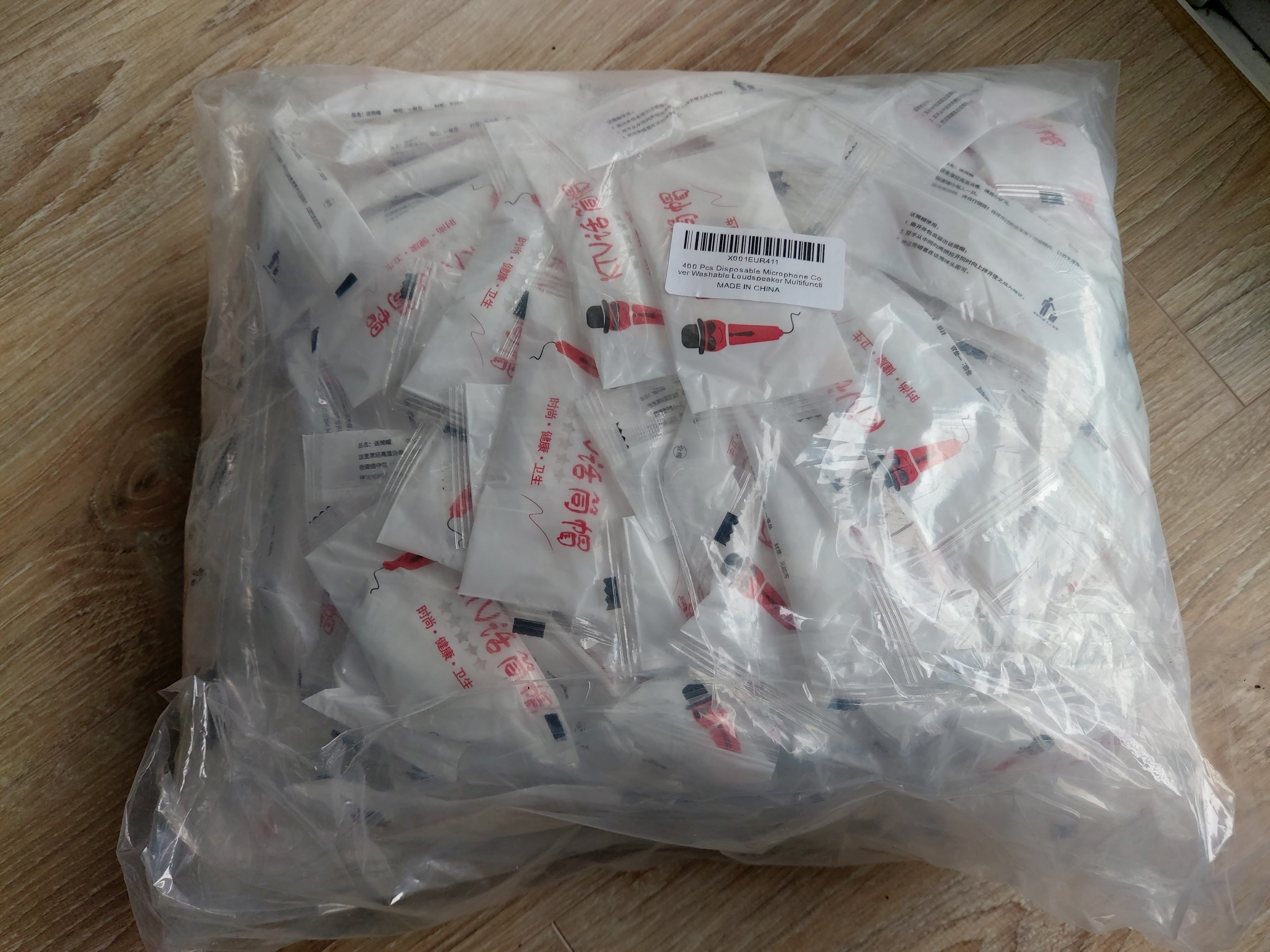
As such, I’ve bought 400 disposable covers for the top. After every reader, the surface will be wiped down and a new cover applied. Because I address the audience for a few seconds after each speaker, I’ve also cut down on cleaning by buying a headset microphone for my own use. There will also be the option for readers not to use the sound system at all.
This is what 400 disposable microphone covers look like.
That, however, only caters for the people who come along to the pub. We’ve seen a thirst over the last 18 months to participate from outside our home city. For many, it was inconvenient or impossible to travel into Dundee, while others weren’t able to navigate the stairs in the venue, or are not ready to mix until the public health threat passes.
In response, we’re trialling an online edition called Hotchpotch Beyond. This works the same way, with the sole exception that priority will be given to those who weren’t at the in-person version. The trial will last for three months to gauge interest.
Over the last couple of weeks, I’ve been invited to meetings with people in different parts of the literary scene.
The first of these was a pal from the Scottish Book Trust. He and his colleagues are trying to set up a professional spoken word organisation in Scotland that’s similar to Apples & Snakes in England.
As my own events have been passion projects rather than for profit, I was limited in how much I could contribute directly. However, I was able to point him towards others in and around Dundee who more readily fitted the bill.
In the other meeting, I was part of a group of performers and producers. The plan is to hold a Fringe-style programme of events in Dundee in September, and I liked the organiser’s attitude, particularly towards audience safety.
Before this opportunity came up, I’d already been devising a stage show for people accustomed to live performance. I didn’t expect to have just a month and a half to put it together, however, so the next few weeks are going to be intense.
But learning from fiction is in no way restricted to children’s books. Anyone can glean or dispute historical stories from Dan Brown, or learn a little about the law from John Grisham.
A personal favourite is The Day of the Triffids, where a character talks about risk management by using an example from his family farm. It was explained that once in a while, the cows would bunch together and burst through the perimeter fence, yet it was so rare and unpredictable that it was quicker and cheaper to fix breaks as they occurred than to reinforce the whole fence.
And then I read Lee Child giving praise to Frederick Forstyth as The Day of the Jackal turns half-a-century old. The entire novel is almost a textbook for an assassination, such is the level of detail. The hitman isn’t a spiv with limitless resources. We see how he funds his operation and where his weapon and fake documents are obtained.
Yet the reader is never overloaded with lists of data. The key technique is to convey much of the detail via dialogue. At the very beginning, for example, a suspect begins to tell the police about the assassination plot, and the reader learns the details at the same time as the officers.
I feel compelled to leave a caveat here that anything learnt in fiction should always be cross-checked with a non-fiction source. That’s doubly true if you plan to include something educational in your own work.
Sometimes I think I know English grammar inside and out. Other times, I stumble upon an aide memoire I’ve never heard of.
I was writing a story where I kept typing ‘Thamos’ in error instead of ‘Thomas’. Out of interest, I looked up ‘Thamos’ as I was sure there was someone with that name. There was: it was an 18th-century play called Thamos, King of Egypt.
However, the top search result defined it as an acronym for remembering conjuctive adverbs, namely ‘Therefore’, ‘However’, ‘Also’, ‘Meanwhile’, and ‘Otherwise’. The last letter of ‘THAMOs’ is in lowercase and seems intended simply to create a word.
I’ve no idea whether the folks at NoRedInk invented this acronym, but it was news to me. They also go on to give two others: ‘FANBOYS’ is for coordinating conjunctions while ‘SWABIs’ is for subordinating conjunctions.
This started me thinking about acronyms and mnemonics as a memory aid. I’m somewhat ambivalent about them. If carefully crafted, they do their intended jobs.
One that sticks out from high school Chemistry is ‘OILRIG’, meaning ‘Oxidisation is loss, reduction is gain.’ This works well because the initial letters always spell out a sentence with the words in the correct order.
But supposing you wanted to remember something in a non-linear order. Before Pluto was reclassified, you could recite the names of the bodies in our solar system with ‘My Very Easy Method Just Speeds Up Naming Planets’.
This is great if you wish to name them all, but supposing you wanted to check the order of Uranus and Neptune, it would take a few seconds to find your place, even starting from the beginning.
Another weakness with this type of mnemonic is that you still need to remember the word that each initial letter stands for.
This system is used extensively by Tony Buzan in his educational books. I read one of his publications when I was younger, and it’s a robust method that allows recall of items in any order, but I never persisted with it.
At present, I have no practical use for acronyms like ‘THAMOs’, ‘SWABIs’, or ‘FANBOYS’. However, I am amazed I’ve reached degree-level English without ever encourtering them, and I’m sure they’ll be of use to someone.
Over time, the number of people reading it has steadily increased. Any given week, I can bank on between 4 to 6 people pressing the Like button, and they are all appreciated.
Every so often, I’ll receive replies to my entries. Most often, it’s from my pal Webgirluk, whom I’ve known for nearly two decades from LiveJournal. Then last week, I found a comment from someone I met at a poetry workshop a few years back.
This started me thinking how bad I am at reading others’ entries. I have followed a lot of people over the last eight years, but I rarely have a chance to read their words, let alone comment on them.
I spend a lot of time speaking to writers and organising events, and I wish I could say I’d make the time to read the words of my WordPress contacts, but I can’t make that promise. The best I can offer is that I know they’ll always be there for when it’s possible to read them.


 Gavin Cameron