A Fully-Booked Weekend

This weekend just gone, I made a point of going to the Dundee Book Festival.

It would have been easy to take in a lot of events. The festival ran from Friday to Sunday, inclusive, and its three venues were all close together. The Steps Theatre acted as the base location, with a few events at the adjoining Central Library, and a few more at the nearby McManus Galleries.

I was selective about my attendance, however, as I’ve previously found it’s easy to be carried away and tie up the whole day. I settled on four events, even if I ended up only seeing three. There was a misprint on the new writing showcase that the end time was 10:30am. This led me to miss the 10:30am start to the next event, about how to submit to My Weekly magazine. However, I’m pleased to report I saw the other two unhindered.

This particular festival is relatively new. It was first organised by Leisure & Culture Dundee in 2025. It also serves as the spiritual successor to the Dundee Literary Festival, which ran from 2006 to 2017 and was an initiative of the University of Dundee.

The literary festival enjoyed a close affiliation with the now-defunct Dundee International Book Prize, which was awarded from 2000 to 2016. As it stands, the university is in no financial position to bring back either the festival nor the prize.

It remains to be seen whether this book festival will match the longevity of its predecessor. However, I can see a lot of potential, so I look forward to its return next year.

Trying Out Urban Folklore

On Thursday of last week, I was invited to a storytelling event in Dundee run jointly by the authors behind MK Hardy and the science fiction publisher Shoreline of Infinity.

I was given around six weeks’ notice to prepare a piece around the theme of dark folklore. I needed that time because I’m the first to admit I don’t typically write folklore, unlike one of my fellow performers, Erin Farley. However, an idea did eventually hatch.

In storytelling circles, local stories tend to be well-received, especially if the details are spot-on. I realised this year marks the 70th anniversary of when the trams in Dundee were discontinued. I built my story around that event, placing myself into the position of someone who was involuntarily taken on the last tram ride, and setting the story on the same day as the event.

I approached this story in a different manner from any of my previous ones. Instead of starting with a pencil and paper to jot down ideas, I began to piece together its constituent elements while out walking. This wasn’t a concious choice, just the way the story naturally presented itself.

I found one great advantage straight away. Had the story been written down first, it would almost certainly have been more difficult to memorise, but composing it in my head produced a memory palace effect, especially as much of the action involved physical movement.

This method allowed for a lot of embellishment, as no two versions were the same in rehearsals, but this also made the timings difficult to predict. I knew the slot was eight minutes; when I first performed the piece against the clock, I initially believed I’d need to stretch it out to fit the time.

Instead, the clock reached eight minutes and I was barely halfway through. That triggered off round after round of edits, removing and simplifying details while trying to keep a sense of suspense that a longer story allows. That said, these edits helped to solve a major problem near the start: how to contrive a way to make a character from 2026 voluntarily step onto an unfamiliar tram from 1956. In the simplified version, the character instead catches a modern-day bus and is transported through time involuntarily.

Around the time I started regularly performing, I would sometimes adopt a prop. I have one particular piece, for instance, that is most effective when delivered through a megaphone. At the event on Thursday, I revived that idea, taking a last-minute decision to wear my rucksack because it lent a sense of transience to the occasion.

By all accounts, the whole Shoreline event went down a treat with the Dundee audience. This was the publisher’s first foray in the city, as they usually run their nights in Edinburgh and Glasgow, so I hope they’re persuaded to come back in the future.

The Unpredictablity of Live Performance

In 2011, the joint premiere of the play White Rabbit, Red Rabbit was held at the Edinburgh Fringe and at the SummerWorks Festival in Toronto. Most playwrights would be left with the difficult decision of which one to attend, but for Nassim Soleimanpour, the decision was made for him.

At the time, he wasn’t allowed to leave Iran, having refused to take part in compulsory military service there. Performing a play usually requires a lot of discussion between the playwright, the director, the actors and the crew, so how was this one staged with one crucial element removed?

In short, the script travelled the world without him, and didn’t require a director nor a set. In front of an audience, the actor takes the script from the envelope and performs a cold reading. Of course, you have only one opportunity to hold a cold reading, so the trade-off with this method is that a different actor is required for every performance, with a 2024 revival attracting some big names.

Soleimanpour was finally granted a passport in 2013, but the format remains untouched.

While I haven’t yet had the opportunity to see White Rabbit, Red Rabbit, I was reminded of the unpredictable energy of live performance after seeing a recent reading of a different kind. This was done by my pal Luca Cockayne at Generator Projects in Dundee. He’s undergoing medical transition, which is baked into some of his work.

After his first poem, the unexpected surprise was to take his regular injection of testosterone live on stage. Furthermore, the vial had been hidden in plain sight under his artwork on the wall, so it was case of walking over to grab it. During the injection, a Bluetooth speaker played a selection of pre-recorded poetry with his voice electronically modulated into different registers.

The audience were, of course, warned in advance. However, nobody left; in fact, nobody even averted their eyes. What can I say? We were an arty audience who thrived on this stuff, however unanticipated.

I’m now rather jaded when it comes to live readings, so it really needs to be something special to stand out, but that performance was definitely in my top unexpected moments. To find an equivalent, I probably have to go back to 2014, when I was invited to perform on a bill at Dundee University Student Association. I wrote a little about that performance at the time, and it produced two highlights.

One former friend performed a piece as if he were a manager showing a new recruit around an office building. There were two microphones on the stage and after each paragraph, he wandered over to the other one. I thought this was a terrific idea to emphasise the wandering nature of the piece. I told him as much later on, although he admitted that was improvised upon seeing two microphones were available.

Another performer walked onto the stage with a rucksack. After his introduction, he ran around the room giving out chocolate bars from the bag. He dubbed my poetry as ‘awesome’, which I held in high regard as I was new to writing verse.

I also have one more lasting impression from that night. The purple mood lighting was so prevalent that it inspired a further poem the following month, although I didn’t have a chance to perform it on that stage under that lighting.

Stage Presence and Off-Stage Presence

The other week, I was listening to the BBC radio programme Desert Island Discs from 2018., where Lauren Laverne was interviewing the comedian Alan Carr.

I’ll say upfront that I’m ambivalent about his work. I enjoy watching it if I happen to catch him on TV, but it’s unlikely I would deliberately seek out gig tickets.

Although he’s known for stand-up comedy, he made a remark early in the programme about how he doesn’t watch other comics because he doesn’t enjoy it. He went on to say that if he’s part of a bill, he’ll only show up for his section and then leave. You can listen to the relevant section on BBC Sounds from the 10m 30s mark.

When I hear about a comic with the stature of Alan Carr saying he doesn’t watch his peers, it sounds like Stephen King saying he doesn’t read novels. Frankly, it comes across as dismissive towards the other acts, even if this doesn’t seem to have hurt his career.

For as long as I’ve done spoken-word events, there’s been an expectation that if you’re invited to perform as part of a bill, you arrive before the start and watch the other performers until the end. It feels like a collective experience and, in some cases, helps to gauge the mood of the room. In more elaborate productions, showing up early also gives the crew time to run a technical rehearsal.

I find I always learn something from the other acts: a turn of phrase, a particular delivery, a way of holding the audience, or – every so often – how not to do these things.

In one positive example, I’m reminded of a Josie Giles gig in Birmingham shortly before the pandemic. I knew a little about her work, and next to nothing about Joelle Taylor who was on the same bill. Having watched a lot of poetry, I thought I’d seen it all before. Yet both their performances were so well done that I walked out of that building saying, ‘I didn’t know you could do that with words.’

There are negative examples too, like the amateur actor who thought he would try stand-up comedy. I’ve no idea how he stayed in his theatre group without being able to read a room, but some of his gags were incredibly out of date and offensive, and nearly every one fell flat.

So I’m curious about other people’s experiences. Do you stay for the whole show when you’re performing, or do you dip in and out? Is this just an expectation for some types of gigs but not others? Am I, in fact, in the minority?


That was where the entry was meant to end, and I clicked Save yesternight with a view to redrafting this entry today. I then received a message from a couple of local writers. They’re looking to bring a poetry evening to Dundee in April, and we’ll need to discuss the type of material they want.

Whoever is on the bill with me, I’ll definitely be listening to their performances.

The Cultural Value of the Public Domain

When I heard about the recent adaptation of Frankenstein by Guillermo del Toro, I absolutely had to see it at some point.

The novel has been a talking point among my poetry circle, the Wyverns, since we released a released a pamphlet with the theme of Frankenstein in 2018. There is a local connection in that Mary Shelley was living in Dundee when she started writing it.

For literature in the UK and EU, a work remains in copyright for 70 years after the death of the author. Even if that law had been around in 1851, Frankenstein is still squarely into the public domain, so any director is allowed complete artistic freedom. The consensus seems to be that this version is faithful to the spirit of the novel, but not the details.

If Mary Shelley somehow arrived in our time and was able to watch this, I think she would be impressed.

But copyright law varies by juristiction and by type of work. In 1998, the US passed the Sonny Bono Copyright Term Extension Act. This extended the copyright of works authored by corporations, meaning they wouldn’t become public domain until 95 years after the date of their creation.

The legislation was named after the late Sonny Bono, who believed that copyright should be in perpetuity. However, the true beneficiary is widely thought to be The Walt Disney Company. Only within the last two years has its first creation – Mickey Mouse – fallen into the public domain, and we can expect to see more following suit over the coming decades.

In the literary world, novels from the middle of the 20th century novels are beginning to fall out of copyright. A prime example is Nineteen Eighty-Four because George Orwell died in 1950, just two years after its publication.

Wikipedia maintains pages about works that will become public domain in 2026, and if you fancy reading some of these, they might be available on the Gutenberg Project website.

A Look Back to Ten Years Ago

I have a couple of upcoming projects that I’m not ready to talk about just yet. To fill the gap, I’ve instead looked backwards in time to the entry closest to today: 26 October 2015.

With the title Relentlessness, the entry described a hectic week. The open-mic night Hotchpotch held an event aboard the vintage HMS Unicorn, the Dundee Literary Festival had just been and gone, and the artist studios WASPS held an open weekend. I’d also been to see Hamlet at the cinema, presented by National Theatre Live, while our writing group was gearing up for National Novel Writing month.

As I read back this snapshot of events, they somehow don’t feel like they happened ten years ago, even though I rationally know they did.

For instance, WASPS studios is very much still open for business and Jen Robson is still around, albeit working from a home-based studio. Hotchpotch is still going, although we’ve never been invited back onto the Unicorn. Then we have National Novel Writing Group, which only ceased operations this year.

On the other hand, although none of us realised it at the time, the last Dundee Literary Festival would be held in 2017. It took until March this year for a replacement event, the Dundee Book Festival, to start up.

There’s something both appealing and lamentable about that ephemeriality. No doubt I’ll feel the same when I look back upon this year’s projects from 2035.

Hotchpotch Moves to Groucho’s

Regular readers will know that I used to run a monthly open-mic event called Hotchpotch, which I handed over to my pal Eilidh in October 2024.

At the time, the event had been running at a café in Dundee until an upcoming permanent closure was suddenly announced in July 2025. The August event was able to go ahead, but she had to find somewhere to hold it in September.

Fortunately, it didn’t take long to find a suitable replacement: a live music venue called Groucho’s that was once a second-hard record shop. For context, Hotchpotch has probably moved ten times in 15 years for one reason or another.

Unlike a typical music gig, however, Hotchpotch has a particular set of requirements for accessibility. There are people constantly entering and leaving the stage area, plus the environment needs to be quiet enough for the audience to hear clearly. Often, you just need to try out the place to find out what fits and what needs improvement.

Aside from a fixable incompatibility with our microphone and the house PA system, the maiden event yesternight went marvellously and attracted some positive feedback. I took the opportunity to read a piece that was specifically written for the occasion.

Being back on the pub circuit feels like a homecoming in a way because that’s where the format evolved. A couple of members even returned after a few years away. The event also made me realise I’ve missed one aspect in particular.

Two venues ago, we were in the basement of a pub called the Hunter S Thompson. At the end of each event, I would pack up and go home soon afterwards because I was always working the following morning. It took me some time to realise members weren’t simply chatting and dispersing; they were instead heading upstairs and drinking together for an hour or two.

From then on, I encouraged folks to do that, as the more cash we could put through the tills, the more likely we were to secure our bookings for the future. I even joined them on occasion, but not every month.

When we moved to a café in 2023, we were given a 9pm curfew to allow the staff to finish at a reasonable time. But with Groucho’s open until at least 1am, I look forward to seeing the return of this particular element.

Reaching Fever Peach

On Saturday just gone, I was given the opportunity to perform a 15-minutes of poetry at the Keiller Centre in Dundee. This was organised by local comedy band Fever Peach as part of their Monthly Indulgence event and here’s how they announced the event.

That said, I only learned of the opportunity on Wednesday and I didn’t have a themed set ready to go. After looking through my collection, the structure came together quickly, with the verse generally moving from more serious to more frivolous.

The actual reading time clocked in around 12 minutes. This was helpful as I knew there would need to be time left for applause and possibly banter with the hosts and the audience; I even gave out Biscoff biscuits as part of the performance.

And there was one other factor at play. When I go to events, I often like to write verse in situ. On one occasion, I wrote clerihews for all the performers who had gone before me. On another, I offered a poetic critique of all the art on the wall of the café. This time, I scribbled a short poem during the soundcheck, based on the, ‘One-two, one-two,’ that sound engineers often use to test microphones.

While the Fever Peach duo kept the show together, the other act on the bill was a travelling Mexican musician called Ed Stone. Despite breaking two different strings on two guitars, he acted as a melodic counterpoint to my poetry.

These shows always end with a complicated improv game, during which my mind went blank more than once, and Ed struggled a little because he was playing in a second language. Still, it was all a bit of fun.

The only downside was the size of the audience, with just five tickets sold. While it is true that the venue is quite hidden away, they always go down a storm and they deserve more eyeballs.

I would happily perform for Fever Peach again, and I look forward to similar opportunities in the future.

The Looming Year

Every year, I take part in Fun a Day. I hesitate to describe it as a challenge or a contest because you’re only competing against yourself, but it’s an encouragement to create something during the month of January. This can be one project for the month or something you update every day, and/or some combination thereof.

I’m pleased to report the exhibition opened on Friday of last week, but more on that shortly.

In previous years, I’ve tackled projects involving writing, such as the fragments I penned in 2018. I’ve also come to realise that I don’t like keeping my work, instead preferring to recycle or reuse the materials after I’m finished with them.

The preparations for 2025 began earlier than ever: on 1 January 2024. I’m in the habit of weighing myself every day, although only the Monday figures are normally recorded.

So for every day in 2024, I tracked my fluctuations on a spreadsheet. A red cell represented an increase from the previous day, a green cell marked a decrease, while blue marked a stable weight or a day I didn’t have access to my scales. To save too much manual work, I quickly learnt how to program Google Sheets to show the colours automatically.

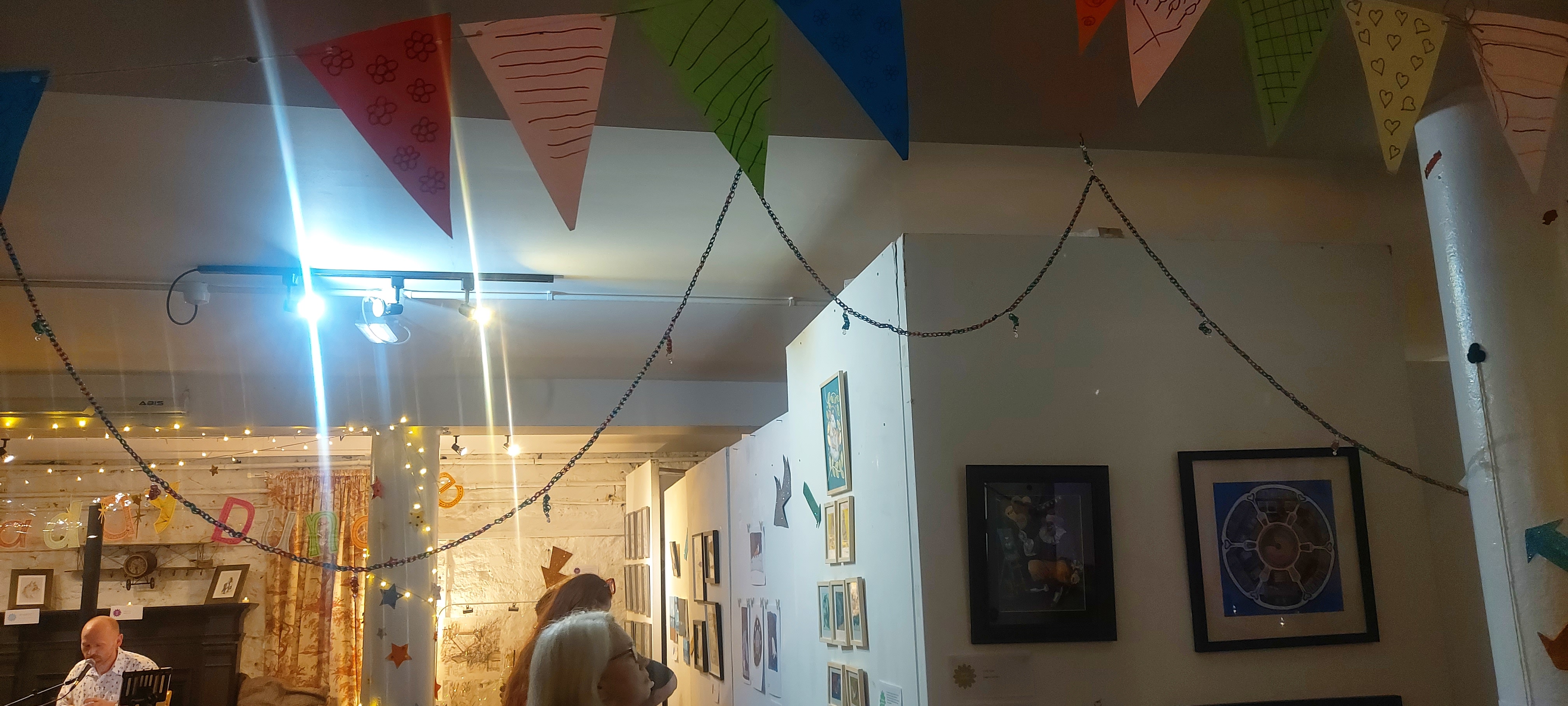
I then converted the colours into a corresponding chain of loom band. As I’m not artisitic in any way, however, I told the organisers to display it in any way they wished. It’s difficult to see in a picture, but it ended up in an M-shape on the ceiling of the café:

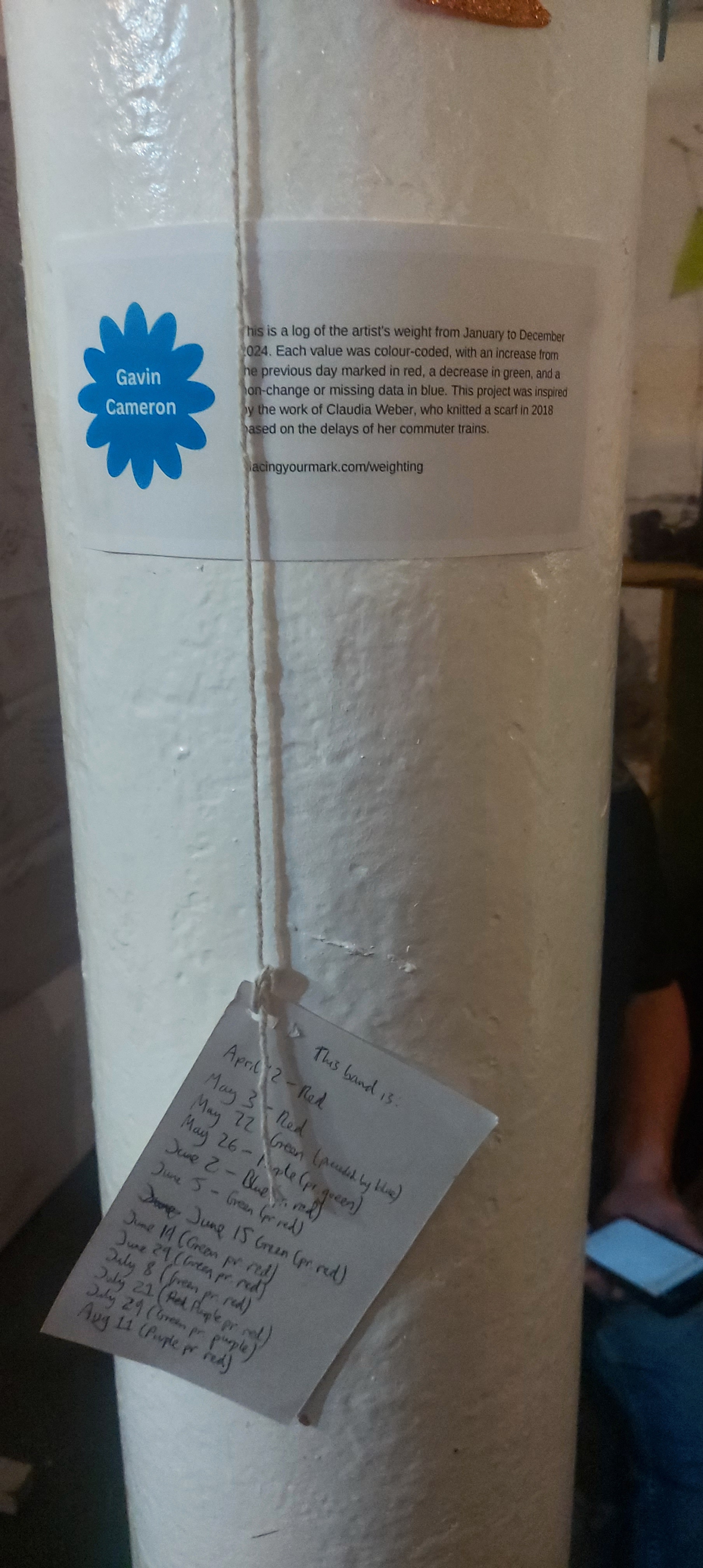
There was also an information panel on the side, along with rough notes about where I was in the chain.

An information panel discussing the artwork, plus a postcard hanging from a string with rough notes about it.

You can see the exhibition at Blend on Dock Street all this month. The website on that panel takes you to the official website for the project, which will stay up all month, but I make no guarantees beyond that.

A Morning in the Library Archives

Thanks to an invitation from the Amps network at Creative Dundee, I was invited to explore the archives at the city’s Central Library on Saturday morning. This should have happened back in March, but plumbing problems forced the place to close for the day.

While there is a wealth of historical documents on public display, there is far more behind closed doors, viewable only by appointment.

It proved challenging to squeeze ten people around the tightly-packed shelves, and it’s just as challenging to describe the breadth of stored material. It spans three centuries of historical newspapers, self-published poetry, local maps, building plans, posters for pantomimes, &c. Each piece tells its own story and can’t always be slotted neatly into one category or another.

A narrow aisle lined with red shelves filled with historical documents and bound books at the Central Library, with a cart containing various bound materials in the foreground.
Some of the shelves at Dundee Central Library.

My pal Dr Erin Farley led the tour, giving answers to every question posed throughout the two-hour visit. When booking the tickets, Amps members were invited to request any special documents they wanted to see. I seized the opportunity to mention my interest in railway infrastructure.

In response, I was rewarded with the original proposal for the first Tay Bridge, bound in a booklet of broadsheet-sized paper and listing Thomas Bouch as the author. As we know from history, the structure collapsed in 1879. Meanwhile, another member enquired about whether there was an LGBT+ collection. Erin explained that efforts were actively underway to develop one.

After the visit, we were treated to coffee and an overdue catch-up with others. Since most Amps events take place during office hours, I’m rarely able to attend, though this scheduling suits many of the self-employed creatives with more flexible routines. I especially miss the wonderful virtual breakfast events at 9am on Tuesdays, so I was keen not to miss a rare Saturday outing.

There’s so much more I could add about the organisation, but I’ve written so much over the past there years that it’s easier to read the relevant back-entries. Indeed, if you’re local and you think this might be for you, here’s how to sign up.