Digging into the Edinburgh Spoken-Word Scene

Continuing a recent trend, I’ve been going to more spoken-word events. This hasn’t been a conscious decision, but instead a combination of wanting to see my poetry pals in action and simply being available on the night.

My schedule worked out in such a way that I was able to visit the Athletic Arms in Edinburgh, known locally as The Diggers, for the two-monthly Graveyard Shift event. It’s further afield than I could normally manage.

One of the headline acts, Ross McCleary, brought this to my attention. I’d originally wanted to surprise him, but it was necessary to clarify some details, particularly as the poster showed the date as Thursday 7 May, whereas the Ko-Fi page initially listed Tuesday 12 May.

So with my train booked and a rough idea of where I was going, I arrived just in time for 7pm. Cards on the table, I would typically steer clear of any pub so closely associated with a football team; in this case, Hearts of Midlothian FC.

However, I found the place nothing less than welcoming to a variety of drinkers, almost none of whom were in team colours. I was particularly impressed by the snug at the back, sectioned off by a thick door from the noise of the main bar. It even contained a makeshift cloakroom.

These are not luxuries I’ve always experienced when running my own events, not by a long chalk.

Ross was the last headliner of the night, with Annie Brechin presenting a wonderful spoken-word set in the first half. I was able to speak to both of them throughout the evening. In between, we heard Grant B Robertson playing comedy songs on guitar. It’s a purely personal view, but what a welcome break from the navel-gazing I’ve come to expect from solo musicians.

The Graveyard Shift also opens its stage to a handful of open-mic performers, who are allotted up to four minutes apiece. Not every one of them was up my street, but grassroots poetry thrives on that mix of voices from the beginners to the seasoned, from the angry to the jaded, and all in between.

The next event in July is on a Tuesday evening when I’ll be running my own group, so I know I won’t make that. If the stars align again, however, I’d be delighted to go back and perhaps grab one of those open-mic slots.

This Year’s Visit to StAnza

About a month ago, I mentioned I was gearing up to visit the StAnza poetry festival in St Andrews. That took place from Friday to Sunday.

I’d booked two events in advance. The first was a virtual writing hour with Fife Writes during Friday lunchtime, so I was able to take part remotely. The other was a poetry walk along the coast on Saturday morning where we stopped every few minutes to hear a related verse.

I’d left a lot of slack time while the rest of the weekend came together. For example, one of the volunteers wanted to speak with me about a new spoken-word event she was setting up, but our schedules didn’t match up, even for a quick conversation.

However, I was able to catch up with a pal who lives in the town. We generally only see each other around once a year. He’d booked a Kate Ireland show for Saturday afternoon, so I followed suit. At the last minute, that was cancelled and replaced with an event by Dean Tsang, who chose the order of his poems using a spinning wheel. I enjoyed that a lot, probably more than I would have enjoyed the expected show.

I go back year after year because it’s a small festival with an ever-present sense of poets coming together to read and write poetry. I can only identify one area of criticism, around pricing, and I’ve said as much in my feedback form.

I understand the aim of their ‘pay what you can’ model to make it accessible to everyone, which comprises a range of up to four price points that could be £5, £10, £15 and £20. I find this to be too much choice. I’d prefer to see just one or two options: (1) the break‑even cost with a surplus, and/or (2) a concession rate. Additionally, that would give me a clearer sense of what the event actually costs to run.

The feedback forms normally include a section where you can specify how much you spent on travel, accommodation, food and drink. I’d kept a careful tally, but that section was missing this year.

For the first time since before the pandemic, I stayed overnight in St Andrews, partly so I could go to shows later at night. I ultimately didn’t go to other events because the times were awkward, but I did nosey around Toppings bookshop before heading to bed at a reasonable time.

There was one other reason I stayed overnight. In August, I’m taking part in a charity Kiltwalk, and the aim is to walk from St Andrews to Dundee via Tentsmuir forest. While I do walk long distances regularly, this is an especially long route, so I need to go on some training walks.

That was the second one I’ve done so for. Every time, I’m learning the best way to prepare and – importantly – what not to do.

The Art of Implied Dialogue

This entry contains plot points from season 1 of Nashville and the 2010 Christmas special of Benidorm. If you don’t want to know about these, skip over this entry.

This week, I encountered a particular technique in screenwriting that I’ve seen before, but I’ve been unable to find out its name. Instead, let me give you an example from a show I’m currently watching.

Nashville is a drama series all about the world of country music. In an episode from Season 1, the characters Rayna James and Teddy Conrad agree to divorce, facing the problem of how to tell their two school-age children.

When the moment finally arrives, viewers don’t hear the conversation because music is playing in the background. It hardly matters, however, as we know roughly what’s being said and how difficult it is for all sides.

The other similar example I have is from the comedy series Benidorm.

At the end of the 2010 Christmas special, the character of Mel Harvey was hastily written out of the series, reflecting the real-life death of the actor Geoffrey Hutchings. In the scene, his son-in-law Mick Garvey receives a phone call from the hospital while at a theatre show with his family.

During the call, we can only hear Mick’s side of the conversation. When he passes on the news to the others, the dialogue is drowned out by music, but the episode as a whole contains enough information for us to understand what’s happened. It’s particularly effective here because Mick normally has an antagonistic relationship with his mother-in-law Madge, but it’s clearly been put to one side.

A technique like this works best when it’s saved for the scenes that can carry the weight and let the surrounding story do the talking. When the audience is trusted to fill in the gaps, the effect can be remarkably strong.

And, as I said at the start, I still don’t know what this technique is officially called. If you do, leave a comment.

The Unpredictablity of Live Performance

In 2011, the joint premiere of the play White Rabbit, Red Rabbit was held at the Edinburgh Fringe and at the SummerWorks Festival in Toronto. Most playwrights would be left with the difficult decision of which one to attend, but for Nassim Soleimanpour, the decision was made for him.

At the time, he wasn’t allowed to leave Iran, having refused to take part in compulsory military service there. Performing a play usually requires a lot of discussion between the playwright, the director, the actors and the crew, so how was this one staged with one crucial element removed?

In short, the script travelled the world without him, and didn’t require a director nor a set. In front of an audience, the actor takes the script from the envelope and performs a cold reading. Of course, you have only one opportunity to hold a cold reading, so the trade-off with this method is that a different actor is required for every performance, with a 2024 revival attracting some big names.

Soleimanpour was finally granted a passport in 2013, but the format remains untouched.

While I haven’t yet had the opportunity to see White Rabbit, Red Rabbit, I was reminded of the unpredictable energy of live performance after seeing a recent reading of a different kind. This was done by my pal Luca Cockayne at Generator Projects in Dundee. He’s undergoing medical transition, which is baked into some of his work.

After his first poem, the unexpected surprise was to take his regular injection of testosterone live on stage. Furthermore, the vial had been hidden in plain sight under his artwork on the wall, so it was case of walking over to grab it. During the injection, a Bluetooth speaker played a selection of pre-recorded poetry with his voice electronically modulated into different registers.

The audience were, of course, warned in advance. However, nobody left; in fact, nobody even averted their eyes. What can I say? We were an arty audience who thrived on this stuff, however unanticipated.

I’m now rather jaded when it comes to live readings, so it really needs to be something special to stand out, but that performance was definitely in my top unexpected moments. To find an equivalent, I probably have to go back to 2014, when I was invited to perform on a bill at Dundee University Student Association. I wrote a little about that performance at the time, and it produced two highlights.

One former friend performed a piece as if he were a manager showing a new recruit around an office building. There were two microphones on the stage and after each paragraph, he wandered over to the other one. I thought this was a terrific idea to emphasise the wandering nature of the piece. I told him as much later on, although he admitted that was improvised upon seeing two microphones were available.

Another performer walked onto the stage with a rucksack. After his introduction, he ran around the room giving out chocolate bars from the bag. He dubbed my poetry as ‘awesome’, which I held in high regard as I was new to writing verse.

I also have one more lasting impression from that night. The purple mood lighting was so prevalent that it inspired a further poem the following month, although I didn’t have a chance to perform it on that stage under that lighting.

Warming Up for the StAnza Festival

As we step into February, the StAnza poetry festival in St Andrews is just six weeks away. This year, it runs for the shortest period I’ve ever known: from Friday 13 to Sunday 15 March. It’s typically four or five days long, with 2022 extending to seven.

Before the pandemic, I would make a weekend of the festival, booking accommodation and attending a wide range of events. The Byre Theatre remains the main hub of activity, but many events are hosted in other venues around the area.

The last time I stayed over was in 2020. Since then, I’ve become more selective, partly due to other weekend commitments and partly because it’s challenging to absorb a lot of intense poetry in one go. Staying over also allowed me to see the poetry slam, which finished after the last bus home, although it’s now held earlier in the day.

One of my other favourite traditions was to start Saturday morning with a panel event that included either a cake or a pie, plus a hot drink. That doesn’t feature this year, so I’ve instead booked a bracing coastal poetry walk, followed by a practical Writing Hour with Fife Writes. The festival atmosphere always nudges me to write a poem or two anyway, so it’s a good start.

These are just the events I have planned so far. There’ll no doubt be others that catch my attention once I’m actually there, and I’ll be sure to tell you all about it.

Stage Presence and Off-Stage Presence

The other week, I was listening to the BBC radio programme Desert Island Discs from 2018., where Lauren Laverne was interviewing the comedian Alan Carr.

I’ll say upfront that I’m ambivalent about his work. I enjoy watching it if I happen to catch him on TV, but it’s unlikely I would deliberately seek out gig tickets.

Although he’s known for stand-up comedy, he made a remark early in the programme about how he doesn’t watch other comics because he doesn’t enjoy it. He went on to say that if he’s part of a bill, he’ll only show up for his section and then leave. You can listen to the relevant section on BBC Sounds from the 10m 30s mark.

When I hear about a comic with the stature of Alan Carr saying he doesn’t watch his peers, it sounds like Stephen King saying he doesn’t read novels. Frankly, it comes across as dismissive towards the other acts, even if this doesn’t seem to have hurt his career.

For as long as I’ve done spoken-word events, there’s been an expectation that if you’re invited to perform as part of a bill, you arrive before the start and watch the other performers until the end. It feels like a collective experience and, in some cases, helps to gauge the mood of the room. In more elaborate productions, showing up early also gives the crew time to run a technical rehearsal.

I find I always learn something from the other acts: a turn of phrase, a particular delivery, a way of holding the audience, or – every so often – how not to do these things.

In one positive example, I’m reminded of a Josie Giles gig in Birmingham shortly before the pandemic. I knew a little about her work, and next to nothing about Joelle Taylor who was on the same bill. Having watched a lot of poetry, I thought I’d seen it all before. Yet both their performances were so well done that I walked out of that building saying, ‘I didn’t know you could do that with words.’

There are negative examples too, like the amateur actor who thought he would try stand-up comedy. I’ve no idea how he stayed in his theatre group without being able to read a room, but some of his gags were incredibly out of date and offensive, and nearly every one fell flat.

So I’m curious about other people’s experiences. Do you stay for the whole show when you’re performing, or do you dip in and out? Is this just an expectation for some types of gigs but not others? Am I, in fact, in the minority?


That was where the entry was meant to end, and I clicked Save yesternight with a view to redrafting this entry today. I then received a message from a couple of local writers. They’re looking to bring a poetry evening to Dundee in April, and we’ll need to discuss the type of material they want.

Whoever is on the bill with me, I’ll definitely be listening to their performances.

The Abridged Pecha Kucha

A couple of weeks ago, I mentioned I was invited to give a talk in Pecha Kucha format at the Dundee Rep theatre. I chose the topic of my Millennium Bridges tours from 2023 and 2025. It’s worth looking back at that previous entry to find out about my preparations.

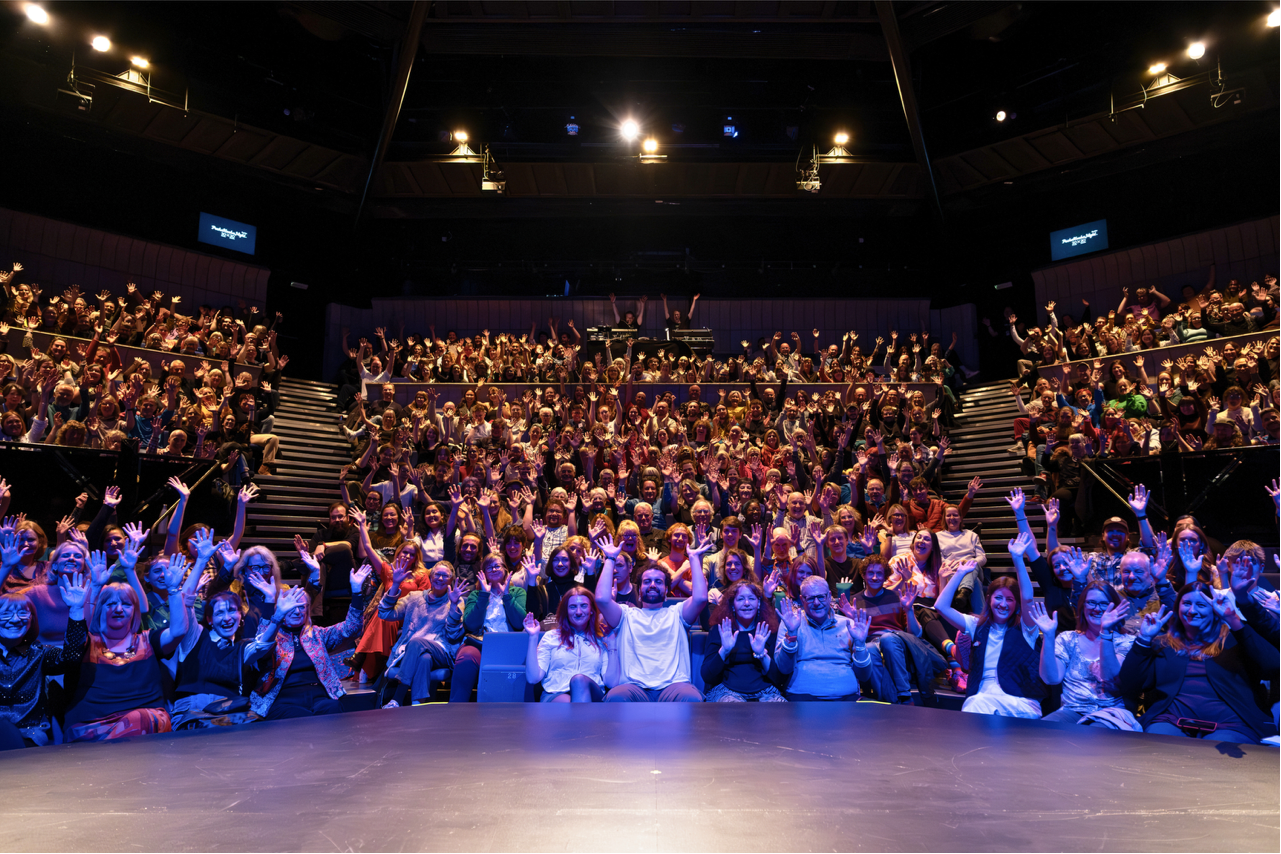
A few days beforehand, I was told the running order. I didn’t mind where I would be placed on the bill, but going second allowed me to relax for the rest of the event. The theatre was set up like a cinema, with a large screen at the back of the stage, plus two TV screens at the back of the auditorium for

I was initially sceptical about being able to commit the entire speech to memory in such a short space of time. Assuming an average of 50 words per slide for 20 slides, that multiplies to 1,000 words. Instead of learning the script word for word, I found the pictures became an aide memoire, giving me a general idea about the next part of the speech.

There are legitimate times to learn by rote – such as acting roles – but I felt this wasn’t one of those occasions. As such, the script was slightly different each time and that gave it a more natural flow. There was no rule against reading from a page, and some of my fellow speakers did just that.

I also warned the organisers in advance that I would be performing while wearing my jacket and bag, as if I’d just come in from the cold, and I wasn’t about to run away.

The event was filmed, but the footage isn’t yet available. In previous years, the organisers would usually stream it online, but that didn’t happen this time. For now, all I can offer is a still image of the audience:

Credit: Aylish Kelly

Topics covered by other speakers included: gardening, pub quizzes, an assortment of community and social engagement projects, and even an interpretative dance to cap off the evening.

Afterwards, a few members of the audience congratulated me on the talk. One man noted that I’d managed to time the end of my speech for exactly when the last slide left the screen. I thanked him but emphasised that it was a coincidence and I could easily have overshot the mark.

A long-term ambition is to help people find the confidence to speak in public, whether it’s for a social event like Pecha Kucha or convincing a boardroom of directors to fund a business project. Heck, maybe that could be my next talk. For the moment, I’ll drip-feed you one piece of advice for free:

Going on stage produces a rush of adrenaline, especially if you’re not used to it. Since it can take up to 30 minutes for this to deplete, and up to an hour for the effects to wear off, it’s best not to go straight to bed. Instead, I recommend spending that time winding down: take a walk, read a book, or listen to the radio.

Accepting One Invitation and Declining Another

I’m pleased to report I’ve been invited to take part in a Pecha Kucha event on Friday 7 November at the Dundee Rep Theatre.

These talks follow a rigid format. Speakers need to prepare 20 slides, which will be projected for exactly 20 seconds apiece, so the accompanying speech must match the time available. Less rigid is the choice of topic, which can be almost anything, provided it’s suitable for a family audience.

I’ll be talking about my trips around the Millennium Bridges in 2023 and 2025.

My challenge here was to take the complex story of the two trips and weave them into a story that the audience could easily follow. This meant indentifying suitably strong start and end points, while needing to eliminate a lot of detail along the way. If unconstrained, I could easily make the story into a half-hour speech.

I thought the accompanying pictures would be the easy part, since many of the were already taken. However, they all needed to be JPEG files converted to a specific resolution and dots-per-inch value. I’m not arty at all, so I relied on online tools with hit-and-miss results; one in particular kept converting pictures at random from JPEG to PNG.

The hard work won’t be over until the night of the presentation. While I have a good idea what my script says for each slide, I need to rehearse and make sure I hit all the relevant points.

But I can’t take every opportunity.

At the end of last week, an event organiser offered me a ten-minute slot to read poetry at his regular spoken-word event near the end of November.

I’ve wanted to go to this event for a long while, but it always clashes with my weekly writing group on a Tuesday. I was even inclined to write a new piece to fill the ten minutes.

Realistically, our own event has to take priority because our members expect us to be there. If my co-host or I know we can’t make a session, we try our best to cover or to make it an online-only event, depending on the type of interruption.

This time, it wasn’t possible to clear the day because of our other commitments. I reluctantly had to turn down his generous offer, with the caveat that I’d be happy to consider other days of the week.

Hotchpotch Moves to Groucho’s

Regular readers will know that I used to run a monthly open-mic event called Hotchpotch, which I handed over to my pal Eilidh in October 2024.

At the time, the event had been running at a café in Dundee until an upcoming permanent closure was suddenly announced in July 2025. The August event was able to go ahead, but she had to find somewhere to hold it in September.

Fortunately, it didn’t take long to find a suitable replacement: a live music venue called Groucho’s that was once a second-hard record shop. For context, Hotchpotch has probably moved ten times in 15 years for one reason or another.

Unlike a typical music gig, however, Hotchpotch has a particular set of requirements for accessibility. There are people constantly entering and leaving the stage area, plus the environment needs to be quiet enough for the audience to hear clearly. Often, you just need to try out the place to find out what fits and what needs improvement.

Aside from a fixable incompatibility with our microphone and the house PA system, the maiden event yesternight went marvellously and attracted some positive feedback. I took the opportunity to read a piece that was specifically written for the occasion.

Being back on the pub circuit feels like a homecoming in a way because that’s where the format evolved. A couple of members even returned after a few years away. The event also made me realise I’ve missed one aspect in particular.

Two venues ago, we were in the basement of a pub called the Hunter S Thompson. At the end of each event, I would pack up and go home soon afterwards because I was always working the following morning. It took me some time to realise members weren’t simply chatting and dispersing; they were instead heading upstairs and drinking together for an hour or two.

From then on, I encouraged folks to do that, as the more cash we could put through the tills, the more likely we were to secure our bookings for the future. I even joined them on occasion, but not every month.

When we moved to a café in 2023, we were given a 9pm curfew to allow the staff to finish at a reasonable time. But with Groucho’s open until at least 1am, I look forward to seeing the return of this particular element.

Reaching Fever Peach

On Saturday just gone, I was given the opportunity to perform a 15-minutes of poetry at the Keiller Centre in Dundee. This was organised by local comedy band Fever Peach as part of their Monthly Indulgence event and here’s how they announced the event.

That said, I only learned of the opportunity on Wednesday and I didn’t have a themed set ready to go. After looking through my collection, the structure came together quickly, with the verse generally moving from more serious to more frivolous.

The actual reading time clocked in around 12 minutes. This was helpful as I knew there would need to be time left for applause and possibly banter with the hosts and the audience; I even gave out Biscoff biscuits as part of the performance.

And there was one other factor at play. When I go to events, I often like to write verse in situ. On one occasion, I wrote clerihews for all the performers who had gone before me. On another, I offered a poetic critique of all the art on the wall of the café. This time, I scribbled a short poem during the soundcheck, based on the, ‘One-two, one-two,’ that sound engineers often use to test microphones.

While the Fever Peach duo kept the show together, the other act on the bill was a travelling Mexican musician called Ed Stone. Despite breaking two different strings on two guitars, he acted as a melodic counterpoint to my poetry.

These shows always end with a complicated improv game, during which my mind went blank more than once, and Ed struggled a little because he was playing in a second language. Still, it was all a bit of fun.

The only downside was the size of the audience, with just five tickets sold. While it is true that the venue is quite hidden away, they always go down a storm and they deserve more eyeballs.

I would happily perform for Fever Peach again, and I look forward to similar opportunities in the future.