On Tuesday two weeks ago, I was hurrying back to the office after lunch to prepare for a meeting. En route, I spotted tourists taking photographs of nearby statues, taking advantage of a brief window of sunshine in an otherwise rainy week.
Exactly a week later, I was the tourist at the Edinburgh Fringe squeezing past locals in bus stops as they went about their business. This started me thinking about point of view in the stories we write.
Let’s fictionalise the scenario above into character sketches, starting with the first-person point of view of the office worker:
I didn’t mean to take so long over lunch, but I was dreading that meeting. Profits are down for the third quarter and couldn’t explain why. Just then, some tourist, not looking where he’s going, steps back trying to get a picture of some statue and knocks the papers right out my hand. He’s in a world of his own and if I wasn’t so late, I’d have had a word with him. But I picked them up and carried on and went to the meeting and just said customer engagement was better than ever.
And now from the first-person point of view of the tourist:
Finally, a sunny afternoon after all that rain. Thought I’d take the chance to come out of the museums and take a few photos round the town centre. There’s an enormous statue of Queen Victoria so I had to step back quite a bit just to fit it all in. Next thing I know, bumped into some local who’s more concerned with reading documents than looking out for people. Said I was sorry, as you do, but she just ignored me. Fine by me. I got the picture I wanted.
Hynek Moravec – Self-photographed
Already, we can see a difference in the two characters’ points of view. The office worker is in a hurry and preoccupied about the meeting, but the tourist is more relaxed and concerned with taking good photos. We also see different details depending on the perspective of the character. Finally, let’s examine the same scenario in third person:
On Tuesday afternoon, Alice left the pub clutching her documents with five minutes to spare until the meeting. She still could give no good reason why profits were down for the third quarter. Meanwhile, Ben cupped his hand to his camera screen against the strong sun. The statue needed a wider angle. Without turning around, he stepped back. At that moment, Alice turned the corner and they bumped into each other.
The first and second passages are in the first-person voice. The characters use ‘I’ and ‘me’ to describe what’s happening from their perspective. But neither of them knows what the other is thinking; they can only make assumptions based on the actions of the other party. This voice is an excellent way to portray an unreliable narrator.
The third passage is in the third person, a more objective point of view. The narrator uses ‘she’, ‘he’ and ‘they’. We now find out the names of the characters, which is also possible in the first person. But that would require a self-introduction or for a second character to mention the name, which might distract from the story. It’s also revealed that Alice was in the pub. Was this detail simply not at the forefront of her mind, or is she an unreliable narrator with a drinking problem?
So we have a choice to make, and it’s a choice that beginner writers sometimes struggle to make. Even experienced writers occasionally need to rewrite.
A few Novembers ago, I was writing an alternate history novel, where the past is reimagined in some way. In mine, the petrol engine wasn’t developed until the end of the 20th century. My plan was to tell the story from the point of view of a historian who had interviewed the reclusive inventor; this would be peppered with newspaper and journal articles.
The technique didn’t work. I couldn’t find enough material to construct a detailed narrative. I recalled some advice I was once given that if a piece isn’t working, the point of view is often the cause. I’ve found this to be true.
I decided I had to let the inventor speak for herself, and the story came alive. The first thing she did was attend an office Christmas party and hit her boss with a glass bottle.
Earlier this year, I read a letter in Writing Magazine that a subscriber’s own story wasn’t working from his main character’s point of view. He explained how and why he rewrote it in the third person, then rather grandly signed off the letter with First person – last choice.
However, I disagree; the point of view will probably change depending on the story you write. In the case of a novel, there might even be shifts from first to third or vice-versa from one chapter to the next. If the subscriber in question did stick slavishly to third-person, he would probably encounter the opposite problem eventually, as I have recently.
The first- and third-person voices are by far the most common, but there exists a far rarer alternative: the second person. This is where the narrator uses ‘you’.
It’s a personal opinion, but I believe this technique is only effective in poetry, as it gives the impression of the poet writing a letter to a third party. In prose, it can feel as though the author is instructing the reader. A novel in the second person can be done, however, as Angelina Mirabella found out.
Anyone who routinely submits work for consideration can tell you how long it often takes to receive a response, let alone see your words in print. Right now, for instance, it’s too late to plan for summer; publications will shortly be looking for Christmas-themed material.
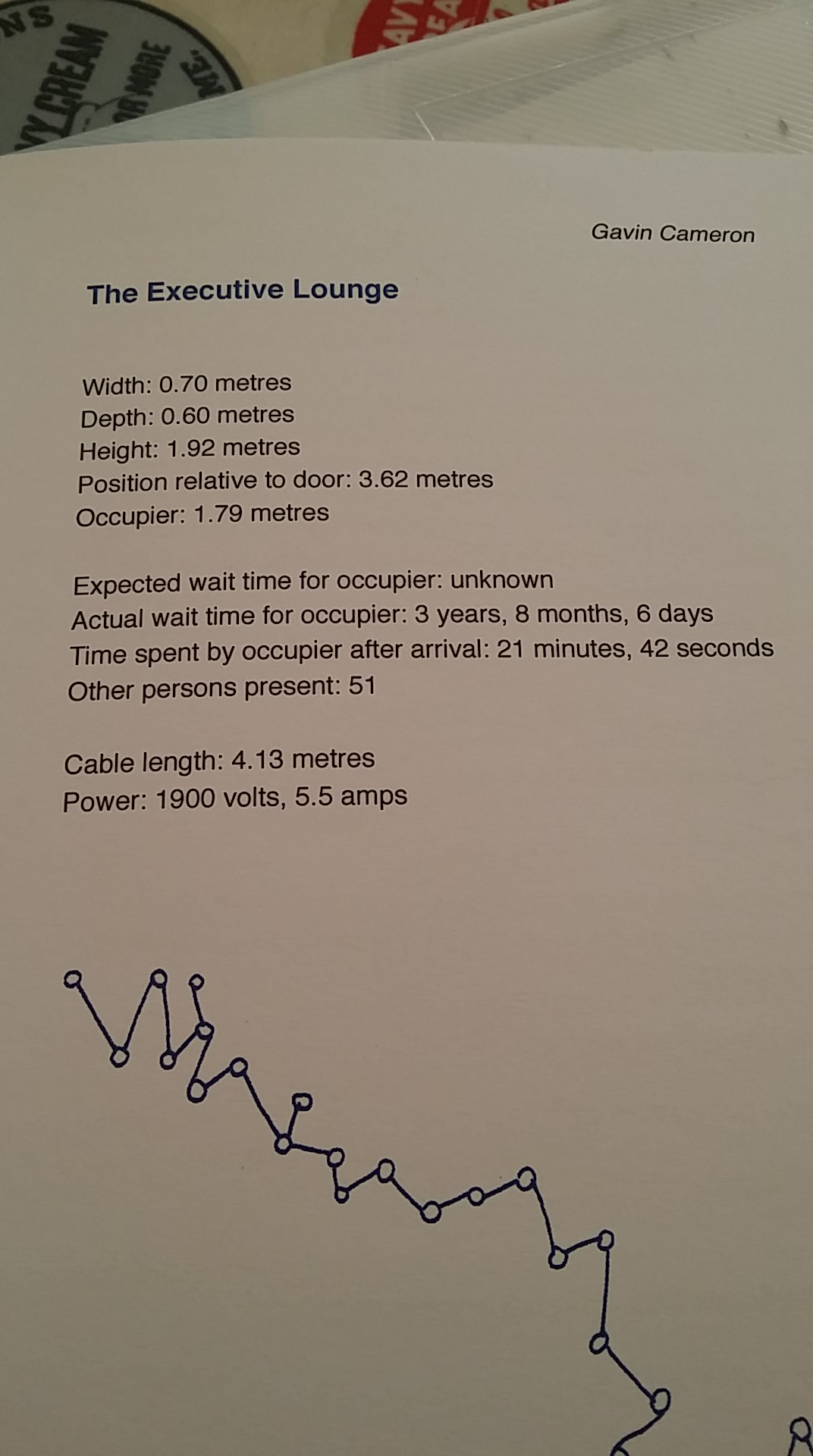
In October last year, I heard that my poem The Executive Lounge had been accepted for the local publication Dundee Writes. However, the launch only took place on Thursday of last week. Nonetheless, it was worth the wait because my piece is alongside some excellent work from students and alumni. There is also a focus on one of the creative writing tutors who died around a year ago.
The style of the pamphlet tends towards the less mainstream and more experimental and wistful. My poem describes an object without naming it. Instead, the reader is presented with a list of statistics about the item, with the most telling stats placed near the end.
It’s a favourite of my own work, and it seemed to go down well with the audience, but it is primarily a page poem. On this occasion, audience members could follow the text in the book; but when I read a loud it a couple of years ago, it received no reaction at the end, not even applause.
Every so often, I’ll hear about a show and instantly feel compelled to go along. Much of the time, is because I’ve heard great word-of-mouth; sometimes it’s because I like an actor or musician involved in the project.
On the odd occasion, I go because I find the concept utterly arresting, and that’s why I bought a ticket for Fat Kid Running at the Scottish Storytelling Centre on Friday. The poster warned that Katherine McMahon’s debut show is not an inspiring before-and-after picture, but an honest insight into her body image issues. As I’ve been overweight all my life, I wanted to hear from someone in a similar position.
In the interests of full disclosure, I’ve met and spoken to McMahon before, but we’re not otherwise acquainted.
The show opens with a mock bleep-test, a theme revisited at the climax of the piece. We’re taken on an autobiographical trip through bullies in the school changing rooms, via health checks at the GP surgery, and how she built up to running several kilometres without stopping. Sometimes the narrative is poignant but always peppered with a sense of humour that lifts the audience at just the right moment.
A pair of ASICS stability running shoes, model GEL-Kinsei (Photo credit: Wikipedia)
Although the poetic prose was compelling in itself, what shone through for me was how genuinely she appeared to accept and love her body with no excuses and no delusions. There are two costume changes, both done in view of the audience, and she makes direct reference to her unshaven armpits and ‘boyish’ figure.
Even after seeing Fat Kid Running, McMahon and I still differ in one respect: I’m still committed to losing weight while she’s determined not to lose any. Yet it’s allowed me to understand the other point of view for the first time, and sends a message that a healthy body is not necessarily a slim body.
This performance, presented by Flint & Pitch, was the only one to date. But I’d love to see it go on tour, along with the support acts.
Calum Rodger was the first act to take the stage with a narrative called Rock, Star, North centred around the landscape of the Grand Theft Auto series. He takes a fresh look at what millions of players see but never study, and creates a rapid-fire homage.
Secondly, a musical group. Belle Jones, Audrey Tait and Lauren Gilmour presented Closed Doors, a story told mostly in rap verse about an unfolding major incident that forces racist neighbours out of their flats to mix with each other. The current ending was left too open for my liking, but I’m assured that it’s a work in progress.
Some time ago, On the advice of Writing Magazine, I joined the Authors’ Licensing and Collecting Society (ALCS). If you’ve ever had an article, script or book published, or if you’ve made a contribution to a book, this not-for-profit organisation collects and pays the secondary royalties. Two-thirds of the money is generated by photocopying, scanning and digital copying.
English: A small, much used Xerox photocopier in the library of GlenOak High School in Canton, Ohio, USA. (Photo credit: Wikipedia)
Lifetime membership of the ALCS costs a one-off fee of £36, but you don’t have to pay anything upfront as it’s deducted from your royalty payments. Likewise, you won’t pay anything if they don’t collect any money for you.
The payments are sent out twice a year, and the March one arrived last week. I was surprised to find I was in profit from the three works I’d registered up to that point.
I debated whether or not to reveal the actual figure. I’ve decided to do so on this occasion by way of encouraging others to register. After the £36 fee was deducted, I was left with £84.12. This isn’t a massive sum, but it’s money that would otherwise have been given to someone else or never have been paid. By contrast, The Purple Spotlights EP has only earned me a total of £7.10 from sales, most of that from the first month after release.
I therefore urge you to join the ALCS today and potentially start receiving those missing payments for your work.
In 2014, there was a referendum on whether Scotland should be an independent country, in which 55% of the voters wanted to remain part of the UK. Over the last week, the issue has again raised its head.
Image of Scotland in the UK (Photo credit: Wikipedia)
At almost every literary event I attended ahead of the poll, I found the issue raised again and again in prose and poetry. Some of what I heard was heavy-handed polemic, while others crafted nuanced satires of the situation.
Regardless of quality, though, it encouraged all sorts of people to express their views through the spoken word and to believe that others might be influenced by their writings.
In my experience, much of the creative work was pro-independence. Such was the mood in the country that the National Collective sprung up, bringing together different types of artist to campaign for a Yes vote under one umbrella.
So the prose and poetry that stems from a potential second referendum will likely be even more passionate: from Yes voters who’ve been granted a second chance and from No supporters who believe the question was settled in 2014.
And further to my last entry, the 18-to-22 age group was considered to be the most apathetic generation when I first attended university in 2002. Maybe it was because we had a Labour government back then; maybe it was because George W Bush hadn’t yet invaded Iraq.
Whatever the reason, the situation today couldn’t be more different. Some of the most active campaigners are those of college age, and I barely go a week without seeing a university literary event responding to current affairs.
A few weeks ago, I started a subscription to Grammarly. As I sometimes churn out my writing work quickly, especially blog posts, it’s a useful tool to pick up any spelling or grammar errors that creep in.
There’s already a proprietary checker in Microsoft Word, and it’s possible to download browser extensions that perform a similar function. But Grammarly software is consistent in Word, in your browser, and anywhere else you type on your computer. It doesn’t, however, seem to be available for mobile devices.
Every week, I’m sent a summary of how well or badly I’ve performed in my spelling and grammar. Here are selected stats from 06 February to 12 February.
You wrote more words than 96% of Grammarly users did.
You were more accurate than 82% of Grammarly users.
You have a larger vocabulary than 97% of Grammarly users.
So far, I feel like a latter-day Shakespeare. However, it’s not all happy news:
Top 3 grammar mistakes
1. Missing comma in compound sentence: 44 mistakes.
2. Incorrect use of comma: 15 mistakes
3. Missing comma(s) with interrupter: 10 mistakes
Grammarly and I can’t seem to come to an agreement on this issue.
Sometimes it allows the use of the Oxford comma in a list, but sometimes I’m told to take it out. Similarly, I’m often shouted at for placing a comma before and in a sentence, but it’s occasionally required to stay in.
I’ve also discovered a problem with the verb form in the following sentence:
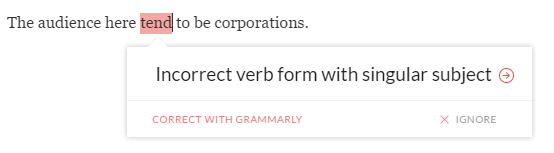
The audience here tends to be corporations.
I’m advised this isn’t correct:
So I duly drop the final letter to make the verb agree with the plural subject corporations. Then I’m told:
Now the verb form is incorrect because it doesn’t agree with the singular audience. And so we go around in a loop. There is a facility to add custom spellings or to ignore a suggestion, but no way to let the software learn your writing style or to flag up false positives.
Ultimately, the writer has to determine whether the words that are written, or the way in which they’re written, are suitable for the intended purpose. Grammarly is a tool that uses algorithms to apply the conventional rules of English; it’s not a textbook that must be followed precisely.
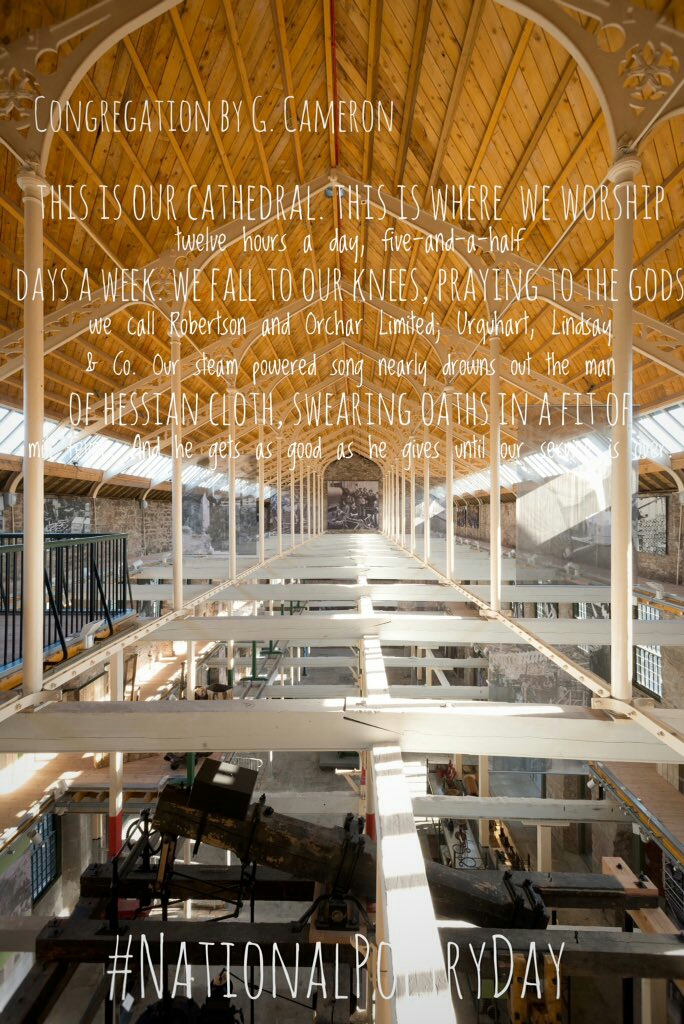
A couple of years ago, I was invited to pen a poem inspired by the former jute mill Verdant Works. I wrote the piece in situ. I later edited it, gave it the title Congregation, and sent it to the mill’s current owners to use as they wished.
Many months afterwards, the poem was published online for National Poetry Day. My original line breaks had been removed, however, so the piece was laid out more like prose. The image is below; the partially obscured words in the bottom line are mill fever and service is over.
I decided I liked this format better than the original.
Fast forward to the present day, and the question of typographical layout has occupied me again. Generally, I steer clear of contests with an entry fee, but I make the occasional exception, this time for the NYC Midnight Short Story Competition.
There are three rounds. At the starting whistle, every entrant is assigned a genre, a character, and a situation. In my case: a comedy about an art teacher and a mid-life crisis. We’re then given eight days to construct a story around these elements, and the winner progresses to the next round.
I struggled to start a story with my elements as they failed to inspire me. So I began to write down some thoughts as poetry, but using paragraph breaks rather than line breaks. I’ve also limited the number of rhymes that appear.
The final piece treads a line between prose and poetry that I would like the judges to pick up on. The other notable feature is that it runs to only 131 words, although there’s no minimum specified in the rules, only the maximum of 2,500.
Moreover, I’m happy with the result, especially since I now have something out of virtually nothing. If it’s enough to make it into the second round, all the better.
I think all writers have pieces that, for some reason, don’t have maximum impact or aren’t coming together in the way we want. In this entry, I have some suggestions for these pieces based on my own experience.
In 2013, I was given homework from a writing group to pen a story inspired by lines from a poem. As it wasn’t coming together, I spent the afternoon in the library writing until it made some sort of sense. I eventually created a flash fiction piece that became my first published story.
A couple of years later, I was working on a poem for performance at an upcoming gig. When it wouldn’t come out in a way I liked, I went for a walk in the cold. By the time I returned home, all the elements began to settle into a list poem. The finished product gained a positive reaction on its début, and has done on each reading since.
Broken mirror (Photo credit: Wikipedia)
Which brings me to my most recent difficulty. This was another list poem, in response to a friend’s work, that wouldn’t flow no matter the order in which the lines were arranged. I ended up writing each line on a separate slip of paper and drawing them out of a bag like raffle tickets. That method helped to identify which lines felt out of place and could be removed, then the remaining fragments naturally joined together.
The most recent poem hasn’t been heard by an audience yet, as I think it needs to be left aside for a while. I’ll revisit the piece in the future with fresh eyes and decide whether I still like it as it stands. And time is one of the best ways to fix non-urgent work.
In 2014, I came home from the aftorementioned writing group having been unable to think of a story from the prompts given. I was so annoyed with myself that I typed up my frustrations in short sentences with plenty of negative space between the paragraphs, then closed the document. Thinking it would be embarrassing, as it was never intended to be seen by others, I didn’t reopen the file until earlier this year.
I was jolly surprised to find that it might actually work as a poem, and I’m also more inclined to figuratively bleed onto the page than I was two years ago. So it might yet be seen before an audience.
We’re now into the thick of National Novel Writing Month. The Dundee & Angus region alone collectively ended 11 November at well over half a million words, and the total is rising every day.
But other literary events are still happening. Tonight, I’m going to a Silent Reading Party, then a Spanish-themed poetry night. And on 25 November, I’ll be seeing the actor Alan Cumming in conversation with Muriel Gray about his latest book.
I would like to take this opportunity to plug a couple of events. You might be aware that my poem Crossing the Road has been included in the anthology Aiblins: New Scottish Political Poetry, which officially launched in Edinburgh last month. There is also to be a Glasgow launch tomorrow 15 November where I can’t be present, and an Aberdeen launch on 21 November where I’ll be performing.
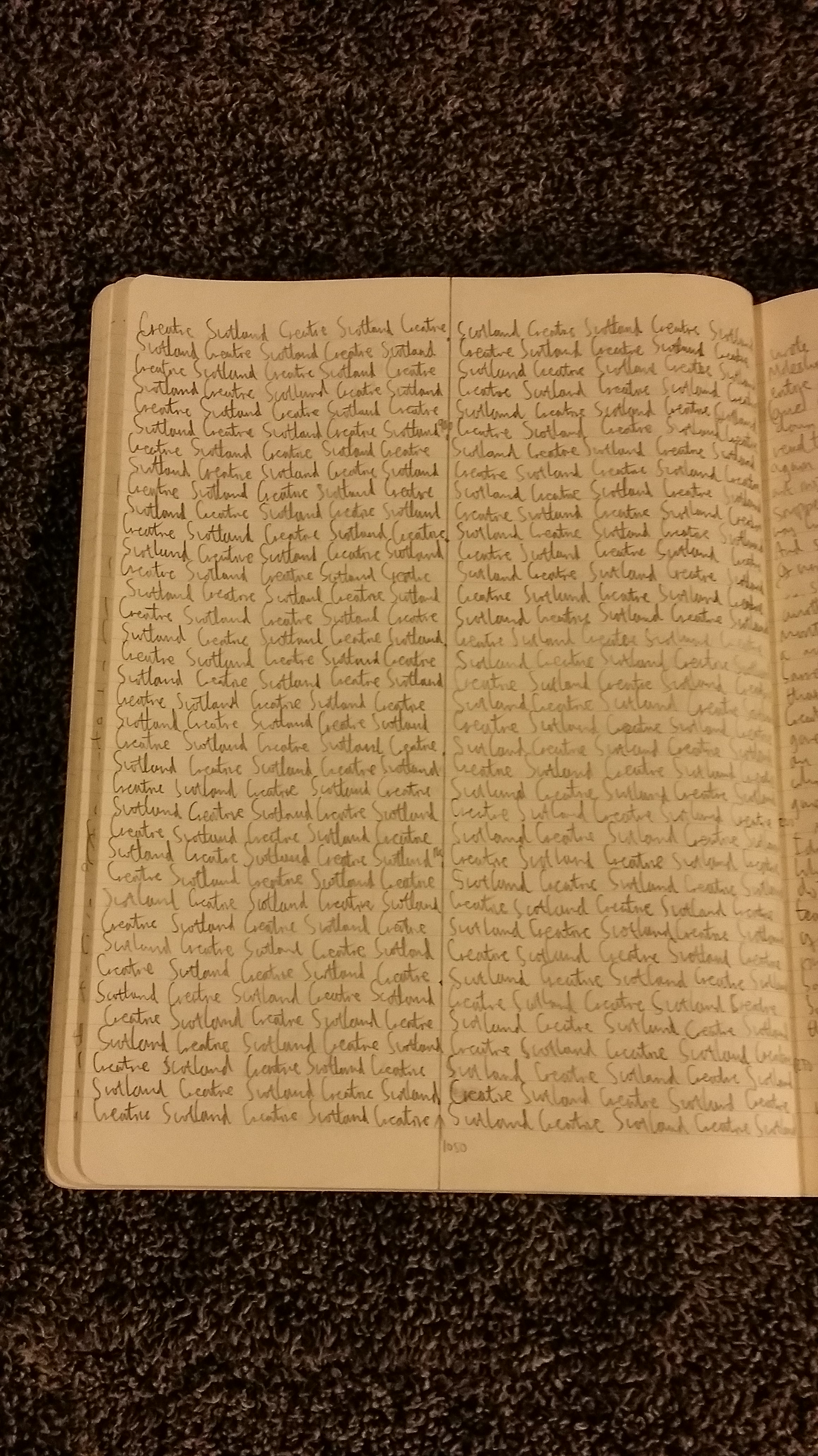
For now, though, it’s back to NaNoWriMo. I didn’t know where I was going with this year’s story – in some respects, I still don’t – but I now have a character who loves to fill notebook pages with the same phrase, much like Jack Torrance in The Shining. Here’s what happened when she was turned down for an arts grant:
Every November, I take part in National Novel Writing Month – aka NaNoWriMo – which is a challenge to draft a 50,000-word novel in a month. Along with an assistant, I’m also a Municipal Liaison (ML) for the Dundee & Angus region in Scotland. We arrange regular meet-ups for members, encourage and support them, and persuade them to donate to the project.
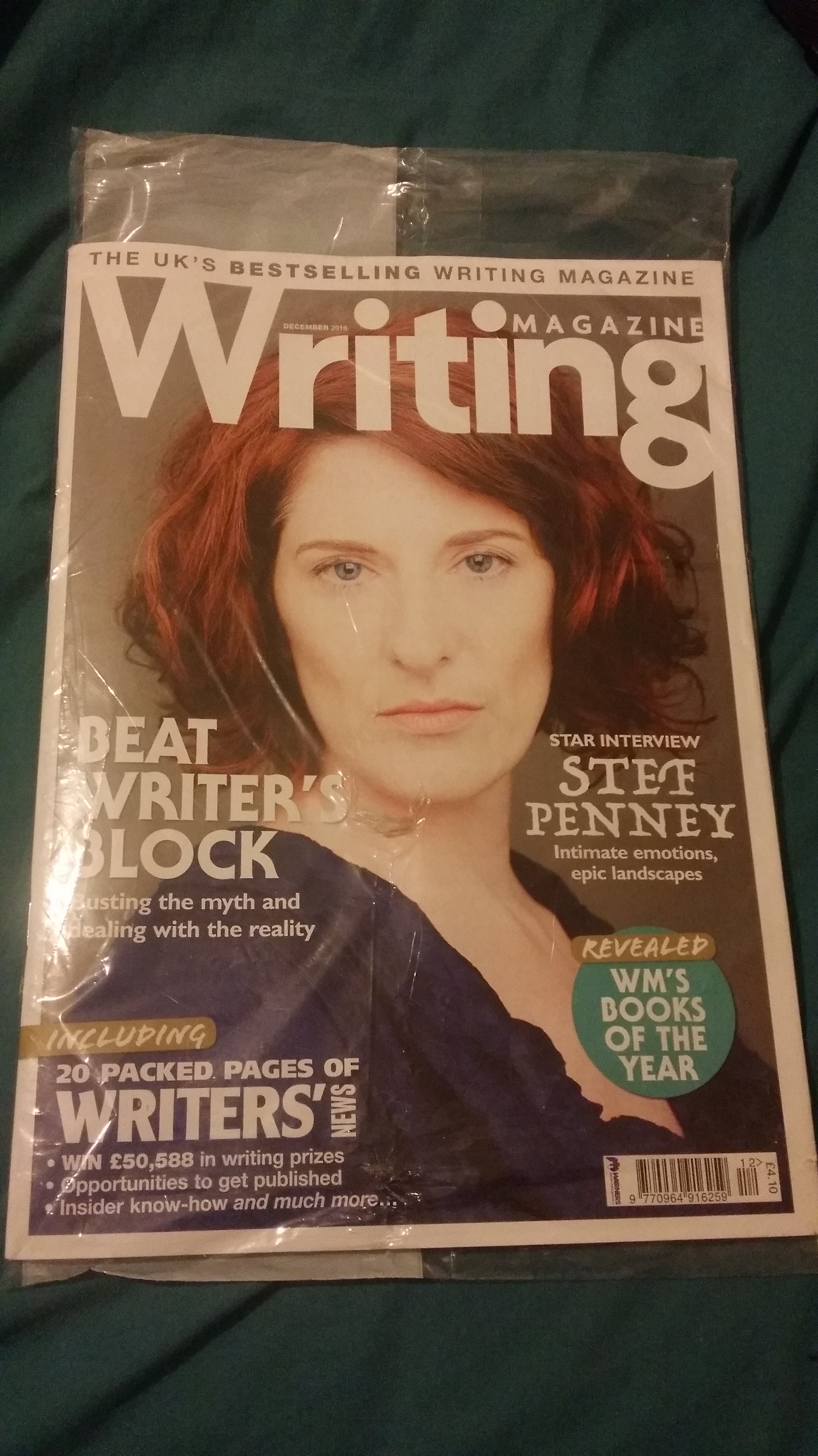
As such, some of my other projects have to be scaled back or placed on hold. This includes submissions to publishers, reading books, and updating this blog. In fact, my current issue of Writing Magazine is still in the cellophane. However, I’m making good progress, having written more words than required every day so far; in fact, the whole region is doing a sterling job.





 Gavin Cameron