Caught up in My Busyness

We’re now into the thick of National Novel Writing Month. The Dundee & Angus region alone collectively ended 11 November at well over half a million words, and the total is rising every day.

But other literary events are still happening. Tonight, I’m going to a Silent Reading Party, then a Spanish-themed poetry night. And on 25 November, I’ll be seeing the actor Alan Cumming in conversation with Muriel Gray about his latest book.

I would like to take this opportunity to plug a couple of events. You might be aware that my poem Crossing the Road has been included in the anthology Aiblins: New Scottish Political Poetry, which officially launched in Edinburgh last month. There is also to be a Glasgow launch tomorrow 15 November where I can’t be present, and an Aberdeen launch on 21 November where I’ll be performing.

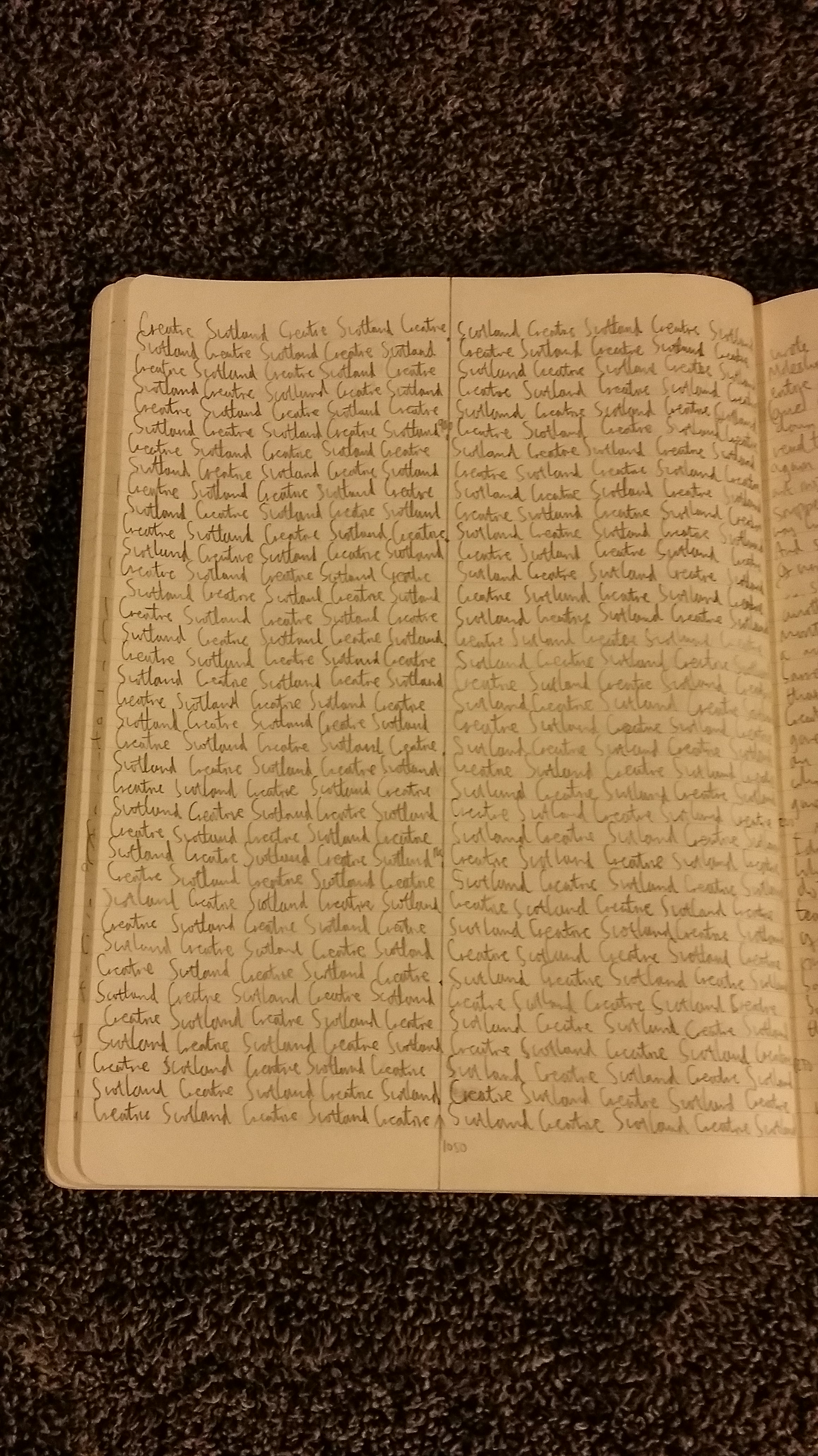
For now, though, it’s back to NaNoWriMo. I didn’t know where I was going with this year’s story – in some respects, I still don’t – but I now have a character who loves to fill notebook pages with the same phrase, much like Jack Torrance in The Shining. Here’s what happened when she was turned down for an arts grant:

The writings of a character in my NaNoWriMo novel

NaNo Seconds

Every November, I take part in National Novel Writing Month – aka NaNoWriMo – which is a challenge to draft a 50,000-word novel in a month. Along with an assistant, I’m also a Municipal Liaison (ML) for the Dundee & Angus region in Scotland. We arrange regular meet-ups for members, encourage and support them, and persuade them to donate to the project.

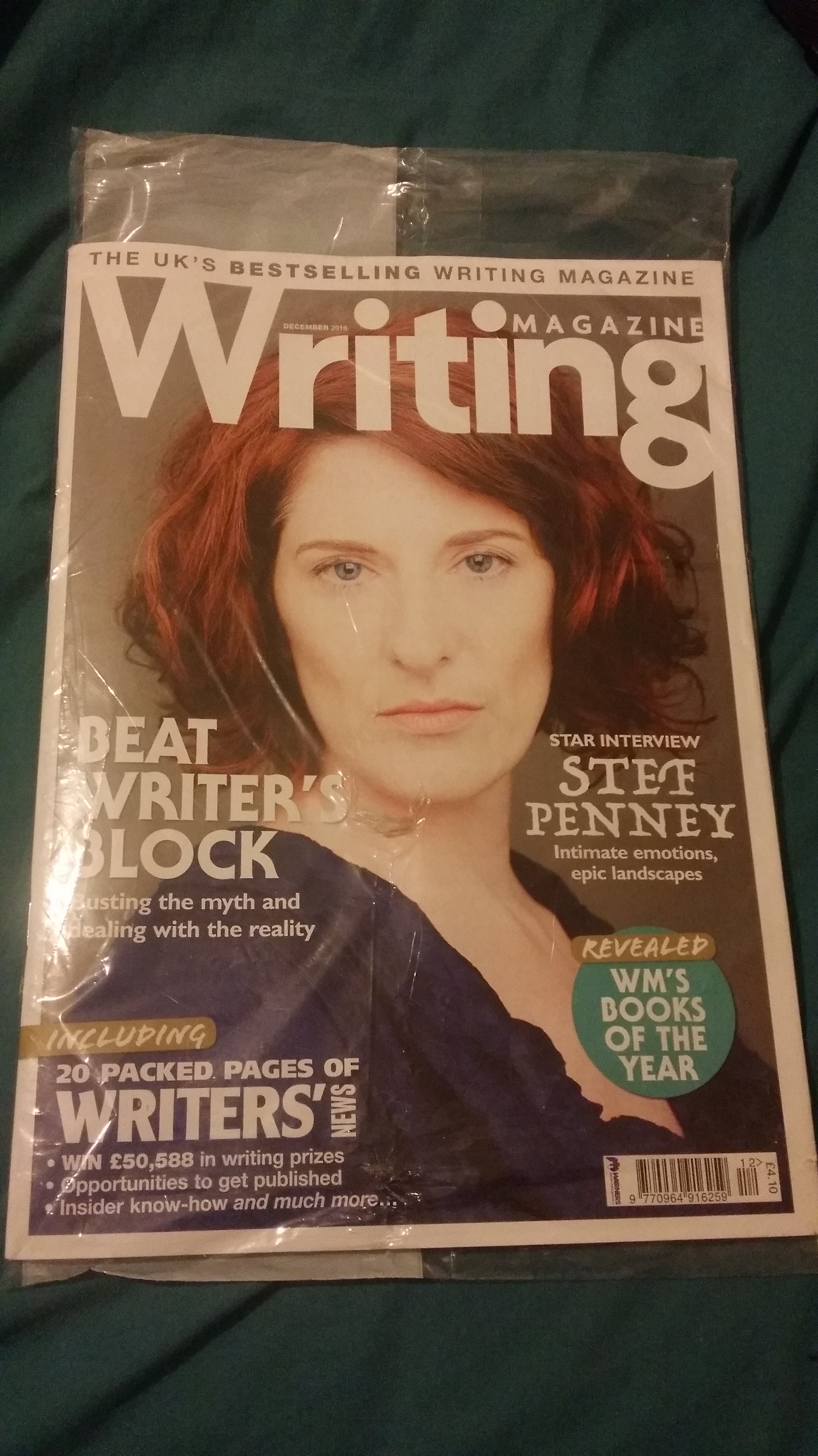
As such, some of my other projects have to be scaled back or placed on hold. This includes submissions to publishers, reading books, and updating this blog. In fact, my current issue of Writing Magazine is still in the cellophane. However, I’m making good progress, having written more words than required every day so far; in fact, the whole region is doing a sterling job.

Writing Magazine still in cellophane

Paper View

Last week, a friend was complaining about a major writing competition that still only allows postal entries. I’d also submitted work because it’s a prestigious publication, but I agree with her point of view. Considering the hundreds of manuscripts that must be received – versus the tiny portion that makes the final cut – this seems a colossal waste of paper, not to mention the needless postage time and cost.

Many competitions offer the postal route as an alternative to an online submission, and there’s nothing wrong with that. Nor is there any issue with posting work that must be physically held to be appreciated. But there are still a bunch who want normal prose and poetry to be sent on paper.

English: A stack of copy paper.
English: A stack of copy paper. (Photo credit: Wikipedia)

Until the 1990s, this was how submissions were made. Internet access and e-mail accounts were generally the domain of academics and computer enthusiasts. Come the next decade, however, and newer technology began to creep into people’s homes. Nearly 17 years after the millennium, online access is nearly universal in the Western world, and postal submissions now look incredibly outdated.

That’s not to say I don’t like a paper book. In fact, some recent research has concluded that sales of e-books are falling. But a book is the final product; the process of gaining the interest of an editor or a competition judge ought to be as quick and cheap as possible.

Yet I would like to understand the other side of the argument. Do you run a publication that only wants submissions on paper? How does it benefit you? What would make you consider accepting online entries?


Together in Electric Screams

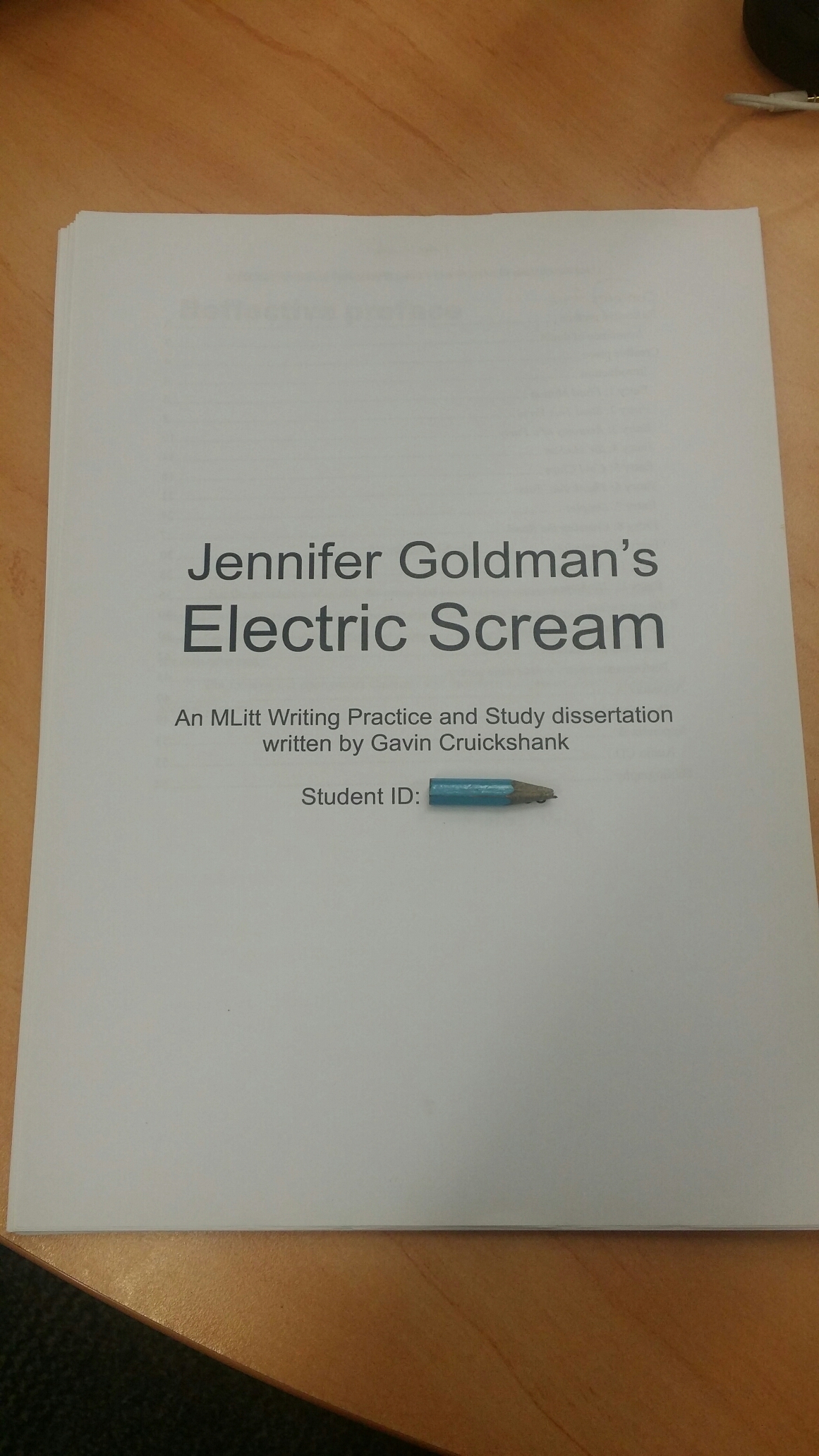
This is the last Monday of working on my MLitt Dissertation, freeing me to give you more in-depth entries from next week onwards. But I’ve one more filler photo for you, and it’s the cover of said dissertation.

There is a creative part of up to 15,000 words, which can include prose and/or poetry, and 3,000-word part to discuss it further. Jennifer Goldman’s Electric Scream is set in 2027 and is written from the perspective of a 29-year-old poet who finds and transcribes a video diary she kept as a student in 2016.
You might notice the dissertation is ‘written by Gavin Cruickshank’, and that’s because I have to use my legal name. I would otherwise use my middle name Cameron.

Last week, I was speaking to a poet and I accidentally used this individual’s last name, which can also work as a first name. The poet accepted my apologies but described such mistakes as a ‘pet hate’.

I was furious with myself not only for doing it to someone whose work I admire, but because I feel the same way when someone spells Cruickshank incorrectly, especially when I’ve spelt it out or the other party has made an assumption. J K Rowling didn’t help by giving Hermione Granger a cat called Crookshanks.

I therefore use my middle name to avoid the spelling issue. Of course, this sometimes causes as much confusion as it saves. At a reading a couple of weeks ago, the organiser thought Gavin Cameron and Gavin Cruickshank were two different people and wasn’t sure which of us had agreed to participate.

Gavin’s improv chums.

On Thursday, I was asked to take part in an event at short notice as one of the poets was unwell. Flow! is a project by Gemma Connell where a poet is teamed up with a dancer. The dancer knows nothing about what the poet will read and has to react spontaneously. The best way to explain it is by watching part of Thursday’s event:

The first poet in this video was the fabulous Amy Gilbrook. She performs most of her work from memory and makes excellent use of internal rhyme. I’d met her before, but I wasn’t acquainted with the dancers.

There are challenges to complete throughout the night, including a section where audience members are invited to writes phrases on pieces of paper. The poets then must assemble these into a new poem, then read it out there and then.

Each dancer and each poet is allowed to take part in no more than three Flow! events, so there’s a potential to take part in two more, and I would happily oblige.

However, it occurs to me that I’m neglecting someone. Prose. When I started out, she was the one I followed, the one I allowed to infiltrate my body of work. But along the way, Poetry surfaced, showed me her possibilities within her boundaries for which Prose has no equivalent.

Now it’s time to go back and find a balance between her and Poetry. Yet there will be no grovelling; there will be the knowledge that Poetry bestowed upon me: how to stretch myself, how to structure, how to affect an audience. And I’ll approach Prose with a renewed enthusiasm, a new sense of purpose, and challenge her to help me produce something to make Poetry jealous.

To that end, I’m going to worship Prose tonight at Hotchpotch, an open-mike night for writers. Anyone can come along and read out their work – or even that of a published author – with no judgement or criticism. If you happen to be in Dundee tonight, it’s at the Burgh Coffeehouse on Commercial Street, and the readings begin at 7pm.

When you don’t like your own work.

Last week, I discussed what to do when you don’t like someone else’s work, be it a novel or a live event, and a big thank-you for all the responses I received. However, I had an experience last week where I didn’t like part of my own work.

I was invited to write a piece inspired by the D’Arcy Thompson Museum at the University of Dundee, which would then be performed in the museum a few weeks later. Sir D’Arcy was a naturalist who disagreed with some aspects of Charles Darwin’s work, and the museum houses his surviving specimens.

I’m quite used to turning round work very quickly: I write it, leave it alone for a few days or a few weeks – depending on the deadline – then give it an edit. If I’ve time, I might be able to repeat this process, refining further each time.

With the Sir D’Arcy piece, I struggled to come up with the idea in the first place even after two long visits to the collection. Finally, I wrote a short poetic monologue inspired by a seven-foot narwhal tusk on the wall. The piece imagines what might have happened when the tusk was delivered to Sir D’Arcy and his students, and uses this to demonstrate that some of his ideas and views are now accepted by today’s scientists.

I was happy with the first section of the piece, but was less happy with the second, which I felt broke the Show, don’t tell rule. I felt it was too factual as the story was not shown through the actions of a character, as in the first section. The actual reading went well, but if I had more time, I could have improved it; in the process of writing this entry, I’ve thought of a possible way.

However, unless I’m invited back for a second performance – and that is a hint to the organisers – I have to accept that I put out what I consider to be substandard work.

I want to be a book star.

In the early 1980s, Van Halen famously requested a bowl of M&Ms at each gig with all the brown ones removed. This was reported in the press as typical rock star behaviour, but the request fulfilled a practical purpose.

The band carried so much equipment on tour that they were worried about accidents from roadies failing to set it up correctly. By including the M&Ms clause deep in the technical part of the contract, they reasoned that if the bowl wasn’t set up as requested, there was a good chance the rest of the technical setup had been ignored as well.

While writers and poets don’t need nearly as much gear as musicians, I think I’ve been to enough literary events to know what I would like and wouldn’t like if I were ever to launch my own book. It’s not to be a diva, I’m merely thinking of practical matters.

I’ve narrowed it down to five key points:

Disabled access

When I’m organising NaNoWriMo events, one of my prime considerations is accessibility. At my hypothetical book launch, this would be a dealbreaker. Everyone ought to be able to come in and hear all about my hypothetical book.

Standing up

Many studies have shown that sitting down for extended periods is a Bad Thing. Sure, most book launches rarely last more than an hour, but multiply that figure by however many launches you’re doing, and the time soon mounts up.

I’d therefore prefer to stand up as much as possible, especially while signing. This has the added advantage that I would be physically on the same level as the reader and it feels more of a two-way conversation. Speaking of signings…

Clearly signposted queue

I went to a launch in July that was so well attended, the bookshop ran out of seats. However, when the time came for the author to sign copies, nobody thought to direct people about where to queue up. Two queues were formed, and the author had to take turn about to keep the wait as fair as possible.

Short questions

I saw a cartoon a few months ago where an academic was being interviewed on stage and the caption read something like We’ve just got time for one rambling self-indulgent question. Unfortunately, I’ve been unable to find it again.

I would have no problem answering questions, but we’d all like to remember what the start of it was by the time we reach the end. One breath, one question, or we move on to the next person.

Red wine available to all attendees

Writers and red wine go together like rock stars and cocaine. I’m sure Van Halen would agree.

The bare necessities.

One of the best ways to edit a story is simply to give it time, much as wine tastes better when it’s allowed to breathe. But there will be times when there’s not a minute to lose and you’ve got to produce something out of necessity, and sometimes that leads to some excellent work.

I was once given a homework exercise from a writing class that was a fragment of a poem. Nothing was immediately coming to mind and I wanted to complete the exercise as I’d paid for the class. After sitting in the library then writing and writing for an afternoon, I eventually produced a rather short piece called A Big Leap but one I was fairly pleased with.

TimeOut
TimeOut (Photo credit: Wikipedia)

Some time later, the tutor alerted me to a flash fiction competition just three hours before it was due to close. I collated what were my best flash pieces at the time, gave them a quick edit, then sent them in. A Big Leap became my first published piece.

I’ve done this a number of times with my work. A looming obligation or a lack of time has a way of forcing you down an unusual path, or to come up with ideas that are unconventional.

This happened most recently in November when I was asked to write an original piece for performance later that month. After a slow start, it ended up being based upon someone I knew many years ago, but I probably wouldn’t have used him if I’d had more time to think about it.

On another occasion, I was all set to read out a particular piece at Hotchpotch, when I was inspired to write another one by a topical event on the news. If I’d left it until the following month, the impetus would be lost, and that gave me just three or four days to concoct the new piece. I’ve subsequently edited it and it now stands alone without the audience needing to know the topical references, and it’s one of my favourites.

But necessity, however superior a result it might produce, isn’t always to a self-imposed goal. When Anthony Burgess found out he had an inoperable brain tumour, he wrote several novels to provide an income for his widow after his death.

Putting quill to parchment.

Many authors are asked the same questions over and over again. One of these is often Do you write longhand or into a computer?

But however repetitive it becomes, it’s a question worth considering. A commercial novel averages around 80,000 words, and that’s just the final product, not taking into account the many redrafts that will inevitably have gone before.

Let’s consider the different ways that different authors physically externalise their words, and the alternative approaches that could be taken.

Learn to touch-type

One of the best choices I ever made at school was learning how to type with 10 fingers, as it’s a skill that served me well in my working life. There are a couple of huge advantages over using just two or three fingers: your word speed can more than double, and it spreads the effort between all your fingers rather than straining just a few of them.

Be advised that it takes a while to master initially, but you’ll eventually be able to do it without conscious thought. A word about tablet computers as well. These have virtual keyboards, so it is possible to touch-type on these, but you’ll need to keep an eye on your finger position as you won’t be able to feel for the keys.

Choose an alternative keyboard

It’s a well-known story that the QWERTY keyboard was originally designed to slow down typists as the first machines were prone to jamming. It’s less well-known that the jamming problem had been solved by the 1930s. This allowed August Dvorak to invent an improved keyboard to help typists increase their speed by placing the most common letters on the middle row.

Sadly, it failed to catch on widely, but it is available on every major operating system. I’ve used the Dvorak layout for some years and it has the edge over QWERTY in terms of word speed. To increase it further, you could try a chorded keyboard. Clerks of court and TV subtitlers use these to keep up with the pace of normal speech. I haven’t used one myself.

Open your notepad

Unless you’re employing a shorthand system, this slows down your thoughts to the speed of the pen or pencil, and some authors are convinced it makes for higher quality writing. Martina Cole claims to be able to tell when a novel has been written directly into a laptop, while James Ellroy sends his handwritten work to a typist.

Be aware, however, that there’s no backup unless you’re using carbon paper. I’ve been told that a highly regarded author was forced to rewrite a large section of a novel when the paper blew out of an open window.

Be a dictator

Barbara Cartland famously dictated her words to an assistant, sometimes producing around 7000 words a day. Happily, you no longer need to pay someone for this service, as voice dictation is supported by many devices.

When I first tried this in the late 1990s, I gave it up as a bad joke. It. Required. Each. Word. To. Be. Spoken. Individually. Today’s software works with normal speech to a reasonable degree of accuracy without any training, even with my Scottish accent, although I recommend doing some to improve it even further.

I often use Dragon NaturallySpeaking, which can also be used to control many of your computer’s functions. In my experience, the actual dictation is fairly quick; it’s the formatting that tends to take a while.

Unconventional means

Probably most famous user of assistive technology is Stephen Hawking. He uses a switch activated by his cheek to choose words and letters from a computer screen.

But another author had to use a more difficult method. Jean-Dominique Bauby was struck by Locked-in Syndrome, so he could only blink and move his neck in a restricted manner. He wrote every word of The Diving Bell and the Butterfly by listening to somebody physically reading out the alphabet and blinking at the correct letter.


There are many ways to put your words out there, and not all of these will work for every author. For me, it’s through necessity that I use voice dictation and handwriting because my fingers are currently strained with typing too much. So until they improve, that’s how I’ll be writing my work.

But I’ve long thought that when you’re forced to take a certain action, you can always learn something useful from it. And that’ll be the theme of next week’s entry.