This entry contains plot points from season 1 of Nashville and the 2010 Christmas special of Benidorm. If you don’t want to know about these, skip over this entry.
This week, I encountered a particular technique in screenwriting that I’ve seen before, but I’ve been unable to find out its name. Instead, let me give you an example from a show I’m currently watching.
Nashville is a drama series all about the world of country music. In an episode from Season 1, the characters Rayna James and Teddy Conrad agree to divorce, facing the problem of how to tell their two school-age children.
When the moment finally arrives, viewers don’t hear the conversation because music is playing in the background. It hardly matters, however, as we know roughly what’s being said and how difficult it is for all sides.
The other similar example I have is from the comedy series Benidorm.
At the end of the 2010 Christmas special, the character of Mel Harvey was hastily written out of the series, reflecting the real-life death of the actor Geoffrey Hutchings. In the scene, his son-in-law Mick Garvey receives a phone call from the hospital while at a theatre show with his family.
During the call, we can only hear Mick’s side of the conversation. When he passes on the news to the others, the dialogue is drowned out by music, but the episode as a whole contains enough information for us to understand what’s happened. It’s particularly effective here because Mick normally has an antagonistic relationship with his mother-in-law Madge, but it’s clearly been put to one side.
A technique like this works best when it’s saved for the scenes that can carry the weight and let the surrounding story do the talking. When the audience is trusted to fill in the gaps, the effect can be remarkably strong.
And, as I said at the start, I still don’t know what this technique is officially called. If you do, leave a comment.
Other than the actual writing, there is another basic skill required from a writer, and that’s to look over back over the words at a later stage to ensure they have the intended meaning.
It can be tempting to edit immediately. With the exception of the most obvious errors, however, I advise against this. Proofreading and subsequent editing is best done cold, as if seeing the text for the first time. It’s also a good idea to keep Track Changes turned on during this time.
But what if you have a piece you need to finish? Below are three tips that have helped me.
1: Leaving enough time
My guideline is to leave the text aside for a minimum of one minute per word, or for 24 hours, whichever is longer. So a villanelle might be left 24 hours on account of its brevity, whereas a 4000-word story might be picked up again in around three days’ time.
I would not be offended if anyone picked up this formula and publicised it as ‘Cameron’s Rule’, or suchlike.
2: Changing the typeface
After reading and reading the same text over again, the words sometimes merge together. One way to counteract this is by changing the text to a completely different typeface and/or the colour of the text. Have a rake through the ones available on your machine and find a legible one in a different style.
If you prefer to make your first draft by hand, you’re already at an advantage when you transfer it to a computer. The same text can look different on a screen. I find I can write what seems like a long paragraph by hand but it seems shorter when viewed in type.
3. Ask someone else to read over it
This method comes with some risk, especially if you’re in a hurry. What if the other person fails to reply? What if it requires a detailed rewrite?
The trade-off is that it’s a often reliable gauge of how readers might view the piece. I’ve sometimes heard back from folks that some content needs to be explained more, or occasionally that they grasped the concept and the words can be cut back.
However, you choose to do it, it’s worth investing the time. You don’t want to find an error once you’ve had 1,000 copies printed.
The intent was to create a deadline each week so I would keep writing regularly. That’s going well so far because when this entry is published, it’ll be number 641, or an average of at least one entry a week. But how many people are likely to read it?
Well, that depends what measure you use.
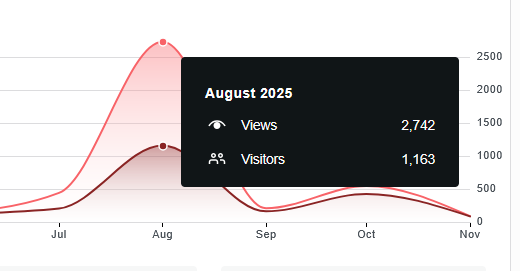
If you look at each entry, you can usually find at least one or two Likes, although some have in the region of eight or nine. The same names tend to pop up week after week. Altertatively, we can look at stats provided by WordPress from December 2024 onwards. The number of monthly visitors ranges from 113 throughout May to 548 in October – with one outlier.
For some reason, August attracted a total of 1,163 unique visitors, most of whom came back two or more times:
All of which is interesting to me, but I haven’t even touched upon the reason I started writing this entry.
Every time I hit Publish, an email is sent to anyone who opts into receiving notifications. I was advised yesterday by a long-term aquaintance that her email provider had suddenly started placing my WordPress notifications into a folder, starting with an entry from June about audio dramas. Before then, the last email in the folder was from a reply I’d made on LiveJournal in December 2016.
Unless something unpredictable happens, I know this blog is never going to reach a wide audience. It helps me to stick to a regular deadline. If it finds an audience, then marvellous, and if not, nothing is lost.
Most of the time, I find it easy to think of what the characters in my stories should be called. Their names often appear at the same time as the storyline.
I wrote one such piece in 2014 titled Adrian Eats the World, which appeared at the same time as the title. Until I found the file while writing this, I thought that was still its name. In 2015, it seems I had a change of mind and amended his name to Mikey. I can’t remember what made me change this, so it’s now been restored.
More recently, I’ve included a Rosalind McQueen because the cadence simply worked well. During the story, she changes this to Scott McQueen, which has a different cadence but is equally as pleasing.
The most difficult character to name was a sci-fi story set during the 1960s in a world where a group of intelligence agents were worried about an impending visit from aliens. This character was supposed to be the young man who had been drafted into the unit as a favour by his father.
I looked to take the James Bond approach, with an ordinary first name and a distinctive last name. It took weeks to settle upon Malcolm St Clement. Even then, I wasn’t certain because the only other person I could find with that last name was the actress Pam St Clement from EastEnders, and even that’s a modification of her real name: Pamela Clements. However, it sounded good, and I kept using it.
On other occasions, a name is the least of my concerns.
In one of my series, the first-person narrator remained unnamed until the 24th part. I didn’t even realise I was omitting the name at first; it simply wasn’t central to the storyline. Besides, the 2004 film Layer Cake pulled off this trick nicely.
Even once I became aware of the omissions, there were workarounds I could employ to avoid saying it. It helped that the series was an ensemble effort comprising seven other named main characters. Eventually, I decided to reveal the narrator’s name as a minor twist in what was intended to be the finale. I’ve since added a surprise 25th story.
The other layer to this discussion is the use of nicknames. I find these hard to pull off convincingly. Unexplained nicknames can be jarring, yet when they are explained, the backstory can feel contrived or a little too perfect.
In this instance, it might be wise to take a cue from real life. For instance, there’s a website for pilots and fans of the F-16 fighter jet that has a whole section devoted to the imaginative callsigns in the forces. A few are clever, but most are a little ramshackle and that makes them sound a little more convincing.
It was quietly announced last week that the organisation behind National Novel Writing Month was to close. Universally known as NaNoWriMo, or even NaNo, this was a challenge to draft a 50,000-word novel during November each year, later expanding to include smaller challenges in other months.
The announcement, made on Sunday 31 March, was so quiet that only those on the mailing list received it. There also exists a corresponding video from the Interim Executive Director, which has not gone down well with the commenters.
And yet, at the time of writing, the official website remains unchanged. So when I heard the news second-hand on April Fool’s Day, I had to double-check it, missing the chance to include the news as last week’s entry. Still, the week-long gap has allowed some time for reflection.
I joined NaNo in 2010. It had been around for 11 years at that point, and was arguably at the height of its popularity, as illustrated by Google search trends over the years. There were dozens of affiliate groups around the world, including one in Dundee city centre. At my very first meeting, my laptop ran out of battery, so I rushed out to buy a notepad and a mechanical pencil. The graphite rods kept breaking, rendering it next to useless.
Fast-forward five years, and I’d graduated from member to organiser in the natural flow of people leaving and joining. I stayed in that role for nine years alongside several different co-leads until we withdrew our affiliation in 2024 over the nonsense that had been happening.
By this time, I’d fallen out of love with the central November challenge, as I found myself with an increasing series of started but incomplete novels. I didn’t fall out of love with bringing writers together, so I’m pleased still to be co-leading the independent group we created to replace it.
So the big question: what caused the closure? It’s a complex story that can best be told by the NaNo Scandal website, which has documented the problems with the organisation from December 2022.
However, the simplest analogy is that of a Fortune 500 company, which will typically act to keep its stakeholders satisfied. In the case of NaNo, the stakeholders were the organisers on the ground who encouraged members to keep writing and to keep donating. After alienating these folks, the cash dried up.
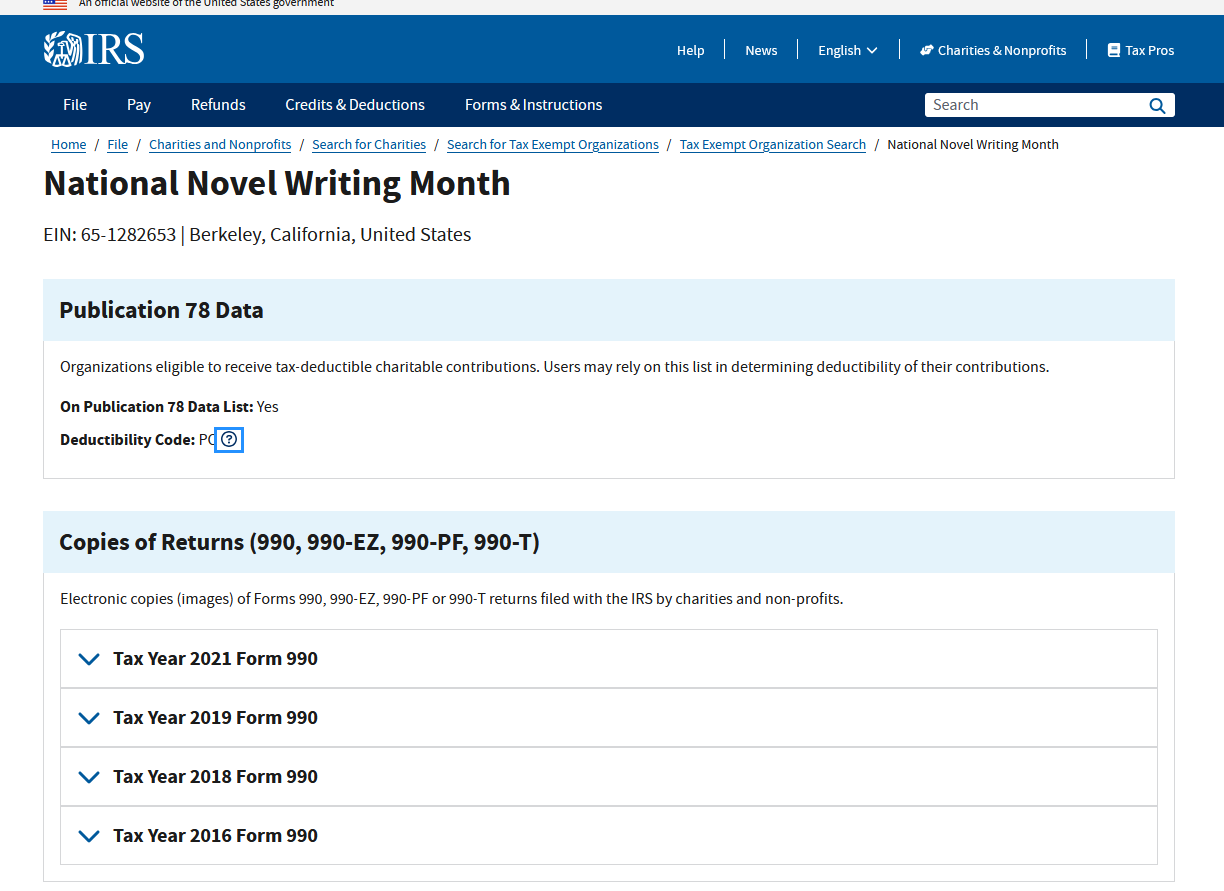
Speaking of cash, search information from the US Internal Revenue Service (IRS) website makes for interesting reading. From what I can gather, the nonprofit National Novel Writing Month should be filing Form 900 annually, which then becomes a matter of public record. However, the last document at the time of writing dates from 2021.
I’m absolutely no expert, so perhaps there’s a genuine reason why the last four years are missing from this list. But if you’re an accountant or you’re connected with the IRS, you can access the search function and enter the Employer Identification Number 65-1282653 to find out the details.
I really don’t want to leave this entry on a sour note. I was involved with the organisation in some capacity for 14 years, so more than half of its 26-year history. I had some wonderful experiences, and I still speak to so many former participants. So here are three memories that stand out:
I held a couple of midnight launch parties at my home, with the plan to start writing in the first hour of 1st November. I had only a two-seater couch at the time, so every chair and cushion was taken up with people, who were also dodging electrical extension cables. As the clock hit 12am, the entire room fell silent for an hour, aside from the tapping of keys.
I’d met someone in real life and was chatting to her via Facebook Messenger. I wanted to take a gamble and ask her out, so I enlisted the members of that week’s NaNo meeting for advice, all of whom were in long-term relationships themselves. They helped me to steer the conversation and figure out what to say next. She still turned me down.
A local organiser used to be known as a Municipal Liaison or an ML. As the pandemic was easing, the government was permitting people to meet up again, while NaNo was still warning MLs to hold only online meetings. To circumvent this, I told the group I would be in our usual venue at a certain time, and there were spare seats if anyone happened to be passing, but that this was not a meet-up. I even wore a sticker reading NOT ML, which became an in-joke for a long time afterwards.
From 2002 to 2005, I studied for a BSc Music Technology degree at what is now called the University of the West of Scotland. The course taught us how commercial music is recorded, along with related skills such as composition, Web design, and making promotional videos.
Last week, I had cause to rake out a short film I’d made as part of the degree. It dates from around 2003 or 2004, but nobody had thought to write the date on the box.
Although DVD was fast becoming the dominant format, we had to submit the piece on VHS. I wish I’d at least kept a disc-based copy. I can’t say for sure whether the tape has been partially wiped or whether my video recorder is at fault, but the picture is almost unwatchable.
The sound, by contrast, is more or less intact. Hearing this for the first time in years unexpectedly reminded me of the scriptwriting process. I distinctly remember sitting in the student union discussing ideas before someone flippantly said, ‘Why don’t we make it about four students who fall out making a film?’ That flippant suggestion became the backbone of our script.
At this point, I wasn’t routinely writing any fiction, but I recall enjoying the process. This should have been a foreshadowing of where my interest would ultimately lie in the future.
Some of the lines were a little clunky, aside from gems like He’s about as much use as a mic stand, yet the structure was spot-on. Each character blamed one or more of the others for the failure of the film, whether it was the director having a go at the others for not understanding his vision, the technician who kept forgetting to charge up the camera batteries, or an unseen ex-girlfriend who split up with one character to date another.
It really does leave the viewer guessing, and I’d be pleased if I managed to pull off that complexity in a current piece. What’s more, the action takes place in a span of well under five minutes. I vaguely recall our brevity cost us some marks, but it was a self-contained story.
I haven’t yet returned the tape to the cupboard, so my plan is to find someone with another video recorder to test whether my equipment or the tape is at fault. At a minimum, it would be prudent to make a safety copy of at least the audio portion and figure out whether the drama could be adapted into a longer piece.
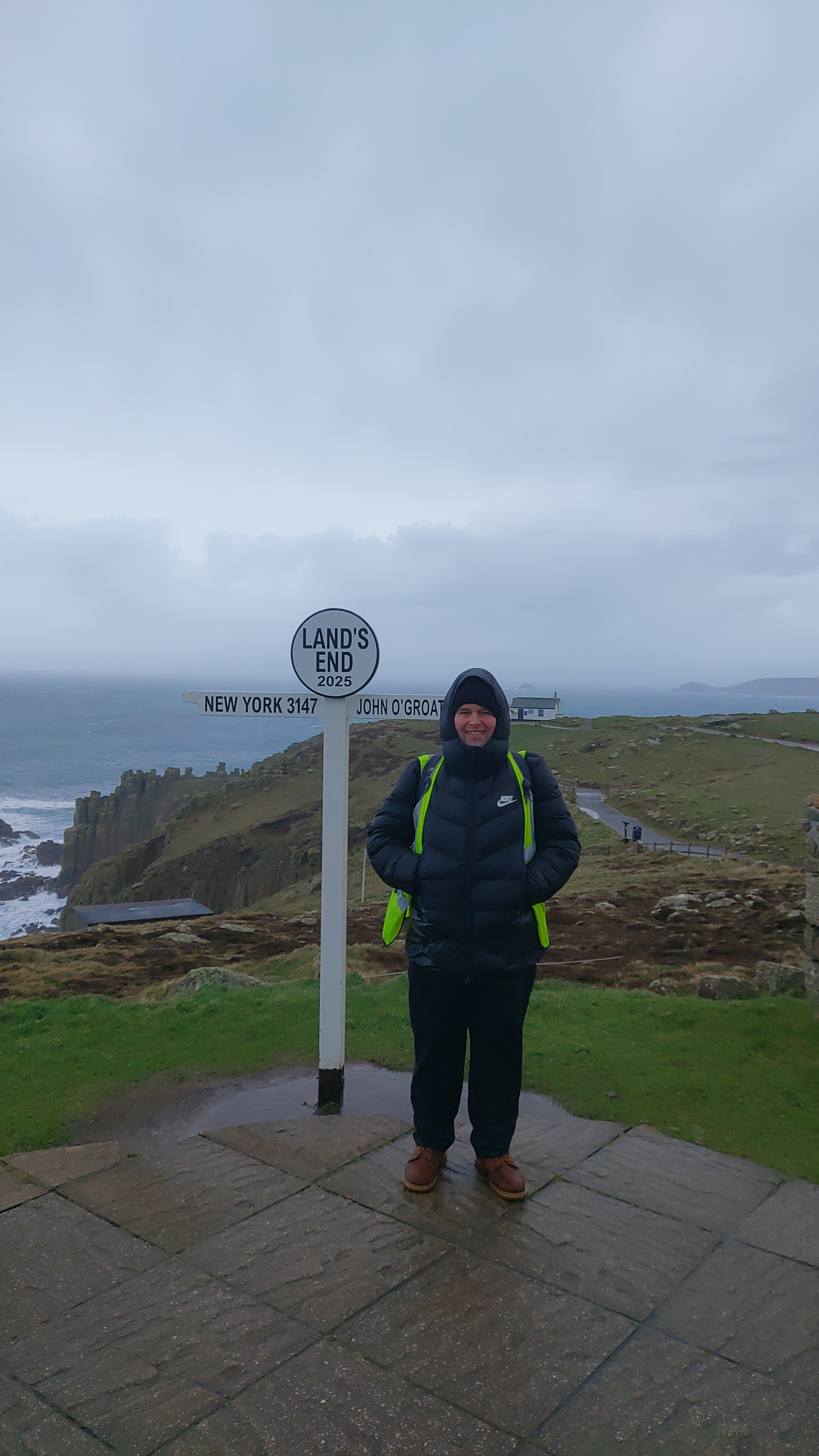
In an entry from 28 January this year, I spoke about visiting the Millennium Bridges in mainland Great Britain, making fleeting mention of a further visit to Land’s End.
The original plan was to pair that with a visit to John O’Groats a couple of days later. My train ticket would allow me to visit both places, but the storms did not, so I delayed my visit to Saturday just gone. My hotel booking couldn’t be cancelled without losing the payment; it could only be rescheduled.
From the January trip, I’d learnt a lot about the logistics of taking long-distance public transport and the luggage required for such a journey. It was almost perfect, but I forgot the charger for my laptop. With eight hours of total journey time between Dundee and Thurso, one of the nearest towns to John O’Groats, that would have been handy.
Yet it didn’t matter too much in the end. I had plenty of battery for the activities I absolutely needed to complete, plus Scotrail didn’t have many three-pin power sockets on this journey.
The trains did all boast USB type A sockets, but they didn’t appear to be at full voltage. This led to the discovery that my phone has an extreme battery-saving mode, so I could at least charge up faster than the power was consumed. If a story idea did occur, I always had a pencil and paper with me.
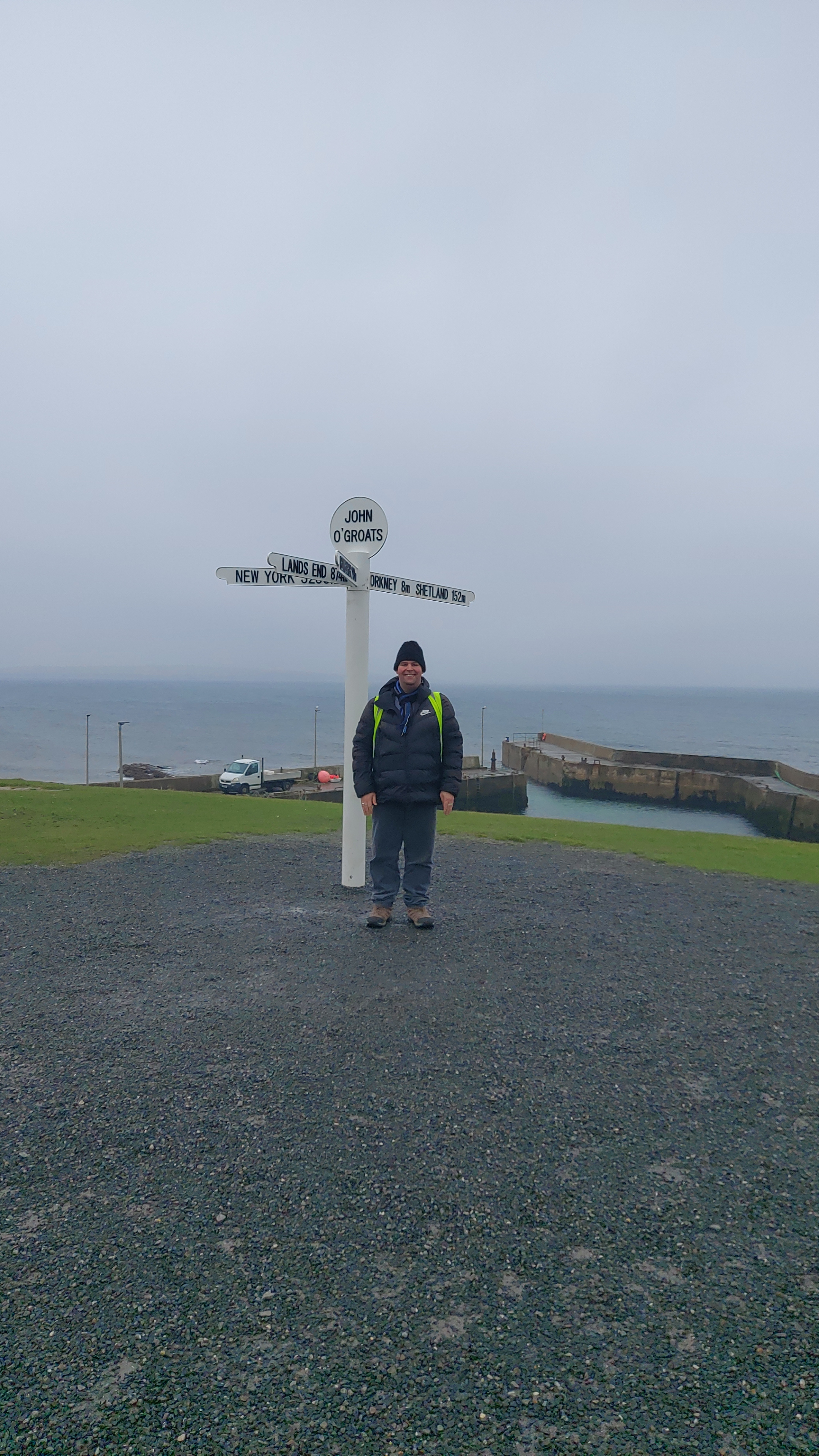
Once I’d reached John O’Groats, I found I didn’t particularly want to write, other than posting a card from the northernmost Post Office in the UK. I just wanted to wander about for a couple of hours, maybe take a couple of pictures for people back home. Unlike the Millennium Bridges, there was never a plan to chronicle this journey in detail.
I did, however, ensure I stood beside the signpost at each end.
I’m a founding member of a monthly writing group called the Wyverns. Over the decade or so of existence, the format has remained relatively constant. A prompt or theme is agreed upon at each session and the members strive to write a poem on that theme for the following session, in return for constructive feedback.
These prompts are generally abstract or open to interpretation because our members write in a variety of styles. Recent themes include peace, cartoon characters and view or scene. I couldn’t make it to the last meeting, so I’m not aware of the conversation that happened, only that the resulting prompt was the more specific Devices that control our lives.
Importantly, the prompts are not mandatory but are treated as a springboard that members can use for their work. As such, this is one of the few instances where I’m considering not following it and instead submitting work on another topic.
On the one hand, I’m up for a challenge. Some of the most difficult prompts have resulted in superior work that I might not have achieved with a simpler one. On the other hand, I’m growing weary of hearing such endless discussions and debates, let alone contributing to them.
It’s not always wise to evade the brief. Try submitting a piece to a competition that isn’t within the rules and I guarantee the editor will have binned it by the time the ink dries on the rejection letter. But there are instances where it’s acceptable to change the nature of what you’re writing.
In 2019, I was looking to write a short joke about how YouTube originally started as a mail-order video-rental catalogue. The more I considered the idea, the more detail I kept adding. It turned into a 1,700-word short story. In the process, it morphed from a one-liner into a satirical alternate history, yet I was pleased with the outcome.
I’m still considering what to do with the Wyverns prompt, but I do intend to submit something before our meeting next month.
The primary motivation for making these blog entries is to keep me producing at least one piece of writing per week. Most of the time, I have something to say, but there are others where the tank is empty.
At the moment, I have several writing topics I can draw upon, but none are enough for a strong or cohesive entry. These include:
Creating a new character and backstory in Dungeons & Dragons after the former one was killed off. Before doing this, it would be more appropriate to discuss it with the group ahead of making it public.
Writing separate emails to the complaints departments of two different companies, but there isn’t much to tell because both queries were solved relatively quickly.
Snatching time to write blog entries while doing other activities. Again, I can’t think of much else to add at the moment.
Watching my first David Lynch film and exploring how he approached the script, but I need to read up on this subject further before talking about it.
What happens when a blog is abandoned by its user, yet is still online and untouched years later. I found a suitable example last week, but I’ve touched on this topic fairly recently when talking about my own LiveJournal blog back in November.
There might be a time in the future when these ideas suddenly become relevant, so they’re parked away for future use. While I was plodding through them, I wondered how much more motivation I would have if were paid like a columnist.
For a start, the process would be somewhat different. I use this blog to say what’s on my mind, whereas a journalist wants to explore a topic cohesively or to put forward a point. After submission, it would then be edited or revised by someone else for legal compliance and/or impact, so it’s debatable how many of my own words would remain.
The National Union of Journalists maintains a spreadsheet of how much its members report being paid for a variety of publications. For those rates, I reckon I could find an angle for any of these parked topic ideas, perhaps using the complaints as a critique of contemporary customer service or commenting on how the works of Lynch have bypassed me over the years despite his popularity.
I’m almost certain I couldn’t earn anything from this blog in its current form. Even by paying attention to search engine optimisation and including affiliate links, it’s simply too niche and too bland to gain any serious traction in the mainstream. I’ve even fallen out of the habit of checking the countries where my visitors are accessing it.
I add the caveat that there’s always a remote chance it’ll blow up in popularity for seemingly no reason, which sometimes happens online. Barring that, I’m happy enough for this page to remain as it is. It hardly receives comments, but it hardly receives tedious people nit-picking some fault or another, allowing me to speak as I find. That’s a trade-off that suits me nicely.
In the world of writing, there are all sorts of routes to publication for poetry and short stories, but they divide roughly into two main types.
The first is a competition format. This usually requires payment of an entry fee, which goes towards a cash prize for the winner – and sometimes runners-up – along with publication. I don’t normally enter these. Among other reasons, the cost is often excessive and the rules of entry tend to be complex and sometimes contradictory.
I much prefer the second format: an open call from a publisher. This is typically free and simple to enter, although the trade-off is a lesser payment, if any is offered at all. Here, the glory lies largely in publication and a contributor’s copy.
That said, the 2025 Rattle Chapbook Prize recently caught my attention. In this competition, the publisher wants poetry chapbook submissions of between 15 and 30 pages. Three winners, anonymously judged by the editors, will receive $5,000 and 500 copies of the book.
I’ve wanted to compile a collection for some time now, so this seemed the ideal opportunity. Additionally, unpublished individual poems from the manuscripts may also be offered standard publication in Rattle.
I’d already settled on a theme of self-confidence and romantic relationships, so I looked through the 200 folders in my poetry archive, hoping to find 12 suitable pieces. I found 11, and I wanted them to flow by mood, almost telling a story. Yet they wouldn’t fall into a suitable order no matter how they were arranged.
As the deadline was closing in, a solution eventually presented itself. I added a 12th poem that wasn’t on the same theme but could be read as such with some canny placement. I then wrote a 13th piece lifting some elements from that poem but taking them in a different direction, and these two act as bookends for the chapbook.
The other problem happened around the middle of the collection, where two poems with contrasting moods disrupted the flow. I separated them by writing a very short 14th piece, just two lines long, but it worked to calm the waters.
The winners will be announced in mid-April, so I’ll be sure not to submit the same poems anywhere else until then. In the likely event that my work isn’t accepted, I still have a chapbook to submit elsewhere or perhaps even to publish myself.

 Gavin Cameron