Who Reads This Stuff Anyway?

The first entry to this blog was posted on 10 October 2013, making it 12 years old last month.

The intent was to create a deadline each week so I would keep writing regularly. That’s going well so far because when this entry is published, it’ll be number 641, or an average of at least one entry a week. But how many people are likely to read it?

Well, that depends what measure you use.

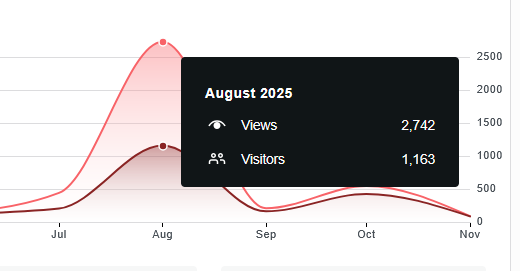
If you look at each entry, you can usually find at least one or two Likes, although some have in the region of eight or nine. The same names tend to pop up week after week. Altertatively, we can look at stats provided by WordPress from December 2024 onwards. The number of monthly visitors ranges from 113 throughout May to 548 in October – with one outlier.

For some reason, August attracted a total of 1,163 unique visitors, most of whom came back two or more times:

Data visualization of site traffic from July to November, showing a sharp rise in both views and visitors during August 2025. Tooltip reveals 2,742 views and 1,163 visitors for that month.

The timescales match up with two entries from that period. The first talked about an Edinburgh Fringe show by Ross McCleary and Stefan Mohamed, while the second addressed the thorny topic of Creative Scotland curbing its funding. I can only expect one or both topics were on the minds of my audience.

All of which is interesting to me, but I haven’t even touched upon the reason I started writing this entry.

Every time I hit Publish, an email is sent to anyone who opts into receiving notifications. I was advised yesterday by a long-term aquaintance that her email provider had suddenly started placing my WordPress notifications into a folder, starting with an entry from June about audio dramas. Before then, the last email in the folder was from a reply I’d made on LiveJournal in December 2016.

Unless something unpredictable happens, I know this blog is never going to reach a wide audience. It helps me to stick to a regular deadline. If it finds an audience, then marvellous, and if not, nothing is lost.

A Look Back to Ten Years Ago

I have a couple of upcoming projects that I’m not ready to talk about just yet. To fill the gap, I’ve instead looked backwards in time to the entry closest to today: 26 October 2015.

With the title Relentlessness, the entry described a hectic week. The open-mic night Hotchpotch held an event aboard the vintage HMS Unicorn, the Dundee Literary Festival had just been and gone, and the artist studios WASPS held an open weekend. I’d also been to see Hamlet at the cinema, presented by National Theatre Live, while our writing group was gearing up for National Novel Writing month.

As I read back this snapshot of events, they somehow don’t feel like they happened ten years ago, even though I rationally know they did.

For instance, WASPS studios is very much still open for business and Jen Robson is still around, albeit working from a home-based studio. Hotchpotch is still going, although we’ve never been invited back onto the Unicorn. Then we have National Novel Writing Group, which only ceased operations this year.

On the other hand, although none of us realised it at the time, the last Dundee Literary Festival would be held in 2016. It took until March this year for a replacement event, the Dundee Book Festival, to start up.

There’s something both appealing and lamentable about that ephemeriality. No doubt I’ll feel the same when I look back upon this year’s projects from 2035.

Letter-Writing Season Again

Shortly before I left for Sweden last month, I received two letters from pen-pals on the same day: one from Wales and the other the Republic of Ireland. They don’t know each other, so the timing was entirely a coincidence.

I’d already planned to send postcards to both of them while I was away, along with selected other folks. Since the Swedish equivalent of the Post Office allows you to buy postage online, I was able to stamp and address them in advance; it was just a matter of writing them while I was there.

But it’s now time to reply to the actual letters, so I’ve been plugging away at this for the last week or so.

I keep lined notepads especially for this purpose, particularly the Nu Elite brand. The pages have perforations near the margin so they rip off into perfect A5 sheets and fold in half for a C6 envelope. It doesn’t have to be that brand, as long at the paper is reasonably thick and has similar properties.

It’s all practical, and certainly less stylish than the letters I received.

The one from Wales has a striped coloured border, but not feint ruling on the writing area. If you ask me, it’s quite a skill to write neatly on unruled paper, as mine would start sloping up or down, no matter how careful I was. I typically write mine by hand.

Then the letter from Ireland starts off in a notecard with an intricate Alice in Wonderland theme before continuing on A5 paper, similar to what I use.

And just as I was writing this paragraph, my Welsh friend sent me a message to say the letter had been received. That’s good news, as her very first one to me went missing without trace. Fortunately, she’d kept a copy of it, although I never remember to take a copy of mine before posting. That said, it barely matters, as long as I’m reasonably careful not to repeat the same news every time.

The one bound for Ireland is around 80% complete, and just needs a final push to complete it. As far as I’m aware, the recipient doesn’t read this blog, so there’s no hurry.

I can’t see it happening any time soon, but I’ll maybe one day be able to introduce the two pen-pals so they can write to each other and complete the circle.

Putting a Full Stop to Scams

I watch a YouTube creator who goes under the alias Kitboga. In 2017, he discovered his grandmother had fallen victim to several scams, costing her hundreds of dollars every month.

Inspired by this, he now produces content aimed at exposing phone scammers and educating viewers about how to spot their tactics. At the very least, he wants to waste hours of their time that might otherwise be spent scamming others.

The style of the channel took some time to grow on me, as it’s rather chaotic. He typically uses a voice-changer to make scammers think they’re talking to an elderly person, before making up nonsensical stories to tell them, often on the spot. Between calls, he explains to the viewers what he’s doing and why.

On Sunday, Kitboga posted a video where he spoke to a scammer who claimed to represent the publisher Penguin Random House. Unusually, the other party agreed to a meeting via Zoom. I won’t give away the outcome, but I promise it’s worth watching the entire 36-minute video as he explains the scam and considers his next move.

This isn’t the first time a publishing scam has been featured on the channel.

Back in October, the channel exposed a group targeting self-published authors with screenwriting deals. At around the 27:45 mark, he even gave a shout-out to the Writer Beware blog, which had been documenting these cases over many years.

Most of us want to see our writing out there in the world, but we also need to be careful. One of the best ways is to be very dubious about anyone who reaches out with an offer regarding your work.

If you’re ever uncertain whether a contact is genuine, be sure to check with the company. You can often find details on their official website, in the indispensable Writers’ Handbook, and/or in the Companies House database. When in doubt, hit the Block button and move on.

NaNoWriMo – The Last Word

It was quietly announced last week that the organisation behind National Novel Writing Month was to close. Universally known as NaNoWriMo, or even NaNo, this was a challenge to draft a 50,000-word novel during November each year, later expanding to include smaller challenges in other months.

The announcement, made on Sunday 31 March, was so quiet that only those on the mailing list received it. There also exists a corresponding video from the Interim Executive Director, which has not gone down well with the commenters.

And yet, at the time of writing, the official website remains unchanged. So when I heard the news second-hand on April Fool’s Day, I had to double-check it, missing the chance to include the news as last week’s entry. Still, the week-long gap has allowed some time for reflection.

I joined NaNo in 2010. It had been around for 11 years at that point, and was arguably at the height of its popularity, as illustrated by Google search trends over the years. There were dozens of affiliate groups around the world, including one in Dundee city centre. At my very first meeting, my laptop ran out of battery, so I rushed out to buy a notepad and a mechanical pencil. The graphite rods kept breaking, rendering it next to useless.

Fast-forward five years, and I’d graduated from member to organiser in the natural flow of people leaving and joining. I stayed in that role for nine years alongside several different co-leads until we withdrew our affiliation in 2024 over the nonsense that had been happening.

By this time, I’d fallen out of love with the central November challenge, as I found myself with an increasing series of started but incomplete novels. I didn’t fall out of love with bringing writers together, so I’m pleased still to be co-leading the independent group we created to replace it.

So the big question: what caused the closure? It’s a complex story that can best be told by the NaNo Scandal website, which has documented the problems with the organisation from December 2022.

However, the simplest analogy is that of a Fortune 500 company, which will typically act to keep its stakeholders satisfied. In the case of NaNo, the stakeholders were the organisers on the ground who encouraged members to keep writing and to keep donating. After alienating these folks, the cash dried up.

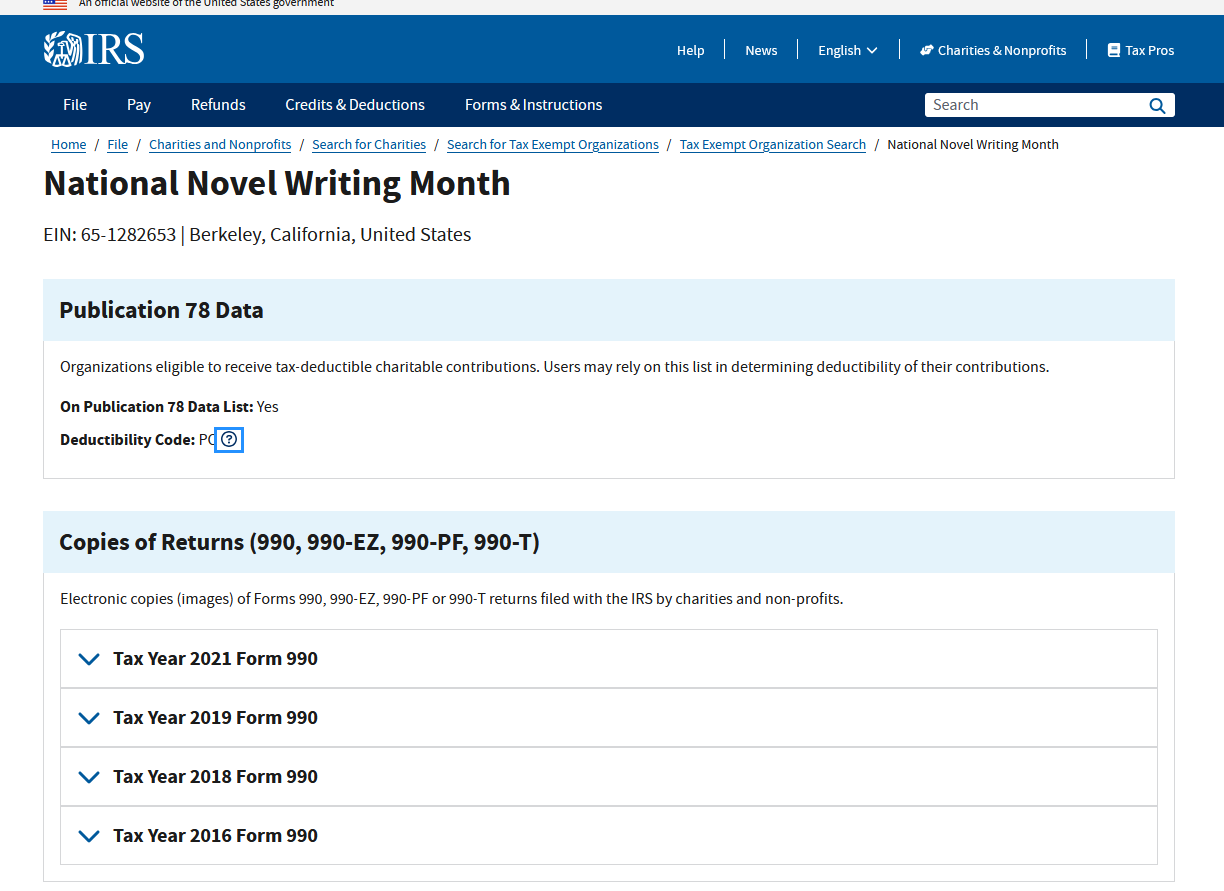
Speaking of cash, search information from the US Internal Revenue Service (IRS) website makes for interesting reading. From what I can gather, the nonprofit National Novel Writing Month should be filing Form 900 annually, which then becomes a matter of public record. However, the last document at the time of writing dates from 2021.

A screenshot from the US Internal Revenue website illustrating the points mentioned in the plain text.

I’m absolutely no expert, so perhaps there’s a genuine reason why the last four years are missing from this list. But if you’re an accountant or you’re connected with the IRS, you can access the search function and enter the Employer Identification Number 65-1282653 to find out the details.

I really don’t want to leave this entry on a sour note. I was involved with the organisation in some capacity for 14 years, so more than half of its 26-year history. I had some wonderful experiences, and I still speak to so many former participants. So here are three memories that stand out:

  • I held a couple of midnight launch parties at my home, with the plan to start writing in the first hour of 1st November. I had only a two-seater couch at the time, so every chair and cushion was taken up with people, who were also dodging electrical extension cables. As the clock hit 12am, the entire room fell silent for an hour, aside from the tapping of keys.
  • I’d met someone in real life and was chatting to her via Facebook Messenger. I wanted to take a gamble and ask her out, so I enlisted the members of that week’s NaNo meeting for advice, all of whom were in long-term relationships themselves. They helped me to steer the conversation and figure out what to say next. She still turned me down.
  • A local organiser used to be known as a Municipal Liaison or an ML. As the pandemic was easing, the government was permitting people to meet up again, while NaNo was still warning MLs to hold only online meetings. To circumvent this, I told the group I would be in our usual venue at a certain time, and there were spare seats if anyone happened to be passing, but that this was not a meet-up. I even wore a sticker reading NOT ML, which became an in-joke for a long time afterwards.

Money for Nothing, Join for Free

There are a couple of perennial topics on this blog. One of them is public speaking, and the other is banging the drum about joining the Authors’ Licensing and Collecting Society.

The ALCS was founded in 1977 to ensure writers are given fair payments for any of their works that are copied, broadcast or recorded. The organisation is the literary equivalent of the better-known PRS for Music, which does a similar job for musicians.

This year, £35,038,136 was shared between 111,415 members. It’s important to note this is not an equal share, but calculated according to the activity of each author’s work. You can bet that bestsellers like Richard Osman and Julia Donaldson took a sizeable chunk of the pie.

My payment this year was around £133. It’s not enough to live on, of course, but it’ll pay my energy company for nearly two months. What’s more, that’s from just nine publications spanning as many years.

So how does an author grab a piece of the action?

The ALCS has recently suspended online applications for reasons unknown, but will accept a postal version. Visit the How to Join page to download and fill in the form.

You don’t need to send any money. Instead, the organisation will deduct a one-off fee of £36 once you’ve earned that figure in royalties. This grants you lifetime membership. Payments are collected for a variety of different visual works, so check the website for details of these.

To start earning, you’ll need to enter the ISBN of each work you’ve had published. This is the 13-digit string of numbers beside the barcode, or 10 digits if the book was published before 2007. Remember to include every publication where you receive credit, regardless of its age.

After all that, it’s just a matter of maintaining your list of works on the website and awaiting the annual payment.

A Weekend of Minimal Writing

In an entry from 28 January this year, I spoke about visiting the Millennium Bridges in mainland Great Britain, making fleeting mention of a further visit to Land’s End.

The original plan was to pair that with a visit to John O’Groats a couple of days later. My train ticket would allow me to visit both places, but the storms did not, so I delayed my visit to Saturday just gone. My hotel booking couldn’t be cancelled without losing the payment; it could only be rescheduled.

From the January trip, I’d learnt a lot about the logistics of taking long-distance public transport and the luggage required for such a journey. It was almost perfect, but I forgot the charger for my laptop. With eight hours of total journey time between Dundee and Thurso, one of the nearest towns to John O’Groats, that would have been handy.

Yet it didn’t matter too much in the end. I had plenty of battery for the activities I absolutely needed to complete, plus Scotrail didn’t have many three-pin power sockets on this journey.

The trains did all boast USB type A sockets, but they didn’t appear to be at full voltage. This led to the discovery that my phone has an extreme battery-saving mode, so I could at least charge up faster than the power was consumed. If a story idea did occur, I always had a pencil and paper with me.

Once I’d reached John O’Groats, I found I didn’t particularly want to write, other than posting a card from the northernmost Post Office in the UK. I just wanted to wander about for a couple of hours, maybe take a couple of pictures for people back home. Unlike the Millennium Bridges, there was never a plan to chronicle this journey in detail.

I did, however, ensure I stood beside the signpost at each end.

The Tour That Didn’t Tour

On Saturday just gone, I was supposed to go on a tour behind the scenes at Dundee Central Library. The visit was organised by Creative Dundee and was only open to members of its Amps network, making it a rare opportunity, especially as their events often happen on weekdays when I’m working.

Fate had something to say about this rare opportunity, in the form of plumbing problems that forced the library to close for the day.

I’ve been to that section a couple of times before, and I subscribe to the city archives blog, so I have some idea of what they do there. Still, making the information available digitally requires thousands of volunteer hours, so I look forward to seeing that aspect when the tour is rescheduled.

So instead of coffee after the tour, that became the main event, with around a dozen attendees descending on an accommodating cafe nearby. This proved to be a time for fruitful discussion and not even necessarily about our creative work.

After a conversation about where we’d travelled last year and our plans for this year – in my case, the Millennium Bridges tour – I possibly have another project brewing which stems directly from that.

Either way, I look forward to the next Amps outing.

What to Write, What to Write

The primary motivation for making these blog entries is to keep me producing at least one piece of writing per week. Most of the time, I have something to say, but there are others where the tank is empty.

At the moment, I have several writing topics I can draw upon, but none are enough for a strong or cohesive entry. These include:

  • Creating a new character and backstory in Dungeons & Dragons after the former one was killed off. Before doing this, it would be more appropriate to discuss it with the group ahead of making it public.
  • Writing separate emails to the complaints departments of two different companies, but there isn’t much to tell because both queries were solved relatively quickly.
  • Snatching time to write blog entries while doing other activities. Again, I can’t think of much else to add at the moment.
  • Watching my first David Lynch film and exploring how he approached the script, but I need to read up on this subject further before talking about it.
  • What happens when a blog is abandoned by its user, yet is still online and untouched years later. I found a suitable example last week, but I’ve touched on this topic fairly recently when talking about my own LiveJournal blog back in November.

There might be a time in the future when these ideas suddenly become relevant, so they’re parked away for future use. While I was plodding through them, I wondered how much more motivation I would have if were paid like a columnist.

For a start, the process would be somewhat different. I use this blog to say what’s on my mind, whereas a journalist wants to explore a topic cohesively or to put forward a point. After submission, it would then be edited or revised by someone else for legal compliance and/or impact, so it’s debatable how many of my own words would remain.

The National Union of Journalists maintains a spreadsheet of how much its members report being paid for a variety of publications. For those rates, I reckon I could find an angle for any of these parked topic ideas, perhaps using the complaints as a critique of contemporary customer service or commenting on how the works of Lynch have bypassed me over the years despite his popularity.

I’m almost certain I couldn’t earn anything from this blog in its current form. Even by paying attention to search engine optimisation and including affiliate links, it’s simply too niche and too bland to gain any serious traction in the mainstream. I’ve even fallen out of the habit of checking the countries where my visitors are accessing it.

I add the caveat that there’s always a remote chance it’ll blow up in popularity for seemingly no reason, which sometimes happens online. Barring that, I’m happy enough for this page to remain as it is. It hardly receives comments, but it hardly receives tedious people nit-picking some fault or another, allowing me to speak as I find. That’s a trade-off that suits me nicely.

Blogging on The Move

On Wednesday and Thursday of last week, I had a plan to visit the eight Millennium bridges in mainland Great Britain: seven listed on Wikipedia and an unlisted one in Ayr that I learnt about from pals. Along the way, I would keep a blog of my progress on Tumblr.

As I had such a strong idea about where I would be at certain times and what I’d be doing, I was actually able to draft a substantial chunk of text in advance and simply copy it over to my travelogue.

Real life, of course, frequently has other plans. For instance, my first stop was to be the Millennium Bridge in London. However, my train from Edinburgh Waverley was cancelled at Newcastle. By coincidence, I’d planned to stop there on the way back for the Gateshead bridge, so I hastily wrote up a revised entry explaining the situation.

The planning did pay off, though. When reached the Big Smoke, I’d also planned to make a quick side-visit to the former London Weekend Television Tower and I’d already written and edited a block of text about why I was going there.

It was helpful that most of the trains had at least a USB socket, if not a 230-volt socket, so I rarely worried about running out of power. It was also helpful to have an All Lines Rover, which lets you travel on almost any National Rail line for a week, as it was necessary to be very flexible about my plans.

That was especially true when I cut the tour short after the seventh bridge at Ayr. The Glasgow one was within sniffing distance, but Storm Éowyn was closing in. There were already some cancellations that day, and no trains the following day, so I couldn’t risk being stranded.

By complete coincidence, I missed the bulk of its effects. The same day, I’d already arranged to be in York, where I’d booked a hotel before the full tour was planned, with it being somewhat central. I was then heading further south to visit a pal in Rhos on Sea. I did catch the fringe of Storm Herminia as I visited Penzance and Land’s End, but that was rather tame in comparison.

Some of these journeys took hours at a time, allowing me to make a lot of progress on a fantasy fiction series I’m writing. I write different projects in different ways, and this one uses a Google Drive document in a browser so the formatting of the text matches the paragraph spacing of the website, meaning I can copy over the text wholesale.

Even today, phone signal is still patchy on many parts of the nation’s railways. I’d assumed Google would simply cache my text locally during dropouts and post it when I next reconnected. What happens instead is that the browser won’t accept any more input until the signal is present. To work around this, I made a local copy, which I hope has maintained the correct formatting.

My next piece of writing will be less fun: an email to Great Western Railway, who sold me the train ticket. While the staff accepted it, all but two automatic ticket barriers failed to recognise it, and those two were only at exits rather than entrances.

That was the second time I’ve been on a tour of the Millennium bridges, the first being in 2023. Although I’ve no plans to do that route again. I’ve learnt a lot about how to prepare for such a tour and how to write about it. Once I think of a new challenge, I’ll build on that even further and tell you about it nearer the time.