On 4 December 1956, an extraordinary coincidence happened. Elvis Presley, Jerry Lee Lewis, Carl Perkins and Johnny Cash all happened to drop by Sun Record Studios in Memphis, which resulted in an impromptu jam session. The engineer had the foresight to record the session, and it’s now a celebrated event among rock ‘n’ roll fans.
On Wednesday of last week, I experienced a similar such meeting. I arrived 15 minutes early for a particular class, but nobody else had arrived after a five-minute wait. I then doubted myself and thought I should perhaps be in another class on the other side of the campus. I immediately headed there.
I had to excuse myself through hundreds of other students, coming the other way, aware that time was ticking away rapidly. When I reached the entrance, I happened to meet Classmate A and explained the situation. As we made our way through the crowds, we met Classmate B by chance and brought him with us. As we approached our destination, we happened to see Classmate C, who joined our small group.
Had you written either of these situations into a novel, the reader might have some difficulty suspending their disbelief. In short, coincidences don’t work particularly well in fiction, even though they happen all the time in real life. It’s related to the broader deus ex machina, when a seemingly unsolvable problem is abruptly resolved by some unexpected intervention.
One way to help the reader maintain that disbelief is to set a few parameters. This could be as simple as dropping a few hints earlier in the story. To demonstrate this, let’s break down my classroom anecdote.
My three classmates and I knew we could only be in one of two particular classrooms, so Classmate D had gone to the second room first, since she was just as unsure as me. And although the rooms were at opposite sides of the campus, there is a main thoroughfare that most students would use to travel from one to the other. So the crowds were not a hindrance to the four of us meeting, rather they were subconsciously leading us to each other.
If I included this incident in a fictional story with that background detail worked into it – Show, don’t tell, said Elmore Leonard – it’s more likely that the reader would see the meeting as quite a reasonable coincidence. It might even be possible to deconstruct the Million Dollar Quartet in a similar fashion. For a start, the label’s owner had brought along Jerry Lee Lewis as an instrumentalist for Carl Perkins, and Johnny Cash later wrote that he had already planned to see Perkins’ recording session that day.
Identify the parameters to help the reader believe those coincedences.
Many authors find it difficult to name characters. It’s not just a case of finding a name you haven’t used before; it has to be consistent with the person’s age, region, class, &c.
My names normally come very quickly, but in my novel The Government Artist, it took weeks to find the right moniker. The main character is a man born in 1943 who could potentially have gone to Oxford University. His name became Malcolm St Clement, which has a certain easy rhythm and suggests he’s from a fairly well-off family. But what about the names given by peers rather than parents?
In the TV series NCIS, Dr Donald Mallard is universally known as Ducky, an affectionate term that plays on his first and last names. By contrast, Agent Gibbs is the boss, and addressed only by his last name as a mark of respect. The only exception is Ducky, who is allowed to say Jethro. It implies the two have a relationship that predates Gibbs’s appointment, and perhaps his tolerance of being addressed so informally is a mark of his own respect to Ducky.
It can also speak volumes about a character whose nickname is not used, at least not to his or her face. In another of my books, Fifty Million Nicker, Josh “Speedy” Rush works in an office where affectionate titles are given to everyone. However, his colleague calls himself Pressure Pete as he’s proud of his harsh sales tactics. Nobody else calls him this, preferring to use names that range from Pete the Pain to Pete the Prick. One of their bosses is also unkindly known as Tart, taken from her first name Flanella.
In a few cases, the nickname can say more about the person who bestowed it than the recipient. I have a real-life example from people I knew a few years ago, so I’ll have to change the actual names used. Person 1 was called Callum, but Person 2 had only just met him and struggled to remember his name. One day, P2 accidentally called him Logan. Even though this was an isolated mistake and he finally learnt Callum’s correct name, P2 continued to nickname him Logan, trying to make it catch on. He persisted for three years, and nobody else ever used it.
If there is one name I should use more often, it’s Jeffrey Archer. I don’t know exactly why, but last week’s post gained twice as many views as normal. Do keep it up.
Firstly, let’s move some issues out of the way. There are many people who don’t like Jeffrey Archer, either as a person or as a novelist. But he is a very popular author, with at least 250 million books sold worldwide, and his advice regarding editing is faultless.
He’s stated in the past that he likes to redraft his work up to 14 times, and he usually does so in longhand. I wondered what would happen if I subjected my own words to the Archer treatment. To do this, I needed a passage that had never been edited, and I found one in notes from an old writing class. I’ll label that passage Revision Zero. The prompt was a photograph of a baby in a sidecar.
I wanted that bike, that particular one, the shiny black Yamaha, with the sidecar. You rarely see sidecars these days, so there was only one place that could help me with that, but it was worth the trip. Six months ago, I was driving in the countryside and I had my son with me. As we were finally picking up speed, I swerved to avoid a pothole and the nearside wheel hit a deep ditch. We both went flying into a field and only missed the fence by a few inches. We were lucky we didn’t suffer bad injuries, but it was the first accident I’d had in thirty years of driving. So with this new bike, the identical one, I go up and down that road with him again as often as I can, being careful at that part. I’m trying my hardest to block it out. The more I do it, the more I drive that route, the more it never happened.
For each redraft, I copied out the passage from start to finish into my notebook (pictured), making corrections as I went along.
My handwritten drafts
This was an unusual and quite time-consuming method for me, as I generally make only first drafts in the notepad then copy my work into a computer. Often I simply type the first draft. Let’s see how this passage has changed by Revision 3.
You rarely see motorcycles with sidecars these days, so when I needed a new machine, only one place could help me out. I ordered a model as close as possible to my old one: a black two-litre Yamaha. 3 months previously, I’d been riding in the countryside with my son beside me. When we reached the speed limit, we hit a pothole. It sent us flying into a field, & we came away with a few injuries. The worst part was having the first blot on a 20-year record of safe driving. No matter how much I explain this to my wife, she won’t let my son near the new bike. Instead, I pack the sidecar with the equivalent of his weight & travel along that same road as often as possible. Every time I do, I make sure I’m travelling at the same speed but swerve to avoid the pothole just as I should’ve done on the day of the accident. I’m trying my hardest to reduce its impact statistically & mentally. If I make this journey safely another 99 times, it means I’ve only had an accident on 1% of them; 999 journeys & that decreases to 0.1% & so on. Eventually, I want to be able to ride up that road without thinking of the accident. The more I do this, the more it never happened.
Revision Zero was written in May, and all subsequent revisions were made in August, during which time I hadn’t thought about the piece.
Already there are improvements. I’ve expanded on his inner conflict between his want to be a perfect driver and the accident that overshadows this.
The introduction of his wife creates a second conflict, this time over whether his son is allowed to ride with him. That conflict isn’t explored quite so much, but its outcome is clear. Perhaps the character is too caught up in his inner conflict to care much about the external one? He might even be in denial about it, which seems consistent with his mindset.
Now let’s explore Revision 6.
You rarely see motorcycles with sidecars these days, but I wanted exactly the same model as my wrecked one. Only one company could help me out, and even then, I had to make do with an approximate match. Three months previously, I’d been riding in the countryside with my son beside me. When we reached the speed limit, we hit a pothole. It sent us flying into a field. We were lucky to escape with few injuries, but the bike was a write-off. What hurts more was the stain on my clean 20-year driving record, which meant my wife wouldn’t let my son near the new machine. Instead, I pack the sidecar with the equivalent of his weight & travel that same road as often as possible. Every time I do, I make sure I’m going exactly the same speed, but I swerve to avoid the pothole just as I should’ve done on the day of the accident. I’m trying my hardest to reduce its impact by statistically & mentally. When I make this journey 99 times, it means I’ll only have crashed on 1% of these trips. When I make 999, that reduces to 0.1%, & so forth. Eventually, I want to be able to ride up that road without thinking about the accident whatsoever. The more I do this, the more it never happened.
I was initially aiming for 14 revisions. By the time I reached that point, however, I began to feel I would be revising for its own sake when the point of the exercise was to make only necessary improvements.
I finished Revision 6 a few days ago. Plot-wise, it doesn’t differ terribly from Revision 3, but the sentence structures do. Looking at it today, I would only change the ampersands into proper words and make minor alterations to some of the sentences.
And that’s one of the key techniques for revision: leave it a few days. Many writers are keen to submit their work as soon as it’s rewritten, but it’s a good idea to leave it for a day or two and revisit it. Archer might revise his work 14 times, but not at one sitting.
The rewriting process will help to tighten up any first draft, and you’ll probably find errors you didn’t realise were there. A good way of checking the punctuation and grammar is to read the paragraphs in reverse order so you don’t follow the story. The very best way of picking up all kinds of mistakes is to ask someone else to read it. A professional proofreader is best, but even a friend’s insight can be invaluable, and less expensive.
After all, a publisher or an agent needs to be hooked from page 1, and if the first thing they notice is careless writing, that piece will go straight to the rejection pile. On the other hand, a little revision now might set you on the road to selling 250 million of your own books.
A couple of weeks ago, I went to see a special screening of Local Hero. It’s an excellent film, and if you have the opportunity, you should see it.
The director Bill Forsyth was brought in at the end to hold a question-and-answer session with the audience. He mentioned at the beginning that he hadn’t seen the film in years, and an audience member asked why this was. He answered that he wasn’t ashamed of his work, simply that he wasn’t interested in looking back, and questioned whether – for example – a writer would be interested in rereading their old stories.
Contrary to the director’s opinion, my answer is a definite yes. I openly admit that being a writer wasn’t a childhood dream, and I therefore don’t have notepad upon notepad of embarrassing teenage musings. Rather, I wrote my first fiction in late 2010, just before I turned 27, and looking back enables me to keep a weather eye on how I’ve improved.
Even if I come across an old piece that I find jarring, I know I only need to rewrite it, or in extreme cases, deconstruct it, to bring it up to my current standards.
A prime example of such a jarring piece is one of the first poems I wrote, called The Cooler, a short verse about a character’s self-imprisonment. Looking at it now, it needs to be longer to fully convey the situation, as it’s currently unclear, and the clumsy language needs to be trimmed, eg, “It stays cold all night like a fridge.” Now I’ve looked back at it, I can think about these issues and improve the work.
In my next entry, I intend to cover the issue of rewriting in a more in-depth fashion.
I mentioned I’ve been writing fiction for less than four years, but I was a blogger long before that, discussing the issues on my mind at that moment, much as I do here. That writing is a little embarrassing, but it’s only by looking back that I can see how much I’ve moved on. Here’s a typical entry from almost exactly ten years ago.
There are many writers who started later in life, and I found out recently that John Grisham is one of them. He didn’t write his first novel until he was in his 30s, and didn’t give up his work as a lawyer until his second was published.
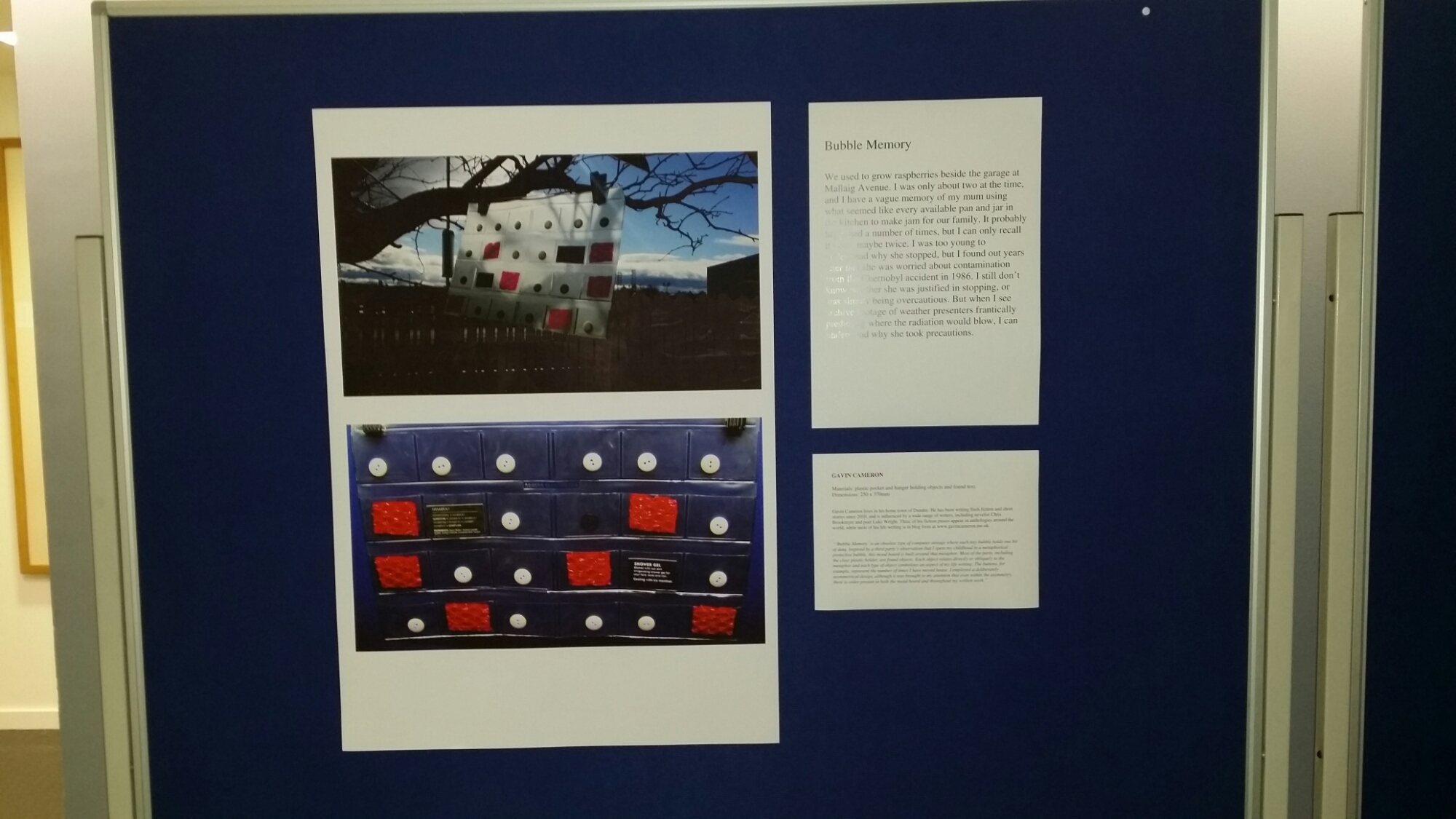
Last year, I joined a Life Writing class at the University of Dundee. One week, the tutor asked us to make mood boards to represent the themes of our writing. I didn’t look forward to this at all. As I’ve mentioned in previous entries, I’m not naturally gifted in visual expression.
But having consulted an artist for advice, I acquired materials from a nearby recycling plant, and pieces gradually fell into place. This task led to a short exhibition at the University where most of the class displayed their boards, with explanatory text and a personal story alongside each one.
In the mood
My mood board came to be titled Bubble Memory, constructed of a 35mm slide holder with buttons and other found materials in each pocket. The photograph shows how it was displayed in the exhibition, which closed on Friday of last week, although we are in talks to extend it. Despite my initial dread, I was pleased with the all-round results.
This is not the first time I’ve experimented with alternative formats. Text-based artist Gerry O’Brien was also a member of the Life Writing class, and submitted a piece of homework on a thumb drive. It contained a PowerPoint presentation that told the story of meeting a man from Honduras in text, interspersed with photographs. The presentation runs automatically at a slow savoury pace, allowing the viewer to absorb every detail.
Inspired by this, another class member created a similar project, speaking about the dolls she makes and collects. And inspired by both their achievements, I converted an existing poem of mine into the format, but with no pictures and no audio. The text is displayed to the reader at approximately the speed I would speak it, but there is freedom on their part to imagine the emphasis and inflections.
I started experimenting with formats a couple of years ago when I took part in the Sketchbook Project at Brooklyn Art Library. I broke down one of my short stories into fragments of one or two sentences, then converted each fragment to a QR code. This is a square barcode that can be read by many mobile devices. When it’s scanned, the device shows the fragment of text.
I then glued each of these codes into the sketchbook in the right order to tell the story, and sent it back to the Library. It was then scanned and placed online, while the original sketchbook was taken on a tour around America. This is the finished sketchbook. The following year, I submitted an apology for the artwork in that first book.
I don’t think I will ever move completely away from text on paper, but the occasional piece in another format or another medium can engage the reader in a different way. I’ll leave you with the story of the world’s first hypertext novels, a form that would be challenging to reproduce on paper.
We’re midway through July now. In some respects, this is a troubling month for me.
Firstly, there’s the weather. I can’t speak for anywhere else, but I’m from Scotland and it can fluctuate wildly. Thursday brought the sort of weather for lying in a hammock and listening to the Isley Brothers. I took the opportunity to walk to the seaside and enjoy a round of crazy golf and a trip on the road train. By Saturday, the rain was tipping down in the least Julyish fashion you can imagine.
Secondly, the daylight. Regardless of the weather, near-perpetual daylight does things to the brain. I find myself waking sometimes an hour or two before my alarm, which does nothing for my concentration.
Thirdly, it’s holiday season for many people. You’re out of your normal routine and writing might not feature as highly as it does during your normal day.
But there are ways to keep your writing flowing even through the least Julyish July. A gloriously warm day or a change of scenery might provide you with fresh ideas. I make it a habit to carry a pencil and notebook with me, and I recommend taking a sharpener as well. And if it’s practical, perhaps a 5am writing session would work for you, or at least give you an opportunity to catch up on your reading, and that can be as important as writing.
Just remember that if you’re writing about summer and you plan to interest a publisher in your work, it might be up to a year before you see it in print as lead times are months long. Right now, editors are planning for Halloween and even Christmas, and probably won’t take you on until the New Year. So if you have any festively-themed stories, this would be a prime time to dig them out, even if it seems a very long time away.
Having been flat on my back with illness last week, I missed the chance to go to a play on 25 June called Shape of a Girl at the Little Theatre in Dundee. It tells the story of a Canadian girl who was bullied and subsequently found dead. I’d been invited by a friend, playwright Mark McGowan, who is involved with Dundee Dramatic Society.
By last Friday of that week, I was feeling much better, and Mark invited me on a backstage tour of the theatre used by the society. It really is a little place: more like a large house than a venue. The auditorium seats just 100 people, and I saw the actors holding an intense rehearsal session there for a show that opens in August. Backstage is upstairs in the attic space, accessed by wooden staircases at the sides of the stage, yet it houses a green room, costume store, sewing room, and a coffee bar.
As Mark persuaded members of the company to sign up for his latest production, I spoke with one of the actors. The theatre group has lasted around 90 years, and we discussed how it has managed to remain in its own niche against comparable venues in the city, and the potential threat from a cinema that is due to open across the road.
I also flipped through an index of plays, each with a summary of the plot and required number of actors. Between the ages of twelve and 14, I had a brief acting career through the National Youth Music Theatre. It now strikes me just how difficult it must have been to find a suitable script so we all had a part. Similarly, Dundee Dramatic Society are volunteers, so there is little control over the age and gender of the players.
I’ve only once tried my hand at playwrighting, and I enjoyed the process. The group that runs National Novel Writing Month used to run a similar event in April called Script Frenzy where participants were challenged to produce a 100-page script during the month. Many of my local SF group chose to produce screenplays, but I elected to write for the stage as it needs only two actors.
I haven’t redrafted the script since it was written. But I’m confident I’ll one day return to it, tighten up the dialogue, iron out any plot holes, and see it performed.
A couple of entries ago, I mentioned that I rarely post my work on the Web. This is because I enter competitions and contact publishers. The rules invariably state that any story submitted should never have appeared either in print or online.
I have one story that’s already in the public domain, and I’m going to share it with you below. I wrote it for a Twitter friend, and it gives you a flavour of my style, although I don’t usually write in American English.
#
Text In The City
By Gavin Cameron
Monday, and for the third week in a row, I took to the streets of downtown Ladymill. I had made some acquaintance with a few of the commuters, one of whom had bought me a cup of coffee every day last week.
But as pleasant as it was to meet these people, I wasn’t doing this for the friends. I desperately needed something that nobody seemed able to give me. I perhaps should explain why I attracted so much attention. I’d been carrying two dry-erase boards attached by two ropes over my shoulder.
The one on my front read: NEED A JOB. CAN’T GET MORE WELFARE. Oftentimes, the rain washed off the semi-permanent ink and I had to rewrite it two or three times.
The blank board on my back allowed potential employers to write down their details. So far, I had only attracted a couple of comments, including KICK ME and I’M WITH STUPID.
But I believed this Monday would be different. Perhaps it was the optimism from the sunnier weather, or that the commuter’s coffee had gone straight to my head after an inadequate breakfast, but I definitely felt a new sense of being.
As the commuters thinned out at around six o’clock, no doubt rushing home for a well-earned beer, I considered finishing up for the day. But I had no beer, just leftover Chinese food.
I walked to the train station, when a man in an expensive-looking suit approached me. Over these three weeks, I developed an ability to tell when someone was about to speak to me, and I spoke first to show I wasn’t afraid to take the lead. “Good evening. I’m Rachel Morton. Can you help me?”
The man nodded. “I think I can.”
Excited, I replied, “Oh that’s great. What kind of work can you offer?”
“I work in advertising and marketing. Have you any experience of the industry?”
“No,” I replied, “but I’m a fast learner. You can even give me a week’s trial, but I’ll only consider a paid trial.”
“Don’t worry,” replied the man, “I would pay you, although it’s minimum wage. And to be fair, you don’t need much experience.”
“I’ll consider any reasonable offer.”
“I have an office a couple of blocks from here. How about you come in tomorrow morning? Here’s my card. Bring a resumé and some ID.”
I arrived as instructed wearing my most professional outfit. The office looked very glassy and modern, and didn’t contain many staff, so I could work almost uninterrupted. Yes, I could do this. No more rainy days wandering around town. I was now an office worker. I signed a month-long contract that day.
I soon found out why there were so few staff. This advertising company wasn’t offering a desk job. They wanted people to walk around the streets with billboards strapped to us.
As writers, we should all protect our most valuable tools of the trade: our fingers. Lately, I seem to have been using them a little too much. I’ve taken leave for a week, and I’ve seen a physiotherapist. So this post is brought to you by Dragon NaturallySpeaking voice recognition software.
This type of technology has improved enormously since Stephen Hawking was kitted out with a synthesiser. Only today, I found a CD-ROM containing ViaVoice 98. That was a nightmare to use. You. Had. To. Speak. Each. Word. Individually. Nowadays, you can speak in your everyday voice.
Dragon is actually relatively accurate, even though I have a Scottish accent. That said, it reset itself for no obvious reason as I was about to type this entry so I’ll need to recalibrate it. I don’t mind because the calibration text is excellent, including excerpts from 2001: A Space Odyssey and Dogbert’s Management Handbook.
Just as handwriting can produce different results from typing, so can dictation. By speaking the words out loud, you can hear the cadence as you go along, or if you have a new idea while writing, you can record it before it’s forgotten.
One word of caution, though: it’s not cheap. Dragon for individuals starts at £79.99. Happily, if you own Microsoft Word, you already have this feature. Have a look at the Help menu to find it.
EDIT: Since writing this entry, I’ve been advised that the facility is not available in Office 2010 on XP.
I once heard digital information compared to a greasy pig. You can hold on to it for so long before it slips from your grasp. Despite this, I’m unable to find a recording of the BBC Breakfast news item about the use of the word, “so,” at the beginning of sentences. I can only find their Twitter update from Friday:
So… turns out lots of us use “so” to start a sentence, and many people find it, like, sooo annoying. Find out why at 0855 #bbcbreakfast
Nonetheless, I’ve found a great example from last year, when the boss of BlackBerry failed to explain adequately how the company lost direction. Stephen Bates uses the conjunction at least four times at the beginning of answers, and several more throughout.
I think we all know people with verbal tics. I probably have one I’m not aware of. I once had a conversation with someone who kept saying, “He/She turned around and said…” By the end of the conversation, I imagined the other party with a nail in one foot, frantically turning round and around with the other.
On the page, a fictional character with a pet phrase can be a useful device in dialogue. If they always start with, “Well, the thing is, you see,” or call everyone, “love,” it eliminates the need for an identifier when multiple people are speaking. Even a gesture can be effective. I have a novel where a character shrugs when he doesn’t know an answer, and that’s a lot of the time.
But, well, the thing is, you see: balance is key. It’s enough to, like, give a flavour of the character’s go-to words. Including it in every, like, sentence or clause will only, like, annoy the reader.


 Gavin Cameron