Meet your heroes.

Last week, it was announced that Colin Vearncombe had died after a car accident. He was noted for his hit single Wonderful Life under the stage name Black.

Of all the musicians that died last month, this one had the greatest impact as I’d met him in April last year. He was performing in a pub with Callum Maccoll; no backing band, no gimmicks, just them and their guitars.

The surprise of the evening was when he revealed he’d been asked to write a song for a young solo artist, but her career never took off. Instead, he started performing the song himself at gigs, complete with the chorus hook It would be so cool to be your girl.

He’d also brought along books of his poetry, and I bought one on the night. He seemed a genuinely nice person who was grateful for his fans’ support. Altogether, it was probably the best gig I saw in 2015, and it’s saddening that it’ll never happen again.

It’s well-worn advice never to meet your heroes or you risk being disappointed. I’m telling you the opposite: if you hear a favourite author is coming to town, go and see him or her.

A few years ago, I was privileged to be part of an audience with Iain (M) Banks on two occasions. He was an extrovert who loved taking questions from his fans while ‘threatening’ them that he would keep talking if nobody put up their hand. Regrettably, I couldn’t think of a question to ask him on either occasion, although a friend did.

In fact, go and see any author who’s nearby, whether or not you’re familiar with their work. Without having read their novels, I’ve met Roddy Doyle, Stuart MacBride, Irvine Welsh and most recently Paula Hawkins, plus many more. Out of dozens of writers, I can think of only two authors in whom I was disappointed: one of them simply parroted the contents of his book, while the other showed off with theatrics rather than being herself.

The easiest way to know about upcoming talks and launches is as you might expect: search it online. Or if you’re in or near a major city, there might be a central point of information, such as Literary Dundee where I live.

However you find out, my message is the same. Meet your heroes – while you can.

Irregular behaviour.

Anyone who’s attempted to learn English as a foreign tongue can tell you how weirdly different it is from other languages. I’d like to focus on just a few of these absurdities, prompted by the recent decision of the American Dialect Society to award their Word of the Year to the singular they.

To refer to yourself, you use I; to refer to a group you’re part of, it’s we. The English language has this sorted. However, a third party group is given the pronoun they, while a third party that’s not part of a group is given he, she or it. These latter three pronouns are often fine to use, but there can be problems.

English: Grammatical Person / Pronouns - third...
English: Grammatical Person / Pronouns – third person singular (Photo credit: Wikipedia)

Supposing you’ve received an anonymous letter. How would you refer to the author? It would be inappropriate to say it because it wasn’t written by an animal nor an inanimate object. Similarly, it’s unwieldy to keep saying he or she. So like a trooper, they steps up to the challenge.

To compound matters, there are people who are not necessarily transgender but who identify as a mixture of both genders or as neither, and therefore it would be incorrect to write he, she or it. Again, they volunteers for duty.

So on the whole, they fills the gender-neutral gap in our language, and it has done for hundreds of years. Yet it falls foul of another uniquely English grammar quirk.

Let’s use the verb to run. Substituting the to for a pronoun gives us: I run, you run, we run, but he, she or it runs. So when we use they as a singular, it ought to be correct to say they runs, but it sounds wrong.

Why, then, hasn’t anyone come up with with a suitable substitute? Folk have tried, but none have caught on. The Guardian gives a detailed account of the search for the magic word while the University of Wisconsin-Milwaukee provides a guide about using personal pronouns.

If you’re unsure about word usage, you could do worse than follow Hannah McCall. She’s a qualified proofreader who writes about the trickier points of English in her blog, yet in an accessible manner. I’m also aware she can probably find a dozen holes in this entry alone.

But I don’t want you to go away feeling that English is the worst language in the world. After all, we have some words that no other language has.

One of these is serendipity, when you make a beneficial or pleasing find by chance. Another biggie is trade-off, which won an award a few years ago as it’s so difficult to translate. It’s not a mere compromise, but where you exchange one quality for another, while understanding the advantages and disadvantages of each.

The element of

Last week, we lost one of the most flamboyant and enigmatic musicians of our generation. Yet you never hear David Bowie described as a 70s star or as retro; he managed to remain relevant throughout his 50-year career.

One way he achieved this was the use of surprise, from the Ziggy Stardust look, to Jareth In Labyrinth, to setting up an ISP in 1998. And that’s something other writers and poets can learn from.

Prior to 1992, PD James was known for writing detective novels. She was 72 when she published her only science fiction work, The Children of Men, earning positive reviews from many corners. Similarly, you would expect something funny from Clive James, but his poetry collection Sentenced to Life is thoughtful and poignant.

So how does a writer deliver something unexpected? It might be as simple as writing a short story when you usually pen poetry, or as radical as having a section of your novel made into an animated video.

Either way, the idea must still come naturally. If you’re writing poetry on a subject when you’d really rather be adapting it for the stage, it’ll be obvious your heart isn’t in it. It’s a good idea to revisit an idea that hasn’t worked its current form and see where it can be adapted to another, or experiment with different ways of creating ideas.

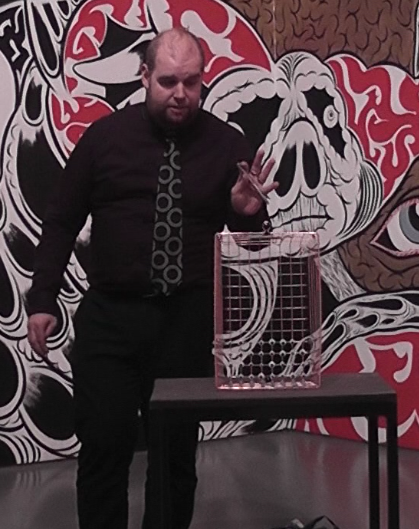
When I have the beginnings of an idea, for Screenshot from DCAexample, I like to go for a long walk and turn over the idea in my head before putting anything down on paper. Yet when I was asked to respond to an exhibition at Dundee Contemporary Arts in October, I had no ideas, not even the beginning of one. Instead, I sat on the yoga mats provided as part of the exhibition with a notepad and told myself I was staying until I put something down.

The result (pictured) was a visual response with a wire basket and 100 googly eyes. It was unusual and untested for me, as I’ve had no art training – and to my friends who know this, it was most definitely a Continue reading “The element of”

Think globally, act locally.

As this blog is about fiction and poetry, my chosen title is a correction of the phrase Think global, act local. Since think and act are verbs, I’ve added -ly to the other two words to change them from adjectives to adverbs. Now both clauses are paired up nicely.

The phrase has been around for decades, however you choose to word it, but it gained new currency at the dawn of the 21st century as more and more people had access to the Internet. For the first time, ordinary individuals could type a message and potentially have it seen instantly by a worldwide audience.

One problem this throws up is relevance. Unless I’m writing only for local folks, I somehow have to make my blog relevant to an audience much further afield, and that often means overlooking what’s happening in my own city to concentrate on our shared mass culture.

Photograph of Desperate Dan statue in Dundee c...
Photograph of Desperate Dan statue in Dundee city centre; behind it is City Square, the Caird Hall (straight ahead) and Dundee City Chambers (to the right) (Photo credit: Wikipedia)

Today, however, I’ll be turning the camera on my own city of Dundee in Scotland, with a population of around 148,000. This place has made its mark on the wider world in several ways. Grand Theft Auto was coded here, James Chalmers introduced the adhesive postage stamp, and the Beano is printed five minutes from my house.

From a literary standpoint, a number of notable works have been produced by its citizens, from William McGonagall’s terrible verse in the 19th century right up to Oliver Langmead’s 2015 novel Dark Star.

Mondays are a particular bottleneck for reading and writing events, with the Literary Lock-In at the end of each month, my own group Hotchpotch near the middle of the month, and a Silent Reading Party fitting in between the two. Literary Dundee helps to coordinate these, plus the regular author visits, not forgetting the major Literary Festival in October.

Altogether, Dundee is one of the best places for a writer to be at the moment, with a more active literary scene than its population figure might suggest. Later this year, two of my poems are also scheduled to appear in Seagate III, continuing from volumes I and II published in the 1970s and 1980s respectively. You can bet I’ll be telling you all about that when it happens.

Buy my book! Buy my book! Buy my book!

I enjoy having people follow me on Twitter. If you’re so equipped, you can do so at @LadyGavGav.

As you might imagine, a number of writers follow me, plus those in other creative fields such as music or visual arts. However, there are a significant minority who do nothing but sell sell sell. If you type the words “Buy my book” into the Twitter search bar, you’ll see plenty of examples.

I understand the temptation. It was September 2013 when my first story was published in an actual proper actual book on an actual shelf somewhere. All I wanted to do was fill my 140 characters with Buy My Book! 50 times a day. But there’s a word for that, and that word is spam.

Spam is everywhere, and has been since the earliest days of the World Wide Web. Regular Web users have long learnt to filter out advertising—legitimate and dubious—to the extent that we can concentrate on genuine content. So when someone comes along with a wall of identical messages, the average user will hit the Back button like Billy Whizz.

Targeting your audience so directly also potentially discourages people from interacting with the user. How often have you been in a shopping centre when somebody at a stall enquires, “Can I ask you who supplies your gas and electricity?” I’m by no means a shy person, but I ignore that as it’s so confrontational.

Twitter
Twitter (Photo credit: Wikipedia)

So how do you use Twitter without coming across as a complete pillock?

One Twitter user, in my opinion, achieves a great balance. Rayne Hall is an author and editor of fiction and factual books. She intersperses promotional material with writing tips and pictures of her cat. Sometimes the feline even ‘promotes’ her books. This approach encourages people to interact with her, particularly if it’s agreeing (or disagreeing) with a writing tip or commenting on a picture, and she makes a point of responding to messages.

For my own part, I like to crack a lot of puns, mostly because they come naturally to me but partly because people bond over a bad joke in a way that they don’t over good material, according to Professor Richard Wiseman. At least then someone can say how much they liked or groaned at it. And then, when I do have something to promote, it stands out from the jokey messages.

PS, buy my books. My stories are in the following anthologies:

Don’t be a slowcoach.

Last week, I mentioned I was working to submit an essay about John Milton’s Paradise Lost before Friday.

I’m pleased to report I managed to submit it via the university’s online system on Wednesday and – as Dundee hasn’t gone fully electronic yet – in person at the office on Thursday. There will be more to come next semester, but that’s it for the moment.

Unlike Douglas Adams, I try my utmost to respect deadlines. Yes, other priorities are going to stand in the way from time to time, but not on every occasion. The last thing I want is to gain a reputation as someone who says they’ll do a piece of work then doesn’t deliver in time. Even with the essay business, I made sure there was an entry here every Monday.

Ladybank railway station Original description:...
Ladybank railway station Original description: Ladybank Railway Station Looking down the track, straight on for Perth, bear right for Dundee. (Photo credit: Wikipedia)

On Saturday evening, I was booked to read poetry at Off the Rails at Ladybank railway station in Fife; it was at one point the stationmaster’s house. About 50 people are packed into a single room, while poets and musicians perform in front of an open fire. The building seems to be well soundproofed, so it’s rare to hear a train; the loudest noise was the wind howling outside the window.

Unfortunately, two of the four poets had to cancel, and only one replacement could be found at short notice. This gave me a deadline of less than half an hour to expand my set accordingly. I’d brought seven poems with me, which would push me just over my 10 allocated minutes.

Fortunately, the rest of my work is backed up to Dropbox and I was able to read a long piece from my phone to make up the time. It ended up being an excellent night, and I’m happy to do it again in the future.

News in brief.

I’m afraid last week’s entry was rather short, and so is this one.

For the first time in six years, I’ve been unable to complete the 50,000 words required for a NaNoWriMo novel. It’s not that I’m stuck with the story – far from it, in fact – but I have to write a detailed essay about Paradise Lost by John Milton for my MLitt degree, and it’s due for this Friday.

Happily, the essay is now under control and I should be able to submit it a day or two before the deadline. After that, I’ll aim to resume my usual long entries.

Bang for your buck.

I realised recently that I hadn’t sent off any work to publishers for rather a while, and now I’m beginning to make up for it.

When you submit short stories or poetry on a regular basis, you quickly realise there are two broad types of market.

  1. Directly to publishers. This is where an publishing house invites submissions of single poems or stories for an anthology, often on a set theme, and an editor decides what’s included. There are usually no charge to send in work and the author is often paid a flat fee or a rate per printed word.
  2. Competitions. This is where an organisation invites submissions, often on a set theme, and a judge or panel of judges decide who wins. There is often a charge to send in work, and the winner usually receives a cash prize along with publication.
English: Wil Wheaton at the 2011 Phoenix Comic...
English: Wil Wheaton at the 2011 Phoenix Comicon in Phoenix, Arizona. (Photo credit: Wikipedia)

At least that’s how it should work. However, I’ve been involved in more discussion of late about places that aren’t giving a fair deal to their contributors. This includes Star Trek actor Wil Wheaton, who was asked to write for the Huffington Post in return for ‘exposure’.

I’ve heard anecdotal evidence from a couple of poet friends that a popular magazine follows a similar ‘exposure’ model with the claim that they’re a small press and are unable to pay. At least one of these friends has been professionally published elsewhere and will no longer submit to this magazine.

I’ve also recently spotted an advert for a competition with a £10 entry fee or £11 if submitting online, and the prize is to read your work at their event. To me, there’s a lot wrong with this.

Firstly, the price difference is not explained; contributors appear to be penalised for not wasting paper. Secondly, it’s still around double what you would expect to pay to enter a competition. Thirdly, there’s not so much as a nominal cash prize offered, nor any mention of a contributor’s copy.

My advice is to be clear about your reason for sending your work to a particular place. Ask yourself whether the reward is proportionate to its quality and to the financial position of the publisher.

That principle still applies to charity or fundraising work. This year, for instance, I’ve been invited to perform at local landmarks to raise funds for the maintenance and restoration. As I know the organisers, I’m clear that I’m donating my time and work to these causes. One of them even offered me travel expenses, which I declined.

But don’t think everywhere is out to get you. Gutter magazine offers a two-year subscription rather than cash payment, which I consider to be fair, while feminist zine Artificial Womb is a tiny operation but makes a point of paying every contributor.

And a final piece of advice: Wil Wheaton wrote that the exchange he had with the editor wasn’t unpleasant, and that he didn’t blame her for company policy.

Echoing this, it’s always a good idea to be civil to editors no matter how the conversation ends. We’re used to reading about authors and other celebrities who act like divas, but if you develop a reputation for being difficult – especially at the start of your career – word will get around quickly and potentially close off avenues you hadn’t yet explored.