Presenting to Creative Folks

Although these entries are posted in a regular fashion, they’re sometimes written days in advance, giving me time to iron out any flaws. This is not one of these entries. This is about an event from this morning.

I’m part of a local group called Amps, self-described as a community of people who make and cultivate creativity in Dundee. Every Tuesday morning, the members gather for a lighthearted online event that includes discussion questions for everyone, and one of the members typically gives a talk about their work.

It was my turn today, and I talked about the challenges of running both a poetry open-mic and a novel-writing group. I first considered the many differences between the two groups, then ended by discussing three key rules I follow when running both of them.

I’ve been working on this topic for a long time. In 2020, I was supposed to make a Pecha Kucha presentation that never went ahead, but I’d planned what I wanted to talk about. All I really needed to do was bring it up to date.

Regarding Amps as an organisation, I’d heard about them a few years back, but I didn’t join until about this time last year. I didn’t initially imagine I’d be welcome as I don’t rely on the arts to make a living, but the organisers keep a broad church.

After the presentation, there is always a short question-and-answer session, in which I was able to expand upon some of the points I made and put some preconceptions to bed. The weirdest question was whether I would consider using artificial intelligence in my writing.

I’m not always at these meetings because of work commitments, but I’ll endeavour to go whenever I’m available.

The Ghosts of Blogs Long Gone

A couple of weeks ago, I mentioned how this blog is now nine years old, and I’ve updated it without any significant gaps. Regular readers will probably be able to identify my style of writing. This is no accident. Before moving to WordPress, I cut my teeth on LiveJournal for many years, and some of what I learnt has carried over to this very day.

Affectionately known as LJ to its users, the site was big news around the millennium. I was relatively late to the party, making my first entry there in 2003. Nonetheless, I kept it updated with day-to-day events until around 2013. My experimentation there was crucial to how I approach blogging today. I found out what topics would engage and disengage an audience, how to structure the text, and the optimum length for a given entry.

Looking back, I’m surprised that some of my least engaging updates were made between 2011 and 2013. I knew LJ was losing its audience by then. In a misguided attempt to keep it alive, I’d largely dispensed with the diary style in favour of a dull series of weekly posts titled #MusicMonday, featuring a different rock or pop track.

By that point, I was starting to take my writing more seriously, so I chose to start afresh on WordPress. This would have a focus on fiction and poetry, and would go on to be updated on a strict weekly schedule. From the moment I set up my account here, I could see why users were moving away: WordPress offered basic features such as scheduled posts and picture uploads as part of their free account, but LJ still charged for them. Most of these features are now free, but LJ still charges $15 just to change your username.

That’s not to say LJ is dead. I still have one pal who updates to this day, and it was a comment underneath her most recent entry that led me back to another blog I kept at Dreamwidth, based on LJ code with modifications.

In 2009, I set up what would now be termed an alt-account to share thoughts that I didn’t want a wider audience to see. I stopped regularly updating there at the same time as I opened WordPress. Then the rabbit-hole deepened when I remembered I’d set up a secondary account to record fragments of dreams. The intention of using them for writing prompts never came to fruition and that blog has remained untouched since 2011.

I have one other LJ page that’s now inaccessible. This was set up for a juggling society at what is now the University of the West of Scotland. Members were kept updated on that page because this was an era before MySpace went mainstream. The student email address no longer exists, my password guesses have been incorrect, and I never set up a recovery question. As such, it’s remained fossilised since 8 Feb 2005.

Reading the LJ Help pages, there is no hope of recovery, so I’ve written to the helpdesk to ask when it’ll be purged. This is often done with accounts that have been idle for too long.

That’s the story of how this WordPress blog came about, and why it’s written the way it is. I can still look back at entries from its earlier days and see what I would have done differently, but I am generally happy with how the past nine years have gone.

Preparing for November

For the last eight years, I’ve had the privilege of running the Dundee & Angus region of National Novel Writing Month. The name is usually shortened to NaNoWriMo.

My official title is Municipal Liaison (ML) and I’m just one of an army of volunteers around the world who run local regions of differing sizes. Dublin, for instance, is one region. By contrast, the entirety of Italy is also its own region for NaNoWriMo purposes, although that’s not uncommon outside the Anglosphere.

The poster child of NaNo is the challenge to draft a 50,000-word novel over the 30 days of November. Regions are not required to meet year-round, but ours does every Tuesday. November sees an increase in membership, so we’ve learnt to plan accordingly.

In addition to our Tuesday meetings, we have an additional one each Saturday in November. Traditionally, this is at a different location. I always like to have a co-ML as a backup, and she organised that alternative venue.

But why meet year-round in the first place?

It’s less well-known that the organisation also runs standalone challenges during April and July where you choose your own goal.

The idea came about after the 2015 November challenge, when there was an enthusiasm to keep meeting up into December. A previous co-ML and I decided to extend it on a trial basis each month, and we eventually met up every week until April 2016.

At that point, it was clear the weekly meetings were a winner. These allowed our members to come along during the off-season to work on other projects or prepare for the next challenge.

When the pubs were closed during the pandemic, we already used Discord as a meeting place, and this was stepped up. Our meetings now take a hybrid form, where members have the alternative to engage in our private server.

The in-person element, however, will always remain central for as long as I’m in charge of the Dundee & Angus NaNoWriMo region.

Acting as Gallery Assistant and Finding the Time to Read

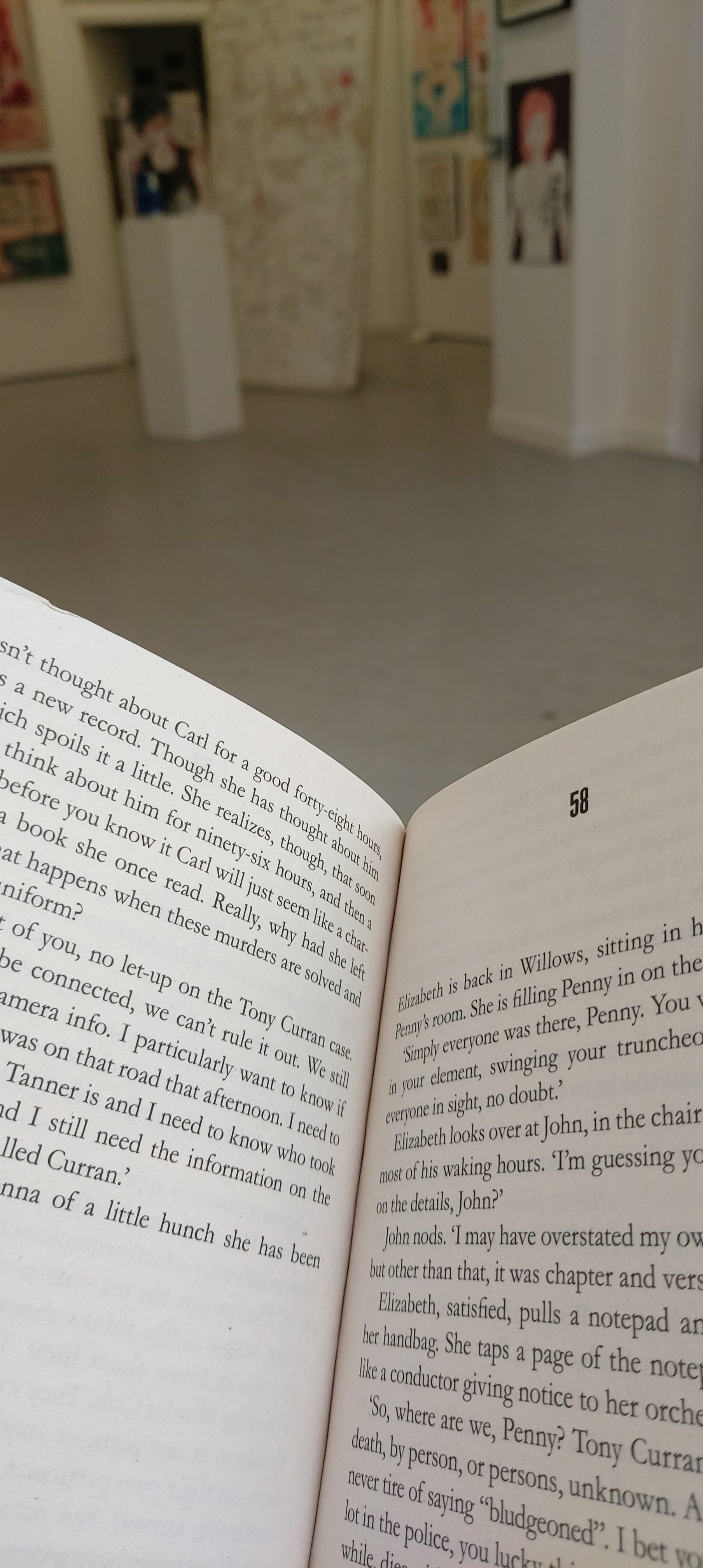
I’m a regular visitor to the Dundee Contemporary Arts building, which holds around three major exhibitions per year. No matter what’s on display, I’m forever fascinated by the job of the gallery assistants. Aside from opening nights and special events, the pace is normally relaxed enough that some of them read novels while on shift.

Last week, I had the chance to experience this for myself on a smaller scale. First, a little background.

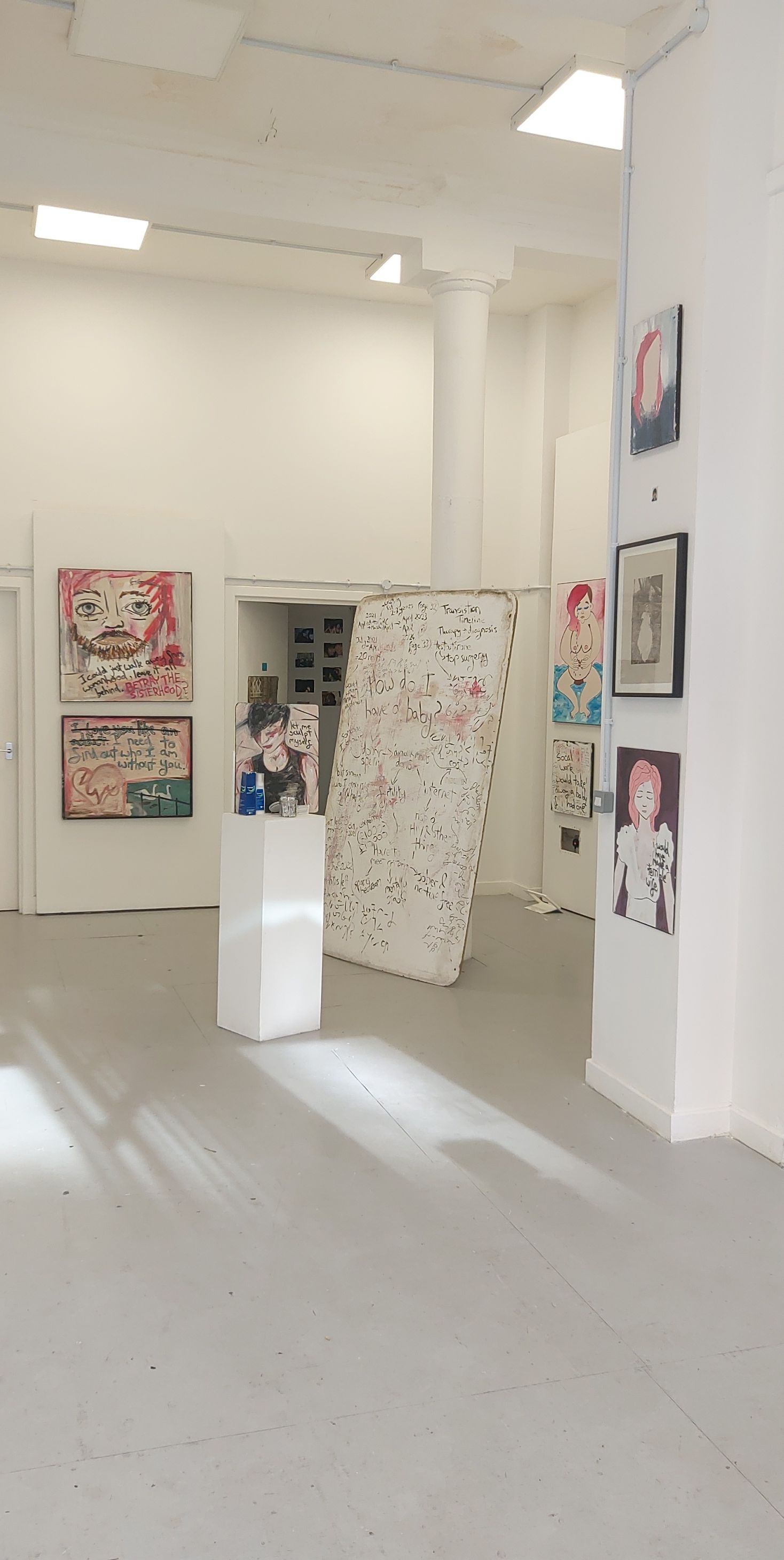
On Thursday, I visited an art exhibition called Funeral For My Deadname at Saltspace in Glasgow. This was run by an artist pal, and the highlight of the opening night was him completing and signing a document to legally change his name to Luke ‘Luca’ Cockayne in front of a crowd of visitors.

Luca also displayed a selection of his artworks in the gallery, some dating back more than a decade. These were available for viewing until Sunday, and some are featured below.

As I hadn’t originally planned to be there on the opening night, I’d already booked my travel for Saturday. I didn’t intend to waste it, so I visited again and spent the day at Saltspace. In contrast with the busy opening night, there was a mere trickle of visitors during the day.

I’d brought with me the Richard Osman bestseller The Thursday Murder Club. It had been sitting in my bag for a long time, and by last week, I’d reached the halfway stage. With a combination of a long bus journey and quiet conditions at Saltspace, I was down to the last few pages by Saturday evening, then I finished it on Sunday.

I also promised my pal I’d dash off a quick clerihew in honour of the event:

Funeral for My Deadname.
I hereby proclaim,
announce and swear
that a change is in the air.

A Regular Writing Routine

I’m part of the Wyvern Poets group in Dundee, having been a founder member in or around 2015.

Unlike my other groups, this one does not actively recruit members but it does publish its work. Most notably, Dundee University has invited us to put together a pamphlet for the Being Human festival every November, and to perform our work on campus.

For the rest of the year, the members each write a poem ahead of our monthly meetings. There is always an optional prompt; normally a single word like ‘environment’, ‘pace’ or ‘journey’. The poems are then discussed on a peer-review basis and suggestions are made between members.

I find if I undertake no other writing in a given month, I always submit something for the group, even if it’s at the last minute or if I’m not entirely happy with it. As there’s only around a week until the next meeting, I’m going to crack on with this month’s prompt – villanelle – right after I finish this.

Catching Up With My Correspondence

Last week, I ended up writing about some major changes to a distribution list I run, but I promised to make this week’s entry about writing to a penpal from North Wales. Since last week, I’ve heard my most recent reply arrived safely, despite intermittent postal strikes.

This has also caused me to forget much of what I’ve written. While I meant to make a special point of keeping a copy – as my pal does – I forgot and just posted it without thinking. It’s a small risk, but one of our letters went missing in transit. The more immediate problem with not keeping a copy is that I sometimes have to infer from the response what we were talking about before.

However, we have developed a tradition of asking each other a few questions out of curiosity, in the vein of ‘What friend do you know best?’ or ‘What have you done now that you never would have done ten years ago?’

On to the actual writing, I’m particular about my paper. I keep an A5 notebook with the pages perforated at the spine, so they tear out neatly and fit into a C5 envelope. I admire my pal for being able to write on unlined paper. If I did that, I guarantee the lines would start sloping downwards towards the edge of the page.

Having written so many letters and using that paper so often, I tend to have a rough idea of its length before I write it. Occasionally, it’s shorter than expected, but it sometimes encroach onto eight pages.

And I do write to others as well. The next scheduled letter will be with a Christmas card to my pal in the Republic of Ireland. I don’t exactly go bonkers for Christmas, but this is something we’ve done since the early 2000s, along with birthday cards. If anything, our messages have become longer over this time rather than shorter.

But it’s not a hobby for impatient people. It can take weeks for a reply, and I always have to post early to the Republic of Ireland to help those cards arrive in time.

Refreshing the Roster of Raconteurs

I have a penpal in Wales who wrote to me last week. We’ve been in touch for nearly two decades online, and this has gradually moved into long paper letters. If you’d asked me last week what my blog was going to be about, that would have been the topic.

But I’ll come back to that next week because I finally carried out an overdue task on Sunday.

Regular readers will know I run an open-mike night called Hotchpotch. When I took over in 2015, I inherited the passwords for the Twitter account, the Facebook page and the e-mail bulletin list. In the case of the first two, users can self-manage their subscriptions, but the bulletins require manual intervention.

Additionally, some people on the list had moved away or not come along for years, but had never requested to unsubscribe. And recently, the server that hosts our domain name had been failing to deliver to otherwise valid addresses, which then needed to be re-sent in their own separate list.

On Sunday, I wrote to everyone on the list individually, explaining we were transitioning to an Announcements list on Dreamhost. This requires people to click a link to opt-in, and it’s much easier to remove members.

At the time of writing, the new list has 34 subscribers, which is less than a quarter of the old list. However, I’m satisfied we’re now sending to a shorter list of opted-in people than 130+ who don’t necessarily want to hear from us.

What’s Occurring in September

Eschewing my usual ‘columnist’ format, this week’s entry takes the format of a bulleted list all about this month’s upcoming projects.

  • The following week, on Wednesday 21 September, I’m leading a gameshow called The Literal Flow Test. This is part of the Dundee Fringe, and takes place at Dock Street Studios. You can book tickets now, but there is no direct URL, so go to the official website and look down the page.
  • The following day, Hotchpotch has been granted a stall at Dundee University Freshers’ Fair. That’s on Thursday 22 September from 11am to 4pm where we’ll be introducing ourselves to the new crop of students.

Callbacks and Foreshadowing

Every August, I spend time in Edinburgh at the Fringe festival, usually for a few of the many hundreds of comedy shows.

This year’s acts were as diverse as they come, including the magician Pete Firman, the musical troupe News Revue, and the brash Nick Helm. One factor they all have in common, however, is that each act references something that happened earlier in the show.

In the comedy world, a common structural element is known as a callback, in which a performer will make a reference to a joke or an event earlier in the show. The most memorable example I’ve seen was the comedian Danny Bhoy in his show Dear Epson, which opened with a letter of complaint to the eponymous company. At the end of the show, he closed with the reply he received to that letter.

Done often enough, a callback can become a running gag, making reference not just to the current show but to past shows or outside events. To this day, Jimmy Carr brings up the subject of his tax avoidance, even though it happened ten years ago.

Many stand-ups speak in a rambling manner, so such back-referencing provides a little clue that the rambling is not entirely aimless and that there’s some structure to be found.

A similar technique can be used in prose, where it’s more often known as foreshadowing. There is often a balance to be found between making it too obvious and giving away a later plot point, or making it so subtle that the reader misses it.

A story that manages to walk that line is The Lottery by Shirley Jackson for a good example. The stones mentioned casually near the start of the story play a significant part as the narrative concludes.

Back on the Festival Circuit

On Saturday, I was invited to perform at the inaugural New Pitsligo International Spoken Word Festival. It’s not the obvious location for an international festival. It’s easy enough to reach Aberdeen by train, but to reach New Pitsligo involves at least two connecting buses, many of them via Fraserburgh.

I was given a 4pm slot to perform in the Public Hall. In practice, it was closer to 5pm because the small delays by previous acts had built up to a much longer delay during the afternoon.

I presented new material, namely found poetry, constructed from sources including a calculus textbook and e-mail subjects. It took a few of my 15 minutes to warm up the audience and win them over, but they seemed to enjoy it by the end.

I have a few other festival-type events coming up soon, including a collaboration with an Edinburgh-based poetry group and a Dundee Fringe in September, and I look forward to seeing what comes of those.