The Layover Formula: Taking My Own Proofreading Advice

For those keeping track, I’ve received no further badges from WordPress at present. I’ll issue updates on that story as I receive them.

Meanwhile, I’m still very much on the writing kick from the start of this month. I’ve previously made allusions that what I’m writing is part of a fantasy series published under a pseudonym on a reasonably well-known platform.

I’ve now churned out two new chapters. The first part totalled around 3,700 words, which is already nearly twice as long as some of the previous chapters. Every story has to be approved by an administrator, and the longer it is, the longer the approval process tends to take.

That first part also ended on a major cliffhanger that will steer the rest of the story. As such, I want to make sure the second part resolves all the action in the first. The second part ends with a resolution rather than another cliffhanger.

I’ve built up both parts in a non-linear fashion, then joined the dots to make a complete narrative. I didn’t consciously choose to work this way; that’s just how it panned out. I’ve been tinkering with the story so long now that I’m down to only minor changes on each reading.

On Thursday of last week, I decided it was time to listen to my own advice: leave it aside and come back to it later. To determine the minimum period that a piece should be left aside, I use a self-devised formula: either (a) one minute per word, or (b) 24 hours, whichever is longer. I’ve dubbed it The Layover Formula.

So a 600-word short story would be ten hours, which is rounded up to 24 hours. By contrast, my next chapter currently stands in the region of 6,600 words, or a layover of approximately 4½ days. In a happy coincidence discovered while writing this, 10,000 words leaves a gap of almost exactly a week:

Word Count Minutes Layover
100 100 24 hours
500 500 24 hours
1,000 1,000 24 hours
2,000 2,000 1.4 days
5,000 5,000 3.5 days
10,000 10,000 7 days

I last looked at the file late on Thursday night and I told myself not to open it again until tonight. I was permitted, however, to carry out some adjacent activities:

  • Jot down relevant notes in another document so I don’t forget them.
  • Work on the history, background and lore of the stories.
  • Start preparing and writing the next chapter.

I’ve been so distracted by all the adjacent work that it’s actually been rather easy to avoid looking at the document. But when I am working on it, one way I like to proofread is by using text-to-speech synthesis because it won’t skip over most spelling or grammar errors.

Microsoft Word can do this, where it’s called Read Aloud, and the voice is reasonably realistic, albeit with the occasional incorrect tone or word stress. The mobile app also has this feature, although I found it kept stopping around two minutes after the screen was locked.

Faced with this problem, I thought it might be prudent to create an audio file instead that could be heard while walking.

Text-to-MP3 converter tools are a dime a dozen, but many of them offer a trial limit of around 1,000 characters before a subscription is required. I found a PDF to MP3 tool that was free of charge and suitable enough for my purposes, even if it handled page breaks with a long gap.

Once the proofreading was done, the piece will be ready to submit and I can give the audience the resolution they crave. I can’t control how long the approval might take, but I can decide how long to wait before submitting it.
The Wild West of WordPress Badges – Supplemental

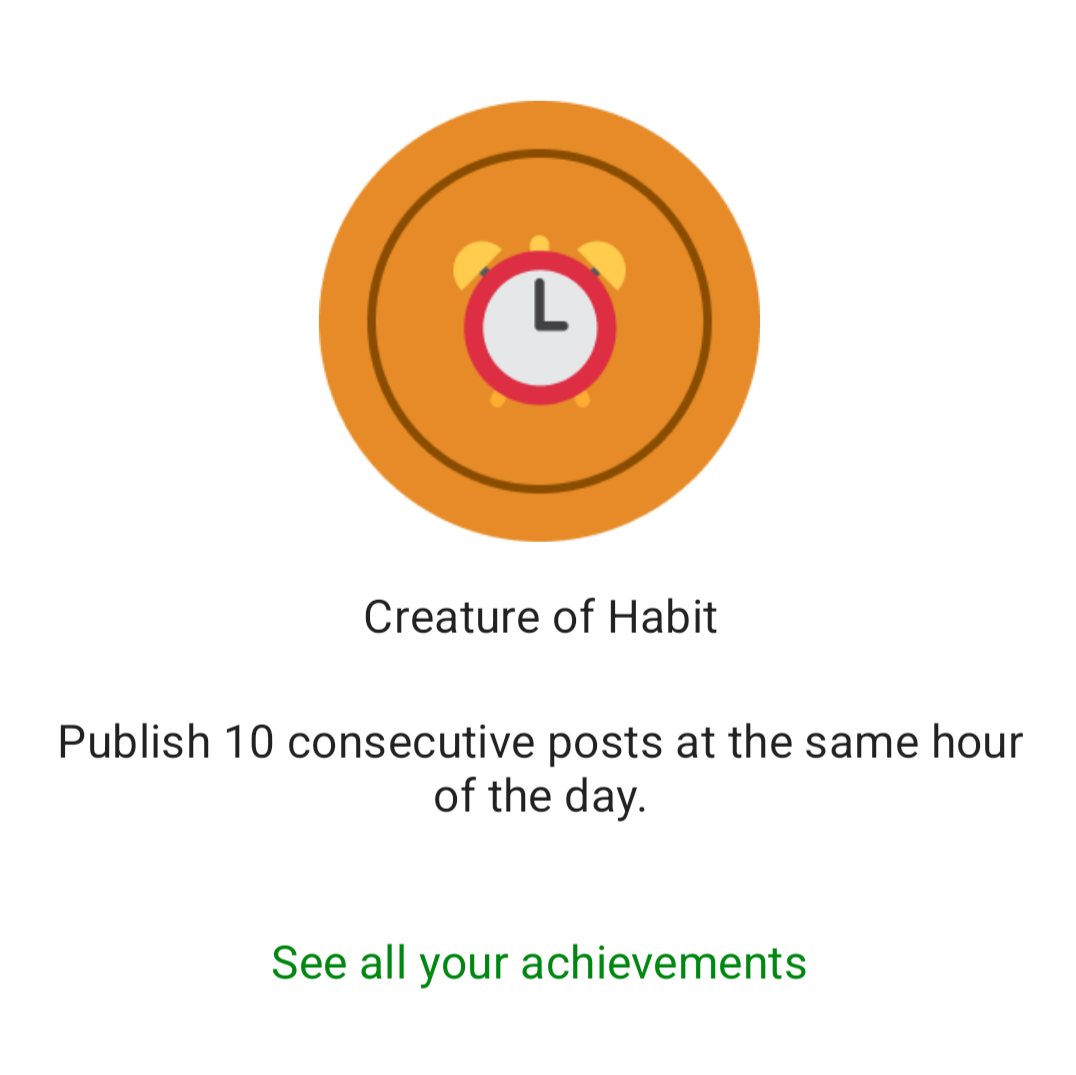
After posting yesternight’s entry about WordPress badges, I then received the one below for publishing ten consecutive posts at the same hour of the day.

By telling you about this at an unusual hour, I wonder whether this will, in turn, generate further badges. I’ll let you know either in a later entry, or the usual Tuesday update.

WordPress achievement badge with an orange circular background featuring a stylised alarm‑clock icon; below it the text reads ‘Creature of Habit – Publish 10 consecutive posts at the same hour of the day’, with a green link beneath stating ‘See all your achievements’.

The Wild West of WordPress Badges

Four weeks ago, I received a notification from WordPress that I’d been awarded an Achievement called Palindrome Post. I’d never heard of such a thing, so I took a closer look.

This is given for a post with at least 100 words where the word count reads the same backwards as forwards. This could be 121, 1,221, 12,321 or a similar pattern. It was credited to the post A Fully-Booked Weekend.

And yet WordPress itself tells me that post is 267 words long. This doesn’t include the title nor tags, and the words in hyperlinks are also counted individually, so I’m not sure of the methodology used. That said, I was only vaguely aware of the achievements system before this, so it’s prompted me to look down the list.

The first two badges were all achieved within the first month of the blog’s life: 200 follows and 1337 Likes. But the wonky maths returned in January 2014 because I don’t understand how this – a weekly blog – could have earned the 500 posts badge.

And then more than a decade passed with nothing.

The next time I heard about the badges was on the 12th Anniversary of the blog in October 2025. I then received two awards on 26 May 2026: Globe Trotter for receiving views from 50+ different countries, and The Headliner for changing a post’s title five or more times before publishing. I’m surprised I took so long to achieve that last one, since the title often goes through a few drafts.

But what about the badges I haven’t yet achieved?

With my predictable Tuesday night update schedule, I know I won’t achieve some of them, including Night Owl for posting between midnight and 5am, nor Early Bird for posting between 5am and 8am. I’m also unlikely to be a Marathon Blogger, publishing for 30 days in a row, and definitely no Dear Diary for posting every day for a whole year.

But there are some within my grasp. I’ll win the Daily Reader badge if I visit the Reader page for 30 days in a row, or Ship It! if I publish a post very quickly with no overthinking allowed; again, I’m surprised this hasn’t yet happened, considering the number of last-minute entries. I’m also in danger of triggering Necromancer for publishing a draft that’s been gathering dust for over a year.

Looking into the future, I won’t achieve Novelist unless I wait a long while or seriously increase the length of my entries. Unbelievably, I’ve written less than 4,000 words across all my entries out of the required 50,000. I also won’t see Leap of Faith until 2028, as I hope to be posting on Tuesday 29 February.

Peppered in between the visible achievements are a list of secret achievements. I’m not opposed to surprises per se, but I think it’s unfair to hide these rather than encourage users to work towards them.

Fortunately, one user has listed a few more that I didn’t know about, so I can use that as a starting point. Perhaps the real achievement is simply remembering this little system still quietly exists in the background..

Still Trying and Failing to Read

Just before Christmas, I was involved in a 12-hour Yule readathon, run by a pal from one of my writing groups. The intention was to devote a day to reading, with optional mini-challenges. I did manage to read on that day, but not as extensively as I’d wanted.

Then couple of weeks ago, we re-ran the event. Rather than start any new books, I wanted to make some progress with War & Peace.

I’d left it about halfway through, and I hadn’t touched it in some time. A lot of people think it’s a hard read from the sheer size, but actually, it’s divided into four volumes with chapters no longer than any other novel. You could easily finish a couple before bedtime.

As I jumped straight back into the story and remembered what had happened, I enjoyed it as much as I did the last time I picked it up. But have I touched it again since then? I really want to say yes, but I have not.

The trouble is not finding the time per se, but alloacating it. You see, a lot of what I do in a week is time-sensitive: creating announcements for my groups, writing this blog, keeping up my exercise routine. Reading, alas, doesn’t need to be done by any particular time, so it’s often left behind.

That said, I’m going to make a concerted effort with Mort by Terry Pratchett. On Saturday, I’m again meeting up with the woman who lent it to me about a year ago, and I’d like to be able to return it fully read.