Acting as Gallery Assistant and Finding the Time to Read

I’m a regular visitor to the Dundee Contemporary Arts building, which holds around three major exhibitions per year. No matter what’s on display, I’m forever fascinated by the job of the gallery assistants. Aside from opening nights and special events, the pace is normally relaxed enough that some of them read novels while on shift.

Last week, I had the chance to experience this for myself on a smaller scale. First, a little background.

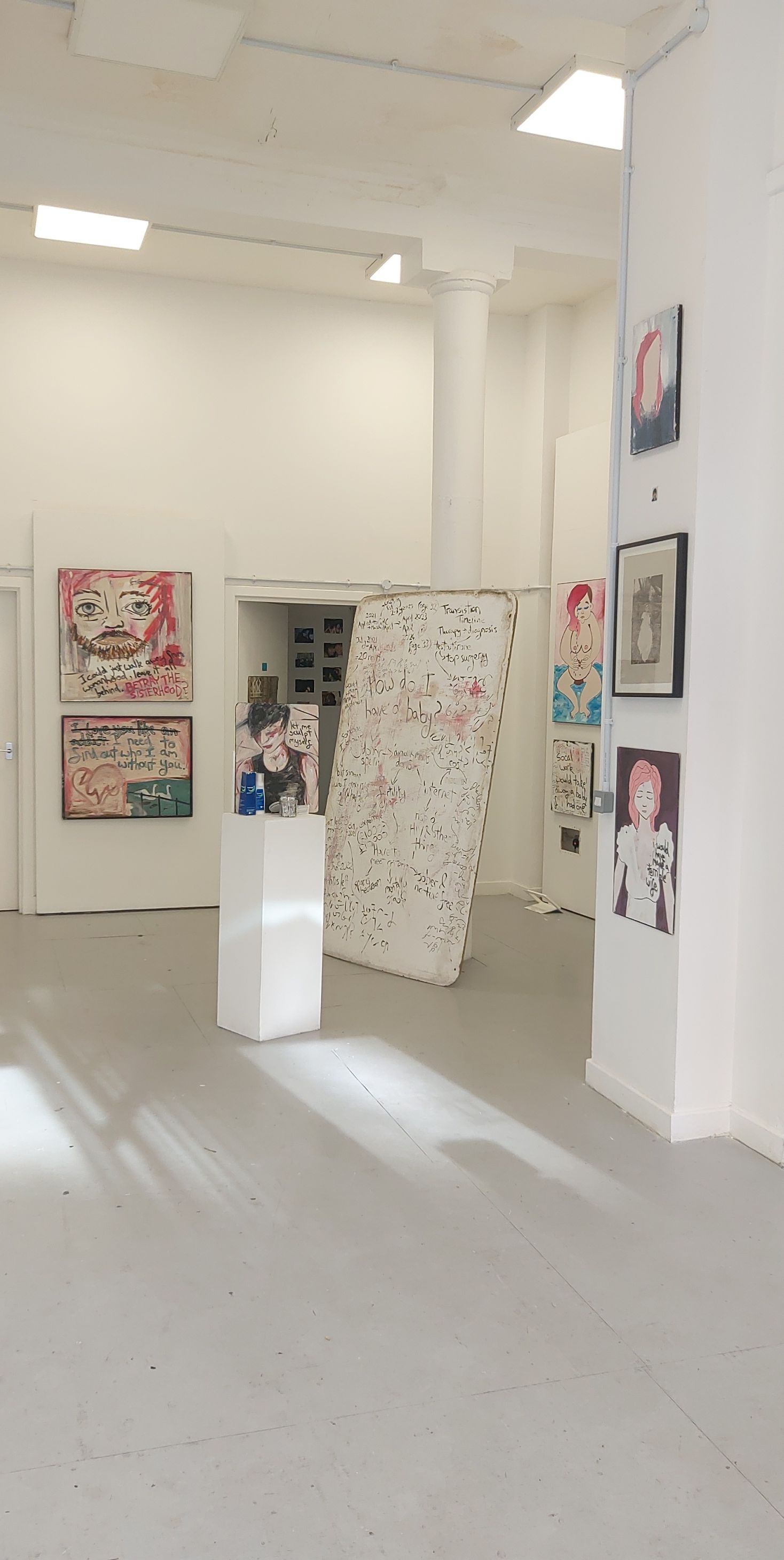
On Thursday, I visited an art exhibition called Funeral For My Deadname at Saltspace in Glasgow. This was run by an artist pal, and the highlight of the opening night was him completing and signing a document to legally change his name to Luke ‘Luca’ Cockayne in front of a crowd of visitors.

Luca also displayed a selection of his artworks in the gallery, some dating back more than a decade. These were available for viewing until Sunday, and some are featured below.

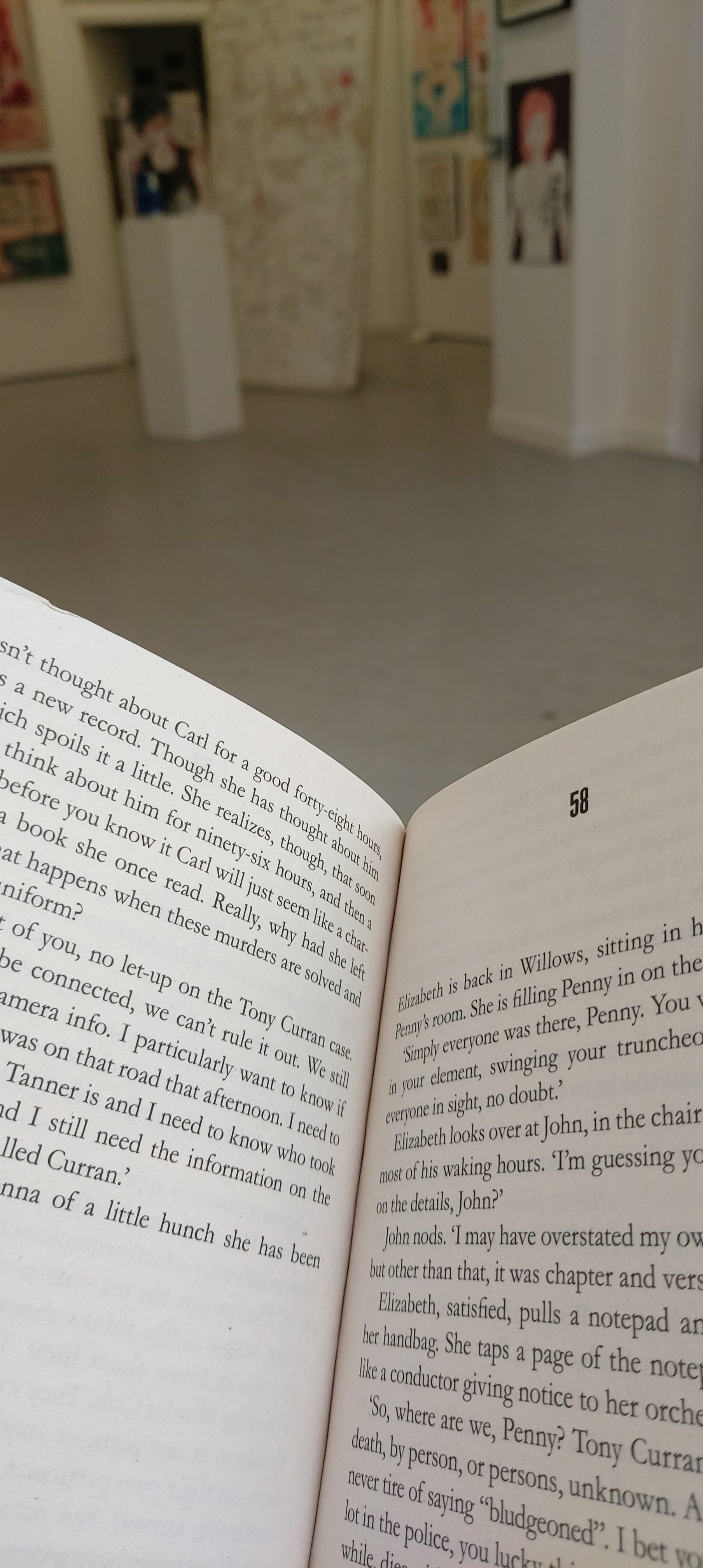
As I hadn’t originally planned to be there on the opening night, I’d already booked my travel for Saturday. I didn’t intend to waste it, so I visited again and spent the day at Saltspace. In contrast with the busy opening night, there was a mere trickle of visitors during the day.

I’d brought with me the Richard Osman bestseller The Thursday Murder Club. It had been sitting in my bag for a long time, and by last week, I’d reached the halfway stage. With a combination of a long bus journey and quiet conditions at Saltspace, I was down to the last few pages by Saturday evening, then I finished it on Sunday.

I also promised my pal I’d dash off a quick clerihew in honour of the event:

Funeral for My Deadname.
I hereby proclaim,
announce and swear
that a change is in the air.

Remembering Where You Read It

More than ten years ago, I read the Herman Melville novel Moby-Dick, which is a hefty 500 pages. At the time, I volunteered every week at a hospital radio station and I used the bus journey to tackle much of my reading. Over time, I began to associate the route with the narrative of the story, even though the two were very different.

I recalled this recently as I read the Richard Osman novel The Thursday Murder Club on a bus, and I realised I have a few of these associations.

Breakfast at Tiffany’s is a book I’ll always associate with a bar where I currently hold a writing group, while A Room With a View reminds me of another bar not far away. Catch-22 is a particularly memorable case, as the association covers both the physical place, namely the school library, and the backdrop of the emerging War on Terror.

This phenomenon isn’t restricted to novels either. On a poetry front, I reviewed a Michael Pederson book in a park, and finished a Lorraine Mariner collection by candlelight one Christmas Eve.

In some cases, it must be stated that the reading locations were more memorable than the books, but I won’t single out any of them – at least not today.

The Importance of Structure and Conflict

This entry gives away the storyline of the novel The Bricks That Built the Houses by Kae Tempest. If you don’t want to know, it’s a good idea to skip this entry.


Every six months or so, one of my writing group members runs a 12-hour read-a-thon, where members can encourage each other to engage with a book they want to start or finish. We had the last one on Sunday just past, and I finished reading the aforementioned novel.

As a long-time fan of Kae Tempest’s other work, including poetry readings and music-backed albums, I really wanted to enjoy this, but what a letdown.

We’re led into the slightly seedy, slightly grimy world of the characters. But when the characters’ backgrounds are spelt out one after the other, it quickly becomes directionless.

Around two-thirds of the way in, there’s a scene where some chancer is beaten up after trying to charge a drug dealer double the previous price. This would have made a fantastic opener, from which we could have seen the tensions rise. Instead, any conflict is almost immediately resolved in the following chapters.

The book also suffers from some hallmarks of the first-time novelist. Firstly, Harry is a thinly-veiled version of Tempest. Secondly, the other characters all talk in a similar manner to each other, and not much conflict is built up between them for most of the time.

All the elements of a great story are there, but the final product feels like a collection of notes than a cohesive whole. The only element that made me push on through is the poetic prose throughout.

Having reached the abrupt ending, I recalled hearing about the first edit of Star Wars. It didn’t impress test audiences very much.

There is a standard story structure underpinning almost every major film, so an editor carefully went through the footage and shuffled it into an order closely resembling that structure. Here is the video of how it was done:

Had someone done the same with this novel, I might have been giving it a far better review.

Redrafting the Unredraftable

Exactly six years ago, I made the first draft of a poem called Sir Madam. The gender identity of the main character is undefined, and the narrative takes a condensed look at this person’s life, culminating in an incident that happens on a train.

This is the only one of my pieces I’ve been genuinely scared to perform, fearing I’d hit the wrong wording, tone or point of view. However, it’s become a piece that I’ve performed at slams and other gigs, and it does receive a positive reaction.

Until a few weeks ago, the text seemed set in stone, but the title started bothering me. Not only has terminology has moved on in the last six years, I now felt the character needed to be given a name, and that name is Shannon, so the title has also been revised.

I also took the opportunity to rearrange and redraft the rest of the text. Although I’ve been writing poetry for nearly a decade now, I still made a rookie mistake on Sunday when I started redrafting just before a gig, held online by Poets, Prattlers and Pandemonialists. I thought once I’d shuffled around a few lines, that would be it, but it still didn’t look how I wanted it.

As my turn rapidly approached, I decided to read out something else. Besides, the tone of Shannon might have brought down the light mood of the room. But I will return to the piece and I will redraft it to my liking once more.

Finishing an Overdue Book

It must be about 12 months since my pal Sofia lent me Mort. This is because I’d never read any Terry Pratchett other than Good Omens, although I’d seen a couple of his novels adaptated for TV.

As such, I’d gained a strong flavour of his style, so I suspected I would enjoy Mort. The problem was that I had enough time to read to the halfway stage, but had made no further progress.

Recently, I decided I would read a few pages at every break time, which helped a little. On Friday, however, I found myself with a two-hour period where I was able to finish it off.

Unfortunately, Sofia has been unwell – but is recovering – so it’s difficult to know when I’ll be able to hand it back. However, I’ll definitely seek out other Pratchett novels in the future.

Still Trying and Failing to Read

Just before Christmas, I was involved in a 12-hour Yule readathon, run by a pal from one of my writing groups. The intention was to devote a day to reading, with optional mini-challenges. I did manage to read on that day, but not as extensively as I’d wanted.

Then couple of weeks ago, we re-ran the event. Rather than start any new books, I wanted to make some progress with War & Peace.

I’d left it about halfway through, and I hadn’t touched it in some time. A lot of people think it’s a hard read from the sheer size, but actually, it’s divided into four volumes with chapters no longer than any other novel. You could easily finish a couple before bedtime.

As I jumped straight back into the story and remembered what had happened, I enjoyed it as much as I did the last time I picked it up. But have I touched it again since then? I really want to say yes, but I have not.

The trouble is not finding the time per se, but alloacating it. You see, a lot of what I do in a week is time-sensitive: creating announcements for my groups, writing this blog, keeping up my exercise routine. Reading, alas, doesn’t need to be done by any particular time, so it’s often left behind.

That said, I’m going to make a concerted effort with Mort by Terry Pratchett. On Saturday, I’m again meeting up with the woman who lent it to me about a year ago, and I’d like to be able to return it fully read.

Poettiquette

I was invited to take part in a poetry reading on Sunday night, spanning not only the UK but other countries in the Anglosphere.

This was a mammoth four-hour stint, even with a time limit of ten minutes per poet, plus just one five-minute break. My spot was halfway through, but I stayed the whole time because I wanted to listen to the rest of them, most of whom were event hosts like me.

I performed one serious piece and two humorous. Although there was no audible feedback, I could see some of the faces in the crowd and read comments in the chat box. The set seemed to go down well.

At that point, I received a friend request on Facebook. I was glad that someone enjoyed my work enough to make that request. Furthermore, I’d been in a planning group with some of the other performers, so we were acquainted already.

It must also be stated that the public part of my profile clearly states ‘Not open to friend requests’, yet as of Monday morning, I had four requests waiting. One of them sent me a message acknowledging that he’d seen my profile, and was basically trying his luck. I admire his gumption, but I told him he could either follow my Hotchpotch open-mike page or my Twitter account instead.

On the back of this, it occurred to me that when people perform at my events, they might also have the same view, and a lot of folk don’t feel comfortable telling someone to back off. To this end, I’ve added a disclaimer to the open-mike. It’s likely I’ll tinker with the exact wording, but the spirit will be reinforced in event promotions:

Unless consent has been given, the host and contributors are not open to friend requests.

This alone is unlikely to stop the issue; three people have either not read my profile or wilfully ignored it. However, it acts as a pre-emptive reminder to keep some distance from those who don’t want to interact so closely with others.

Trying and Failing to Read

For the last few years, I’ve followed the Icelandic tradition of reading on Christmas Eve, or Jólabókaflóð if you speak the language. In a nutshell, it’s about exchanging books, then reading them all evening with a cup of hot chocolate. This year didn’t go to plan.

Firstly, I hadn’t been able to exchange with anyone, although I have plenty of unread books on my shelf. I normally choose a poetry book and try to finish it in one night. This year, it was This: Tay Poems by Jim Stewart, published posthumously.1

Secondly, I’d underestimated how rich and descriptive the poetry would be. I was enjoying what I was reading, but I found it difficult to concentrate. I gave up at the halfway mark to head to bed.

Just a few days before this, a pal of mine had arranged a 12-hour reading event the previous Saturday to roughly coincide with Yule. There wasn’t a schedule as such, just time set aside to start or finish our books, but that also didn’t go to plan.

My intention was to sit down and finish Mort by Terry Pratchett, lent to me by a friend. Instead, as the day approached, other events kept encroaching onto the day, including a three-hour Dungeons & Dragons session. As such, I ended up listening to a total of about two-and-a-half hours of my audiobook: Beauty’s Release by Anne Rice.

Indeed, audiobooks are the way I tend to take in fiction these days. I’ve been trying to increase my walking this year, and it fits in with my schedule much better than sitting down to read. Still, I will carve out time to finish Mort as it needs to be returned at some point.

1 Although it was only published in 2018, I’m having difficulty finding a place you can buy the book. The only place that seems to stock it is a Dutch website called Athenaeum. The publisher barely has an Internet prescence, although you could try contacting the editors via the site they do have.

Friday Night Amphitheatre

For over four months now, it hasn’t been possible to run my two writing groups in person because they’re both in pubs. While the venues cautiously opened a couple of weeks ago in line with government guidance, each group has a different obstacle preventing us from returning.

Let’s take the weekly National Novel Writing Month meet-ups. Last week, a member and I scoped out the venue with a view to deciding whether it was safe to bring members back. Before we could reach a conclusion, however, the decision was taken out of our hands.

NaNo HQ took a blanket decision not to endorse or support any in-person meet-ups until further notice. It’s a disappointing decision, especially as our area is controlling it well, but I understand they’re making the decision for every region in the world.

The other group is the monthly Hotchpotch open-mike for writers. Normally, we can attract a membership of 30 or more per session, so it wouldn’t be possible to cram everyone into the same space while leaving the required one-metre distance between people. On top of this, we have the additional hygiene issue of everyone sharing the same microphone.

What we can potentially do is arrange social night out where everyone sits at different tables, but this would have to be done in consultation with the bar.

That said, the rules are more relaxed in outdoor areas. On Friday night, I went to a street poetry event at a public amphitheatre in Dundee. This was run by Mark Richardson, who organises these ‘guerrilla’ gatherings on an occasional basis.

I’ve always half-joked that if Hotchpotch didn’t have a venue one month we would do it in the street. But was accounting only for the lack of a place and not a public health emergency. Besides, Mark did it first and his evenings have their own distinct character, so I’m not inclined to step on his toes.

My First Library

It came to my attention this week that Kirkton Community Centre in Dundee is on the market and there is a petition to stop the sale. The building also houses the local library. I haven’t been in for years, but only because it’s the wrong side of town for me.

My grandad lived around the corner and he would take me there every week. This was the first half of the 1990s, so I would have been aged between about seven and 12. As such, this was also before the Internet, so there were only books, newspapers and a small selection of video tapes.

I did read the occasional novel, especially those by Roald Dahl and Enid Blyton, but I don’t recall borrowing any from Kirkton library.

Instead, I always headed for the non-fiction section, where I’d borrow books about any and all subjects: building models from cardboard, how the weather behaves, running a shop, the ancient Egyptian way of life, &c. It never occurred to me to look at the catalogue system. My literary kicks came from simply rummaging around the shelves.

I could even find enjoyment in pure reference books. My grandad owned a thick Chambers dictionary from the 1970s that also contained a wealth of other data: the etymology of given names, ready reckoners for unit conversion, a guide to musical terms, &c. I still posess a copy, although mine is dated 1990. Even the BT Phonebook occupied much of my attention, with its pages of crisis helplines, or instructions about how to call a ship at sea.

All of which reminds me it’s been the longest time since I’ve visited my nearest library, just five minutes’ walk away. That’s only partly because of the lockdown; I’d used it only a handful of times even when it was open.

My favourite feature is the separate reading room, making it an ideal spot to work without the distractions of home. It would be entirely possible to set aside regular time to visit and to take out some books there once it’s open again. I could brush up on my knowledge of ancient Egypt.