Running a Readathon

For the last six years or so, I’ve been involved in a small readathon that takes place on Discord. Over time, it’s been scheduled on various dates and has been run by different people.

In its current incarnation, I help my pal Jenny to run it once a year, approximately around Yuletide. This year, it was set to start at 8pm on Saturday, finishing at 8pm on Sunday. This left us both enough time for a screening of It’s a Wonderful Life first.

For the avoidance of doubt, the intention of the readathon is not to stay up and read for 24 hours straight. Instead, it encourages participants to ringfence some time over these 24 hours to settle down with a book.

We provide regular prompts throughout the event. These might include:

  • Sharing how you discovered the book you’re reading.
  • Telling the group three facts about the author.
  • Writing a haiku about an event or character in the story.

There are also reminders to stand up, stretch, eat and drink. We established early on that some participants were in different time zones, so we could say, Depending on your side of the Atlantic, it’s likely to be approaching either breakfast-time or lunchtime, so be sure to stop and fill up.’

Because Jenny is a night owl and I’m more of an early riser, it was relatively easy to coordinate the full 24 hours., particularly as I had a half-baked plan to watch the winter solstice sunrise from the Law Hill in Dundee. This meant it would pair nicely with the summer solstice six months earlier, even if the cloud cover meant there wasn’t particularly much sun.
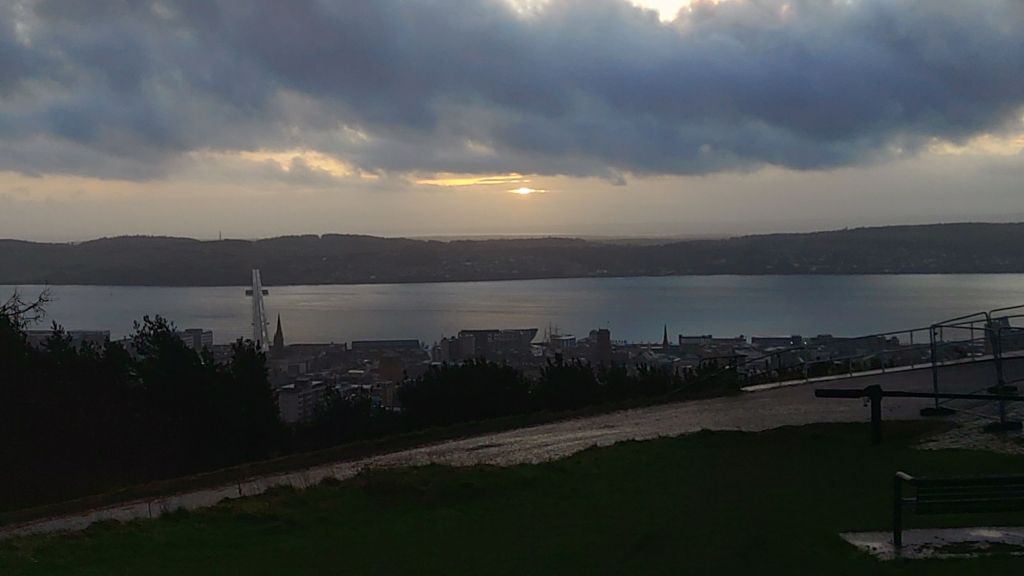
Winter solstice sunrise as seen from the Law Hill in Dundee. There is thick cloud cover partially obscuring the sun. The sky glows softly behind dramatic clouds, casting muted light across the water and buildings. A bridge spans the river, and a bench in the foreground sits beside a damp path and grassy verge.

So what of the actual stories?

I’ve become a lot more interested in audio storytelling over the last 12 months, so rather than reading paper books during the readathon, I listened to a drama on BBC Sounds based on the Fukushima nuclear accident in 2011, a radio drama called Cat and Mouse Game by R D Wingfield on YouTube, and an audiobook of The Time Machine by H G Wells.

The participants’ reading lists incorporated a variety of authors such as Ayn Rand, Becky Chambers, Iain M Banks and George Orwell.

I was a somewhat tired by the end of Sunday, but the event was very satisfying to run. It goes at an easy pace with just enough interaction to keep the server ticking over. I look forward to holding it again next year.

Start a Story Late, Finish it Early

Every so often, a pal and I run a readathon where we invite members to set aside some time one weekend to catch up on reading. It last took place a couple of weekends ago, and I intended to make some progress with War & Peace.

However much I wanted to read, though, I kept putting it aside because I wanted to write. I can’t think of the last time I had such an urge to pick up a pen. I was continuing a fantasy series under a pseudonym on a well-known website. It’s a passion project and I can’t foresee a time where I wish to claim ownership, so references to the plot will be vague.

The classic wisdom for writing a story, and especially a play, is to start late and leave early. The aim is to hook the reader by going straight into the drama rather than explaning the backstory, which can be done once said drama is established.

Stories will sometimes will arrive fully-formed, and these are a joy to write. In the most recent parts, I’ve had a strong idea of where the charcters should be, yet I’ve struggled with how to place them there while maintaning the pace of the story.

Despite its genre, this series still has one foot in the recognisable world. In the most recent part, I needed four characters to end up in a riverside cottage and I tried to build up a sense of drama before they even arrived.

The first draft saw their trains delayed because of industral action and bad weather, so there was a sense of relief upon arrival. Another draft saw them arrive early, only to be told by the grumpy cottage owner they couldn’t enter for another two hours.

Because fiction is so subjective and personal, it’s difficult to teach someone how to spot where the action should begin. When you’ve been doing it for a while, though, you develop a sense of where it fits best.

As I continued, I realised the real drama would happen at the cottage, so I didn’t need to create any more on the journey and I began the story at the time of their arrival. By contrast, if I’d needed to convey any backstory to the reader, having the characters stuck on a train chatting about previous events might have been the ideal way to do it.

War in Pieces

I had to make a journey on Sunday involving a change between two buses. In case of delays, I’d left myself plenty of time, so I made a last-minute decision to grab a book for the journey – but not just any old book.

For several years, I’ve owned a paper copy of War and Peace by Leo Tolstoy. Before falling out of the habit, I’d already reached the halfway point and it had remained virtually untouched ever since.

Despite its reputation for being dense, the structure is surprisingly reader-friendly. The book is actually an omnibus of four volumes, each divided into several parts and subdivided into a lot of short chapters. So in the 45 minutes between buses, plus the journey itself, I made some decent inroads.

Even the text itself is rich in humour, not something I expected from a tome about the Napoleonic Wars. That said, I took a decision early on not to worry too much about following the plot and simply enjoy the current page.

After making such a positive start on Sunday, I wanted to continue the good work. As such, I’ve given myself a target to finish the last page by the end of December, and I’ve even set up a spreadsheet to monitor my progress. And when it’s finished, I’ll be sure to pass it on to someone else who wants to see what all the fuss is about.

A Short Trip Across the Water

Every March, I make a point of going to the St Andrews poetry festival, or StAnza. While I’m there, I take the opportunity to visit a pal who lives at the back end of town.

A couple of years ago, he lent me a poetry book – Occasional Poems by Callum Rodger – which I thoroughly enjoyed. I recently found it again while clearing out some old papers, and I asked whether he wanted it back, which he did. I happened to have some free time that coming Saturday, so I arranged to pop over.

He was unwell on the day of the visit, but I didn’t plan to stay long anyway, as I had other places to be before and afterwards. I was glad of the visit because I came away with several suggestions for novels to read, to the point where I’m considering reactivating my Audible account.

St Andrews is also home to my nearest branch of Topping & Co, somewhere else I usually make a point of visiting, but time wasn’t on my side. There will always be a next time, though.

Tackling War & Peace

Around 2015, I bought a copy of the Leo Tolstoy novel War & Peace. I say ‘novel’, but it actually comprises four volumes, telling the story of the French invasion of Russia through the eyes of four fictional families.

The book is noted for its length, but all the chapters are short enough that you can read one or two before bed; there are just a lot of chapters. That also doesn’t mean the story has been stretched out longer than it needs to be. Tolstoy has enough plot points to justify the word count.

I recently found the book again, with the bookmark still around the halfway point where I left it. I’d fallen out of the habit of reading it, and I’d really like to restart it.

My edition has character biographies at the start, but I made a decision early on that I wouldn’t try too hard to keep up with the individual characters and instead just enjoy the story.

I think my best tactic for diving back in is to devote a full day or weekend to making progress. Meanwhile, the book is now at least in a prominent place so it won’t slip my mind.2024-05-21 Fractal

Discussion Questions About Discussion Questions

On Sunday evening, I reached the end of the Richard Osman novel The Man Who Died Twice. I always like to read over the acknowledgements, and then I turned the page to find a section titled ‘Discussion Questions for Readers’.

Most of the questions give away plot points, so I won’t repeat those here, but there are a few only tangentially related to the story, such as ‘Have you ever been lonely in a new town?’ and ‘What is an acceptable name for a pet, and what is unacceptable?’

I’d never before seen this feature in a novel, so I asked around to see whether others had. While some pals were – like me – surprised to see this outside of an educational setting, others reported discussion questions appearing in other books, such as:

  • A Man Called Ove by Fredrik Backman
  • The Seven Husbands of Evelyn Hugo and Daisy Jones and the Six, both by Taylor Jenkins Reid

These titles were all published in or after 2012, and I’d be interested to find out whether any older novels also have this feature.

One respondent reported debating with herself whether such questions encourage critical thinking or are merely there to spoon-feed reading groups. I’ve considered this question myself, but I have no conclusions so far.

It’s not clear whether the discussion section was the initiative of the author or the publisher, but I expect you’d want to test the waters first. My edition boasts ‘The multi-million-copy bestseller’ on the cover, so I expect Penguin Random House knew by this point that its readers would want to discuss the title.

Although I really enjoyed The Man Who Died Twice, perhaps I haven’t seen a discussion section before because I simply don’t normally lean towards crime fiction, cosy or otherwise. However, I will keep an eye out for this in the future.

Sky Writing and Railway Reading

Yesterweek, I talked about going to Dublin for a few days and what I would bring to read and write on the three-day trip.

The flight there takes about an hour and five minutes from Edinburgh. I used the journey there to write six postcards, which I would then post on arrival, and tackled some other writing on my return. As predicted in that last entry, the cashier was indeed rather bemused as she handed over my stamps.

On the second day, my pal and I took a train to Belfast and back, taking around two hours each way, I split my time between writing in my notebook and reading my magazine.

It was helpful to have this time, but it would be more helpful if I were able to recreate this experience at home without the expense of travel. I’ve heard the suggestion of listening to ambient train noises as I write, but I also rationally know I can step outside my door at any time; not something you can do on a mainline railway.

If you’ve any suggestions on that front, I’m all ears.

Towards More Enthusiastic Speeches

With the possible exception of slam poetry, it’s usually acceptable to read from notes at literary events, whether you’re performing or introducing others. It makes a difference, however, whether you’re simply reading the words off the page or adding the meaning behind them.

I’ve been to a few events – literary and otherwise – where the host has stepped on stage, pulled out a piece of paper, then said, ‘We are very excited to welcome…,’ in a flat tone.

I thought about this last week as I heard a speaker at a protest last week who had notes on his phone. However, he only used the device as an aide memoir, as his speech was flawless. If I hadn’t been watching him, I would have thought it was done from memory.

As I say this, I know public speaking is not an easy skill to learn. Because I do so much of it, I sometimes forget some people have stage fright, even household names with long careers. I’ve long wanted to start a class to help people overcome this, and the idea has recently been bubbling up again.

I don’t currently know where these classes would be held, or even what they would be called, but I do know they would meet the following parameters:

  • One-to-one tuition, in contrast to Toastmasters International who hold group sessions.
  • In person, where possible.
  • Charged by the hour.
  • Aimed at a specific goal: business presentation, wedding speech, &c.

Meanwhile, I’ll leave you with my three top tips for giving speeches and presentations:

  • Look beyond the back row of seats, which avoids eye contact and helps keep your posture straight.
  • Avoid alcohol beforehand so you’re fully focussed on the moment.
  • Learn your words thoroughly so they sound natural when you present them.

A Weekend of Reading

I’m in a few different literary groups that meet on a monthly or weekly basis. There is also one that’s active only a few times a year, set up by a pal who is a particularly enthusiastic reader. The group has come to be known as the Seasonal Readathon.

From its inception until earlier this year, its format had been largely the same: we would reserve a Saturday or a Sunday and spend time reading between the hours of 8am and 8pm. The leader would also give out optional prompts every hour, ranging from ‘Predict what happens next in your book’ to ‘Don’t forget to eat dinner’.

The most recent event took place on Saturday 24 June, with a radical difference. We would still spend 12 hours reading, but these would be spread over two days without necessarily having prompts every hour. As it was summer and unusually warm, we also arranged a meet-up in a nearby park.

Initial feedback suggests that while members didn’t manage a full 12 hours of reading, it still spurred them on to read more than they otherwise would have. Also, the slower pace seems to have been a hit with those who were working or had other difficulties being present for the usual 8am to 8pm period. For my own part, Saturday was booked solid, so it helped to have the Sunday reserved as well.

Our next readathon will be in autumn. As this is Scotland, an open-air meet-up is unlikely at that point, but there remains the possibility to congregate indoors and carry on our reading.

Acting as Gallery Assistant and Finding the Time to Read

I’m a regular visitor to the Dundee Contemporary Arts building, which holds around three major exhibitions per year. No matter what’s on display, I’m forever fascinated by the job of the gallery assistants. Aside from opening nights and special events, the pace is normally relaxed enough that some of them read novels while on shift.

Last week, I had the chance to experience this for myself on a smaller scale. First, a little background.

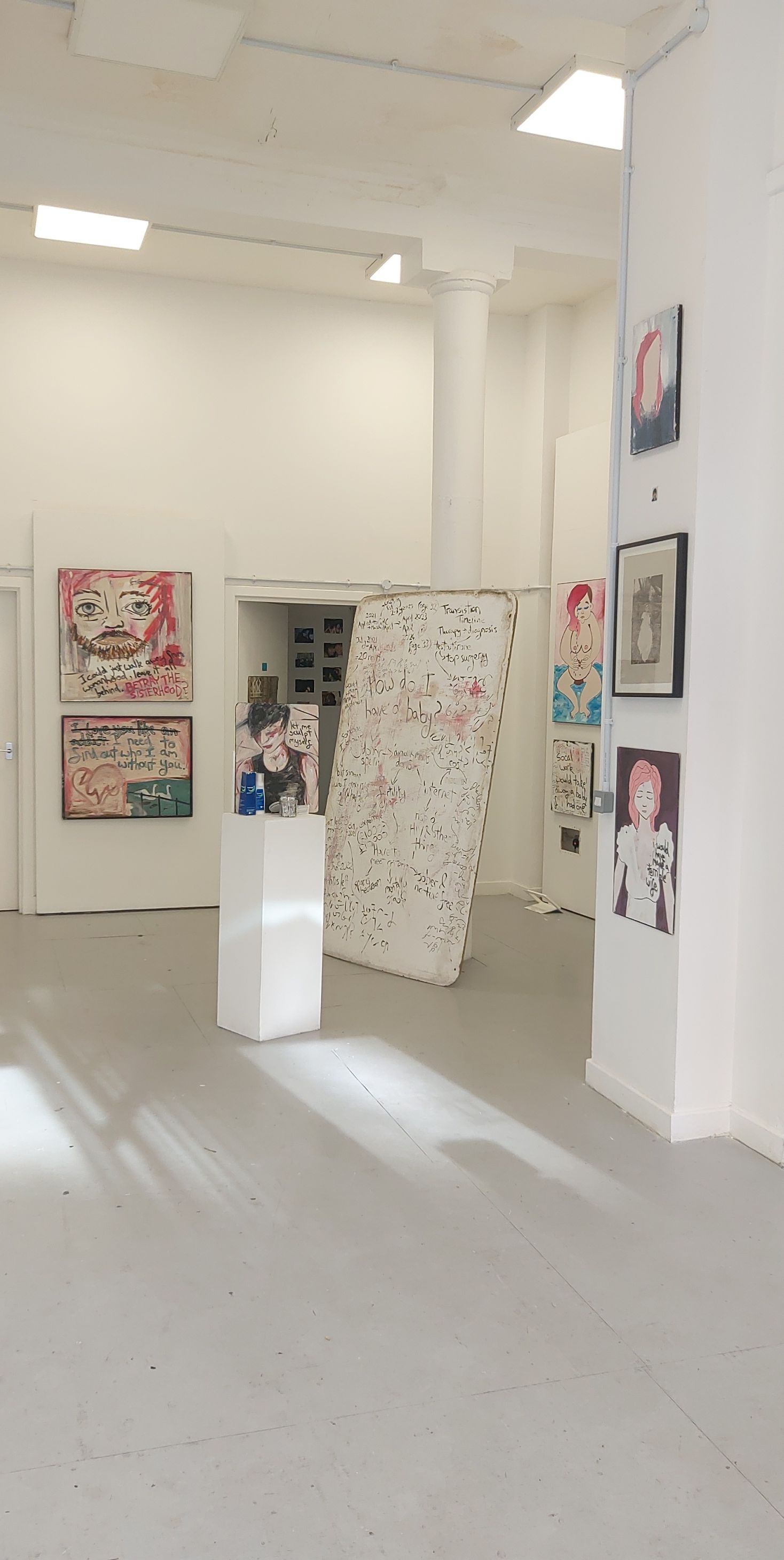
On Thursday, I visited an art exhibition called Funeral For My Deadname at Saltspace in Glasgow. This was run by an artist pal, and the highlight of the opening night was him completing and signing a document to legally change his name to Luke ‘Luca’ Cockayne in front of a crowd of visitors.

Luca also displayed a selection of his artworks in the gallery, some dating back more than a decade. These were available for viewing until Sunday, and some are featured below.

As I hadn’t originally planned to be there on the opening night, I’d already booked my travel for Saturday. I didn’t intend to waste it, so I visited again and spent the day at Saltspace. In contrast with the busy opening night, there was a mere trickle of visitors during the day.

I’d brought with me the Richard Osman bestseller The Thursday Murder Club. It had been sitting in my bag for a long time, and by last week, I’d reached the halfway stage. With a combination of a long bus journey and quiet conditions at Saltspace, I was down to the last few pages by Saturday evening, then I finished it on Sunday.

I also promised my pal I’d dash off a quick clerihew in honour of the event:

Funeral for My Deadname.
I hereby proclaim,
announce and swear
that a change is in the air.