This entry serves as a kind of companion piece to last week, where I talked about still being able to hold the open-mike night Hotchpotch.
It did indeed go ahead, but with substantially reduced attendance. On any other night, we can normally welcome upwards of 30 people in the room, with more than half of the attendees taking a turn on stage. But last week, we saw less than ten readers.
To be fair, a few of them had called off in advance because they were either away for Christmas or didn’t want to catch anything before seeing relatives, so we made the best of it. Dispensing with the timer, anyone who wanted to read was allowed two turns, with a drinks break in the middle. I’d encouraged the absentees to come instead to the virtual version that Sunday, called Hotchpotch Beyond.
But a smaller pub attendance didn’t translate to a larger online presence. There, we welcomed two genuine readers – one Scottish, another from Russia – while two troublemakers were booted out and reported to Zoom. In November, the Beyond event had to be abandoned altogether because only one other person turned up.
Yesterday morning, I made an executive decision to suspend Beyond, and I told the pub regulars before the wider membership. Nonetheless, our previous online presence has shown we’ve been able to reach an otherwise untapped market.
I can’t stress enough that it’s never the fault of the audience if they don’t turn up. It’s up to me as an organiser to attract attendees, and to show them a good time once they’re through the door, so it’s us who needs to adapt. It’s a much bigger question how we’re going to adapt to reach that otherwise untapped market, but it’s one that we’ll work on.
One of the pieces of advice often given to beginner writers is to keep a notepad and pen by your bedside to write down any ideas that occur in the middle of the night. I’ve said a few times on here that this has never worked for me. Yet something happened last week that helped me with a current project.
I woke up before 5am on a couple of occasions last week, and was unable to get back to sleep. It’s a dangerous distraction to switch on your computer at that time, but I decided to give it 20 minutes, then head back to bed.
Instead, I ended up solving a problem with a story that wasn’t coming together properly. There were a lot of solid plot points that were difficult to arrange into a logical narrative. This was also part of a series, so there needed to be a little explanation for those who hadn’t read the previous instalment, but not so much that it slowed down the pace.
The breakthrough came after about ten minutes, and once I’d arranged the first few paragraphs into the right order, the rest followed. It’s now up to more than 1,300 words with more to follow, and the next story in the sequence will include the points I had to leave out of this one.
It sometimes happens that a number of writing projects need to be completed at the same time, and that’s exactly what’s happened over the last week.
Some of these are self-imposed, like two job applications and writing a private blog entry for a closed group. But the others have been opportunities like supporting a funding application for an Edinburgh poetry organisation, and an invitation to write a public blog post for Creative Dundee.
This deluge has been a prime lesson in prioritising, some pieces due on sequential dates. I’m making headway, with only the Creative Dundee post still outstanding, but at the time of writing, I haven’t been given a definite submission date.
It does, however, pay to hit a deadline. Just yesterday, I heard I’ve had a piece selected to appear in Poetry Scotland and I can’t wait to see it in print.
Every January, I take part in a project called Fun a Day Dundee that happens every January. There is no specific brief: you can write, draw, compose music, dance, or whatever your skillset us. The timing is designed to fill the void that artists often experience after the Christmas rush.
For the first time in a long time, we were able to meet up in person on Sunday. As I’d already arranged to do something else that day. I was only able to come along in the last 15 minutes, but it was great to see everyone again.
When I first started Fun a Day, my work was strictly writing, creating one new poem or story for each day of the month. One year consisted of writing a number of words each day that would combine to form a single sentence.
I’ve edged slowly into drawing, inspired by the other participants, and I’ve developed a style that includes recycled materials. Sometimes I use the recycled material in the work, other times I shred what I’ve created.
At the beginning of this year, I looked back at popular culture between 1998 and 2001, and writing was still an integral part of my projects. I kept a handwritten diary of my thoughts as I created each piece.
I don’t yet know what form this year’s project will take, but I know the title, and I know I’ll continue to log my thoughts in a notebook as it progresses.
Every so often, I’ll start to write an entry, then abandon it. Sometimes I don’t know how to finish it; sometimes a more urgent topic arises before I can finish it.
As such, I have five draft entries in my WordPress account, listed in order of when they were last edited. The original unedited words are in italics, with further explanation below each one.
18 Mar 2018: The Importance of Outside Influences
While it is necessary for an author to read within their own genre, one of the first pieces of advice given to beginner writers is to read widely. and collect influences from different sources.
This is fairly self-explanatory and probably would have segued into a couple of examples of where the author has successfully put together two disparate ideas to create something new.
Oddly enough, I was at a workshop run by Kirsty Logan a couple of weeks ago where she explored this very idea, so this topic might make a resurgence.
15 Oct 2019: But Who Would Want to Hear About That?
At the weekend, I took part in two different tours: on Saturday, a road train around Arbroath; on Sunday, a walking tour around the mostly-disused basement of Glasgow Central Station.
In both cases, it was clear that the guide had a vast knowledge of his subject, including a recognition that there were still mysteries to be solved
There is no shortage of fiction written by people with an exhaustive knowledge of their subject: Herman Melville in Moby-Dick, Dan Brown in Angels & Demons, &c. Often it makes for compelling reading, but an author needs to be careful not to overload the reader.
21 Jul 2019: Respeaking
Respoken.
This was the entirety of my note. It was a reference to how TV subtitles are created, at least on the BBC.
I wrote this fragment while listening to a poetry event from Wolverhampton and surrounding areas. Someone talked about living in a post-industrial place and the language that grew out of that, and I could draw a comparison with where I live, hundreds of miles away.
I’m not sure how much I could expand much on this idea, but it’s still there for the taking.
10 Aug 2020: The Fallback Formula
While taking my Masters degree, our class was asked to perform a piece for public reading. We could do anything we wanted, but the tutor suggested the prompt ‘piece of my mind’. As I wasn’t finding any ideas, I did what I often do in that situation, and go for a walk. I recall it was a freezing February night.
The walk resulted in my first list poem, called Textbook. Each of its 23 lines begins with the words ‘I’ve learnt’, in which the narrator is worried about a third party. The original plan was to begin each line with a different verb, but I found the repetitive structure worked rather well.
Those two paragraphs were the original entry, while the one below was copied directly from notes I made at the time.
Kirsty, voice suited the piece, dichotomy, you’re never the subject until last line. Corrin, liked the repetition, person depression, created flickering image. Graeme, think you can tell it’s someone close to narrator, didn’t get gender. Jackie, speaker was male, person was female. Eddie, took it as daughter who was self-harmer.
I’ve discussed my writing process many times, including the devices I rely upon, so there’s no specific reason to finish this piece.
I’m going to write this entry in a markedly different style to demonstrate a point. I’m normally pernickety about starting a new paragraph every two to three sentences, or perhaps only one sentence to emphasise particularly pertinent information. A surprising number of people don’t leave enough paragraph breaks, or don’t leave any, which makes the text harder to read. If you analyse a newspaper or a novel, you’ll invariably find the first sentence of each paragraph indented by a few millimetres. This tiny gap indicates that the narrative is moving on and allows the eye to rest briefly. There are occasional exceptions, like the Will Self novel Shark, deliberately shunning paragraphs in favour of a single sentence that spans the whole narrative. The Look Inside feature on Amazon shows how the publisher prudently compensates for this by using wider line spacing. In the early days of the CD-ROM and the Web, it was quickly discovered that longer articles aren’t so easy to read on a PC, and not just because of screen brightness. The main difference is that it’s possible to turn your head or eyes quickly to see a whole double newspaper spread, giving a solid frame of reference, but a computer screen can typically only show part of the text at any given time without some input by the user. As such, additional eye rests are necessary, and professional websites will generally leave at least one line between paragraphs, often with additional negative space at the sides. A big shout-out must go to WordPress for its readability. Composing an entry is done in blocks, typically containing one paragraph or illustration, and as such, it encourages spacing. The publishing layout is also widely customisable – something that social media sites could learn from – so you can fill as much or as little of the screen as you need. If you’re a writer of any sort, one action that makes your work look instantly more professional is to leave paragraph spaces. It doesn’t have to be every two or three sentences like me; indeed, Virginia Woolf was known to use page-long paragraphs. Your reader’s eyes, however, will thank you for the occasional rest.
Regular readers will know that I run Hotchpotch, an open-mike night for writers rather than musicians. Over the last 18 months, we’ve been holding it online and experimenting with different formats.
Last week, it was confirmed that we were able to go back to our previous venue. For the foreseeable future, however, it won’t be as simple as just turning up with a microphone and some poetry.
The main health hotspot is the microphone itself, which can be shared by between ten and 20 people of an evening, and can therefore pick up a lot of bacteria.
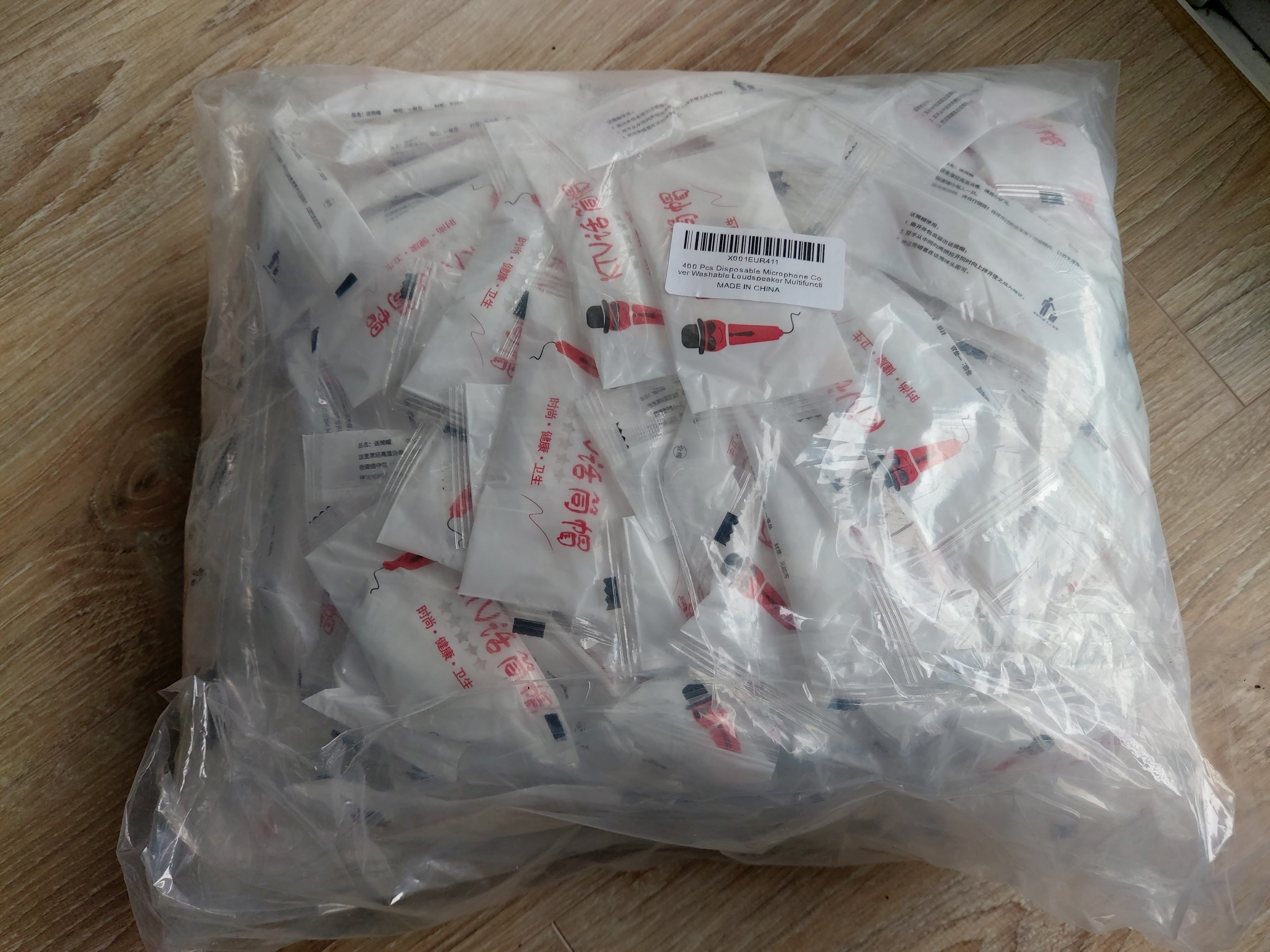
As such, I’ve bought 400 disposable covers for the top. After every reader, the surface will be wiped down and a new cover applied. Because I address the audience for a few seconds after each speaker, I’ve also cut down on cleaning by buying a headset microphone for my own use. There will also be the option for readers not to use the sound system at all.
This is what 400 disposable microphone covers look like.
That, however, only caters for the people who come along to the pub. We’ve seen a thirst over the last 18 months to participate from outside our home city. For many, it was inconvenient or impossible to travel into Dundee, while others weren’t able to navigate the stairs in the venue, or are not ready to mix until the public health threat passes.
In response, we’re trialling an online edition called Hotchpotch Beyond. This works the same way, with the sole exception that priority will be given to those who weren’t at the in-person version. The trial will last for three months to gauge interest.
Over time, the number of people reading it has steadily increased. Any given week, I can bank on between 4 to 6 people pressing the Like button, and they are all appreciated.
Every so often, I’ll receive replies to my entries. Most often, it’s from my pal Webgirluk, whom I’ve known for nearly two decades from LiveJournal. Then last week, I found a comment from someone I met at a poetry workshop a few years back.
This started me thinking how bad I am at reading others’ entries. I have followed a lot of people over the last eight years, but I rarely have a chance to read their words, let alone comment on them.
I spend a lot of time speaking to writers and organising events, and I wish I could say I’d make the time to read the words of my WordPress contacts, but I can’t make that promise. The best I can offer is that I know they’ll always be there for when it’s possible to read them.
One of my favourite places to write is a particular McDonald’s restaurant, especially on a Saturday morning.
There’s no obvious reason why it should be this way. The place is on an industrial estate with a view onto dull buildings and a car park, yet if I go there on any given Saturday morning, I’ll come away with something written or redrafted. Perhaps it’s by association; I used to live almost across the road and it was the most convenient venue that wasn’t home.
I haven’t been there recently because of local restrictions. For weeks upon weeks, pubs were closed in Scotland, while restaruants and cafes were only allowed to offer a takeaway service. During this time, I discovered I was craving somewhere to write that wasn’t at home.
I’ve found I’m able to batter through a lot of work in pubs on a Monday or a Tuesday. While writing and editing this entry, I’ve taken advantage of a quiet pub and a bus journey. I will be back to McDonald’s in the future, but not just yet.
Additionally, I’ve discovered I don’t much like writing outside. It’s not just that the sun makes it difficult to read the laptop screen, or rain makes it impossible to use paper, but I don’t find it very productive nor satisfying and I don’t know the reason. That said, I still find that going for a walk is good for genetrating ideas or consolidating existing notions.
Now it’s possible to go to many places again, I hope it’ll do wonders for increasing my output.
The last week has proved to be quite a productive one, even if my pieces were inspired more by deadlines than by the need to express my thoughts.
For starters, my poetry circle is compiling an anthology to mark the 250th birthday of Sir Walter Scott. My original plan was to copy selected lines from the Mark Twain book Life on the Mississippi, in which he levels a number of criticisms at Scott, and create a poem from those. It wasn’t happening that way, but I was able to write a shorter verse during a bus journey.
I also have a pal who runs the writing podcast Story Circle Jerk. Unfortunately, the latest episode has been held up with technical problems, so Kai asked previous guests to submit readings of original flash fiction to appear in a future one. I actually submitted two pieces, allowing the host to choose: an old piece that was revamped for the occasion, and a new one inspired by the title of the podcast.
Finally, I’ve been working on a longer-form piece since last year. It’s not ready to be shown to the public at this stage, but the feedback I’ve received from the other website users has been encouraging. I’d posted a one-off short story, never expecting it to spawn no less than seven sequels, with another one in the pipeline. My current thoughts are to draw them together into a single 15,000-word volume.
On top of this, I’m once again starting to see writer pals getting published, being booked for events, launching pamphlets, &c. It even turns out I know someone involved in Life & Rhymes, which won a BAFTA on Sunday. I feel all this energy starting to rub off on me, and I hope I can sustain it and create something useful with it.


 Gavin Cameron