I haven’t had much time to pull this entry together, but working quickly has very much been the theme of this weekend.
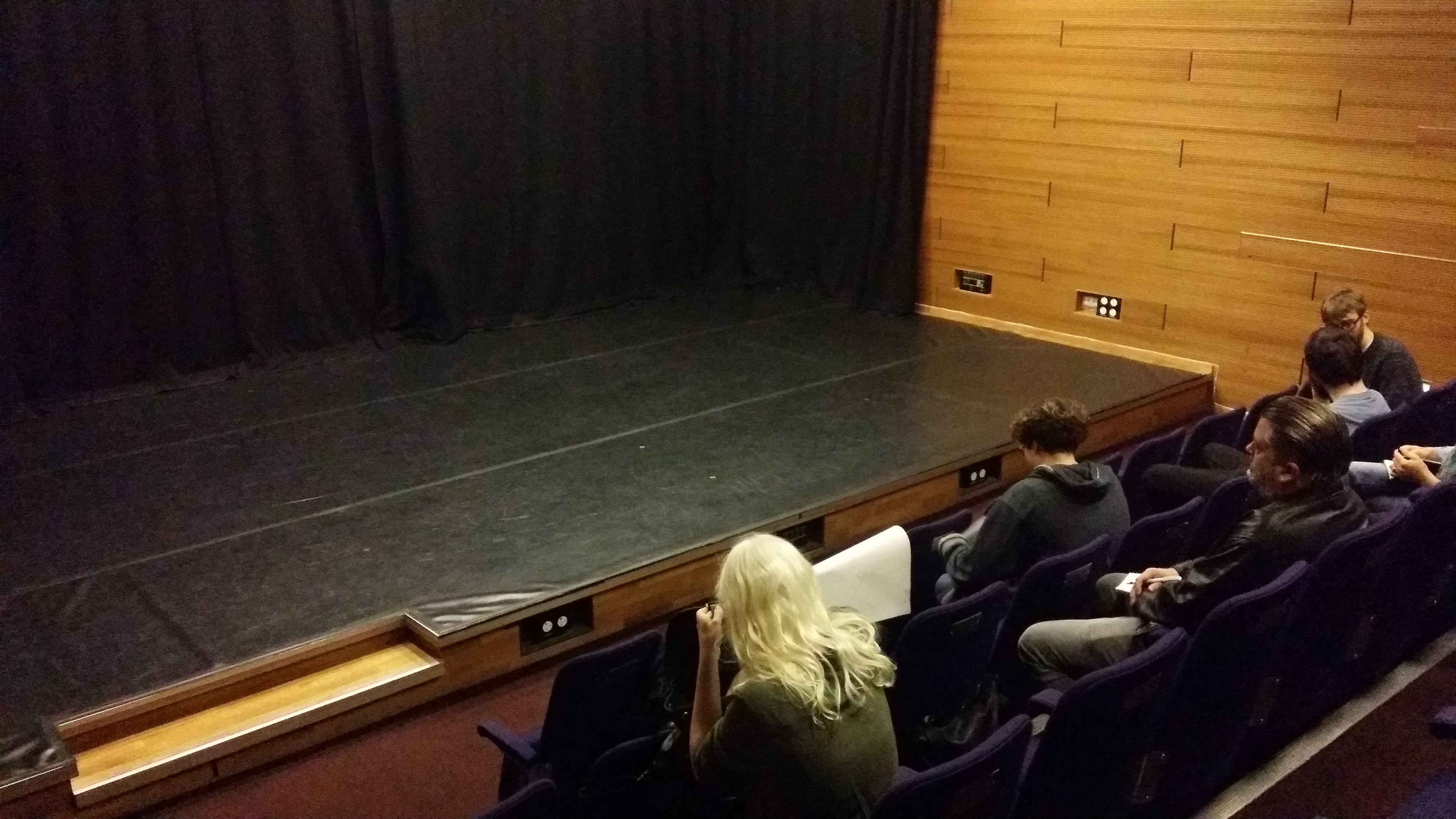
The Netherbow Theatre at the Scottish Storytelling Centre
I attended a workshop run by poets Jenny Lindsay and Rachel McCrum at the Scottish Storytelling Centre (SSC), aimed at those who have a spoken word show either already written or at the draft stage.
On the Saturday, we discussed such topics as: how the show might be mapped out, technical considerations, and how to attract funding. We were also invited to try a number of physical movement exercises and experiment with using the space.
The next day, the group put together a show from scratch, making sure the running order flowed, discussing lighting requirements with a technician, and ultimately performing our best pieces in the custom-built Netherbow Theatre at the SSC.
I found the group a joy to work with. Jenny and Rachel pointed out there were no ‘egos’ and that we all took each others’ ideas on board. The final show went incredibly well. I usually find among a group of writers that I like many of the others but there’s one whose work I especially admire. This weekend, I found that person and let them know.
As I begin the week, I’m excited to take my project to the next stage, and I’m looking forward to keeping up with some of the other participants.
There’s a much-quoted theory that 10,000 hours of quality practice can make you an expert in anything. While the notion of becoming an expert by this method has been debated for nearly 25 years, it is true that quality practice makes you better at what you do.
If you’re a long-term reader – and there must be one or two of you out there – you know I’m upfront about not being a lifelong writer. I started to pen fiction seven years ago at the age of 26; my last creative writing before then was done at high school, at which time I was more interested in music and computing. I’d entered my thirties before I felt comfortable calling myself a poet.
Creative writing class-fine arts center (402690951) (Photo credit: Wikipedia)
For the purposes of this entry, let’s convert the 10,000-hour theory to more manageable figures. It’s near-impossible to calculate accurately, but let’s say I practised my writing for two hours every day. If we enter that into the 10,000 Hours Calculator, it gives me a figure of 13.7 years. Eight hours devoted to my field per day brings that down to 3.4 years.
By this measure, I’m not convinced I’ve reached 10,000 hours yet, but does it matter?
As I started relatively late, I used to believe I’d forever be catching up with more established writers. These days, however, I lean toward the view that once you’ve practised for a certain length of time, the gap begins to close. The writer who’s done it for two years will know far more than the one who started 12 months previously. Yet when you’ve written for five years, say, you’ll probably have more in common with someone who’s written for 20 years than two.
The message here, of course, is not to stop practising once you’ve been at it for two decades. On the contrary, the more a relative newbie learns, the narrower the gulf will be between their knowledge and those with more experience. Every day is a schoolday.
I’ve recently joined a new poetry group. It’s so new that we don’t even have a name yet, but I’m enjoying the work of the other members.
One of them wrote about his time at Stirling University and included a photo of the place in the springtime. For the following month’s meeting, I visited Paisley, where I studied at what’s now the University of the West of Scotland. I’d paid a brief visit to the town centre in 2016, but it had been some years since I’d explored its other areas.
I’d expected some change, and I saw it particularly in the accommodation. There were new blocks of flats in a couple of spots, while one place I used to rent from the University had clearly been sold to a slum landlord – and the other might well have been going the same way.
I then walked up Neilston Road, which is one of the backbones of the town. From the moment I turned onto it, I began to wonder where I was. There were new tearooms with seats outside – even though it rained all day – but even taking them out of the equation, I didn’t even remember other landmarks.
Logo of the University of the West of Scotland (Photo credit: Wikipedia)
There were bends in the road I didn’t recall, buildings that must have been there a century I didn’t register, and a field with cows as you head out of town that I must have seen at some point.
At least now I had a focus for my poem. One of the prompts had been ‘A letter to…’ so my piece became A Letter to Paisley, with the first lines reading:
I saw you the other day,
I’m sorry I didn’t recognise you.
But I found the opening words to be the easy part. Sometimes I can have something I really want to say, or I theme I particularly want to explore, and I find it difficult to work out how to present it.
In the rest of the piece, I muse upon the changes that have taken place and the parts I didn’t recognise, and I ponder whether it was the excitement of moving there at age 18 that caused me not to take in the details I saw on that day. I presented the piece to the group on Thursday of last week, and they helped me to make a few changes that will probably find their way into the next draft.
Strangely enough, I gained a BSc Music Technology while I was there. I didn’t do much with the qualification as it was, but I was able to use it to gain a place on the Masters degree I completed last year.
Once you’ve written a piece, it’s a good idea to lay it aside for a few days, perhaps a few weeks. But what happens when the days and weeks turn into months and years?
In 2013, I was given a homework task from a writing class. I had to pen a story containing the words sleeping, falling, and alchemy. I struggled to write something, so I used a fallback technique of creating a diary form. The draft of the story was about an 18-year-old woman who had just started university and was assigned a nasty flatmate. I titled it F in Hell, the F being short for the antagonist’s name.
I redrafted the story a couple of times over the next two years, tightening the language and enhancing the plot points. But I didn’t do anything else with it, other than giving readings at a couple of events.
In 2016, I was desperate to write a creative piece for my MLitt Writing Practice & Study dissertation. The problem was that there was no unifying theme to my pieces because I’d wanted to expand my horizons, so they were difficult to bring together into a cohesive collection. I’d printed off some of my best short stories and poems to show my supervisors. One of them picked up on F in Hell and suggested expanding it.
Phone Booth (film) (Photo credit: Wikipedia)
The tactic worked. The diary structure was ideal for demonstrating my prose skills yet flexible enough to allow interpolation of my poetry. Furthermore, as the story is told in an impromptu first-person narrative, I didn’t necessarily have to iron out every inconsistency before the relatively tight deadline. The title was changed to Jennifer Goldman’s Electric Scream.
Almost overnight, a short story that had lain forgotten in my archive became the piece that helped me to clinch my Masters degree.
And the tale doesn’t stop there. In August of last year, I was in the audience for a BBC radio recording when I realised the piece would work well on stage. I spoke again to one of my tutors, a playwright himself, and learnt the basics of script formatting and practical considerations for the props and scenery.
From then until last week, I’d been converting Jennifer Goldman’s Electric Scream into a script, and making the plot much darker, before entering it into a competition. Even if I don’t win, I know I have a finished product ready to be sent elsewhere.
There are many professional writers who have left work aside for one reason or another and reaped the benefits.
In the 1960s, Larry Cohen pitched an idea to Alfred Hitchcock for a film set entirely in a phone booth, but neither could find a compelling reason to keep the character there. When Cohen revisited the concept decades later, the world had changed: nearly everyone carried a mobile and had fears of terrorism on their minds. In 2002, with the idea well over 30 years old, Phone Booth finally opened in cinemas.
Sometimes the delay is beyond the control of the author. Jilly Cooper left a novel manuscript on a bus in around 1970. Disheartened, it took 14 years to begin again. In the intervening time, the plot and characters had time to mature, and her novel Riders was finally released in 1985. She considers it among her best work.
Moving away from writing, My Modern Met ran an article in April about the Draw This Again project, inviting artists to revisit and redraw their old pictures. Sometimes there’s a year between the two, sometimes there’s a decade. Be sure to click through to the Deviant Art page for many more examples, and see how each one has improved by being left aside for so long.
Anyone who routinely submits work for consideration can tell you how long it often takes to receive a response, let alone see your words in print. Right now, for instance, it’s too late to plan for summer; publications will shortly be looking for Christmas-themed material.
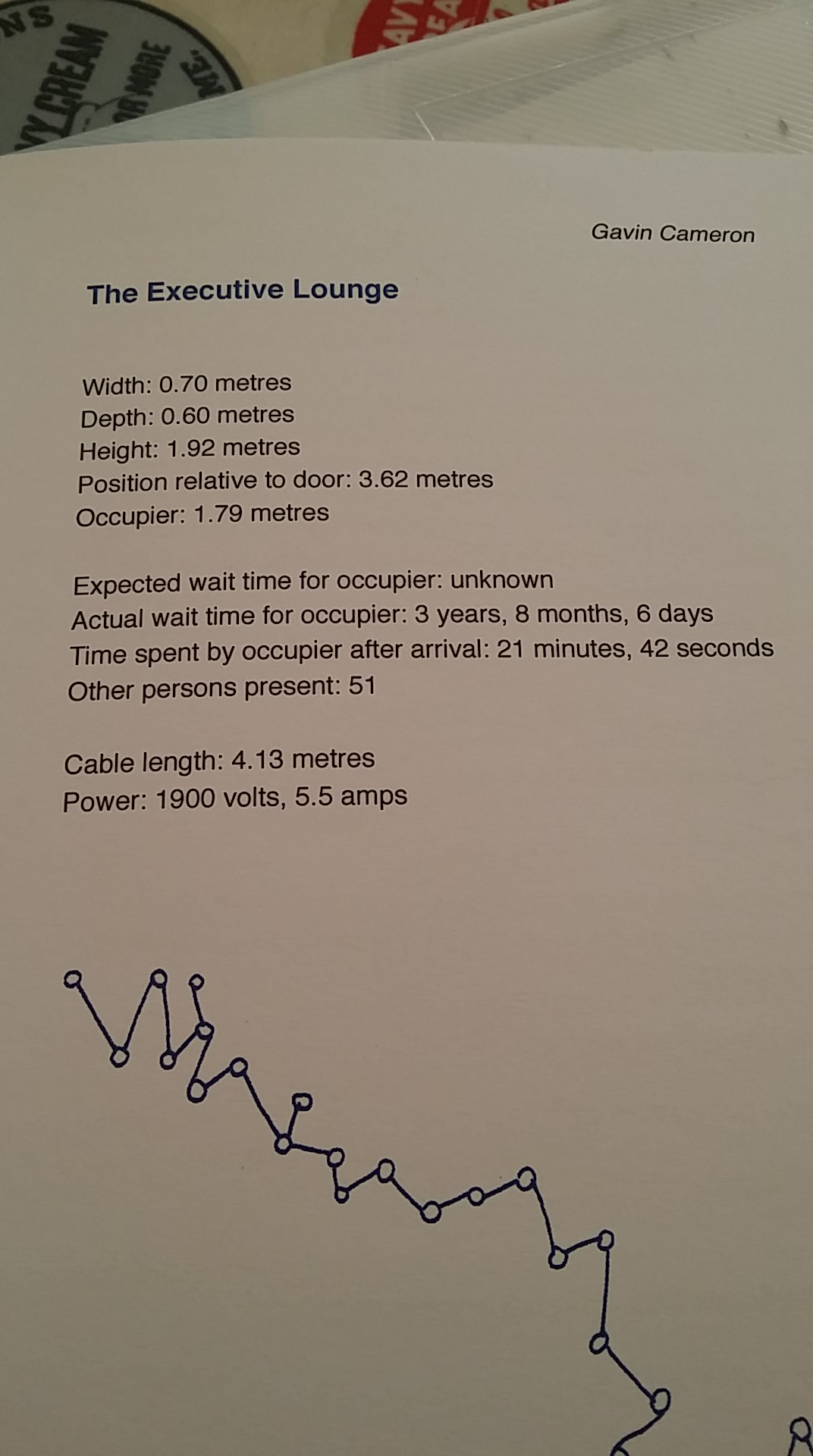
In October last year, I heard that my poem The Executive Lounge had been accepted for the local publication Dundee Writes. However, the launch only took place on Thursday of last week. Nonetheless, it was worth the wait because my piece is alongside some excellent work from students and alumni. There is also a focus on one of the creative writing tutors who died around a year ago.
The style of the pamphlet tends towards the less mainstream and more experimental and wistful. My poem describes an object without naming it. Instead, the reader is presented with a list of statistics about the item, with the most telling stats placed near the end.
It’s a favourite of my own work, and it seemed to go down well with the audience, but it is primarily a page poem. On this occasion, audience members could follow the text in the book; but when I read a loud it a couple of years ago, it received no reaction at the end, not even applause.
A couple of Saturdays ago, I visited the Botanic Gardens in Dundee, owned by the city’s university. Within its 21 acres, there are plants and trees from around the world and educational areas where you can learn more about them.
That day, the Gardens had been opened up specifically for writers, artists and photographers to respond in their chosen media for an upcoming anthology by the organisation who maintains them. A botanist even led us to many of the noteworthy spots, from tropical plants that change gender overnight to hardy shrubs that live on a limited water supply.
I’ve long believed that going for a walk helps to sort out any thoughts a writer has. In this case, there was a lot of input from the botanist’s talk, from discussions with other participants and indeed from my own observations.
Yet there was so much input to process that it took several days to form any meaningful output. During these days, I was taken by the idea that some trees can survive forest fires while other trees actually rely on fire for their seeds to germinate. I made drafts in free verse with internal rhymes, but the narrative was ultimately going nowhere.
Some friends, also poets, were on the same tour. One of them writes poems around the length of a haiku, although he doesn’t use the haiku form itself. Looking at my own work, I realised I liked the opening line and the conclusion, and I felt that to include other details would simply be filler and distract from the message I wanted to impart. So, borrowing his style, I kept only those parts: two sentences enjambed over four lines.
After leaving it aside for another few days, I came back to my verse yesterday morning and decided to enter it for the anthology. For that reason, I’m unable to publish the finished product online, but you’ll be the first to know if it’s included.
Which brings me to an event happening this coming Thursday. I’m having a poem published in Dundee Writes, a pamphlet distributed by the University of Dundee. I’ll report back on the launch event next week.
Every so often, I’ll hear about a show and instantly feel compelled to go along. Much of the time, is because I’ve heard great word-of-mouth; sometimes it’s because I like an actor or musician involved in the project.
On the odd occasion, I go because I find the concept utterly arresting, and that’s why I bought a ticket for Fat Kid Running at the Scottish Storytelling Centre on Friday. The poster warned that Katherine McMahon’s debut show is not an inspiring before-and-after picture, but an honest insight into her body image issues. As I’ve been overweight all my life, I wanted to hear from someone in a similar position.
In the interests of full disclosure, I’ve met and spoken to McMahon before, but we’re not otherwise acquainted.
The show opens with a mock bleep-test, a theme revisited at the climax of the piece. We’re taken on an autobiographical trip through bullies in the school changing rooms, via health checks at the GP surgery, and how she built up to running several kilometres without stopping. Sometimes the narrative is poignant but always peppered with a sense of humour that lifts the audience at just the right moment.
A pair of ASICS stability running shoes, model GEL-Kinsei (Photo credit: Wikipedia)
Although the poetic prose was compelling in itself, what shone through for me was how genuinely she appeared to accept and love her body with no excuses and no delusions. There are two costume changes, both done in view of the audience, and she makes direct reference to her unshaven armpits and ‘boyish’ figure.
Even after seeing Fat Kid Running, McMahon and I still differ in one respect: I’m still committed to losing weight while she’s determined not to lose any. Yet it’s allowed me to understand the other point of view for the first time, and sends a message that a healthy body is not necessarily a slim body.
This performance, presented by Flint & Pitch, was the only one to date. But I’d love to see it go on tour, along with the support acts.
Calum Rodger was the first act to take the stage with a narrative called Rock, Star, North centred around the landscape of the Grand Theft Auto series. He takes a fresh look at what millions of players see but never study, and creates a rapid-fire homage.
Secondly, a musical group. Belle Jones, Audrey Tait and Lauren Gilmour presented Closed Doors, a story told mostly in rap verse about an unfolding major incident that forces racist neighbours out of their flats to mix with each other. The current ending was left too open for my liking, but I’m assured that it’s a work in progress.
I’m watching the acclaimed TV series The West Wing at the moment. The characters frequently have to change their plans or meet earlier deadlines at short notice. Similarly, I’ve recently had to make tough decisions about what to tell an audience.
A week ago, I attended a poetry event called Interconnected Issues jointly run by the University of Dundee’s LGBT+ Society, Feminist Society, and Mental Health Society. I expected simply to be a punter watching a line-up of poets, but the organiser called on people to stand up and read. Regular readers know I’m a big fan of performing my work, so I didn’t wish to pass up the opportunity. On the other hand, I hadn’t prepared anything, plus I’d already finished a red wine and my first rule is never to drink before a performance.
With encouragement from my friend Ana Hine, I stood up to read Sir Madam. Although it fitted the theme of the evening, I was scared to read this one because it tells the life story of a character who is either intersex or transgender – it isn’t made explicit. As I’m neither of these, I was worried that an LGBT audience might take offence at my portrayal.
However, I’d tested it out at last year’s Dundee Literary Festival where it received a positive response from the general public. If there was any anger at Interconnected Issues, I didn’t hear it. Encouraged by this, I cobbled together three other pieces that were not as risky to be read later that evening. One was from memory, one was a draft from a notebook, and one was read hipster-like from a phone screen.
As I’d already broken my no-alcohol rule, I decided to order another wine. This led to me peppering the rest of my performance with a little more personal detail than I intended, albeit related to the content of the poems. Yet it’s also rewarding to leave yourself figuratively exposed on stage and let it be infused into your work. I’ve heard it described as making the personal into the political.
Dundee Contemporary Arts, Dundee, UK (Photo credit: Wikipedia)
The first time I heard that phrase was at a weekend poetry workshop in Edinburgh. On the final day, I climbed Arthur’s Seat to watch the sunrise and came down with the idea for a short poem about a character on a cliff who intends to jump but changes their plans when they’re captivated by the sunrise.
I was looking for a title and I’d just heard about the suicide prevention charity The Semicolon Project, so it was named Semicolon. In a poignant parallel, it was reported last week that its founder Amy Bleuel had died.
I have no mental health conditions myself, but Semicolon is one of a few pieces where I’ve found the subject creeping into the narrative, particularly where I’m looking in from the outside. In February, for instance, I took part in a Q&A with Dundee Contemporary Arts after making a poetic response to one of the artworks on display.
My piece, called Surprise Attack, had already been written. The artwork was a pastiche of the Commando comic books but with Army mental health policy in place of the dialogue. Studying the pastiche helped me to finalise my poemafter well over a year of redrafting.
I’m finally pleased with Surprise Attack, while I believe Sir Madam needs more testing, Yet both pieces have shown me that a little personal exposure can bring a rich reward.
Some time ago, On the advice of Writing Magazine, I joined the Authors’ Licensing and Collecting Society (ALCS). If you’ve ever had an article, script or book published, or if you’ve made a contribution to a book, this not-for-profit organisation collects and pays the secondary royalties. Two-thirds of the money is generated by photocopying, scanning and digital copying.
English: A small, much used Xerox photocopier in the library of GlenOak High School in Canton, Ohio, USA. (Photo credit: Wikipedia)
Lifetime membership of the ALCS costs a one-off fee of £36, but you don’t have to pay anything upfront as it’s deducted from your royalty payments. Likewise, you won’t pay anything if they don’t collect any money for you.
The payments are sent out twice a year, and the March one arrived last week. I was surprised to find I was in profit from the three works I’d registered up to that point.
I debated whether or not to reveal the actual figure. I’ve decided to do so on this occasion by way of encouraging others to register. After the £36 fee was deducted, I was left with £84.12. This isn’t a massive sum, but it’s money that would otherwise have been given to someone else or never have been paid. By contrast, The Purple Spotlights EP has only earned me a total of £7.10 from sales, most of that from the first month after release.
I therefore urge you to join the ALCS today and potentially start receiving those missing payments for your work.
In 2014, there was a referendum on whether Scotland should be an independent country, in which 55% of the voters wanted to remain part of the UK. Over the last week, the issue has again raised its head.
Image of Scotland in the UK (Photo credit: Wikipedia)
At almost every literary event I attended ahead of the poll, I found the issue raised again and again in prose and poetry. Some of what I heard was heavy-handed polemic, while others crafted nuanced satires of the situation.
Regardless of quality, though, it encouraged all sorts of people to express their views through the spoken word and to believe that others might be influenced by their writings.
In my experience, much of the creative work was pro-independence. Such was the mood in the country that the National Collective sprung up, bringing together different types of artist to campaign for a Yes vote under one umbrella.
So the prose and poetry that stems from a potential second referendum will likely be even more passionate: from Yes voters who’ve been granted a second chance and from No supporters who believe the question was settled in 2014.
And further to my last entry, the 18-to-22 age group was considered to be the most apathetic generation when I first attended university in 2002. Maybe it was because we had a Labour government back then; maybe it was because George W Bush hadn’t yet invaded Iraq.
Whatever the reason, the situation today couldn’t be more different. Some of the most active campaigners are those of college age, and I barely go a week without seeing a university literary event responding to current affairs.