A couple of friends have recently asked me to look over pieces they’ve written. At one time, it would have been difficult for me to do this as I didn’t like to give negative feedback. Having received honest critiques of my own work, I now feel comfortable about identifying areas of improvement in others’ work and making suggestions for improvement.
Firstly, I received an 11-line poem. Among other suggestions: I could see that each line began with a capital letter even in run-on sentences, which is unconventional in modern poetry; I swapped around a couple of clauses to create a stronger image; and I broke up the poem into three stanzas instead of one. These suggestions are partly personal preferences, but they’re informed by reading a lot of poetry and considering what works well and not so well.
Editing film at the Lubin film studio in Philadelphia, 1914. A reel difficult job.
The other piece I looked over was an application for a university course, and I had help from a friend who has experience in this field. In this instance, I didn’t know all the specialist terminology or concepts, but there were aspects common to most writing styles that I could point out: using shorter paragraphs to create more negative space, which is easier on the eye; thoroughly checking spelling and grammar, for which I suggested reading the piece out loud while alone; and moving a certain project nearer the top of the application as it stood out among the others.
Ultimately, the writer has the final call on how to present their own piece. As such, I made it clear that the corrections were merely suggestions.
There is always a risk that the other party will react badly or become disheartened, particularly if you don’t know each other very well. It’s impossible to police another person’s feelings, but there are ways to make an unfavourable outcome feel less harsh. A classic is the Bad News Sandwich: a positive greeting, the negative result, a positive next step. Here’s a rejection e-mail I received last year:
Thank you for entering the August 50 Word Fiction Competition.
Unfortunately, your story was not selected as the winner this month. It was another very busy month and very difficult decision for our judges.
If you’d like to enter again, we’d love to see your words.
So when I close that message, I don’t think What an arrogant bunch, I think, I’ll up my game for September.
I also like to participate as often as I can, and I’m always happy to give advice to those who want to do the same. I’ve updated my guide from 2016, and I stress that it is only a subjective guide, not a textbook.
Talk with the organisers about what’s required
Ask the organisers to talk you through their plan for the event. This will typically include, but is not limited to: how long you’ll be asked to speak for, what type of content is required, whether you’ll be given an introduction, where you should wait before you’re called up, and whether any fee is payable.
If it’s an unfamiliar venue, be sure to obtain the exact address and check how to access the building. Don’t forget to arrive in plenty of time.
Think about your own structure and running order
The organisers will take care of the overall structure and running order, but it’s wise to plan your own time so you don’t miss a step. A typical note-to-self might read:
Give name and say you’re reading from short story collection The Pie Seller
Briefly mention editor at Law Hill Books
Tell obesity clinic anecdote
Read out And an Onion One Too
Thank Tracey Jones for organising
You’re happy to sign copies
Read out The Crust of the Matter.
Note that the thanks isn’t placed at the very end. This structure means the audience are more likely to go away with the ending of your work in their head.
Briefly explain if you need to, but don’t apologise
Some pieces do require an explanation; perhaps a work is unfinished, is an extract from a longer work, or was written under certain circumstances. But keep it brief and don’t explain anything that the audience will take from the piece.
If you feel you can’t read a particular piece without apologising, either take it out of your set or work on it until no apology is necessary.
Read out loud and time your words
The best way to identify weak parts in your set is to read it aloud – and that’s the last thing you want to happen in public. So find a space on your own and read it out when nobody can hear you. Are there any long sentences that need to be broken up? Are there words that are difficult to say clearly?
When reading from a book or from sheets of paper, it’s a good idea to turn up the corner slightly or stick a post-it note to the back. When using an e-reader or tablet computer, practice tapping the correct area of the screen to turn the page; there might also be a delay on some devices.
Don’t forget to use a stopwatch so your words fit within the agreed timeslot.
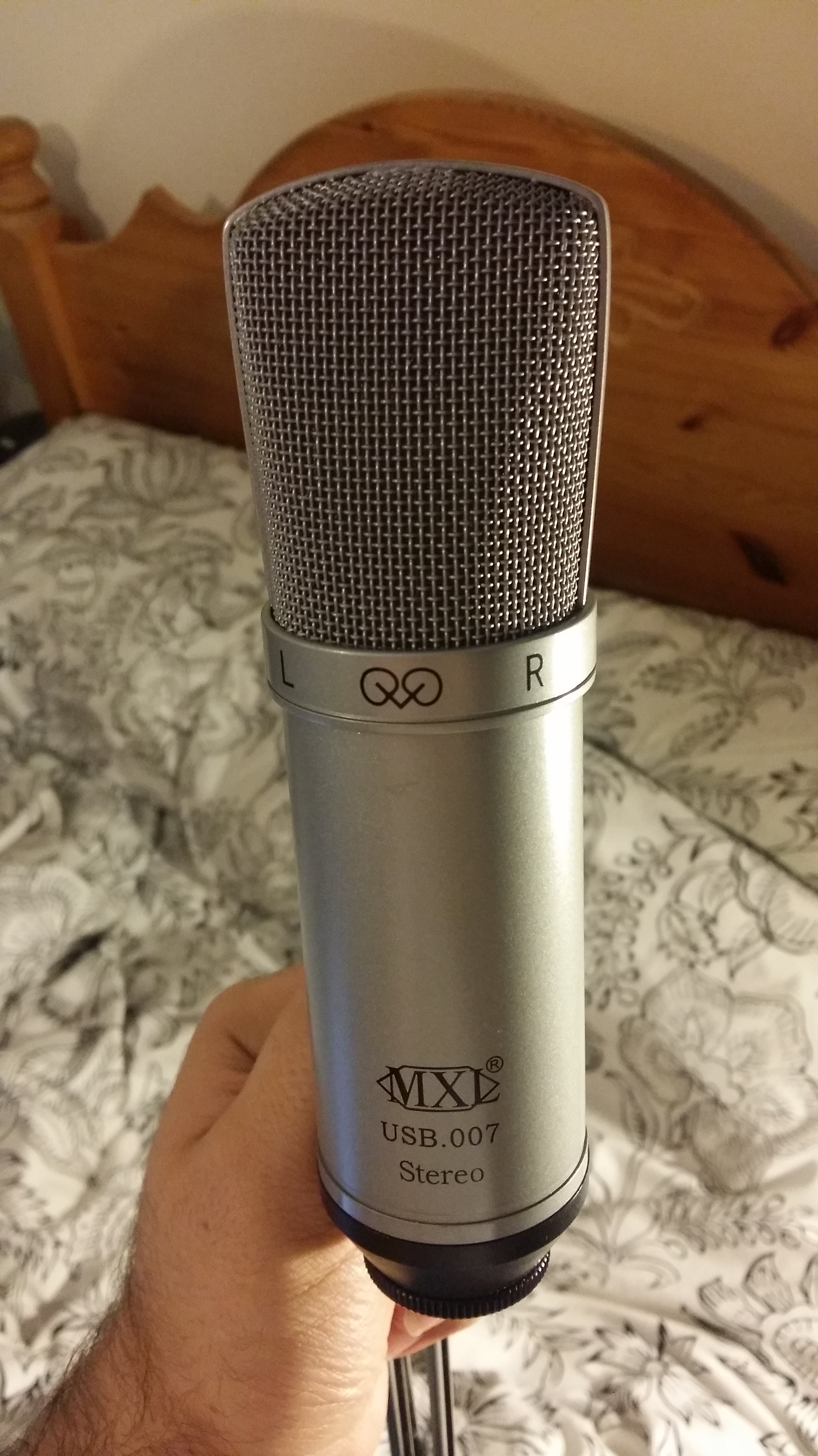
My USB condenser microphone.
Make sure everyone can hear you.
In my experience, smaller readings tend not to use a microphone, so you need to project. Avoid tilting your head down to read the piece; instead, hold your manuscript higher and off to one side so it doesn’t muffle your words, or look down only with your eyes. Always speak slowly than you would in normal conversation.
If you do have a microphone, ask the sound engineer if you can test it out beforehand, especially if you’re unfamiliar with using one. Whether the microphone is handheld or on a stand, keep it at the same distance from your mouth. One of the biggest distractions for an audience is a sound level that increases and decreases at random.
Avoid too much alcohol or a heavy meal before the gig
I fully understand why folks need Dutch courage before going on stage. But a drunk speaker rarely makes a good impression, especially during a paid gig.
My rule is not to take alcohol before speaking, only coffee or a soft drink. It’s also a good idea not to eat too much in the hours before the performance, as a heavy meal can also slow down your thought process.
Decide where in the room to look.
I know a few poets who deliberately look at individual audience members. However, it can be unnerving to make eye contact. Fortunately, there are some techniques to make this easier.
One of my favourite methods is look between two people, so the person on the right assumes I’m looking at the one on the left, and vice versa. Another way, which is particularly good for a theatre setting, is to look beyond the back row. This has the advantage of keeping your posture correct.
Keep going through the cock-ups
Perhaps the microphone fails, perhaps you forget the words, perhaps somebody keeps chatting during the show. A performer has no control over these factors.
The audience will normally forget the problem if you ignore it and keep going. Conversely, they’ll remember the person who dries up and leaves the stage or screams at noisy attendees. However, if you find different audiences keep reacting in the wrong way to the same part, consider revising it or editing it out in future performances.
Signalthat you’ve finished.
At the end of a piece, the audience doesn’t necessarily know whether you’re finished or simply pausing for dramatic effect. But an audience can pick up on your gestures. You can lower your manuscript, step backwards slightly or say Thank you, whereupon they’ll take the hint and applaud.
Do it again.
It’s an eye-rolling cliche, but the more you stand up and speak in public, the easier it becomes. Over time, you’ll learn little nuggets like which techniques work or don’t work for you, which pieces always or never provoke a reaction, and so on.
Ultimately, a good performance can increase your fan base and help sell more work.
On Saturday, I attended the Scottish Slam Championships for the first time. At this event, poetry slam champions from around Scotland compete to be crowned the first among their peers. Before we move into the details of the evening, what is slam poetry?
Ross McFarlane, who performed at the event, outlined the idea in an article from 2015:
Based on different criteria depending on the slam itself, poets are expected to, in one way or another, perform their poetry to be judged by the audience as a whole or a panel of onlookers (sometimes experts and sometimes not). While it might be the case that a lot of slams have more in common than just this description, it would be pretty safe to say that any event with this format could be considered a slam.
This particular Championship is run under Glasgow Rules:
The running order of the performers is determined by names drawn from a hat.
In round one, the performers each have 3 minutes to perform a poem in front of a panel of judges. The running order is then reversed and each performs a second poem.
In the second and final round, the three highest-scoring poets each duke it out with a third poem until a winner is declared.
The photo isn’t from this night, but it is royalty-free. Here are the photos from the night. [Photo by Charlyfoxtrott4 (Own work) [CC BY-SA 4.0 (https://creativecommons.org/licenses/by-sa/4.0)%5D, via Wikimedia Commons)]So what type of material can the audience expect to hear? While there’s no fixed theme, don’t expect to hear nature or Shakespearean poetry, except in a satirical context. You’re more likely to learn about the political landscape, LGBT issues, religion, and of course the self. It’s not uncommon to hear swearing either. I attended to support Angela Strachan who performed a hilarious satire on the appeal of Aldi, and A.R. Crow who reflected upon the death of George Michael.
I also happened to meet a university friend attending her first-ever slam, and what an introduction it was. It’s sometimes possible to guess who the finalists might be, but the performances were so strong that the field was wide open, even at the end of the first round. The host Robin Cairns kept the night running smoothly, trading the occasional strong insult with some of the poets.
Having seen some amazing work produced last year, I was pleased to be accepted into the Fun a Day Dundee challenge. The aim is to work on something new during January; it could be one new piece per day and/or something you append throughout the whole month.
Despite the lax rules, I decided to set three of my own to keep me moving forward:
“Rules help control the fun.” Monica Geller, Friends
I’ve stuck to Rule 1 every day so far. Rule 2 has already been tested when I’ve wanted to start a piece again and I have to tell myself I can’t. Rule 3 has already been satisfied; most of the work is prose and poetry, but I have pieces that don’t fall into those categories.
Those rules are listed in my commonplacing document. I’m experimenting with this practice at the suggestion of a friend; it’s essentially the process of recording how and why your works are created while you’re still working on them. Some people choose to make a scrapbook, others fill their documents with drawings, but I’m recording mine in plain text like a diary.
Fun a Day has been an opportunity to scribe the first draft of some outstanding ideas, which will then be redrafted next month. I’ve also had the opportunity to create ad-hoc work; a case in point is when I received a watch strap from Amazon in excessive packaging, and I’ve turned that packaging into an artwork that makes an environmental point.
A couple of weeks ago, a friend posted her thoughts on LiveJournal about creativity and how she sometimes doesn’t feel as though her imaginative endeavours are noteworthy.
I found it oddly difficult to leave a comment under the entry. I do consider this friend to be creative, particularly in the way she bonds with people she knows well. Yet I’m surrounded by amazing writers, painters, dancers and so forth, and it’s rare to hear the word ‘creativity’ or variations thereof. I reckon that’s because we treat our chosen artistic fields as part of our daily lives, not something we make time for once our day-to-day work is complete.
The C-bomb does pop up from time to time, however.
For the first time, I attended an event on Tuesday called Make / Share, in which people from different disciplines talk on a specified theme; this month, it was ‘Creativity and self-care’. Had it not been for someone else raising my interest, I probably would have seen the event and dismissed it, believing it was solely for those who work in crafts. In fact, the event featured people who dance, perform music and make films.
I was chatting with people I knew and didn’t know, and I felt quite at home there. Yet equally, I felt I was talking to such great folks that I had to improve my writing game, much like my LiveJournal friend felt about her endeavours.
I also think the intent of any creative project is another important factor. It’s usually easy to tell through someone’s work whether the intent is to express a view or emotion, or whether it’s to make something that looks pretty or sounds pleasant. When I began writing, I was in the second camp, and only later did I begin to express myself far more through my pieces. There’s nothing wrong with either approach, but nobody likes a ‘wannabe’.
On Saturday evening, I was invited to be part of a podcast with a small group of people. One of the participants was pleasantly surprised at how seriously the recordings taken, as she’d been accustomed to people who would talk grandly about what they would do but never followed through. The official podcast hasn’t yet been released. However, we did produce a couple of impromptu ones that were streamed live online. I prefer the second, an NSFW show recorded at 2am yesterday morning.
I think creativity is something we all do, whether it’s writing something personal in a Christmas card or helping a niece with homework, even if we don’t always use that term. And if you’re a regular reader of this blog, you’re probably not an aforementioned ‘wannabe’. Keep doing what you’re doing and try not to worry about whether it reaches someone else’s standards.
National Novel Writing Month (NaNoWriMo) officially ended on 30 November, freeing up time to make more detailed entries here. And what a great deal has happened over the last seven days.
Let’s start off with NaNoWriMo itself. I’m pleased to report that I hit the 50,000 word-target on day 29, although I’m still writing the story. Our Tuesday meet-ups will also continue off-season, but not before a Thank Goodness It’s Over party tomorrow.
Meanwhile, I’ve been asked to write a guest blog post for NaNoWriMo on the theme of the ‘Now What?’ months, when the contest is finished and the novel needs to be edited. I found it more difficult than an ordinary blog entry because I wanted to stick as close to the theme as possible. I’ve yet to find out when the guest post will be published, but I’ll point you in that direction when I know.
Speaking of other blogs, I took a snap decision on Saturday to start using Tumblr again after a gap of four years, roughly when I began to use WordPress. I used to keep a weekly video blog there, but I gave it up because I didn’t have the time to generate content. The videos have disappeared because my Flickr account is closed, but the transcripts remain. Tumblr will now serve as an outlet for my Instagram photos, interesting content from other people, and original long-form blog topics that aren’t related to writing.
[Insert fangirl squee]
Another place I’m active is Twitter. Some weeks ago, the allowed number of characters was doubled from 140 to 280. Having had the chance to try it out for a while, I’m ambivalent about the change. On the one hand, a sense of Twitter’s core identity has been lost as you’re no longer forced to find inventive ways to comply with the cap. On the other hand, the relaxed limit comes into its own when I’m advertising our Hotchpotch open-mike events, and it’s now possible to squeeze in all the core points without relying on users clicking the link to our Facebook page.
But what about offline activities? There have been plenty of these happening too.
On Thursday, I was invited to a St Andrew’s Day celebration at the Dundee Maggie’s Centre to read Scottish poetry. My friend Erin Farley had pointed me towards, among others, a poet called Violet Jacob from the county of Angus. It was a challenge to read work written in her dialect, but I found it an ultimately rewarding experience.
On Friday, Erin was part of a line-up telling stories related to food while the audience enjoyed soup and bread; hers was a folk tale from Shetland. This event was held in the library – not a place where food and drink is normally encouraged – as part of Book Week Scotland. I wish I’d been able to take part in more events over the week, but it overlapped with NaNoWriMo and then I needed to complete tasks that I’d put off because I was writing.
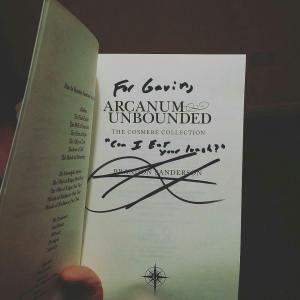
I could go on for pages and pages about Saturday, but the condensed version is that I met the author Brandon Sanderson in Edinburgh and bought his short story collection Arcanum Unbounded. Unlike the two friends who came with me, I’m new to his Cosmere, the universe in which all his sci-fi novels are set. When I mentioned this, he pointed out which stories I should read first. He seemed such a genuine man and I can’t wait to start reading.
And yesterday, a little light-hearted relief at the University of Dundee as I watched the LIP Theatre Company present their retelling of the classic Cinderella tale in If the Shoe Fits. A hilarious, highly self-referential treat.
On Thursday, I spoke at an open-mike night jointly held by two groups from the University of Dundee: the Feminist Society and the LGBT+ Society. I’d spoken at the previous one and enjoyed the experience.
This person was not involved with the event; she’s here for illustrative purposes only. (Photo credit: Wikipedia)
There were a number of fantastic readers who tackled a range of themes. I have a few poems on the subject of gender, but I instead opted for another topic: mental health. However, it was around me looking at the health of friends and acquaintances and being unsure exactly what to do.
Two of the poems I read were ones I’d last performed around a year previously. When I’m reading them from the page, I don’t really feel their impact. It’s only when I say them out loud that it hits home what they actually mean.
An interval was called after my set. I had people come up to me and say how much they enjoyed my work, and that was much appreciated. By this time, I was almost in tears, which is not like me. But I steadied myself, stayed until the end, and left the event ready to write more poetry.
One piece of advice often given to writers is to keep a notepad and pen by your bed to capture any ideas that occur overnight. So for years, I’ve duly kept said pen and paper but it didn’t work; I need physical movement to come up with ideas. At least, that was the case until a few weeks ago.
I realise there’s nothing duller than hearing other folks’ dreams, so I’ll keep this brief. I saw an image of a woman called Magin – that’s Magin, not Maggie. She was in hippie-style clothes sitting next to a man in plainer clothes; both were eating ice cream. I can’t remember at what point I decided they were cousins, but on waking up, I realised there was a story there. I’m currently working through that.
Then on Saturday, I began a poem for a poetry group, in which I wanted to include the phrase ‘Young’s Modulus of Elasticity’ as it was part of the prompt. I discovered that was the easy part, and I was having some trouble completing the rest of the poem. I left it aside, went for a long walk, and headed to bed on my return.
I must only have been in bed 10 minutes when I figured out how I might continue the poem. I spent the next hour drafting five stanzas in total, then I really needed to go to sleep.
But this doesn’t mark a change in the way I come up with ideas. These are merely two cases in nearly seven years of writing and they stand out because they’re unusual. In any case, I still need to finish these pieces and find out whether they’re any good.
There’s a group of ageing Hollywood actors who appear to have given up learning their craft. They might have been a hot ticket in town 30 years ago, but now they turn up in forgettable films, probably thinking only of the paycheck.
For as long as I write and perform spoken word, I never want to slip into this mentality. I always want to be able to look at other poets – and folks in other creative fields – and take something from their work that hadn’t occurred to me.
To chart my progress so far, I need to go back to the Millennium, years before I began writing. This was when I first heard the Gil Scott Heron track The Revolution Will Not Be Televised on the radio.
Gil Scott-Heron (Photo credit: Wikipedia)
I’d never heard anything like it, this relentless and repetitive stream of consciousness with cultural and political references I only half understood. It opened my eyes to what can be done with words. I eventually bought the whole album on vinyl, and it’s of an equally high standard.
Another early influence was Original Pirate Material, the debut album by The Streets, and its follow-up A Grand Don’t Come for Free. I was at university at this time and whenever I listen to these, I’m transported back there.
Looking back, I can now spot weak points in the lyrics, but I particularly admire the concept album structure of the latter. There are two other major releases by The Streets that followed these, but I’ve never liked them as much as the first two.
These days, I continue to be influenced by those I’ve seen and heard: the humour of John Cooper Clarke, the forthrightness of Andrea Gibson, the politics of Alan Bissett.
I recently attended two performances by my friend Gemma Connell, who’s a dancer. But as well as movements, she made prolonged eye contact and even brief physical contact with members of the audience. And last week, I once again saw Luke Wright, who gave an energetic performance of What I Learned from Johnny Bevan. I’m now asking myself how can I make an audience feel the same way as I did, but using my own words.
Of course, there comes a point where I can have too much creative input and I think I’ve reached that stage now. So I’m going to let it settle, then start writing my own original pirate material.
On Tuesday two weeks ago, I was hurrying back to the office after lunch to prepare for a meeting. En route, I spotted tourists taking photographs of nearby statues, taking advantage of a brief window of sunshine in an otherwise rainy week.
Exactly a week later, I was the tourist at the Edinburgh Fringe squeezing past locals in bus stops as they went about their business. This started me thinking about point of view in the stories we write.
Let’s fictionalise the scenario above into character sketches, starting with the first-person point of view of the office worker:
I didn’t mean to take so long over lunch, but I was dreading that meeting. Profits are down for the third quarter and couldn’t explain why. Just then, some tourist, not looking where he’s going, steps back trying to get a picture of some statue and knocks the papers right out my hand. He’s in a world of his own and if I wasn’t so late, I’d have had a word with him. But I picked them up and carried on and went to the meeting and just said customer engagement was better than ever.
And now from the first-person point of view of the tourist:
Finally, a sunny afternoon after all that rain. Thought I’d take the chance to come out of the museums and take a few photos round the town centre. There’s an enormous statue of Queen Victoria so I had to step back quite a bit just to fit it all in. Next thing I know, bumped into some local who’s more concerned with reading documents than looking out for people. Said I was sorry, as you do, but she just ignored me. Fine by me. I got the picture I wanted.
Hynek Moravec – Self-photographed
Already, we can see a difference in the two characters’ points of view. The office worker is in a hurry and preoccupied about the meeting, but the tourist is more relaxed and concerned with taking good photos. We also see different details depending on the perspective of the character. Finally, let’s examine the same scenario in third person:
On Tuesday afternoon, Alice left the pub clutching her documents with five minutes to spare until the meeting. She still could give no good reason why profits were down for the third quarter. Meanwhile, Ben cupped his hand to his camera screen against the strong sun. The statue needed a wider angle. Without turning around, he stepped back. At that moment, Alice turned the corner and they bumped into each other.
The first and second passages are in the first-person voice. The characters use ‘I’ and ‘me’ to describe what’s happening from their perspective. But neither of them knows what the other is thinking; they can only make assumptions based on the actions of the other party. This voice is an excellent way to portray an unreliable narrator.
The third passage is in the third person, a more objective point of view. The narrator uses ‘she’, ‘he’ and ‘they’. We now find out the names of the characters, which is also possible in the first person. But that would require a self-introduction or for a second character to mention the name, which might distract from the story. It’s also revealed that Alice was in the pub. Was this detail simply not at the forefront of her mind, or is she an unreliable narrator with a drinking problem?
So we have a choice to make, and it’s a choice that beginner writers sometimes struggle to make. Even experienced writers occasionally need to rewrite.
A few Novembers ago, I was writing an alternate history novel, where the past is reimagined in some way. In mine, the petrol engine wasn’t developed until the end of the 20th century. My plan was to tell the story from the point of view of a historian who had interviewed the reclusive inventor; this would be peppered with newspaper and journal articles.
The technique didn’t work. I couldn’t find enough material to construct a detailed narrative. I recalled some advice I was once given that if a piece isn’t working, the point of view is often the cause. I’ve found this to be true.
I decided I had to let the inventor speak for herself, and the story came alive. The first thing she did was attend an office Christmas party and hit her boss with a glass bottle.
Earlier this year, I read a letter in Writing Magazine that a subscriber’s own story wasn’t working from his main character’s point of view. He explained how and why he rewrote it in the third person, then rather grandly signed off the letter with First person – last choice.
However, I disagree; the point of view will probably change depending on the story you write. In the case of a novel, there might even be shifts from first to third or vice-versa from one chapter to the next. If the subscriber in question did stick slavishly to third-person, he would probably encounter the opposite problem eventually, as I have recently.
The first- and third-person voices are by far the most common, but there exists a far rarer alternative: the second person. This is where the narrator uses ‘you’.
It’s a personal opinion, but I believe this technique is only effective in poetry, as it gives the impression of the poet writing a letter to a third party. In prose, it can feel as though the author is instructing the reader. A novel in the second person can be done, however, as Angelina Mirabella found out.






 Gavin Cameron