If there’s one activity that unites writers other than producing words, it’s a tendency to go for long walks, an endeavour that seems to help organise the thoughts. I aim for 21,000 steps every day – a 20,000 target, plus a 1,000 margin of error – so I’m on my feet for a lot of the time.
Over the last few months, I’ve been catching up with a podcast on my walks. it started five years ago, so it’s been quite amusing recently, as the hosts and guests lay out their plans for 2020, assuming live gigs and workshops would be going ahead as normal.
I’m now only about six months behind, but I’m finally feeling the fatigue of consuming so many episodes on the trot. I’ve therefore made a conscious decision to ease up on my listening for the moment, and I’ll catch up when I’m ready to dive back in.
Now I’m back to using the time to organise my thoughts – just like I used to – and it’s helping me produce more work. Long may that continue, even when I start my podcast again.
For instance, I wanted to write a piece for my poetry group to include in a pamphlet, but I couldn’t strike the right tone. After a few walks, I managed to sort it out and make a submission.
Although I don’t generally have a problem with spelling or grammar, I like to use Grammarly software as a double-check. It’s especially useful in a browser, which tends only to have basic correction functionality.
Every week, I receive an e-mail with some statistics about my writing. This week, I was advised I have a voluminous vocabulary. Let’s take a look at what that means:
You were more productive than 85% of Grammarly users.
You were more accurate than 78% of Grammarly users.
You used more unique words than 86% of Grammarly users.
So far, we’re onto a winner. Reading on, here are the tones it’s detected in my writing and the percentage of the time I’ve used them.
Informative: 20%
Informal: 16%
Joyful: 13%
Appreciative: 12%
Formal: 9%
Friendly: 7%
Neutral: 7%
And the number of words checked since 18 Jan 2017?
1,033,593
Now let’s see the weaknesses:
Missing period: 16 alerts
Missing closing punctuation: 16 alerts
Missing comma in compound sentence: 13 alerts
The is where Grammarly and I disagree most. I like to use an Oxford comma and the software doesn’t. And fet it would like me to use them before and after ‘therefore’, whereas I think that slows down the sentence unnecessarily.
The purpose of these e-mails is not merely informative, but to encourage me to upgrade from the basic package. I used to subscribe to the Premium servies, but I find it has more features than I need.
But if spelling and grammar is your sticking point, or you’re worried about accidental plagarism, it’s definitely worth subscribing.
One of the best-known verses in the English language is I Wandered Lonely as a Cloud, written more than 200 years ago. I can hardly compare myself to William Wordsworth, but a couple of days ago, I took my own walk with the aim of writing poetry.
Since 2017, I’ve been a member of the Wyverns poetry group, which has been meeting by e-mail rather than in person for most of the year. There are, of course, better solutions than e-mail, but that’s the way we’re stuck with for the moment. As such, I’d missed the theme for this month and I didn’t have much time to write it.
So I headed up the Law Hill in Dundee with the intention of writing in the forms of a tricube and a ghazal. Unsurprisingly, at 572 feet above sea level, the poems ended up being about a hill.
The connection between walking and writing has been known for centuries, so it’s perhaps unsurprising that Wordsworth was so gushing about his daffodils.
And yet the other classic piece of advice to writers is the very opposite of going for a walk: to keep a pen and paper by your bed for ideas. Apparantly, the limboland between waking and sleeping is a good place for them to materialise, but that doesn’t work for me.
I need to be moving around, pencil and paper at the ready, just in case I spot golden daffodils.
It’s a largely personal list, but the more I looked down the list, the more I nodded at what John McCullough was saying: the difficulty of reading a handwriting font, poets covering the same old topics, and disappointing last lines. He adds that there are non-winners who have still moved him in some way, poets who successfully connect two unrelated concepts, and how he reads each entry twice at different times to give a fair hearing to every entrant.
When I was submitting regularly, I always preferred doing so to publishers rather than competitions, with a few select exceptions like New Writing Scotland. There’s almost never a fee to pay, they usually reply to you even if it’s a rejection, and the rules for entries are often simpler. In fact, I was left baffled by a few smaller competitions with rules that were difficult to interpret or were even self-contradictory.
Still, as someone who has dealt with the public for many years, I’ve seen how people have a tendency to ignore or make up rules on a selective basis, and it rarely leaves a good impression on the receiving party.
So when the rules tell you to use Times New Roman, don’t resort to the aforementioned handwriting font, even if you think it looks nicer. Certain topics might also be wanted or not wanted, so don’t be tempted to send an inappropriate piece ‘just in case they like it’; it’ll only signal that you haven’t followed the requirements.
There’s no formula for winning a writing competition, but there are plenty of avoidable ways to lose one.
Parallel to this, I’ve been taking part in online life drawing classes. At the beginning, the model poses for three minutes as a warmup exercise before moving onto 10- and 20-minute poses.
I felt defeated before I’d even started: three minutes simply wasn’t long enough for me to make a decent attempt. That’s about as long as it takes to read this post twice over, according to http://readtime.eu/. What’s more, I spoke to artists who not only liked these short poses, but sometimes preferred them.
But then I began to make a comparison with the poetry I write, specifically the clerihew form. I’ve written these for so long that it’s now relatively simple to pen an original one on the spot. For instance, my personal trainer asks me to send a food and exercise report every evening, and I always include one with the e-mail.
I reasoned that if these three-minute poses were as simple to some artists as clerihews are to me, then there must be some value in persisting with them.
With Ana’s help, I’ve been drawing people passing in the street or sketching characters from a film without pressing Pause. One day, I aim to churn these out as quickly as those clerihews.
In her autobiography Sex and Shopping, the novelist Judith Krantz talks about a professor from her college days. In the anecdote, he’d reduced her grade from an A to a B on account of her spelling. That incident put her off writing for more than 30 years.
Rationally, it seems like an overreaction: one comment by one person on one day set her career back three decades. Yet negativity is a powerful weapon.
Some years ago, I had a job where I spoke to the public by phone for 37 hours a week. On any given day, the interactions that I remembered most vividly were not from the friendly and co-operative callers, but from the rude and obstructive ones. And it works in reverse: one disrespectful sales assistant on one day can mean a shop losing a customer.
There is research to suggest that it takes five positive events to cancel out a negative one. In the case of Krantz, she was also of college age at the time and therefore in learning mode, so it’s likely she would have taken this more personally than if she’d already been producing work.
Last week, a friend finally showed me some of her poetry after we’d talked about it for weeks. She hadn’t shown anyone before, so I’d promised to take it seriously and to provide constructive feedback.
Dismissing someone’s work without good reason is at best unproductive and at worst unprofessional. If a writer hasn’t received feedback before, how can they improve? I’ve never seen a piece that couldn’t be improved by restructuring the narrative or removing words.
After our discussion, I hope the aforementioned friend will feel encouraged to show future work to me and to others.
When I’m stuck for a blog post idea, I check my Drafts folder on WordPress to see whether I can resurrect a half-written idea. At the time of writing, however, there is little material in any of the drafts.
One of them covers the concept of life writing, which I’d already discussed last week. Another was placed there by WordPress about how to use their Guttenberg editor interface. A third entry simply contains the words ‘Jesus wept’, and I’m not certain what caused me to exclaim this.
While considering these entries, I began thinking of the prose and poetry I’ve started but not fully finished. Sure, I generally finish a first draft of what I write, but that doesn’t mean I’ve gone back to edit it. However, I do keep everything I write because sometimes it comes in useful.
A few years ago, I was reaching the end of a Masters degree in Writing Practice & Study. The course had worked its magic, encouraging me to move in different directions with my writing, which wasn’t a problem until it was time to compile the dissertation. With 80% of the mark resting on a creative portfolio, I was faced with the challenge of bringing together my disparate work into one unified piece.
I had a meeting with two tutors to discuss the matter, bringing along samples of my work to figure out how to present it. As we were coming to the end of the pile of samples, we looked at a short story written in diary form about a first-year student with a horrible flatmate. I’d written the story as a homework piece for a writing group, falling back on the diary form because I was so short of time.
One of the tutors suggested incorporating my pieces into the form of that story, presenting it as though someone else had written my work. This character was rather flighty anyway, so she could feasibly have written in different styles over a short space of time.
I went back to the draft of this writing homework, converted it into a script, and beefed out the story. It solved the problem nicely and helped me to bag an A-grade for that part of the dissertation.
I’ve since gone on to refine this into a one-hour dramatic monologue, which is now more or less finished.
For over four months now, it hasn’t been possible to run my two writing groups in person because they’re both in pubs. While the venues cautiously opened a couple of weeks ago in line with government guidance, each group has a different obstacle preventing us from returning.
Let’s take the weekly National Novel Writing Month meet-ups. Last week, a member and I scoped out the venue with a view to deciding whether it was safe to bring members back. Before we could reach a conclusion, however, the decision was taken out of our hands.
NaNo HQ took a blanket decision not to endorse or support any in-person meet-ups until further notice. It’s a disappointing decision, especially as our area is controlling it well, but I understand they’re making the decision for every region in the world.
The other group is the monthly Hotchpotch open-mike for writers. Normally, we can attract a membership of 30 or more per session, so it wouldn’t be possible to cram everyone into the same space while leaving the required one-metre distance between people. On top of this, we have the additional hygiene issue of everyone sharing the same microphone.
What we can potentially do is arrange social night out where everyone sits at different tables, but this would have to be done in consultation with the bar.
That said, the rules are more relaxed in outdoor areas. On Friday night, I went to a street poetry event at a public amphitheatre in Dundee. This was run by Mark Richardson, who organises these ‘guerrilla’ gatherings on an occasional basis.
I’ve always half-joked that if Hotchpotch didn’t have a venue one month we would do it in the street. But was accounting only for the lack of a place and not a public health emergency. Besides, Mark did it first and his evenings have their own distinct character, so I’m not inclined to step on his toes.
I periodically remind people that I’m not a lifelong fiction writer nor poet. I started in 2010, when I was around 27 years old.
As such, I’ve now gained an decade of intensive experience that I reckon brings me up to a similar level compared to those who have been writing for far longer.
That said, I don’t ever want to be that writer who feels they’re too good to learn something new. When I took part in Imogen Stirling’s classes recently, I knew I could manage the work, yet I was still pushed in new directions that I wouldn’t have walked by myself, such as kennings and univocal poetry.
In the same spirit, I’ve been taking art lessons from my pal Ana Hine over the last couple of months, who is offering weekly classes via Patreon. This is a major deal for me because I’ve always had a mental block with art: I wouldn’t do it because my drawing wasn’t of a high standard, yet it wasn’t of a high standard because I wouldn’t draw.
I had a problem with the way I was taught at school. The focus was on making a finished work rather than going through the process or making a rough draft first. Yet that same criticism also applied to my poetry teaching. I should note that I’m talking about the 1990s, so their methods might have improved since then.
I have once before attempted drawing lessons with another pal, Jen Robson. Last year, she ran an afternoon class called Scared of the Paper, and my picture is still on her website. That was a great experience, and I learnt techniques that I’ve carried over to Ana’s lessons, such as correcting mistakes by adding lines rather than erasing them, and listening to music as I work.
However, I didn’t ride the wave of enjoyment and instead let the mental block build up again. Now, with being asked to stay indoors, I decided to give art another shot.
With six of Ana’s lessons under my belt, I’ve only once burst into tears and I’ve only once thrown away my eraser in frustration, so that’s progress. I’m still clouded by The Dread before I start, and it’s something I need to fight through.
When it comes to poetry, I no longer care whether people see my half-done work as I know I can go back and improve it. With art, by contrast, I sometimes can’t properly capture a particular scene and I don’t know how to fix it, so I’ve shown only Ana and my partner thus far.
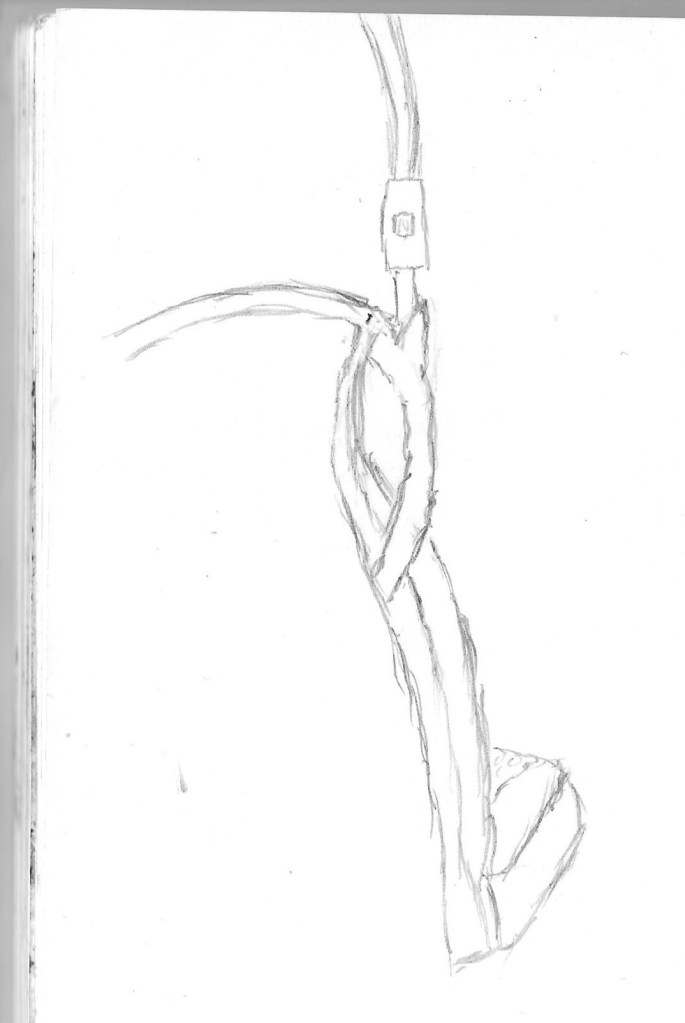
Indeed, there’s only one drawing I’m willing to pull out in public just now. This is a drawing of a bus seat done while on the bus:
Sketch of bus seat
It’s a fluke that everything looks roughly the same here as it did in real life, so I need to work on achieving a decent image by skill rather than luck.
Be advised that today’s deviation from writing is a one-off event, and that this page will not turn into an art blog. Meanwhile, as I’m shining the spotlight on pals, Eilidh Morris is a visual artist who doing the opposite of me by including more spoken word in their practice.
I attended my first writing class in 2011. On a Saturday morning, we would meet in a craft shop.
For two hours, with a cup of tea in the middle, the leader would give us exercises to complete. She might provide a sentence, or five randomly-chosen words, or even a photograph. Our challenge was to write a passage inspired by that prompt and share it with the group. It’s understood that this is a draft, not a finished product.
Over the next few years, our class moved from the craft shop to different cafes in town. At one point, we were even able to use a private dining room in a four-star hotel.
The type of exercises, however, remained similar: here’s a prompt, go and pen something. It’s a format I enjoy because it encourages the writer to make decisions and solve problems quickly. I think this has made me a better writer, just as actors take part in improv classes to help their skills along.
I’ve recently taken the opportunity to revisit this type of practice. Under the banner Poetry in Turbulent Times, Imogen Stirling is running a weekly class via Zoom.
One particular area of focus is a concept I knew little about: the kenning, using two words where only one would normally appear. The run is currently scheduled for four weeks, but if it’s extended, I’m interested in still taking part.
Even though I’ve now had nearly a decade of experience since 2011, I find I’m still being challenged almost as much as when I was a beginner.