Performing to an Audience: Updated Oct 2018

It’s come to my attention that this blog is now five years old. After a few test posts, it officially launched on 14 Oct 2013.

Throughout this time, I’ve periodically updated my guide to performing in front of an audience. From this entry onwards, these posts will have a consistent title format. I’ve placed this one and my previous posts about performing into a single category so you can read them on one page.

If you have time, two other great sources are a guide from Lies, Dreaming and a more detailed post from John Foggin.

My last update was made in January, and wasn’t due to be revised so soon. However, a few incidents happened last week that made me return to the topic. These are peppered throughout the current guide, below. Remember this should be treated as a subjective guide, not a textbook.


Talk with the organisers about what’s required

Ask the organisers to talk you through their plan for the event. This will typically include, but is not limited to:

  • How long you’ll be asked to speak for
  • What type of content is required
  • Whether it’s de rigeur to read from paper or speak from memory
  • Whether you’ll be given an introduction
  • Where you should wait before you’re called up
  • Whether any fee is payable

Each event has its own particular character. At Platform Poetry, for instance, each performer is asked to fill a 10- to 15-minute slot. At Blend In – Stand Out, each person performs one poem before the interval, then the reading order is reversed after the interval.

If it’s an unfamiliar venue, be sure to obtain the exact address and check how to access the building. Don’t forget to arrive in plenty of time.

Think about your own structure

The organisers will take care of the overall structure and running order, but it’s wise to plan your own slot so you don’t miss a step. A typical note-to-self might read:

  • Give name, say you’re reading from short story collection The Pie Seller
  • Say you’re happy to sign copies
  • Briefly mention editor at Law Hill Books
  • Tell obesity clinic anecdote
  • Read out And an Onion One Too (page 24)
  • Thank Tracey Jones for organising
  • Read out The Crust of the Matter (page 12)

Note that the thanks should be placed second-last, not as the final item. That means the audience are more likely to go away with the ending of your work in their head rather than why you think Tracey is so great, even if she is.

Briefly explain if you need to, but don’t apologise

Some pieces do require an explanation; perhaps a work is unfinished, is an extract from a longer work, or was written under certain circumstances. But keep it brief and don’t explain anything that the audience will take or infer from the piece.

If you feel you can’t read a particular piece without apologising or telling a long story, either take it out of your set or work on it until only a short introduction is necessary.

Read out loud and time your words

The best way to identify weak parts in your set is to read it aloud – and that’s the last thing you want to happen in public. So find a space on your own and read it out where nobody can hear you. Are there any long sentences that need to be broken up? Are there words that are difficult to say clearly?

When reading from a book or from sheets of paper, it’s a good idea to turn up the corner slightly or to stick a post-it note as a lever. When using an e-reader or tablet computer, practice tapping the correct area of the screen to turn the page; there might also be a delay on some devices.

Don’t forget to use a stopwatch to make sure all your words fit within the agreed timeslot.

Make sure everyone can hear you

In my experience, smaller readings tend not to use a microphone, so you might need to project. Avoid tilting your head down to read the piece; instead, hold your manuscript higher and off to one side so it doesn’t muffle your words, or look down only with your eyes. Always speak slowly than you would in normal conversation and don’t be afraid to pause.

If there is a microphone, always use it; it’s generally there because there’s a known problem with people being able to hear the performer. However, unless it’s a major gig, there’s unlikely to be a professional sound engineer around, so ask to test it out beforehand.

A big annoyance for an audience is a sound level that increases and decreases at random. So whether the microphone is handheld or on a stand, keep it at the same distance from your mouth and speak into the top; that said, there are types of microphones where you speak into the front. Don’t worry about being too loud or causing distortion; it’s almost always better than the alternative.

Avoid too much alcohol or a heavy meal before the gig

I fully understand why folks need Dutch courage before going on stage. But a drunk speaker rarely makes a good impression, especially during a paid gig.

My rule is not to take alcohol before speaking, only coffee or a soft drink. It’s also a good idea not to eat too much in the hours before the performance, as a heavy meal can also slow down your thought process.

Decide where in the room to look

I know a few poets who deliberately look at individual audience members. However, it’s  unnerving to make eye contact for most people. Fortunately, there are some techniques to avoid this.

One of my favourite methods is look between two people, so the person on the right assumes I’m looking at the one on the left, and vice versa. Another way is to look beyond the back row; again, everyone assumes you’re looking at someone else.

Both of these methods have the advantage of keeping your posture correct.

Keep going through distractions and cock-ups

A common issue at spoken-word nights is the audience member who keeps talking. Unlike a music gig, you don’t have the advantage of drowning them out with your instruments. A good host will take charge of silencing any chat, but if they don’t, either carry on as you were or – if it’s too distracting – politely ask them to refrain.

Perhaps the microphone fails, perhaps you forget the words, perhaps a hundred other unpredictable problems crop up. Keep going as best as you can. It might mean cutting a piece short or shouting instead of reading, but the audience are there to see you perform.

Listen to the performers

This might seem like an obvious and unnecessary piece of advice, but it doesn’t always happen.

I was speaking at an event last week where I talked about Hotchpotch, the open-mike night I run; I was on a panel with others who are involved in the local literary scene in different ways.

Someone in the audience clearly hadn’t listened to what I was saying. At the end of the event, he kept commenting to me how ‘brave’ I was for standing up, then giving me advice about how to handle an audience. I explained to him that I’m completely comfortable doing this, but he didn’t seem to listen to this either.

Later in the week, I went to an event where some of the performers were standing outside the venue rather than listening to their peers’ readings. I found it rather disrespectful to expect others to listen to their work when they didn’t offer the courtesy of returning the favour.

Signal that you’ve finished

At the end of a piece, the audience doesn’t necessarily know whether you’re finished or simply pausing for dramatic effect.

A good clear signal is to lower your manuscript or to step backwards slightly, or even say ‘Thank you.’ At that point, people should take the hint and applaud.

Do it again

It’s an eye-rolling cliche, but the more you stand up and speak in public, the easier it becomes. Over time, you’ll learn little nuggets like which techniques work or don’t work for you, which pieces always or never provoke a reaction, and even which subjects to cover for different audiences.


There are no guarantees that your poetry performance will be a success. But by following the suggestions above, you can maximise the chances that it will.

The Art of the Anecdote

On Thursday, I went to see the new Gyles Brandreth show Break a Leg, which is running at the Edinburgh Fringe until Sunday 26 August.

In his career as a writer, broadcaster and former Member of Parliament, he’s become friends with a number of people in the worlds of entertainment and politics. The show talks about his acquaintance with a few of them, from June Whitfield to Frankie Howard.

The show is listed in the Comedy section of the brochure as there are a lot of laughs. Yet it isn’t stand-up, nor is it bragging. Rather, he uses his privileged access to these well-known figures and tells humorous anecdotes about them in his slightly camp fashion.

By User of Waffle TV YouTube channel (https://www.youtube.com/user/waffIeTvUK/) [CC BY 3.0 (https://creativecommons.org/licenses/by/3.0)], via Wikimedia Commons
Gyles Brandreth in 2013
As such, his material is strong. The show could run for two hours and there would still be more to tell, and the audience would probably lap it up. But not everyone has such great anecdotes.

In 2007, I went to an event featuring Clive Swift, who played Richard Bucket in Keeping Up Appearances. He specifically didn’t want to discuss his sitcom days. Instead, he was there to tell us about his theatre career and how he’d worked with prominent stage actors such as Peter O’Toole.

It quickly became apparent, however, that he’d worked with these notable thespians only in supporting roles and that he was trying to turn minor episodes into a big deal. He was certainly never friends with them. One anecdote, for example, involved meeting Sir Laurence Olivier by chance in a theatre bathroom and hearing some worldly advice from him.

The only factor that saved Swift’s show from being a total train wreck was his skill on the trombone, accompanied by a pianist called Claire Greenway. Had it been a musical event with those minor stories peppered between songs, it might have worked well.

A review from the Scotsman newspaper very much captures the essence of the performance; scroll down past the review of Pete Firman to read it.

The lesson here is to make sure your material stands up to some scrutiny. Many performers – especially comedians – like to arrange preview shows, often to an audience who have paid a special reduced price for a ticket. This approach is invaluable for ironing out any kinks in the material and a useful guideline for how listeners will react at different parts of the script.

Additionally, there’s a lot to be said for having an honest friend or professional who can listen to your show to tell you what works and which parts need strengthening.

On Roles and Pigeonholes

In 2016, I graduated with an MLitt Writing Practice and Study degree from the University of Dundee. At the time, I was in the mindset that I wanted to write in as many different styles and formats as possible.

This wasn’t a problem until it was time to pull together all my work into what the syllabus described as a ‘unified dissertation’. In other words, the whole document had to flow, but my pieces were too dissimilar to achieve this easily. With the help of two tutors, we eventually solved the problem, but I still didn’t like having to adopt one role or to be pushed into one pigeonhole.

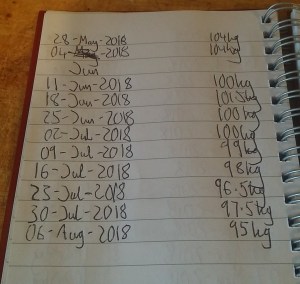
I only began to change my stance earlier this year when a friend posted a video of a TED talk about sugar addiction, which inspired me to start writing a spoken-word show about the struggles I’ve had with my weight. And for the first time, I felt as though I’d found a niche that I enjoyed occupying, and that I had plenty of material to fill.

That said, I’ve lost a lot of weight since starting to write that show. This is an achievement, but I feel as though it’s defeating the point of the narrative.

Notebook in which I log my weight every week

On Saturday, I went to my first Edinburgh Fringe shows of the season, all of which reinforced my dedication to sticking with my niche for as long as it takes.

The first two were by people I know, and could only have been written by them. John McCann has a deep understanding of politics in Northern Ireland and has penned a monologue called DUPed, all about the Democratic Unionist Party. Meanwhile, Amy Gilbrook in Nutshells touches upon her experience of not fitting in. And while I don’t know Alan Bissett personally, it’s difficult to imagine anyone else emulating Moira Bell in The Moira Monologues or More Moira Monologues.

These shows are playing on selected dates throughout August.

Despite my promise to stay in a niche for the foreseeable future, I realised this week that some of my favourite novels have one thing in common. I’m attracted to those one-off stories where a sequel is unlikely because the story is so self-contained, such as A Clockwork Orange or The Bell Jar.

Busy Bee

Last week, I learnt that the venue we use for Hotchpotch – the spoken-word open-mike night – will be closed for refurbishment until the end of August or the beginning of September.

By Texas State Archives from Austin, Texas, USA (2001078_009_70_132_002ac) [No restrictions], via Wikimedia Commons
You might remember three weeks ago, I spoke about the importance of keeping a kind of Cabinet office when there are difficult decisions to be made. The system definitely worked in this instance, with regular members making good suggestions about what to do next.

Within 24 hours, we’d managed to secure another bar in the city centre for this month, and potentially next. We even had an offer from another venue that we can investigate if we need to. The next Hotchpotch will now take place in the Westport Bar in Dundee on Monday 16 July at 7pm.

Meanwhile, I’ve been working on my Make / Share presentation on the subject of impostor syndrome, as touched upon in last week’s entry. If you’re local to Dundee, this happens tomorrow at The Beer Kitchen from 7pm.

When to Stop; When to Start

In April, I began to redraft a novel that I originally wrote in 2011. In the intervening years, I’ve learnt a lot more about the principles of structure and how to raise the stakes in a narrative, so I was pleased with the way the redraft was turning out.

By Tom Murphy VII [ GFDL (http://www.gnu.org/copyleft/fdl.html), CC-BY-SA-3.0 (http://creativecommons.org/licenses/by-sa/3.0/) or CC BY-SA 2.0 (https://creativecommons.org/licenses/by-sa/2.0)], from Wikimedia Commons
By Tom Murphy VII [GFDL (http://www.gnu.org/copyleft/fdl.html), CC-BY-SA-3.0 (http://creativecommons.org/licenses/by-sa/3.0/) or CC BY-SA 2.0 (https://creativecommons.org/licenses/by-sa/2.0/) ] from Wikimedia Commons
However, there came a point where I’d pushed the main character through as many hoops as I could conceive until he’d achieved his goal. At that point, there wasn’t much to keep him from doing anything he wanted without resistance, so the narrative began to stall. At around the same time, I began to pull together a spoken-word show. I therefore made the decision to leave aside the novel, so for the last month, I’ve been concentrating on the show.

When I stop thinking about a work in progress, I find that’s the time to leave it. The novel is currently handwritten, so I’ll start typing that up once I’m finished with the show, then see where we can take the main character from there.

Other highlights this week include performing at Inky Fingers in Edinburgh on Tuesday and listening to some cracking poets, including the featured Rachel Plummer.

And on Thursday, I heard Caroline Bird performing from In These Days of Prohibition. This is the second time I’ve heard her on stage, and it was again a wonderfully absurdist experience.

Gibson and Goodfellow

On Wednesday, I saw one of my idols at The Mash House in Edinburgh. Andrea Gibson is a non-binary poet who uses the singular ‘they’ pronoun. This was the very city where I’d been introduced to their work.

It seemed to be the convention that the audience sat on the floor, so I was battling with needles and pins for much of the evening, not to mention a wet patch where someone had accidentally kicked over my wine.

But in spite of the setbacks, the gig itself was amazing. I enjoyed Gibson’s often dense wordplay and imagery, which engaged and touched us in equal measure. Many of the poems were accompanied by recorded music.

Just about everyone in the audience queued up to have merchandise signed after the gig. I didn’t, but I wanted to tell them how much their work had helped me write mine. From nowhere, I found myself ready to cry as I spoke. They seemed to be genuinely appreciative of the thought.

The support act was Suky Goodfellow. I’d heard of her before but this was the first time I’d encountered her poetry. She commanded the stage as she spoke about wealth creators and why swear words shouldn’t be rude.

If I have the opportunity to see Gibson and/or Goodfellow again, I shall definitely take it.

Passing the Microphone

I feel as though I’m giving you a cop-out entry this week because it exists only to link to other posts.

This is partly because I haven’t had much time; I’ve spent a lot of it on a new long-form piece. And it’s partly because another poet has put together some excellent advice that I’d like to share.

A microphone
A microphone. It seemed like the best picture to illustrate this entry. (Photo credit: Wikipedia)

A couple of weeks ago, Andrew Blair asked his friends what advice they wish they’d known before taking part in their first open-mike night. The advice he received – including mine – appear in his entry So…you want to do an open mic night.

Additionally, this seems a prime opportunity to dust off my own advice for speaking in front of an audience from earlier this year.

In With the Old

Over the last week, I’ve been revising two pieces of prose.

The first piece was a 1500-word short story about a female soldier returning home after conscription into an unnamed war. I first wrote this in 2013, but I’ve periodically returned to it, most recently to submit it to a publisher who might appreciate the sentiment.

File:Colouring pencils.jpg

The second is an overhaul of the piece I wrote for my Masters dissertation in 2016. I subsequently turned it into a one-woman play, but the last revision didn’t reach the 60-minute mark. Over the weekend, I’ve been lengthening the script by unpacking and exploring some of the plot points that the original doesn’t address. In two weeks’ time, I have the opportunity to have an extract read by an actor at a new playwriting evening.

When I read back over those two pieces, there were no major problems, but I could find a number of minor ones. Perhaps I’d used a clause too many in the sentence; perhaps a vital piece of information could be shown rather than told.

Whatever the problem, I’ve enjoyed fixing them. I feel the two pieces are better overall now. I keep all my drafts, so I was able to look back at previous versions and I can see that my writing has improved over the years. It’s entirely possible that I’ll revisit these pieces in the future with more experience and be able to improve them in ways I can’t imagine right now.

The Local Circuit

Last week, I talked about an open-mike night that I run in Dundee. However, the majority of the events I attend happen in Glasgow or Edinburgh. These cities are not prohibitively far away; I can reach either one by bus or train.

The problem is that I have an office job and I’m generally required to work until 5pm. I’m often obliged to take the train to arrive on time, even though bus travel is almost always cheaper. Coming back on the same night poses other challenges: do I book a cheap late-night bus where I need to hang around after the event finishes, or do I spend more on a train ticket I can use at any time?

Scottish Poetry Library, Crichton's Close, Can...
Scottish Poetry Library, Crichton’s Close, Canongate, Edinburgh Designed by Malcolm Fraser Architects, shortlisted for Channel 4’s Building of the Year 2000 (Photo credit: Wikipedia)

Many poets do make a point of stopping in Dundee, but it would be great to have more of a home-grown scene. There’s a well-established poetry circuit between Glasgow and Edinburgh where acts from one city will regularly perform in the other, and so it would be great to have Dundee contributing to that route as well as being an equal player.

Among other initiatives, a couple of folks I know want to host a cabaret night, and a third is proposing a regular playwriting evening, so I think there’s definitely an appetite for doing something right here. I don’t know much about the scene in other major Scottish cities, but the potential is enormous.

Regardless of the logistics, it’s often a rewarding experience to be at spoken-word events.

A couple of weeks ago, I saw the Jenny Lindsay show This Script & Other Drafts  in Glasgow; on Friday just gone, I was back in the city for a trans and non-binary event. On both occasions, I had an excellent time and I caught up with people I haven’t seen for a while. Leyla Josephine’s Hopeless is on the cards for Friday coming.

Making a Move

Every month, I organise an open-mike night called Hotchpotch for writers to read their work in front of an audience.

Mayfly, May 2007
Mayfly, May 2007 (Photo credit: Wikipedia). Mayflies are aquatic insects belonging to the order Ephemeroptera.

For the last couple of years, we’ve been using a bar called the Tinsmith, who took us in when a previous venue closed. We’re indebted to them for allowing our group to keep going, and we made it clear that the move was on good terms.

They have a snug area that offers some degree of separation from the other customers. Over the last few months, however, our audience has grown beyond this area. As a result, it’s become difficult for everyone to hear, even with a PA system.

With help from another member, we scouted out a few locations, bearing in mind that any venue needs to benefit from our presence. Some didn’t have the privacy or the space we need, while others charged amounts that we wouldn’t be able to sustain in the long run. We found the Mayfly, who take a reasonable approach to space versus cost.

Of all the impending changes ahead, the format of Hotchpotch remains the same: for writers to read out their fiction or poetry with no judgement and no criticism. The next meeting is on Monday 14 May.