We’re now into the thick of National Novel Writing Month. The Dundee & Angus region alone collectively ended 11 November at well over half a million words, and the total is rising every day.
But other literary events are still happening. Tonight, I’m going to a Silent Reading Party, then a Spanish-themed poetry night. And on 25 November, I’ll be seeing the actor Alan Cumming in conversation with Muriel Gray about his latest book.
I would like to take this opportunity to plug a couple of events. You might be aware that my poem Crossing the Road has been included in the anthology Aiblins: New Scottish Political Poetry, which officially launched in Edinburgh last month. There is also to be a Glasgow launch tomorrow 15 November where I can’t be present, and an Aberdeen launch on 21 November where I’ll be performing.
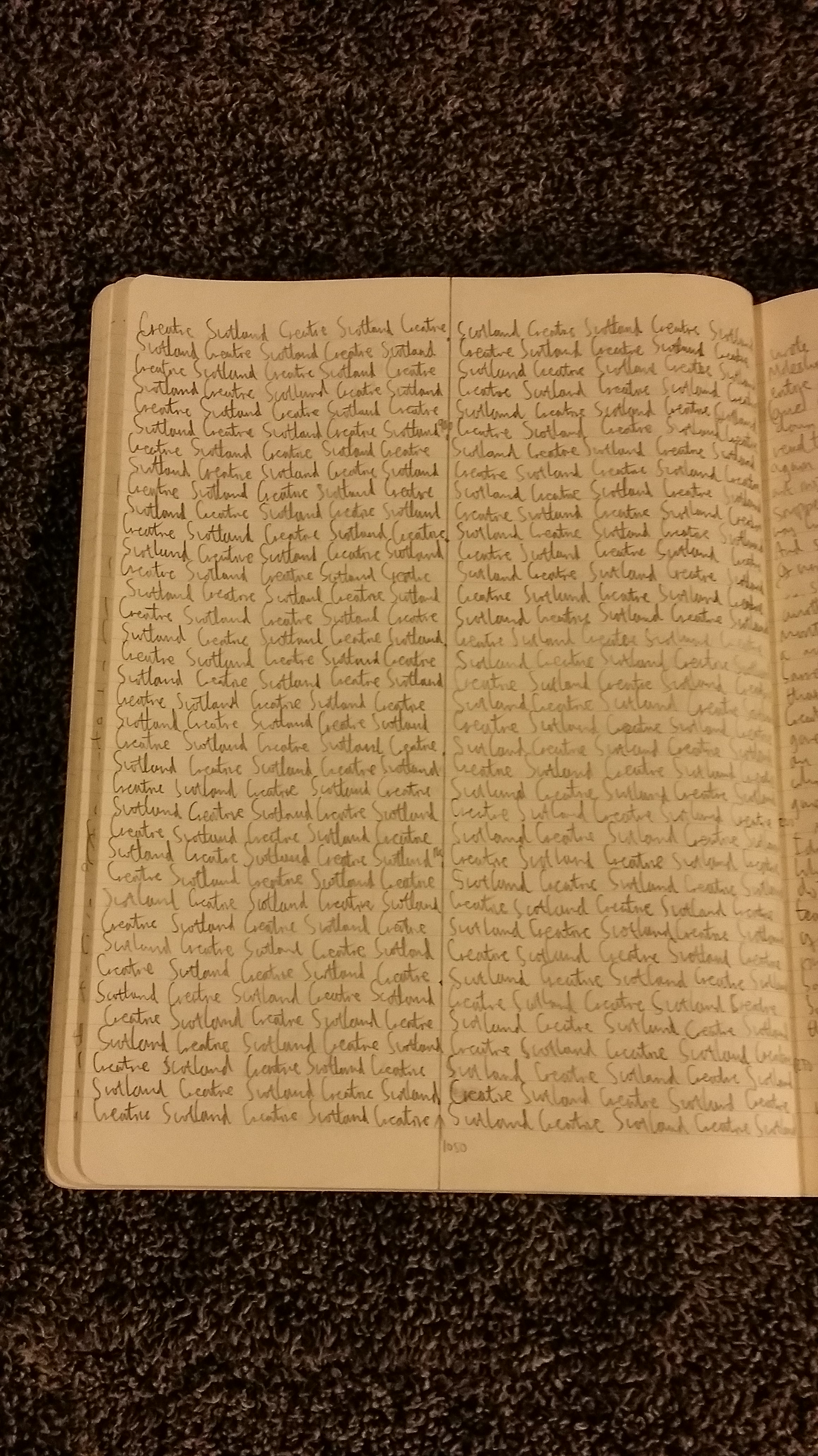
For now, though, it’s back to NaNoWriMo. I didn’t know where I was going with this year’s story – in some respects, I still don’t – but I now have a character who loves to fill notebook pages with the same phrase, much like Jack Torrance in The Shining. Here’s what happened when she was turned down for an arts grant:
Every November, I take part in National Novel Writing Month – aka NaNoWriMo – which is a challenge to draft a 50,000-word novel in a month. Along with an assistant, I’m also a Municipal Liaison (ML) for the Dundee & Angus region in Scotland. We arrange regular meet-ups for members, encourage and support them, and persuade them to donate to the project.
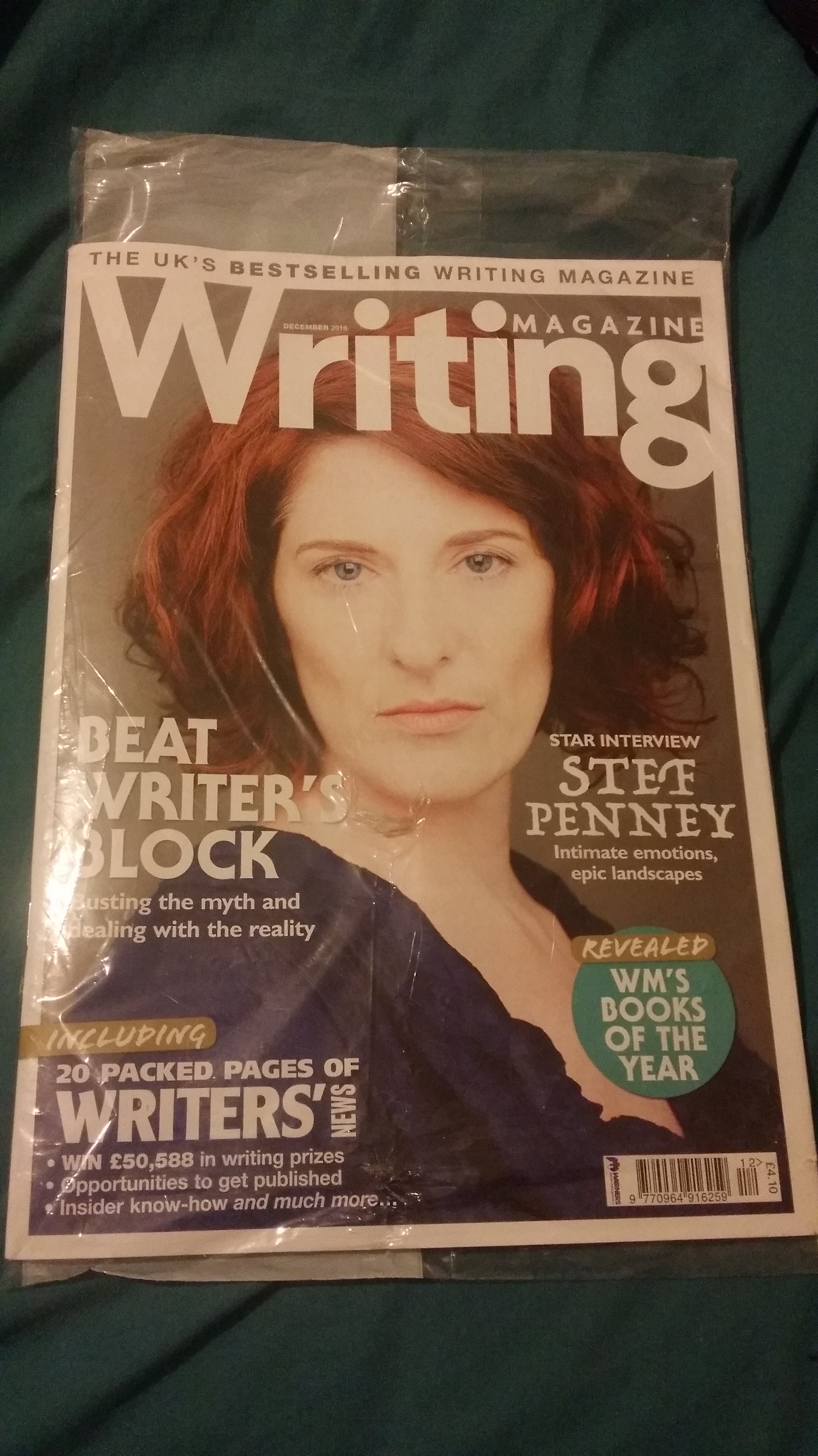
As such, some of my other projects have to be scaled back or placed on hold. This includes submissions to publishers, reading books, and updating this blog. In fact, my current issue of Writing Magazine is still in the cellophane. However, I’m making good progress, having written more words than required every day so far; in fact, the whole region is doing a sterling job.
Hot on the heels of my copyright post the other week, a case of poetic plagiarism was brought to my attention. Remaining copies of Laventille have been pulped after Sheree Mack admitted to including others’ work in her own inadvertently, although fellow poets have accused her of stealing work deliberately.
In this instance, it’s not only the original poets who have been hurt by her actions, but the pulping will wipe out the profit margin that Smokestack Books would otherwise have made.
The one positive aspect we can salvage from this mess is that this type of plagiarism is relatively rare. If it happened every day, this story wouldn’t have been reported and nobody would have kicked up such a stink.
Postgraduates
I’m a firm believer that every writer ought to learn the skill of public performance. More on that story later. But last Wednesday marked the first time I would be performing to an audience of academics, rather than the general public or other writers.
The University of Dundee has run a Postgraduate Conference for the last four years where students set the agenda by presenting papers. Students were also free to respond creatively to this year’s theme, Lost in Translation. When I saw the final running order, I appeared to be the only person giving a creative response, and I seriously considered withdrawing as I didn’t feel it would fit in with the other presentations.
The upshot is that I did go ahead with it, although I was moved to a different slot with theatre students and a novelist. I felt it flowed more smoothly, and I received an excellent response, both verbally and on the anonymous feedback slips. My tutor was also sure to stop by and ask a couple of tough questions.
Performance
Shortly after the Postgraduate Conference, I went along to a workshop… on performance; unfortunately, it had to be in that order. Jenny Lindsay, one half of poetry duo Rally & Broad, was hosting, and they’re one of my favourite contemporary acts. She asked each of us why we were there. I told her I was quite comfortable with public speaking, but I felt there was always more to learn.
Blockbusters (UK game show) (Photo credit: Wikipedia)
She took us through the process of preparing for an event, including how we might introduce ourselves, putting together a set list, and we even took turns at walking out in front of an audience. The organiser is hoping to put on another event in the near future but using an actual stage.
If you have the chance to hone this skill where you live, I recommend signing up. What many writers don’t realise is that if you’re snapped up by a publisher, you’ll be expected to read excerpts to a live audience. I’m not going to pretend it’s easy to stand up and entertain people, but the only way to make it easier is to keep practising, and prepare your materials thoroughly in advance. Remember, most audiences aren’t sitting waiting for you to slip up – they’re willing you on.
Promotion
Although National Novel Writing Month and its offshoot Camp NaNoWriMo are over, an enthusiastic band of us have continued to meet each week. The most recent meeting was yesterday, but we left after an hour to visit Waterstones where Kirsty Logan was promoting her novel The Gracekeepers.
I’d seen the posters across town, but I hadn’t heard much else about it until that evening. By the time I’d listened to the excerpt, learnt about the background of the world in which it’s set, and was told were some characters written as gender-neutral, I decided I wanted it. The issue of gender is something I become interested in since my feminist friends talk about from time to time.
And our group each spoke to Kirsty Logan for a couple of minutes each as she signed our books. I wish I’d thought to take a photo, as her dress contained pictures drawn in the same style as the book jacket. If I ever have a novel published, that’s a touch I’ll think about adopting, although I might settle for a shirt rather than a dress.
You were expecting an entry on Monday, weren’t you? Douglas Adams commented, “I love deadlines. I like the whooshing sound they make as they fly by.”
While I normally frown upon such a laissez faire attitude, I completed National Novel Writing Month on Sunday 30 November at 1:13pm with 50,123 words. As Municipal Liaison, I wanted to set a good example, but I was keen to stress to the members that there’s no shame in not reaching the target.
From there, it was straight into the folio for my MLitt module, comprising two short stories, two poems and a poetic monologue, representing a variety of styles. I’d done most of the work, so it was a matter of pulling together the threads into one document. I submitted that at lunchtime yesterday, the day it was due.
Which left today to craft an entry, and I’ve had plenty of time to do so, as I’ve been awake since 1:50am after approximately four hours’ sleep.
This will be my blow-out weekend before I dive straight back into other projects and catch up on my reading. On my coffee table lies Quiet Dell by Jayne Anne Phillips and Raymond Carver’s collection Elephant and Other Stories, both of which need to be returned to the library in under a fortnight. The former is a weighty volume, but I shall tackle it before that deadline.
For this, I’d like to introduce Binge Reading™. It’s similar to the more familiar binge drinking or binge watching, but better for you than both of these activities. Use Binge Reading™ as you please, but remember to mention you read it here first.
When I’m writing a new story, I have a particular manner of approaching it. I tend to let it churn around and around in my head, and then when I think it’s ready, I’ll write it in one sitting. From conversations I’ve had recently, it seems I’m not the only one who works this way.
Yet when I was asked to write a monologue recently – which I performed on Thursday – I approached it in the manner suggested by the person who set the challenge. That was to think of somewhere that means something to you, either good or bad, and write about this place for 15 minutes without stopping. Then think of somebody striking, whether someone you know personally or who is in the news, and write about them for 15 minutes without stopping. Finally, put them together and use that as a jumping-off point.
At first, I didn’t know whether I could do anything with the place and person I chose, but after those 15 minutes of writing, I found a lot of usable material, which I then assembled into a poetic monologue. Instead of writing from the top to the bottom, I worked on the second part first, setting my ideas to an iambic rhythm; then worked on the first part second, using a dactyl meter.
(Photo credit: Wikipedia)
It produced a piece with which I’m very happy and went down well with the audience. I wonder whether I should approach more of my pieces like this?
I’m tackling National Novel Writing Month at the same time, where the aim is simply to write the raw material for a first draft and worry about the editing at a future date. As always, I’m finding unusual twists and turns simply by the process of writing. For instance, the novel was originally to be a series of newspaper reports about an inventor, with a historian filling in the gaps. However, more and more of the inventor’s own words started to creep in, and now it’s written almost entirely from her point of view with only a little help from the historian.
The next time I work on something original, I might try writing it out instead of just thinking about it, but I’ve learned a little lesson on that front as well. NaNoWriMo was planned out on three sheets of paper the size of newspaper pages. This is fine to refer to when writing at home, but inconvenient to take along to a cafe.
In the early hours of Saturday morning, National Novel Writing Month kicked off. As I’m the organiser for Dundee, I’ve been in the thick of it since then, and I’ve had other work on top. It’s left me little time to compose a full WordPress update.
So far, we’ve held our Kick-Off Event and our first meet-up, and our word count continues to rise. When I checked it at 4:30pm tonight, we’d managed to register 168,000 words. My own words make up about 0.5% of that.
So I’m going to crack on with this, and aim to come back with a fuller entry next week.
When you’re a writer, and one of the country’s best literary festivals is on your doorstep, you can’t help but pop your head around the door. The Dundee Literary Festival closed yesterday after five days of events.
If you only look at one thing, make it The News Where You Are by James Robertson (below). I had a debate with one of the DURA bloggers over whether it was a story or a poem, but it’s a hilarious satire about what is implied when the national newsreaders hand over to the local newsrooms.
This year, I’ve become Municipal Liaison for National Novel Writing Month in Dundee. I arranged our Kick-Off Event to coincide with the festival. It’s impossible to tell how many people will come to a given event, but we ended up with ten members altogether, and we listened to last year’s MLitt graduates each reading his or her magnum opus. Our regular write-ins will begin on Saturday, and I’ll no doubt write more about these throughout November.
The cast of Avenue Q performs “It Sucks to Be Me” at Broadway on Broadway, September 10th 2006. (Photo credit: Wikipedia)
In between all that, I found time to see Avenue Q, the show that’s broken out of Broadway and crossed the Atlantic. The actors stand on stage and sing alongside the puppets, but this soon ceases to be a distraction as they settle into the story of a new graduate coming to town, Kate Monster’s fight to have monsters recognised in society, and Rod’s reluctance to admit his sexuality. Content-wise, there is very little actual swearing. If this was a film, it’s the adult concepts that would probably earn it a 15 classification.
It’s also hard to see why Teenage Mutant Ninja Turtles, which I also caught this week, was given a 12A rating, when I could find nothing that would it earn it any more than a PG.
I don’t often swear in my own writing. The intention is often to shock, but when everyone does it, the words lose their impact. Comedian Bill Bailey summed it up nicely when he compared effing and jeffing to road humps: one or two isn’t an issue, but a constant barrage is. By contrast, Quentin Tarantino takes the view that, “I’m a writer, no word is in jail,” but from watching his films, I do see the F- and C-words being given more parole than any other.
That said, I’m not above including blasphemy, as that’s commonly used and – generally speaking – is no longer thought of as swearing. There’s a 90-page study from Ofcom on the matter if you have the time, but the relevant sentence is: “There were a small, but vocal number of participants who found the use of holy names unacceptable.”
But in the right hands, swearing can be done well. I’m thinking mostly of John Cooper Clarke’s Evidently Chickentown, in which the F-word appears 83 times to produce an onomatopoeic effect of a chicken’s squawking. When he recorded it in the early 1980s, though, he had to replace 80 of these with bloody.
I was going to end this entry with a word that sounds a bit rude, but I shan’t.
I promised in my last entry that if I had the opportunity, I would memorise one of my poems and perform it the following Friday. Speakerbox is a new event for writers and poets at Dundee University union. During a chat with the organiser, she told me she hopes to hold it every month. She has also been to the existing Hotchpotch meetings to share her material.
I was asked to read first, and I have some footage of how it went. The purple mood lighting made this stage look fabulous in person, although not so much through a camcorder.
That’s right, I fluffed my lines. However, I managed without any further cock-ups in, “Take two,” along with another piece from memory, and two others from notes. I like to use an e-reader to save paper. I was followed by several other acts, mainly poetry but interspersed with prose and music. There were innovations I hadn’t seen before: one man walked between two microphones while delivering a monologue, another gave out chocolate bars to whomever he dubbed, “awesome.”
I hope this event continues, as I plan to be back next month. During the week, I also had a much rarer opportunity to be in the audience at a recording of a Mrs Brown’s Boys Christmas episode. Although the story is set in Ireland, it’s filmed in Glasgow.
BBC Scotland broadcasting centre in Glasgow. (Photo credit: Wikipedia)
In many respects, it’s a standard sitcom, except that many of their bloopers and ad-libs make it into the final programme. There were a number of these during the three hours we were in our seats. Many scenes were recorded twice in succession. I found I was watching the monitors rather than the action on the set, so I deliberately tried to keep my eyes away from them to catch the full experience.
Agnes Brown is played by Brendan O’Carroll who also writes much of the material, but it’s accessible scripting that doesn’t require the audience to understand any particularly Irish references, so it plays very well to a BBC1 viewership. It’s less well-known that he is also a novelist. In 1999, his book The Mammy was made into film called Agnes Browne, starring Anjelica Huston as the eponymous character. Unlike the sitcom, these take a sombre tone.
Also worth a look is What We Did On Our Holiday, starring David Tennant and Billy Connolly. It’s written by Andy Hamilton and Guy Jenkins, the force behind Outnumbered, although I’ll always remember them primarily for satirical comedy Drop The Dead Donkey. The duo have found a particular niche in giving the child characters all the best lines, often relentlessly, while the adults fumble for an answer.
The coming week is a busy one for me. Not only is the aforementioned Hotchpotch happening tonight, the Dundee Literary Festival also begins on Wednesday and runs to Sunday. At the same time, I’m organising the first meeting of the local National Novel Writing Month group, finishing my library books, and still taking time out to see Teenage Mutant Ninja Turtles at the cinema.
Having been flat on my back with illness last week, I missed the chance to go to a play on 25 June called Shape of a Girl at the Little Theatre in Dundee. It tells the story of a Canadian girl who was bullied and subsequently found dead. I’d been invited by a friend, playwright Mark McGowan, who is involved with Dundee Dramatic Society.
By last Friday of that week, I was feeling much better, and Mark invited me on a backstage tour of the theatre used by the society. It really is a little place: more like a large house than a venue. The auditorium seats just 100 people, and I saw the actors holding an intense rehearsal session there for a show that opens in August. Backstage is upstairs in the attic space, accessed by wooden staircases at the sides of the stage, yet it houses a green room, costume store, sewing room, and a coffee bar.
As Mark persuaded members of the company to sign up for his latest production, I spoke with one of the actors. The theatre group has lasted around 90 years, and we discussed how it has managed to remain in its own niche against comparable venues in the city, and the potential threat from a cinema that is due to open across the road.
I also flipped through an index of plays, each with a summary of the plot and required number of actors. Between the ages of twelve and 14, I had a brief acting career through the National Youth Music Theatre. It now strikes me just how difficult it must have been to find a suitable script so we all had a part. Similarly, Dundee Dramatic Society are volunteers, so there is little control over the age and gender of the players.
I’ve only once tried my hand at playwrighting, and I enjoyed the process. The group that runs National Novel Writing Month used to run a similar event in April called Script Frenzy where participants were challenged to produce a 100-page script during the month. Many of my local SF group chose to produce screenplays, but I elected to write for the stage as it needs only two actors.
I haven’t redrafted the script since it was written. But I’m confident I’ll one day return to it, tighten up the dialogue, iron out any plot holes, and see it performed.
A few days after my handwritten entry last week, I was looking for something in my bottom drawer, when I discovered an old notepad. It’s nothing special; it’s a Tesco Value spiral-bound A4 pad with a slightly ripped cover.
I’ve used a quarter of its 80 pages, and most of it is taken up with attempts to expand on a fragment of poetry that I tried to expand into a song, although there is also a brief novel idea, pages of free writing, and a poem on the topic of my own handwriting.
Of these, I only consider the poem be a decent piece of work. As for the rest, I know what I was trying to express, but I didn’t have the techniques at my disposal to do it properly. But looking at the content, I’ve calculated that I last wrote in this notebook in September 2009, more than a year before I began writing. I’m therefore not surprised about the quality.
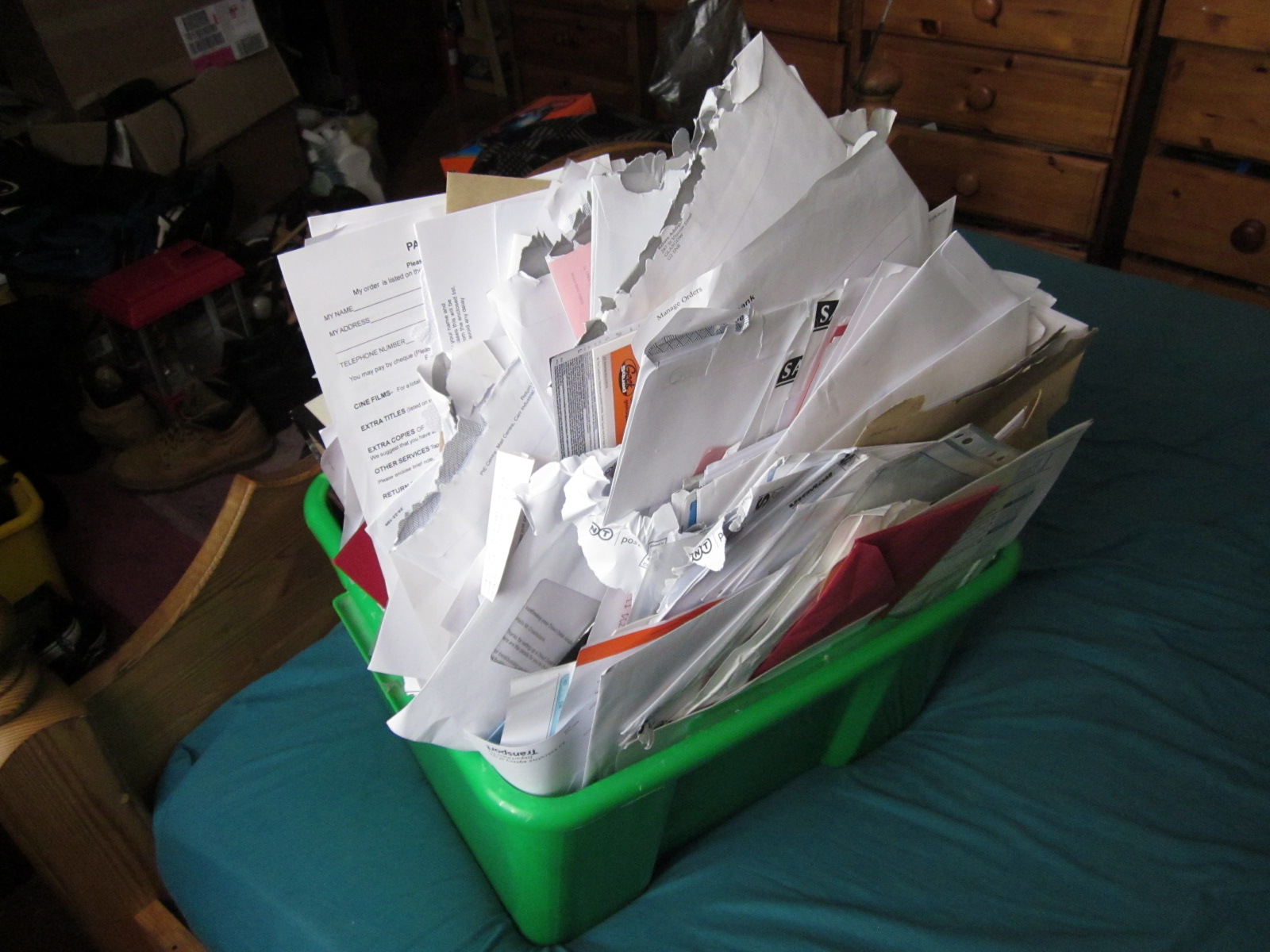
My filing system
Yesterday, I discovered other half-completed notebooks, but none as full or detailed as this one. I’ve noticed I rarely reached the last page, although I’m more than likely to complete my current ones. Also, there are hardly any drawings or even doodles, just text.
But the one notebook I would like to look at again is missing, believed lost. At my very first National Novel Writing Month meeting, my laptop battery died. I had to rush out and buy a notepad and mechanical pencil so I could continue my story. I had it about a year before its disappearance, and it contains drafts of my first novel, and some of my earliest stories. I don’t think I’ve lost anything, but I might have.
I know I’m not the only writer with notepads dotted about, and I’d like to hear about yours. Do you have any hidden in a drawer somewhere? What did you discover when you pulled them out again? Have you misplaced an important story you wish you could recover?



 Gavin Cameron