Caught up in My Busyness

We’re now into the thick of National Novel Writing Month. The Dundee & Angus region alone collectively ended 11 November at well over half a million words, and the total is rising every day.

But other literary events are still happening. Tonight, I’m going to a Silent Reading Party, then a Spanish-themed poetry night. And on 25 November, I’ll be seeing the actor Alan Cumming in conversation with Muriel Gray about his latest book.

I would like to take this opportunity to plug a couple of events. You might be aware that my poem Crossing the Road has been included in the anthology Aiblins: New Scottish Political Poetry, which officially launched in Edinburgh last month. There is also to be a Glasgow launch tomorrow 15 November where I can’t be present, and an Aberdeen launch on 21 November where I’ll be performing.

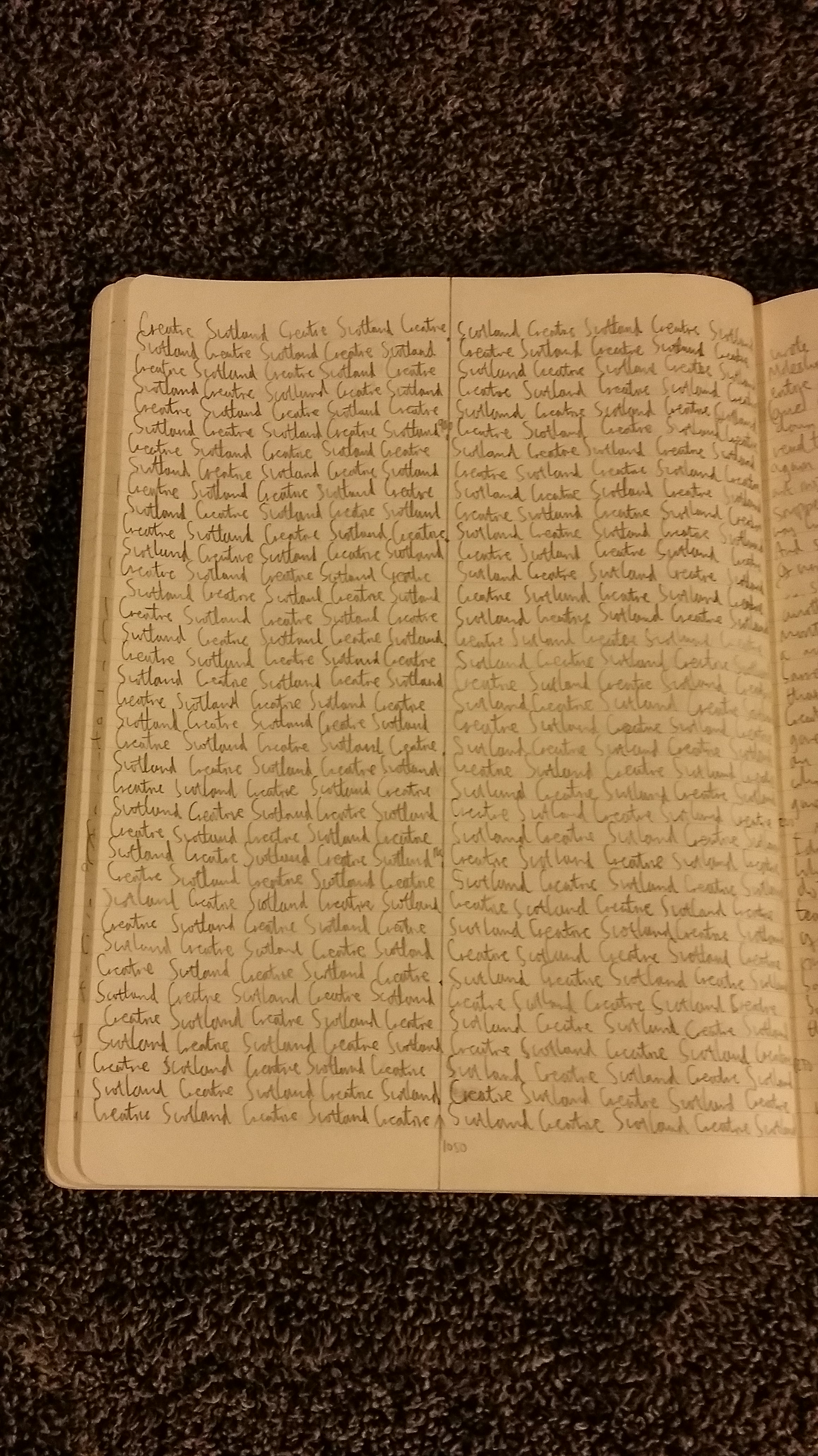
For now, though, it’s back to NaNoWriMo. I didn’t know where I was going with this year’s story – in some respects, I still don’t – but I now have a character who loves to fill notebook pages with the same phrase, much like Jack Torrance in The Shining. Here’s what happened when she was turned down for an arts grant:

The writings of a character in my NaNoWriMo novel

NaNo Seconds

Every November, I take part in National Novel Writing Month – aka NaNoWriMo – which is a challenge to draft a 50,000-word novel in a month. Along with an assistant, I’m also a Municipal Liaison (ML) for the Dundee & Angus region in Scotland. We arrange regular meet-ups for members, encourage and support them, and persuade them to donate to the project.

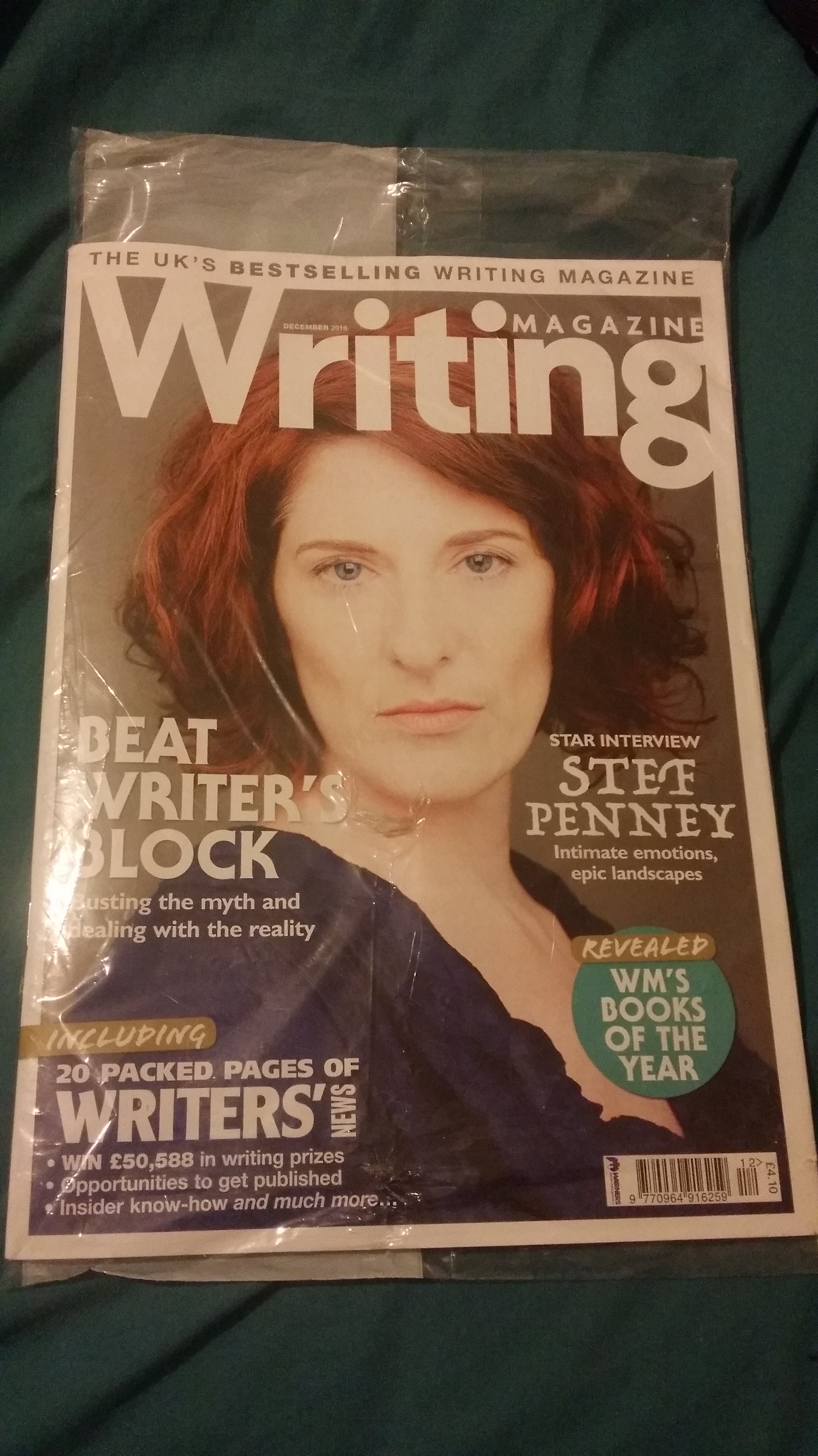
As such, some of my other projects have to be scaled back or placed on hold. This includes submissions to publishers, reading books, and updating this blog. In fact, my current issue of Writing Magazine is still in the cellophane. However, I’m making good progress, having written more words than required every day so far; in fact, the whole region is doing a sterling job.

Writing Magazine still in cellophane

How to manage a writing group.

For the last couple of years, I’ve been organising literary events, and I’ve gathered some experience during this time. Remember that every group is different, and what worked or didn’t work for me might prove the opposite for you.

The two groups I currently run are: Hotchpotch, an open-mike night for writers; and the Dundee & Angus region of National Novel Writing Month (NaNoWriMo), a challenge to pen a novel in a month. The two groups are rather different beasts, and there is little crossover between their memberships, but there are common factors in the way they’re run.

Planning

Ensure your group has a defined purpose

Hotchpotch has a definite purpose: you can take along your own work and read it for up to 10 minutes, or simply come along to listen to others. It’s a format that works for us and has done for some years.

NaNoWriMo is a franchise of sorts with a not-for-profit organisation, so you must follow their instructions and ethos. As such, we started off with purely November meetings where we would encourage each other to finish our novels. But there was such enthusiasm that we continue to meet up weekly and work on other individual projects.

There’s nothing wrong with experimentation, of course, but don’t stray too far from your original intention. There is a risk that your members will be put off going as it’s not what they expected.

Be early

Think months or weeks in advance, not days, to save rushing around at the last minute. The main NaNoWriMo event happens in November, so I’ll start planning in August as I need to receive promotional material and work out where and when our meetings should be. The next Hotchpotch is usually booked on the same day as the last meeting. Always be super-early to set up for meetings.

Coordinate and cross-promote

Hotchpotch must ‘compete’ with a monthly Silent Reading Party and a monthly Literary Lock-In as these also happen on Mondays. Through having conversations with the organisers of the latter two events, we now coordinate these events so they hardly ever clash. When one of them announces a new date, I also promote it to Hotchpotch and NaNoWriMo participants.

Communication

Use suitable methods

This depends largely on the IT skills of your members. Our NaNoWriMo region has a Facebook group where most people engage with us, although NaNoWriMo HQ require us to use their own mailing system. Conversely, many Hotchpotch members don’t use Facebook and prefer to be on our mailing list.

Hotchpotch has business cards with contact details to give to new members. During NaNoWriMo months, I also have a mobile number with a budget SIM card so people can contact me with urgent enquiries. In practice, however, we’ve rarely needed to use it.

Not too little; not too often

By all means send out a message early, but remember to issue regular reminders. People forget, or accidentally delete the e-mail. Also make sure your latest message reflects any changes that have happened since the last one. For NaNoWriMo, once a week is the usual pattern, reflecting our weekly meetings. Hotchpotch reminders are usually two or three weeks apart as the meetings are monthly.

But once a day is far too often, unless you happen to be sending out daily writing prompts.

Exercise privacy with e-mail

Whenever you send out a group e-mail, use the Bcc box, not To or Cc. This means each member will only see his or her own address when it’s received. Always give people the option to unsubscribe from updates; the last thing you want is to be reported for spam. It can be as simple as typing Let us know if you want to unsubscribe at the bottom of each message.

People

Be welcoming

This is a big one for me. Unless your group is really only for you and your mates, everyone who comes along needs to feel welcome. I’ve been put off going to groups in the past when it became clear the existing members were only interested in their own company. Whenever new folk turn up to NaNoWriMo or Hotchpotch, I make a point of introducing myself and chatting to them.

Consult, don’t dictate

Keep a list of a few trusted regulars you can talk to when the going gets tough. In the case of Hotchpotch, we had to make a difficult decision about a venue. We made a collective decision that I now agree with, but if I’d dictated, I would have gone the opposite way and might have lost their cooperation. NaNoWriMo is largely stable now, but I know the core membership are there should any problems arise.

Deal with troublemakers appropriately

Literary meetings are generally safe spaces. I can think of only one serious incident. I was a member of a group where we felt the standard of leadership fell far below what was expected. The incident was resolved, but not before pages of online words had been exchanged. If you need to keep someone in line, it’s rarely appropriate to do it over the Internet or in front of other members.

Most often, someone will say he or she didn’t like the group. I find it’s best to fix the problem, where possible, or to acknowledge his or her point of view and accept you’ll be one member down next time. It’s not worth turning a complaint into an argument, but to learn from it and concentrate on attracting new members.


If you have any tips you’d like to add, leave them below. I’ve no doubt I’ll think of one or two more myself when this has posted.

Relentlessness.

It’s been a busy week for writers and artists in Dundee.

Last Monday, our regular Hotchpotch meeting was held aboard a 19th-century warship. More than 40 people showed up – double our usual maximum attendance – and we enjoyed a fantastic and varied night of writers reading their own work. We even made the local paper. There’s a picture of me dressed as a captain.

Then the Dundee Literary Festival began on Wednesday and ended yesterday. I attended a selection of events, including a play set in a disused jute mill, an interview with Nick Frost from Spaced and Shaun of the Dead, and an investigation into the success of Ladybird books over the last 100 years. There wasn’t an event I didn’t enjoy, but I’m not going to review any of them here. Instead, some of them have already been reviewed by students.

In the middle of the festival, I saw Benedict Cumberbatch as the eponymous Hamlet with the National Theatre. The live cinema screening was sold out, but it was well worth seeing the recording. I’m glad, however, that I read up on the story before seeing it. I found it a lot easier to follow when I heard the words than when I read them on the page.

And at the weekend, artist studios WASPS held an open house, allowing the public to see how their art is made and to buy it directly from the creator. I went along with a friend to visit artist Jennifer Robson and jeweller Genna Delaney, among others.

Unfortunately, Saturday’s session was cut short by a fire alarm apparently set off by someone using a blow torch. The building was perfectly fine, but the alarm malfunctioned and wouldn’t switch off.

And just as these finish, National Novel Writing Month begins on Sunday 1 November. I’m returning as the Dundee & Angus regional organiser for a second year, and there will be someone else helping me.

The five previous times I’ve done it, I’ve exceeded the target, sometimes by less than 100 words. But one of the messages I always give out is that there’s no shame in not reaching the 50,000 word target. I’ll keep you updated during the month.

Can I Have a P Please, Bob?

Plagiarism

Hot on the heels of my copyright post the other week, a case of poetic plagiarism was brought to my attention. Remaining copies of Laventille have been pulped after Sheree Mack admitted to including others’ work in her own inadvertently, although fellow poets have accused her of stealing work deliberately.

In this instance, it’s not only the original poets who have been hurt by her actions, but the pulping will wipe out the profit margin that Smokestack Books would otherwise have made.

The one positive aspect we can salvage from this mess is that this type of plagiarism is relatively rare. If it happened every day, this story wouldn’t have been reported and nobody would have kicked up such a stink.

Postgraduates

I’m a firm believer that every writer ought to learn the skill of public performance. More on that story later. But last Wednesday marked the first time I would be performing to an audience of academics, rather than the general public or other writers.

The University of Dundee has run a Postgraduate Conference for the last four years where students set the agenda by presenting papers. Students were also free to respond creatively to this year’s theme, Lost in Translation. When I saw the final running order, I appeared to be the only person giving a creative response, and I seriously considered withdrawing as I didn’t feel it would fit in with the other presentations.

The upshot is that I did go ahead with it, although I was moved to a different slot with theatre students and a novelist. I felt it flowed more smoothly, and I received an excellent response, both verbally and on the anonymous feedback slips. My tutor was also sure to stop by and ask a couple of tough questions.

Performance

Shortly after the Postgraduate Conference, I went along to a workshop… on performance; unfortunately, it had to be in that order. Jenny Lindsay, one half of poetry duo Rally & Broad, was hosting, and they’re one of my favourite contemporary acts. She asked each of us why we were there. I told her I was quite comfortable with public speaking, but I felt there was always more to learn.

Blockbusters (UK game show)
Blockbusters (UK game show) (Photo credit: Wikipedia)

She took us through the process of preparing for an event, including how we might introduce ourselves, putting together a set list, and we even took turns at walking out in front of an audience. The organiser is hoping to put on another event in the near future but using an actual stage.

If you have the chance to hone this skill where you live, I recommend signing up. What many writers don’t realise is that if you’re snapped up by a publisher, you’ll be expected to read excerpts to a live audience. I’m not going to pretend it’s easy to stand up and entertain people, but the only way to make it easier is to keep practising, and prepare your materials thoroughly in advance. Remember, most audiences aren’t sitting waiting for you to slip up – they’re willing you on.

Promotion

Although National Novel Writing Month and its offshoot Camp NaNoWriMo are over, an enthusiastic band of us have continued to meet each week. The most recent meeting was yesterday, but we left after an hour to visit Waterstones where Kirsty Logan was promoting her novel The Gracekeepers.

I’d seen the posters across town, but I hadn’t heard much else about it until that evening. By the time I’d listened to the excerpt, learnt about the background of the world in which it’s set, and was told were some characters written as gender-neutral, I decided I wanted it. The issue of gender is something I become interested in since my feminist friends talk about from time to time.

And our group each spoke to Kirsty Logan for a couple of minutes each as she signed our books. I wish I’d thought to take a photo, as her dress contained pictures drawn in the same style as the book jacket. If I ever have a novel published, that’s a touch I’ll think about adopting, although I might settle for a shirt rather than a dress.

The Finish Line.

Every April, there’s a contest called Camp NaNoWriMo, an offshoot of November’s National Novel Writing Month. In November, the aim is to write a 50,000-word novel in 30 days. Camp, by contrast, allows participants to choose a word goal starting at 10,000 and to work on any type of writing.

I intended to do more work on one of my unpublished novels, which is mostly written but needed extra scenes. I did write a few thousand words of it, but I didn’t feel the same enthusiasm as I did when I edited it a couple of months ago. Rather than bore myself stupid with it, I changed focus.

A piece of advice often given to new writers is Finish what you start. It’s rare that I don’t finish work, but I did have a few short stories that had gone nowhere. I therefore used the opportunity to finish two of them.

One had started off as a little self-indulgence but rereading it after this time allowed me to work out and deliver the message I was trying to convey. The other one should have been written in one session, but I was interrupted and never went back to it. I now have a satisfactory ending for both pieces and they’re ready for a second redraft – and a ruthless reduction in their word counts. As for the novel, I will redraft it when my enthusiasm returns.

Camp NaNo is traditionally done without a group leader and without meet ups in person. In Dundee, however,  we’ve been fortunate enough to have active members who have met up every Tuesday in April to work on their respective pieces. I set my own target at 10,000 words as I also had a university paper to hand in around the same time, but thanks to these meetings, I managed to reach the goal.

If you’re also in Dundee, by the way, there’s a new monthly Literary Lock-in at the George Orwell up the Perth Road. There are no speeches or readings, just an opportunity for writers to mingle and speak with each other. The next one is on 25 May.

Binge Reading™.

You were expecting an entry on Monday, weren’t you? Douglas Adams commented, “I love deadlines. I like the whooshing sound they make as they fly by.”

While I normally frown upon such a laissez faire attitude, I completed National Novel Writing Month on Sunday 30 November at 1:13pm with 50,123 words. As Municipal Liaison, I wanted to set a good example, but I was keen to stress to the members that there’s no shame in not reaching the target.

From there, it was straight into the folio for my MLitt module, comprising two short stories, two poems and a poetic monologue, representing a variety of styles. I’d done most of the work, so it was a matter of pulling together the threads into one document. I submitted that at lunchtime yesterday, the day it was due.

Which left today to craft an entry, and I’ve had plenty of time to do so, as I’ve been awake since 1:50am after approximately four hours’ sleep.

This will be my blow-out weekend before I dive straight back into other projects and catch up on my reading. On my coffee table lies Quiet Dell by Jayne Anne Phillips and Raymond Carver’s collection Elephant and Other Stories, both of which need to be returned to the library in under a fortnight. The former is a weighty volume, but I shall tackle it before that deadline.

For this, I’d like to introduce Binge Reading™. It’s similar to the more familiar binge drinking or binge watching, but better for you than both of these activities. Use Binge Reading™ as you please, but remember to mention you read it here first.

Just a Moment.

In the early hours of Saturday morning, National Novel Writing Month kicked off. As I’m the organiser for Dundee, I’ve been in the thick of it since then, and I’ve had other work on top. It’s left me little time to compose a full WordPress update.

So far, we’ve held our Kick-Off Event and our first meet-up, and our word count continues to rise. When I checked it at 4:30pm tonight, we’d managed to register 168,000 words. My own words make up about 0.5% of that.

So I’m going to crack on with this, and aim to come back with a fuller entry next week.

Ready to Play.

Having been flat on my back with illness last week, I missed the chance to go to a play on 25 June called Shape of a Girl at the Little Theatre in Dundee. It tells the story of a Canadian girl who was bullied and subsequently found dead. I’d been invited by a friend, playwright Mark McGowan, who is involved with Dundee Dramatic Society.

By last Friday of that week, I was feeling much better, and Mark invited me on a backstage tour of the theatre used by the society. It really is a little place: more like a large house than a venue. The auditorium seats just 100 people, and I saw the actors holding an intense rehearsal session there for a show that opens in August. Backstage is upstairs in the attic space, accessed by wooden staircases at the sides of the stage, yet it houses a green room, costume store, sewing room, and a coffee bar.

As Mark persuaded members of the company to sign up for his latest production, I spoke with one of the actors. The theatre group has lasted around 90 years, and we discussed how it has managed to remain in its own niche against comparable venues in the city, and the potential threat from a cinema that is due to open across the road.

I also flipped through an index of plays, each with a summary of the plot and required number of actors. Between the ages of twelve and 14, I had a brief acting career through the National Youth Music Theatre. It now strikes me just how difficult it must have been to find a suitable script so we all had a part. Similarly, Dundee Dramatic Society are volunteers, so there is little control over the age and gender of the players.

I’ve only once tried my hand at playwrighting, and I enjoyed the process. The group that runs National Novel Writing Month used to run a similar event in April called Script Frenzy where participants were challenged to produce a 100-page script during the month. Many of my local SF group chose to produce screenplays, but I elected to write for the stage as it needs only two actors.

I haven’t redrafted the script since it was written. But I’m confident I’ll one day return to it, tighten up the dialogue, iron out any plot holes, and see it performed.


The End of Days.

I know you can’t see me, but I’m blowing a whistle as we speak, indicating the final dying minutes of National Novel Writing Month. I breached the 50,000-word target by only 29 words; that’s 13 less than my very first novel in 2010.

Last year’s total was 60,000 and I’d barely scratched the surface, but this time around, I don’t have the material to go much higher, so I’m happy with my haul. Many congratulations if you’ve also hit the benchmark.

My aim is for this to be the last time I bore you with this subject for the next eleven months.

I’ve been to a number of literary events this week, including a fiction writing and a life writing class, and I’m pleased to say I’m enrolled in the continuation class for the latter.

On Thursday, I attended a literary salon where I heard current English students read out their best pieces. Then on Friday, a poetry and cabaret event. A number of pieces were in the Dundee dialect, which must have confused the last act, a songwriter from New Orleans.

I’ve lived in the city most of my life and understand most of the vernacular, yet I’ve never naturally spoken it. It inspired me to write a poem exploring the theme, and I completed it before the event ended. I’m not known as a poet, and I’m not at the stage where I would describe myself as one, but I have been dabbling in the form.

I’ve also been working on another piece, but I need to give you a bit of background. If you didn’t know, I’ve only been a writer since October 2010. To put that in context, I was 27 when I wrote a fictional story for the first time since high school. The piece was that first NaNo novel.

However, when I was at school, I fancied myself as a singer-songwriter, not to mention an actor. I’d tried to write song lyrics, and I recently rediscovered a four-line fragment with two internal rhymes. Moreover, I can still remember the tune, and the words still resonate as much now as they did then.

At the time, I tried to expand it by writing extra verses, but nothing seemed to work until I turned to Google+ earlier this week. With the help of a community, I preserved the rhyme scheme but expanded the number of syllables, and I’ve now squeezed nearly four verses out of it. If I keep making progress, I finally hope to perform it on December 9th after all these years.

After a conversation with my former NaNo Municipal Liaison a couple of weeks ago, I raked out my school qualifications. I’d correctly remembered I’d earned only a C for English, although I have criticisms about the way it was taught. Perhaps that’s why I never pursued it, or perhaps I was too fixated on music to realise my strength was in words, not instruments.

I’ve got to make up for the time I wasted setting up blogs writing factual events without realising that I was able to write fiction. I kick myself every day about my late start, although I take some comfort from the careers of Barbara Taylor Bradford and Richard Adams. Their first books weren’t published until they were over 40 and over 50 respectively.

But I need to work fast if I want to reach a state of parity. I want to reach the point where I’ve produced as much work as if I’d started as a teenager. I have around 200 pieces in total, but that could have been 1,000 if I’d begun at age 15.

I won’t rest until I’m satisfied I’ve made up for every minute of wasted time.