Hotchpotch Moves to Groucho’s

Regular readers will know that I used to run a monthly open-mic event called Hotchpotch, which I handed over to my pal Eilidh in October 2024.

At the time, the event had been running at a café in Dundee until an upcoming permanent closure was suddenly announced in July 2025. The August event was able to go ahead, but she had to find somewhere to hold it in September.

Fortunately, it didn’t take long to find a suitable replacement: a live music venue called Groucho’s that was once a second-hard record shop. For context, Hotchpotch has probably moved ten times in 15 years for one reason or another.

Unlike a typical music gig, however, Hotchpotch has a particular set of requirements for accessibility. There are people constantly entering and leaving the stage area, plus the environment needs to be quiet enough for the audience to hear clearly. Often, you just need to try out the place to find out what fits and what needs improvement.

Aside from a fixable incompatibility with our microphone and the house PA system, the maiden event yesternight went marvellously and attracted some positive feedback. I took the opportunity to read a piece that was specifically written for the occasion.

Being back on the pub circuit feels like a homecoming in a way because that’s where the format evolved. A couple of members even returned after a few years away. The event also made me realise I’ve missed one aspect in particular.

Two venues ago, we were in the basement of a pub called the Hunter S Thompson. At the end of each event, I would pack up and go home soon afterwards because I was always working the following morning. It took me some time to realise members weren’t simply chatting and dispersing; they were instead heading upstairs and drinking together for an hour or two.

From then on, I encouraged folks to do that, as the more cash we could put through the tills, the more likely we were to secure our bookings for the future. I even joined them on occasion, but not every month.

When we moved to a café in 2023, we were given a 9pm curfew to allow the staff to finish at a reasonable time. But with Groucho’s open until at least 1am, I look forward to seeing the return of this particular element.

Reaching Fever Peach

On Saturday just gone, I was given the opportunity to perform a 15-minutes of poetry at the Keiller Centre in Dundee. This was organised by local comedy band Fever Peach as part of their Monthly Indulgence event and here’s how they announced the event.

That said, I only learned of the opportunity on Wednesday and I didn’t have a themed set ready to go. After looking through my collection, the structure came together quickly, with the verse generally moving from more serious to more frivolous.

The actual reading time clocked in around 12 minutes. This was helpful as I knew there would need to be time left for applause and possibly banter with the hosts and the audience; I even gave out Biscoff biscuits as part of the performance.

And there was one other factor at play. When I go to events, I often like to write verse in situ. On one occasion, I wrote clerihews for all the performers who had gone before me. On another, I offered a poetic critique of all the art on the wall of the café. This time, I scribbled a short poem during the soundcheck, based on the, ‘One-two, one-two,’ that sound engineers often use to test microphones.

While the Fever Peach duo kept the show together, the other act on the bill was a travelling Mexican musician called Ed Stone. Despite breaking two different strings on two guitars, he acted as a melodic counterpoint to my poetry.

These shows always end with a complicated improv game, during which my mind went blank more than once, and Ed struggled a little because he was playing in a second language. Still, it was all a bit of fun.

The only downside was the size of the audience, with just five tickets sold. While it is true that the venue is quite hidden away, they always go down a storm and they deserve more eyeballs.

I would happily perform for Fever Peach again, and I look forward to similar opportunities in the future.

Background Noise

Whenever I’m starting a longer writing session, I like to play some music in background. Over time, my playlist of choice has changed.

It was initially the soundtrack of the film The Assassination of Jesse James by the Coward Robert Ford, composed by Nick Cave and Warren Ellis. Since that lasted only around 45 minutes, I bulked up the playlist to just over an over with more Nick Cave songs.

More recently, I’ve switched to a musician called Jason Lewis, although I can’t recall when I first discovered his work. Since 2006, he’s produced three-hour mixes with isochronic tones. These are regular repetitions of a single tone mixed into rapid beats, which are supposed to enhance concentration.

From what I can gather, there’s no scientific basis for this, but I find his mixes work for me. They’re completely instrumental, allowing me to focus on writing, and free to access on YouTube.

The only real difference between the soundtrack and the Jason Lewis music is the familiarity. With Cave and Ellis, I would hear exactly the same songs in the same order and know roughly where in the playlist I was. With Jason Lewis, by contrast, I tend to listen to either the most recent mix or choose one that matches the mood of my piece.

Of course, I’m completing this entry at my regular Tuesday writing group, which comprises whatever the bar decides to play. It can be a strange mixture of pop, metal, easy listening, dance or rap, with no apparant pattern. Tonight is a reasonable mix, featuring Elton John and Kiki Dee with Don’t Go Breaking My Heart right now.

Marching into March

Around a week ago, tickets for the StAnza poetry festival went on sale. For around a week, there are poetry events all over St Andrews, particularly in the Byre Theatre and Parliament Hall, but also taking advantage of smaller rooms and venues across town.

I’d normally be at the front of the queue for events, but I’ve held off booking them this year. I have other commitments that potentially clash, plus I was waiting to receive this month’s wages.

It’s likely I’ll go to the breakfast event on Saturday, with a pie or a pastry served before it. I’m then going to visit a pal I haven’t seen for two years who lives in the area. At night, I need to decide whether to enter the slam competition, as the late finish means staying overnight or catching one of the last buses home. I’m then playing Dungeons & Dragons the next day.

So as soon as I publish this, I’ll be looking through the festival programme and working out a plan. I can already see some of the staple events, like poetry in translation, round table discussions and music recitals; I just need to work out how to fit them into my schedule.

I have

One Poem, Three Audiences

A couple of weeks ago, I was invited to a fundraising event featuring open-mike slots. I’d gone along under the assumption that the stage was reserved solely for musicians, and there were a number of talented ones there. But after a chat with the organisers, I discovered it was open to anybody.

If you know me, you’ll know I’m always willing to perform. This, however, would be a tough crowd because a music audience is different from a poetry audience.

Your average pub rock group expects to encounter some external noise, like audience chatter or the noise of the till, but three or four instruments with amplification can easily compete against that. By contrast, a poetry audience knows to be silent because the performer has only words to convey; even with amplification, it can be hard to talk over a noisy audience.

I drew upon my experience to pick two suitable poems, and they received a better response than I could have hoped for, even with a lot of background chat. One of the poems was a humorous and surreal piece about personified biscuits; I’d picked it because it seems to appeal equally to poets and non-poets.

The following night, I performed the biscuit poem at a dedicated poetry night with an open-mike element. While the audience did hold a respectful silence, they were harder to excite than the pub group crowd, perhaps because many of them had heard it before.

While drafting this entry about the two aforementioned evenings, I was then unexpectedly invited to perform at another gig.

I sing in the church choir on a Sunday, and the organist was organising the music to entertain their Wednesday Club. Most of the choir performed solo songs, but I was asked to perform a couple of poems. I turned again to – you guessed it – the biscuits.

This time, I was uncertain how it would be received. I knew the audience would lend me their silence, but not whether they would consider it appropriate for the event. But I needn’t have worried, as I heard some great feedback both on the night and at the next Sunday performance.

There is no foolproof way to tell how an audience will react. However, by performing often enough, it’s possible to gauge which pieces to perform – and sometimes it pays off incredibly well.

Poetry in the Community

On Monday of last week, I had the opportunity to teach my colleagues how to write a type of poem called a clerihew. This was part of a larger event called Learning at Work Week where people were teaching their skills to their workmates, such as Zumba, knitting and making mocktails.

A lot of people don’t think they’re very good at writing poetry, so the aim of my workshop was to encourage colleagues to write verses about each other using a simple format. I ended up with a number of good ones, and the clean ones might make it into the internal newsletter.

Colleagues and friends have also occasionally commented that they don’t understand poetry in general, with some asking how to appreciate it.

The best advice I can offer is to read and listen to a wide variety of different poets. There will probably come a point when you begin to differentiate between what you like and don’t like.

After all, most people are certain of their taste in music, and that’s because we’re surrounded by it every day and have built up a template in our heads of what is ‘good’ and ‘bad’. If you’re willing to take the time, it’s possible to do the same with poetry.

Writer About Town

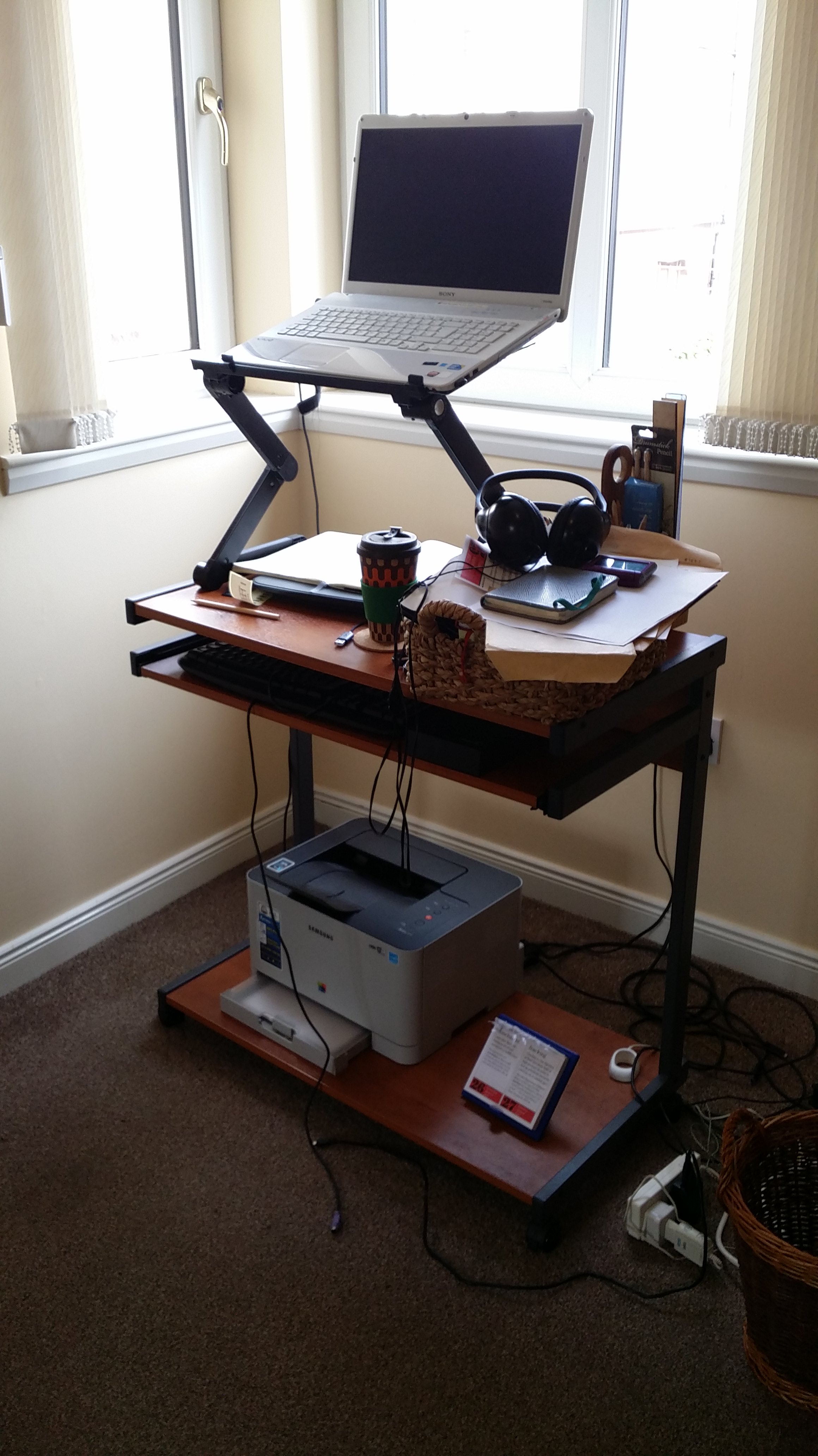
Some time ago, I posted a picture of my writing desk at home. I’ve included an up-to-date one in this entry.

Although I type up pieces here, they normally begin life as pencil on paper and usually far away from the room. This includes not only fiction and poetry, but often blog posts and routine correspondence.

When I was stuck with a piece, I used to head to a café called The Empire State, with a view of the city centre from each of its three levels. The ambient sound was Motown and classic hits, and I found these helped me to break through writing blocks.

I haven’t been there lately, but mainly because I’ve found somewhere else that’s slightly more convenient.

My nearest BrewDog bar opens at midday and is usually quiet enough for writing undisturbed until mid-afternoon. What’s more, there are power sockets for laptops, plus my shareholder card gives me a discount. The only downside is that the music repeats on a 60-minute loop.

I have one more place I like to write, and it’s the most bizarre of all. It’s in a retail park on the edge of the city, surrounded by a DIY retailer, a supermarket and other warehouse-style outlets. It’s a McDonald’s restaurant.

At some point over the last five years, I’ve discovered that it’s most conducive to writing. I know I can turn up there with a notepad and by the time I finish my coffee, I’ll have something on the page, and not just crumbs.

Great as it is for creative work, though, it’s not so good for my weight loss attempts.


Taking the Rap.

It must have been about fifteen or so years ago that I was listening to a portable radio – perhaps tuned to Radio 2 – and the DJ played an incredible track. It was simply a wall of words shouted by an incredulous, angry voice. I caught the name of the artist: one Gil Scott-Heron with his poem The Revolution Will Not Be Televised.

I use the word poem very deliberately, as that’s how he wrote it. It contains many of the elements of performance poetry, being light on metaphor but heavy on wordplay. Today, it would probably be classed as rap because it also embodies many of the hallmarks of a modern rap track, with repetitive backing music and rapid spoken words.

Even if you don’t remember the racial tensions of the 1970s, he conveys the spirit of the time in just over three minutes. I also have the rest of the eponymous album on vinyl. If you seek it out, do listen for Whitey On The Moon as well.

I was just as surprised listening to Radio 1 in 2002 as some ska-like sounds started to play. The trumpets of Let’s Push Things Forward made me a fan of The Streets for their first two albums.  I recommend avoiding the last two, as Mike Skinner appeared to have run out of ideas by then.

His first CD Original Pirate Material (OPM) was hailed as ‘Shakespeare for clubbers’ as he spoke about urban life in the UK, painting an uneasy sense of civil unrest bubbling under the surface. For this, the BBC also made the comparison to Never Mind the Bollocks, an unfair comparison because Skinner is far more intelligent than that.

For a start, each track on OPM quotes a lyric from another track, while his second album A Grand Don’t Come For Free is a proper concept album, each track adding a little more to the story arc. Between the machine-gunning internal rhymes, Skinner also surprises with the beautiful ballads It’s Too Late and Dry Your Eyes.

More recently, Rizzle Kicks burst onto the scene with Stereo Typical. I can’t get enough of their second album Roaring 20s. It’s the hooks that draw you in, but the lyrics keep you there.

Even when you move past the radio-friendly Skip to The Good Bit and Put Your Two’s Up there isn’t a duff track among them. I Love You More Than You Think is about unrequited love, while Me Around You explores the awkwardness of acting normally around an ex-girlfriend. It’s hard for lads to talk about things like that, yet they acknowledge this difficulty while expressing themselves in such a fluent way.

The point I’m trying to make is that not all rap should be dismissed as rubbish spouted by overpaid bigheads. If you know where to look, there is some good quality writing out there that we can all learn from. At the very least, it can help bring on the right mood or give just a small suggestion to expand upon. I openly admit that poetry is my weak point, so I mainly listen in awe of how these artists construct their words and phrasing.

Of course, inspiration can come from the strangest of sources. I have a short story that came from watching an RSPB advert, and a poem that was helped along by Corona’s dance track Try Me Out.

And that’s a wrap.

The End of Days.

I know you can’t see me, but I’m blowing a whistle as we speak, indicating the final dying minutes of National Novel Writing Month. I breached the 50,000-word target by only 29 words; that’s 13 less than my very first novel in 2010.

Last year’s total was 60,000 and I’d barely scratched the surface, but this time around, I don’t have the material to go much higher, so I’m happy with my haul. Many congratulations if you’ve also hit the benchmark.

My aim is for this to be the last time I bore you with this subject for the next eleven months.

I’ve been to a number of literary events this week, including a fiction writing and a life writing class, and I’m pleased to say I’m enrolled in the continuation class for the latter.

On Thursday, I attended a literary salon where I heard current English students read out their best pieces. Then on Friday, a poetry and cabaret event. A number of pieces were in the Dundee dialect, which must have confused the last act, a songwriter from New Orleans.

I’ve lived in the city most of my life and understand most of the vernacular, yet I’ve never naturally spoken it. It inspired me to write a poem exploring the theme, and I completed it before the event ended. I’m not known as a poet, and I’m not at the stage where I would describe myself as one, but I have been dabbling in the form.

I’ve also been working on another piece, but I need to give you a bit of background. If you didn’t know, I’ve only been a writer since October 2010. To put that in context, I was 27 when I wrote a fictional story for the first time since high school. The piece was that first NaNo novel.

However, when I was at school, I fancied myself as a singer-songwriter, not to mention an actor. I’d tried to write song lyrics, and I recently rediscovered a four-line fragment with two internal rhymes. Moreover, I can still remember the tune, and the words still resonate as much now as they did then.

At the time, I tried to expand it by writing extra verses, but nothing seemed to work until I turned to Google+ earlier this week. With the help of a community, I preserved the rhyme scheme but expanded the number of syllables, and I’ve now squeezed nearly four verses out of it. If I keep making progress, I finally hope to perform it on December 9th after all these years.

After a conversation with my former NaNo Municipal Liaison a couple of weeks ago, I raked out my school qualifications. I’d correctly remembered I’d earned only a C for English, although I have criticisms about the way it was taught. Perhaps that’s why I never pursued it, or perhaps I was too fixated on music to realise my strength was in words, not instruments.

I’ve got to make up for the time I wasted setting up blogs writing factual events without realising that I was able to write fiction. I kick myself every day about my late start, although I take some comfort from the careers of Barbara Taylor Bradford and Richard Adams. Their first books weren’t published until they were over 40 and over 50 respectively.

But I need to work fast if I want to reach a state of parity. I want to reach the point where I’ve produced as much work as if I’d started as a teenager. I have around 200 pieces in total, but that could have been 1,000 if I’d begun at age 15.

I won’t rest until I’m satisfied I’ve made up for every minute of wasted time.