Running a Readathon

For the last six years or so, I’ve been involved in a small readathon that takes place on Discord. Over time, it’s been scheduled on various dates and has been run by different people.

In its current incarnation, I help my pal Jenny to run it once a year, approximately around Yuletide. This year, it was set to start at 8pm on Saturday, finishing at 8pm on Sunday. This left us both enough time for a screening of It’s a Wonderful Life first.

For the avoidance of doubt, the intention of the readathon is not to stay up and read for 24 hours straight. Instead, it encourages participants to ringfence some time over these 24 hours to settle down with a book.

We provide regular prompts throughout the event. These might include:

  • Sharing how you discovered the book you’re reading.
  • Telling the group three facts about the author.
  • Writing a haiku about an event or character in the story.

There are also reminders to stand up, stretch, eat and drink. We established early on that some participants were in different time zones, so we could say, Depending on your side of the Atlantic, it’s likely to be approaching either breakfast-time or lunchtime, so be sure to stop and fill up.’

Because Jenny is a night owl and I’m more of an early riser, it was relatively easy to coordinate the full 24 hours., particularly as I had a half-baked plan to watch the winter solstice sunrise from the Law Hill in Dundee. This meant it would pair nicely with the summer solstice six months earlier, even if the cloud cover meant there wasn’t particularly much sun.
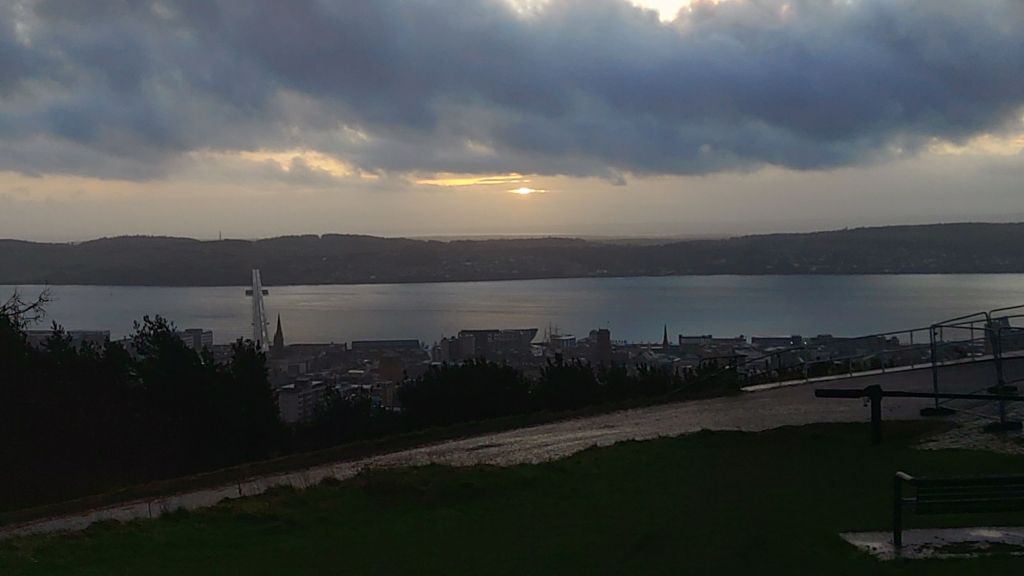
Winter solstice sunrise as seen from the Law Hill in Dundee. There is thick cloud cover partially obscuring the sun. The sky glows softly behind dramatic clouds, casting muted light across the water and buildings. A bridge spans the river, and a bench in the foreground sits beside a damp path and grassy verge.

So what of the actual stories?

I’ve become a lot more interested in audio storytelling over the last 12 months, so rather than reading paper books during the readathon, I listened to a drama on BBC Sounds based on the Fukushima nuclear accident in 2011, a radio drama called Cat and Mouse Game by R D Wingfield on YouTube, and an audiobook of The Time Machine by H G Wells.

The participants’ reading lists incorporated a variety of authors such as Ayn Rand, Becky Chambers, Iain M Banks and George Orwell.

I was a somewhat tired by the end of Sunday, but the event was very satisfying to run. It goes at an easy pace with just enough interaction to keep the server ticking over. I look forward to holding it again next year.
Dipping Back Into an Older Blog

I must preface this entry with an assurance that I’m not ditching this blog. Rather, I’m here to talk about two others that still exist but are largely disused.

My first is LiveJournal – known to its users as LJ – which was once the enfant terrible of blogging and is now the senine grandparent. My profile page has always shown the start date as 15 March 2004, but I suspect there’s some longstanding technical glitch because my first entry was written three months previously on 19 December 2003 and I definitely didn’t backdate it.

I do have cause to visit LJ regularly to read entries from one person who’s never stopped updating. But I only update it when I believe it’s the most appropriate medium. The last time was for an art project in January 2022.

But that’s not the blog I’m here to talk about. I’m here to talk about the other one.

In 2008, two former LJ employees set up a new site called Dreamwidth that addressed their concerns over the user experience. When LJ was the target of several Distributed Denial of Service attacks the following year, several users began to crosspost there, fearing their own blogs might be taken offline. Because both sites share a similar codebase, it was simple to adapt.

I used it differently, taking the opportunity to curate a circle of close friends where I would post more private thoughts. To this day, every entry remains protected and the profile has no connection with my profiles elsewhere.

I updated a lot back then, to the point where I bought a seed account for $200, which is essentially a lifetime membership with premium features. Looking back, I now realise I needed to fix the root of my angst earlier rather than analyse it extensively every month or two while taking no real action. Once I did, the updates ground to a welcome halt and there have only been a handful of entries since 2013.

That said, I updated once again a couple of weeks ago after I felt it was the only possible outlet.

This entry wasn’t quite like the older ones. For a start, it was much more measured and positive. This was more the digital equivalent of writing a letter to someone and placing it in a filing cabinet instead of posting it. There’ll be only one still-active person likely to read it, but I simply had to spill out my thoughts before I could move on.

As I write, I realise I’ve been updating WordPress regularly for more than 11 years, which is approximately equal to the 11 years I was regularly updating LJ. It won’t be too long before I’m past the balance point. Even so, I’ll be keeping that site and Dreamwidth active for the foreseeable future, just in case they come in handy.

Writing Yourself Out of a Corner

If you were a fan of Friends back in 1998, you’ll remember the hype and speculation around what would happen during Ross and Emily’s wedding.

Coming at the end of Season 4, this had to be a climactic scene. These days, it’s hardly a spoiler to mention that Ross accidentally says Rachel’s name, which feeds into the entirety of Season 5. However, I’ve only learnt in the last week that the writers struggled to think of a proper ending until the actor who played Ross – David Schwimmer – accidentally switched the names during another scene.

This serves as a good example of how even professional writers are rarely bestowed with fully-formed ideas. A story often needs to be written out and figured out along the way, and that process can take years.

Larry Cohen pitched the idea for the film Phone Booth to Alfred Hitchcock in the 1960s, but neither of them could think of a reason to keep the main character in the booth. By the late 1990s, the public was becoming increasingly vigilant to the threat of terrorism, and Cohen played into that as he realised a sniper with a weapon could be a good reason. It was even a plot point that the main character was one of the few people still using a payphone by that point.

I even have a few examples of my own. One particular example was a three-line fragment of poetry I wrote at school before I ever routinely wrote poetry. In 2013, more than ten years after I left school, I finally found a way to work it into a fuller piece. It gained a sequel in 2018, taking a very different tone from the original, chiefly in recognition of how I’d changed in those five years.

But even professional writers miss the mark sometimes. The final episode of The Prisoner was broadcast in 1968. Although its writer Patrick McGoohan was pleased with the result, he was under pressure to deliver it quickly and many viewers were unhappy that it raised more questions than it answered.

And we must mention the ninth season of Dallas, which was entirely written off as a dream to bring back the character of Bobby Ewing.

Poettiquette

I was invited to take part in a poetry reading on Sunday night, spanning not only the UK but other countries in the Anglosphere.

This was a mammoth four-hour stint, even with a time limit of ten minutes per poet, plus just one five-minute break. My spot was halfway through, but I stayed the whole time because I wanted to listen to the rest of them, most of whom were event hosts like me.

I performed one serious piece and two humorous. Although there was no audible feedback, I could see some of the faces in the crowd and read comments in the chat box. The set seemed to go down well.

At that point, I received a friend request on Facebook. I was glad that someone enjoyed my work enough to make that request. Furthermore, I’d been in a planning group with some of the other performers, so we were acquainted already.

It must also be stated that the public part of my profile clearly states ‘Not open to friend requests’, yet as of Monday morning, I had four requests waiting. One of them sent me a message acknowledging that he’d seen my profile, and was basically trying his luck. I admire his gumption, but I told him he could either follow my Hotchpotch open-mike page or my Twitter account instead.

On the back of this, it occurred to me that when people perform at my events, they might also have the same view, and a lot of folk don’t feel comfortable telling someone to back off. To this end, I’ve added a disclaimer to the open-mike. It’s likely I’ll tinker with the exact wording, but the spirit will be reinforced in event promotions:

Unless consent has been given, the host and contributors are not open to friend requests.

This alone is unlikely to stop the issue; three people have either not read my profile or wilfully ignored it. However, it acts as a pre-emptive reminder to keep some distance from those who don’t want to interact so closely with others.

The Initial Hurdles

As I’ve been writing for so long, I sometimes forget that less experienced writers still struggle with the initial hurdles that I overcame a long time ago.

Earlier this month, my partner sent me a poem she’d written, after we’d spoken about her interest in developing her craft. She’d always been reluctant to revisit and redraft her work, yet that’s arguably the first step to improving your writing. When you’ve just placed something on the page, you’re not reading it fresh like the next person will.

Probably the most important task to undertake before showing someone is to learn how to edit your own writing.

We discussed the sent poem, in which I suggested trimming many words and restructuring the stanzas. It’s not unrecognisably different from the first draft, but it now flows significantly better.

And now a friend has asked me for help. She has no problem redrafting her work, but is reluctant to show it to anyone. It’s a real fear among some people that their work will be disrespected. I’m currently working with this person to encourage her to open up a little.

When I’m asked to look over someone else’s piece, I sometimes ask whether there’s a particular aspect I should focus on; for example, grammar, structure, themes, &c. I also make it clear that whatever suggestions I make are optional. This sometimes means letting go of aspects that break convention: a couple of poets, for instance, like to capitalise the beginning of each line, even though the widespread practice died out a century ago.

When someone has asked me to look over a piece I might not understand it, or it might not be to my taste. But what I won’t do is sneer at, ridicule or dismiss someone’s work when they’ve taken the time to request constructive feedback.

Notes from Neighbours, and Letters to Other Lands

For the last three years, I’ve lived in a block of flats just out of town, and I’ve become rather well acquainted with my neighbours below me and beside me.

Just after the lockdown was announced on 23 March, I recieved notes through my letterbox from both households, offering assistance if necessary. I didn’t require any help, but it gave me an opportunity to write letters back to them.

Since then, I’ve also received notes from two other neighbours that I’d seen en passant but didn’t know by name. One of them apologised for dropping soil onto my balcony, while the other wanted to talk about a noise issue from another flat.

I keep a special notepad for letters, styled as ‘nu:elite‘. The pages are ringbound A5 sheets that tear off along perforations, leaving a smooth edge. It’s also a heavier weight of paper, which I favour, although I do have a lighter weight, styled simply as ‘nu‘. if I’m not trying to impress the other person.

While I had the notepad to hand, I penned one to a friend in Florida, enclosing some commemorative David Bowie stamps that I rediscovered while clearing up. Shortly after that, a pal in California wondered whether I could send her a pen I’d had custom-made for my open-mike Hotchpotch.

Then I had a birthday card returned undelivered from Dublin; this had been posted before the lockdown. I’d bought and printed my postage online rather than visit the Post Office, but I’d messed it up. Reading back the letter I’d originally enclosed with the card, it seems I’d been pushed for time and hadn’t written much. I therefore decided to send it back with a longer letter, as the first had gone out of date because of the movement restrictions. I was sure to learn how to properly affix self-printed postage.

The letter-writing bug must also have hit my Canadian pen-pal, whom I met through National Novel Writing Month. She apologised via a private Twitter message that she hadn’t managed to write back. I, of course, said not to worry about it.

I remember learning at school how to write letters by hand in the mid-1990s. Looking back, it seemed a little dated even then: word processing software was near-universal, though e-mail was not.

In sixth year, however, I learned how to touch-type and to format a document correctly. The teacher was near retirement age, but she’d moved with the times: there were no double-spaces after full-stops.

Despite my love of letter-writing, I’m also doing it sparingly, as we don’t yet know exactly how the current virus is transmitted. The aforementioned neighbours now have my phone number, so as to reduce physical contact as soon as possible.

The Go-To Person

On this blog, I’ve previously discussed the theory that 10,000 hours of practice makes someone an expert in a given field. In particular, I raised the topic first in December, but held off from defining what an expert is in relation to writing.

As there is no objectively good way to write, it’s awkward to apply the word ‘expert’ to anyone. I think it more accurate to use a term such as ‘go-to person’.

Every so often, one friend or another will ask me for writing advice. I’ve recently been asked me to look over a poetry chapbook by one person, while another wanted help to create a workshop about how to perform on stage.

I always feel privileged to be the go-to person in any given matter, even if I make clear that my advice is made up of subjective suggestions and that the writer can implement or reject each one.

This also works the other way around. I have a roster of folks I can ask for help. One might be the go-to person for playwriting, for 19th-century poetry, or for academic writing.

I’m an expert by no means, even if I have a lot of experience in a given area, and neither are the people I rely on. Instead, we are mutual go-to people. None of us know all the answers; instead, we work together to find the answers.

The Benefit of Experience

Last week, a friend sent me a poem she’d written about a recent bereavement, asking for some suggestions. I immediately agreed. I copied the piece into Microsoft Word and switched on Tracked Changes, then looked through the piece line by line.

The first thing I did was check whether she’d followed generally accepted conventions, such as placing a lowercase letter where the start of a line isn’t a new sentence, and making sure a significant word ends each line.

When you read poetry a lot, you begin to build up a template in your head of what you like and don’t like, and what looks ‘right’ and ‘wrong’. So aside from the conventions outlined above, I considered how the piece sounded overall, and omitted or added words accordingly.

I made it clear than anything I wrote was merely a suggestion and could be ignored if she felt it didn’t work. Indeed, the poem was great to begin with, but someone else could easily come along and make different suggestions in accordance with their experience.

I don’t know yet whether this friend took my suggestions on board, but if she does, I believe it would improve the piece.

Surprise, Surprise

On Tuesday of last week, I came home to a parcel. I was only stopping for a brief time before heading out again. I didn’t pay much attention to it, as I was expecting a USB cable.

Just before leaving, I opened the parcel to check I’d received the correct equipment. So imagine my surprise when I found it actually contained the following:

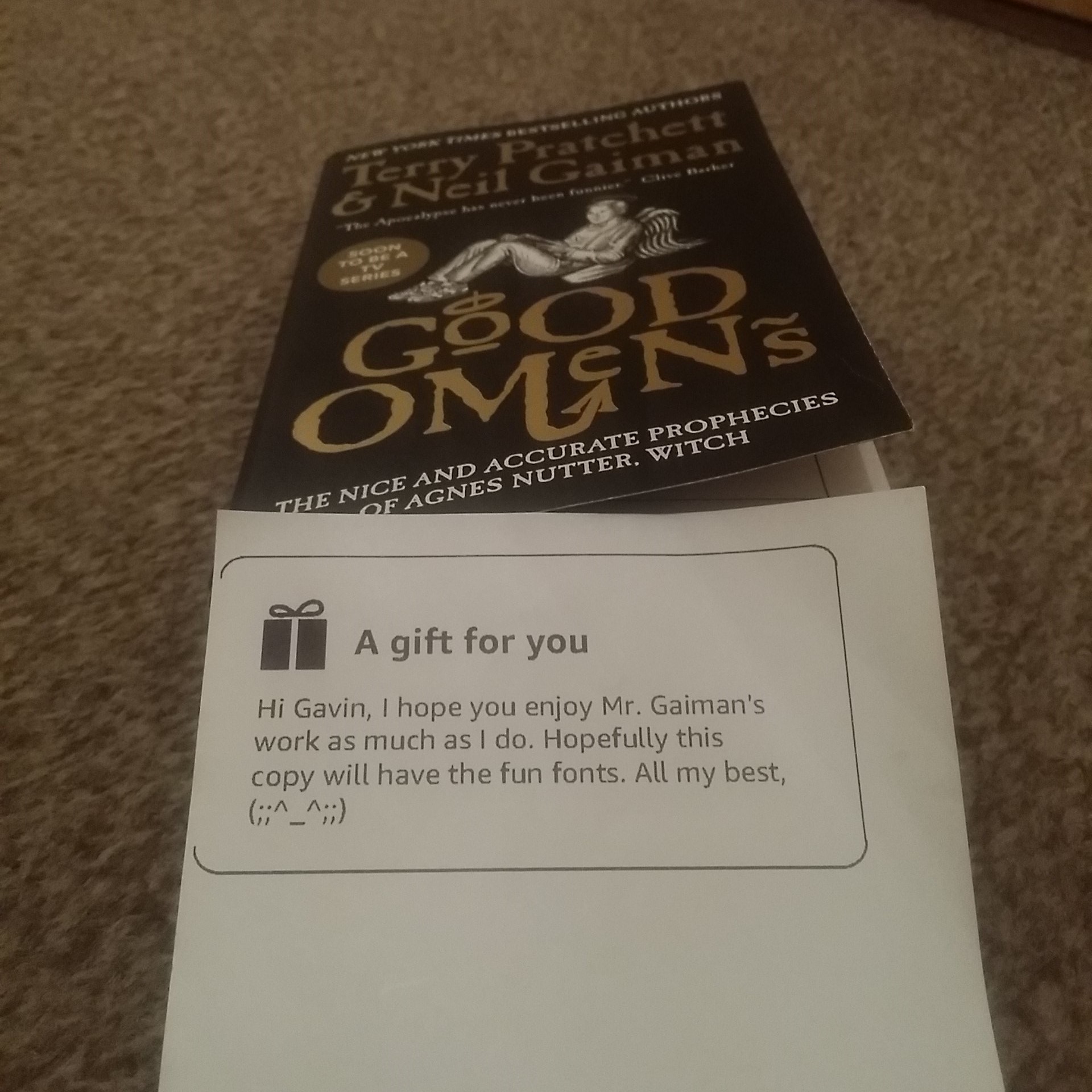
Picture of Good Omens with a personalised gift note

Good Omens by Terry Pratchett and Neil Gaiman. There was no sender’s name, only a cat’s face made up with punctuation marks. However, it didn’t take long to trace it to an American friend. Around a week before, she’d heard the BBC radio adaptation from 2014. I’d casually mentioned I’d heard this, but hadn’t read the full novel, so she’d jumped at the chance to send it.

It was an incredibly thoughtful gift, and I’m making good progress with reading it. I’m working on what to send back as I have National Book Tokens that need to be spent before the balance expires.

The One with the Problem

Last week, I made reference to an event called Make / Share, in which four people from different artistic disciplines were invited to talk on the subject of ‘Creativity and Self-Care’.

Each speaker gave biographical account of their practice and how each finds a balance between working and resting. Although each story was unique, they all had one factor in common: the artist had to suffer ‘burnout’ before striking this balance.

Mulling this point over afterwards, I was reminded of comments I made in the summer to some good friends that are believed we should be working longer hours in this country, as is common in places such as Japan and South Korea, and being more productive. My friends are great people, so while they thoroughly disagreed with my view, we didn’t fall out over the matter.

APO headquarters.jpg
A place called the Asian Productivity Foundation by Kwangyun.lee – Own work, CC BY-SA 3.0

I apologised to them and retracted my comments in mid-November. Looking at said comments objectively, I realised they were right and that I’m the one with the problem. Over the last few months, I’ve read a few articles on workaholism and found I could answer ‘yes’ to many of the questions. I began reading the Helen Russell book The Year of Living Danishly and thought it sounded like a dystopian nightmare.

The trouble is that I don’t feel as though I have a problem. Here’s how I stand now:

As this writerly lark doesn’t pay very much, I also have a full-time office job. I have more than 26 hours flexitime credit, although I have reached the limit of 29 before, and the last time I took annual leave was in August, with no plans to take any more in the foreseeable future. I run a writing group that meets up every Tuesday and I was pleased to find out our venue is open on Boxing Day and 2 January so we wouldn’t need to take a break. I also have plans to continue writing my November novel and a potential sequel, as well as adapt a public-domain book into a screenplay. I have a target of sending 53 pieces to publishers each year, an average of one a week plus another for good measure. I’ve managed 43 thus far, so I’ll add the other 11 to the 2018 target.

Yet I’m far from burning out; I make a lot of time to see friends and I have a reasonable sleep most nights. It’s simply a case that I need to be working in some way, either in the office or outwith; it’s what keeps me sane. Even when I read a book or watch a film, it’s never entirely for enjoyment, but to comb it for structure and techniques.

Thanks in part to the Make / Share event, I now know the signs of burnout to look out for. Unless that happens, though, I’m going to keep doing exactly what I’m doing – even more if I can squeeze it in – because I’ve never been happier.