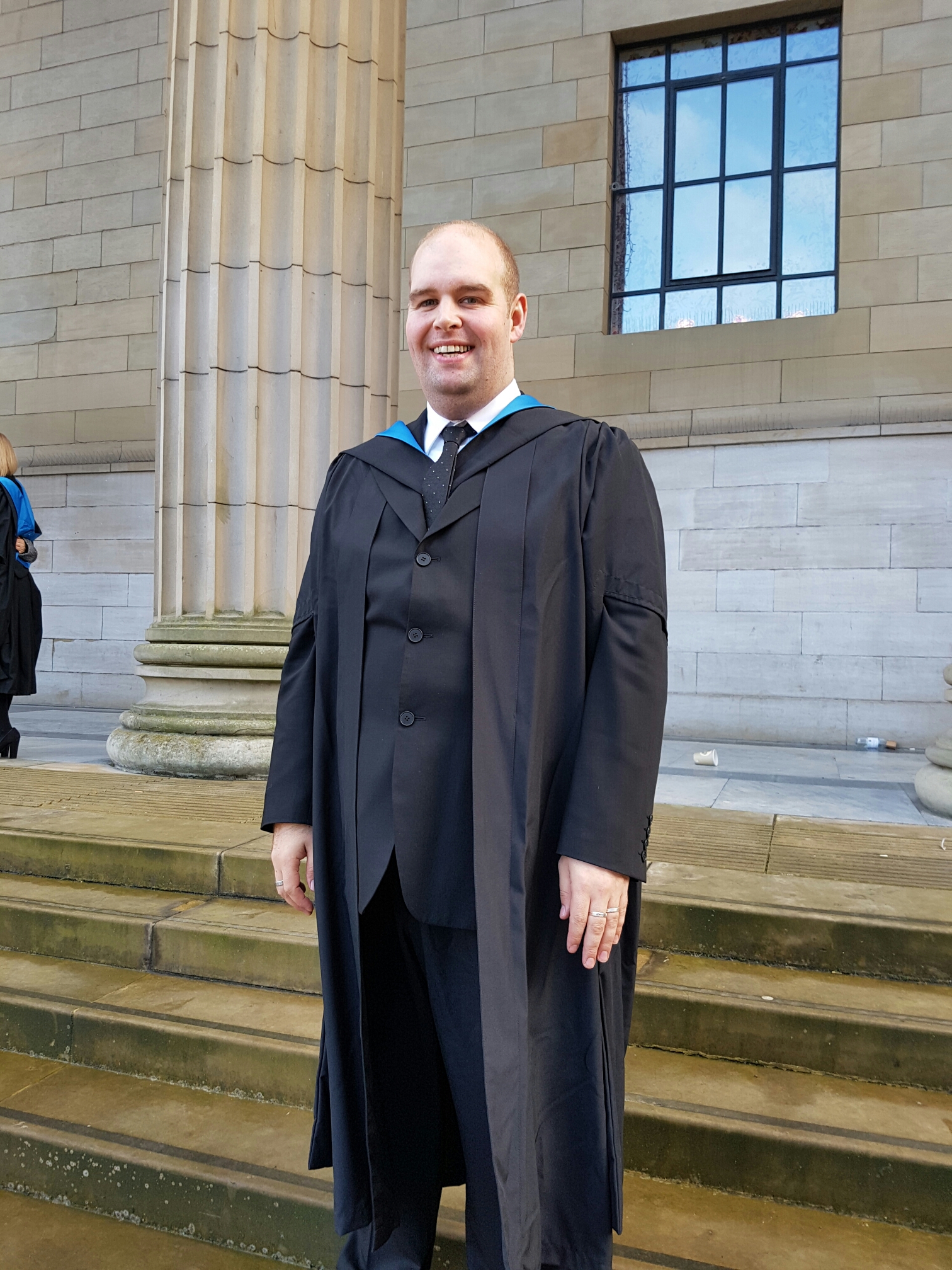
For those of you who haven’t read it elsewhere, I’m pleased to report that I’ve now graduated with an MLitt in Writing Practice and Study. I’ve become a jack of all words, and master of letters.
The logistics of the ceremony has left me behind with my other work, so I’m afraid it’ll be another short entry.
We’re now into the thick of National Novel Writing Month. The Dundee & Angus region alone collectively ended 11 November at well over half a million words, and the total is rising every day.
But other literary events are still happening. Tonight, I’m going to a Silent Reading Party, then a Spanish-themed poetry night. And on 25 November, I’ll be seeing the actor Alan Cumming in conversation with Muriel Gray about his latest book.
I would like to take this opportunity to plug a couple of events. You might be aware that my poem Crossing the Road has been included in the anthology Aiblins: New Scottish Political Poetry, which officially launched in Edinburgh last month. There is also to be a Glasgow launch tomorrow 15 November where I can’t be present, and an Aberdeen launch on 21 November where I’ll be performing.
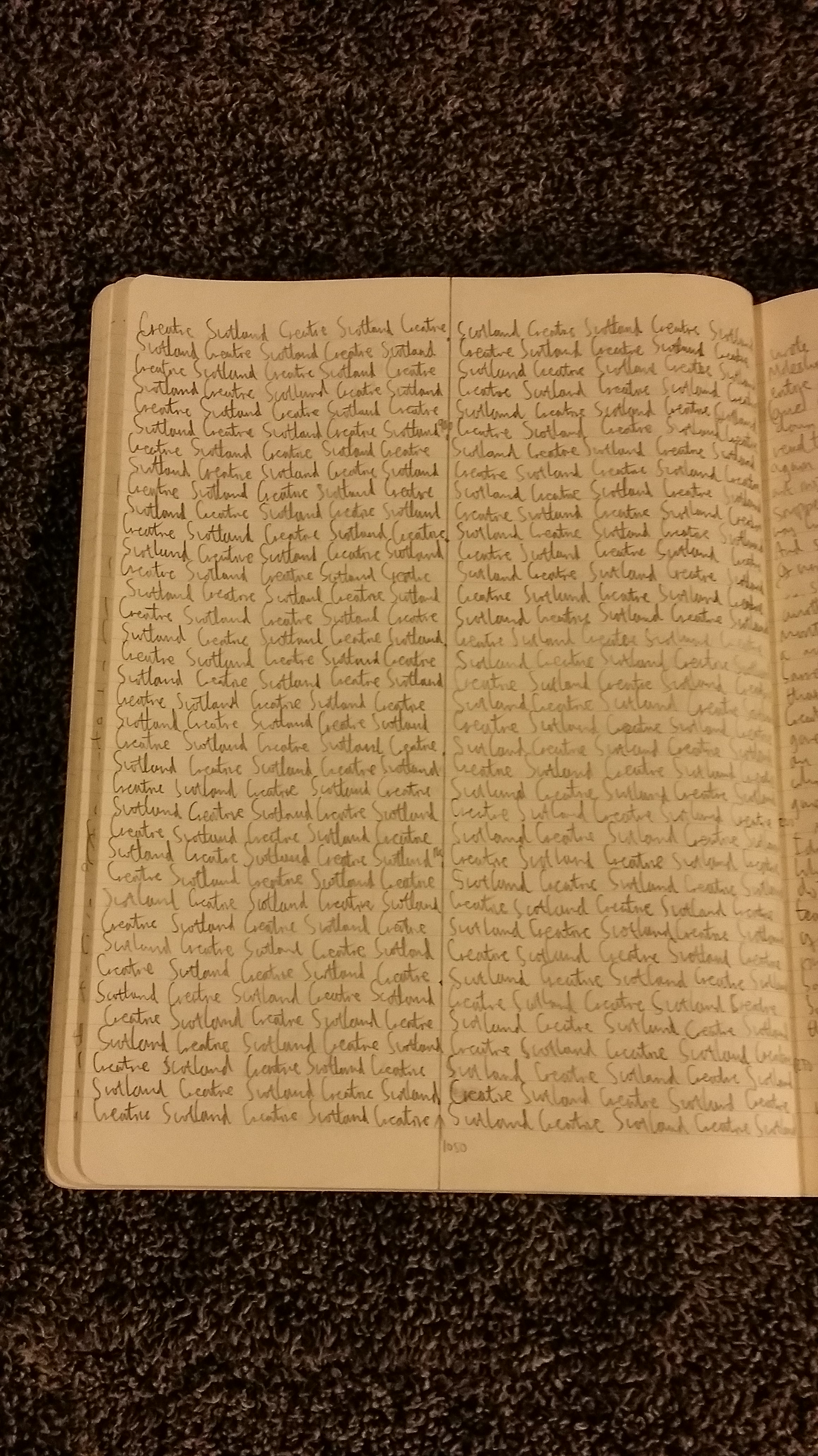
For now, though, it’s back to NaNoWriMo. I didn’t know where I was going with this year’s story – in some respects, I still don’t – but I now have a character who loves to fill notebook pages with the same phrase, much like Jack Torrance in The Shining. Here’s what happened when she was turned down for an arts grant:
Every November, I take part in National Novel Writing Month – aka NaNoWriMo – which is a challenge to draft a 50,000-word novel in a month. Along with an assistant, I’m also a Municipal Liaison (ML) for the Dundee & Angus region in Scotland. We arrange regular meet-ups for members, encourage and support them, and persuade them to donate to the project.
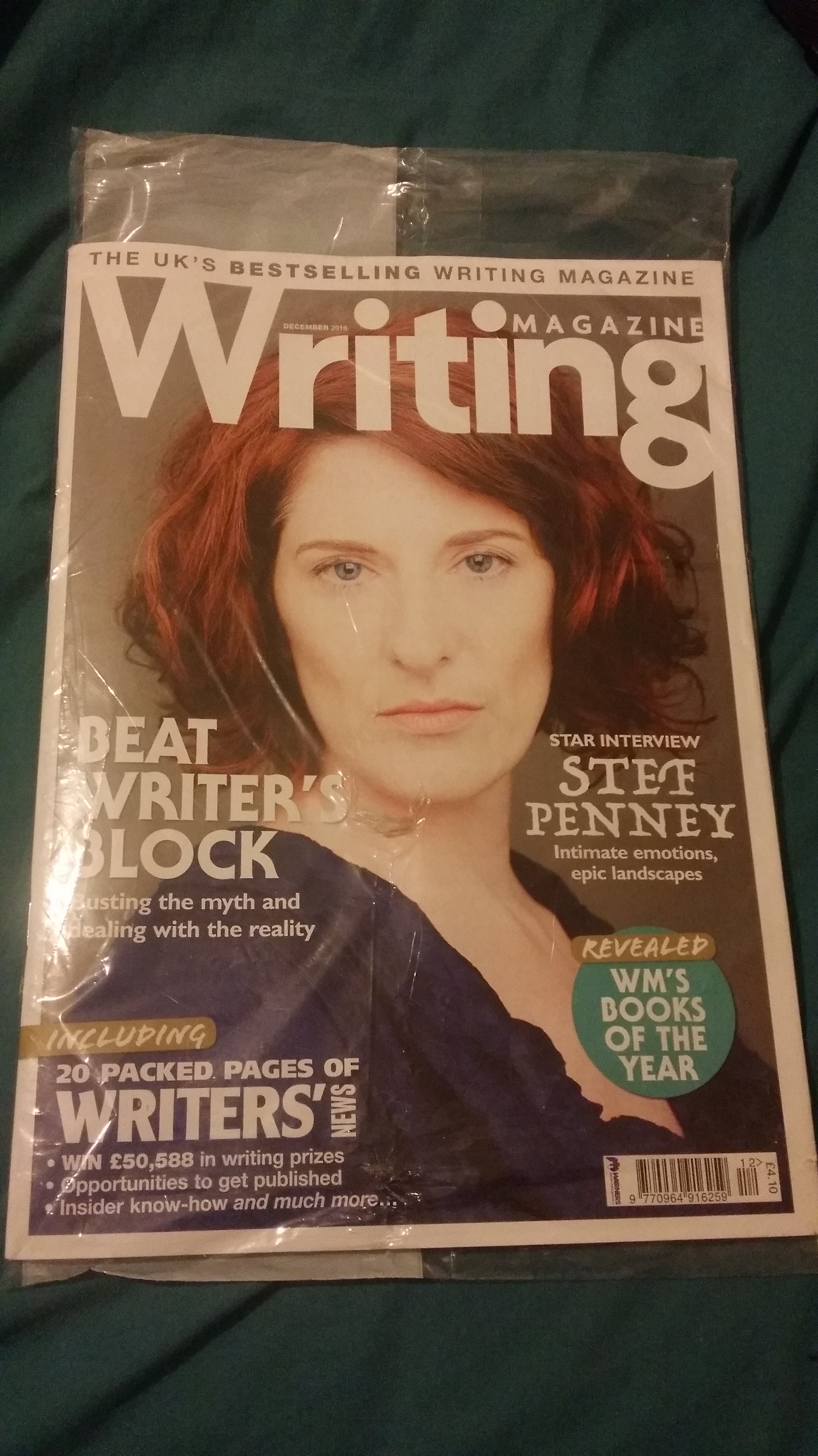
As such, some of my other projects have to be scaled back or placed on hold. This includes submissions to publishers, reading books, and updating this blog. In fact, my current issue of Writing Magazine is still in the cellophane. However, I’m making good progress, having written more words than required every day so far; in fact, the whole region is doing a sterling job.
Fans of the BBC TV show The Apprentice will remember a candidate who styled himself as Stuart ‘The Brand’ Baggs. While his idea of branding was certainly misguided, it was nonetheless a memorable gimmick. As a writer, it is similarly important to consider how you’ll be perceived by your readers.
Next time you’re in a bookshop or a library, have a look at some of the book covers. You’ll often find that books by the same author share certain elements: perhaps the author’s name is written in a particular typeface, or perhaps a certain style of artwork is common between them. But branding goes so much deeper than a cover. It can include the personality or values that you want to convey to the reader.
Bronco branding in the Top End. (Photo credit: Wikipedia)
My own branding begins with my moniker: Gavin Cameron is actually my first and middle names. My real last name is Cruickshank, but I don’t use it because there are several possible variations in the spelling, and it serves as a small distinction between my real life and writing life. Not to mention that Crookshanks is Hermione Granger’s cat in the Harry Potter series.
There is a long literary tradition of pseudonyms, and this is catered for in the standard manuscript format. Your real name goes in the address at the top left-hand corner, while your pen name is included in the byline underneath the title. I also mention it in the body of the e-mail or on the cover sheet.
Even so, the issue does occasionally cause problems. A couple of times, show organisers have thought that Gavin Cameron and Gavin Cruickshank were two different people. One organiser recently made publicity material in the name of Cruickshank instead of Cameron, and it’s now being corrected.
In an attempt to stop this from happening again, I’ve now made it clear in my e-mail signature:
On the same subject, you might have noticed my Twitter name @LadyGavGav. Although I’ve never liked my first name being shortened to Gav, and still don’t, I felt I had to take that Twitter name as it was available and was an improvement over my previous handle @Knaw_Says.
I spoke a little about my upcoming gigs in the last entry. This week, I want to pass on some of the advice I’ve picked up in the years I’ve been performing.
A live performance is a great way to introduce yourself to a new audience, and to add extra enjoyment for your existing fans. So it’s crucial to make a solid effort. The advice below should be treated not as strictly unbreakable rules, but as guidelines to make your event flows as smoothly as possible. Some of the points were made in a 2015 entry, but have been updated as I’ve gained more experience.
Think about your introduction.
Check with the organisers what content you need. Sometimes you need to give an introduction; other times, you’ll be asked only to read the piece. If you do need to introduce your work, it’s worth making brief notes, such as:
Give your name
Thank Tracey Jones for organising
Story is called On the River Tay
Taken from collection The Pie Seller
Published by Law Hill Books
Brought copies, happy to sign
Then on the night, you might say, “Good evening, my name’s Mary Walker. I’d like to thank Tracey Jones for inviting me to read tonight, and the piece I’ve chosen is called On the River Tay. It’s taken from my collection The PieSeller, and that’s published by Law Hill Books. I’ve brought some copies and I’ll be happy to sign them afterwards.”
Explain if you need to, but don’t apologise.
Some pieces do require an explanation. Perhaps the work is unfinished; perhaps it’s an extract from a longer work and needs context. But whatever you have to explain, keep it as brief as you can and certainly don’t apologise. If you feel an apology is necessary, ask yourself whether the piece is ready to be heard in public.
Before reading to someone, read to no-one.
The best way to identify any weak parts in a piece is to read it aloud – and that’s the last thing you want to happen in public. So find a space on your own and read it out when nobody can hear you. Are there any long sentences that need to be broken up? Are there words that are difficult to say clearly when grouped together? Can you add or take away any alliteration or rhyme?
If you don’t have the luxury of solitude, the next best method is to use text-to-speech software and listen to your words through headphones. There is plenty of suitable software available online, and some programs allow you to adjust the speed and the type of voice.
Make sure you also time yourself and keep it within the constraints laid down by the organiser. This might mean writing a longer introduction to expand a short piece, or reading out only a section to reduce it.
Practice your page turns.
Unlike a rock star, the great thing about being a writer is that you’re often allowed to take your notes on stage. When reading from a book or from sheets of paper, it’s a good idea to turn up the corner slightly or stick a post-it note to the back to help turn it more easily. When using an e-reader or tablet computer, practice tapping the correct area of the screen to turn the page. Make sure to account for any delay, as not all devices instantly show the next page.
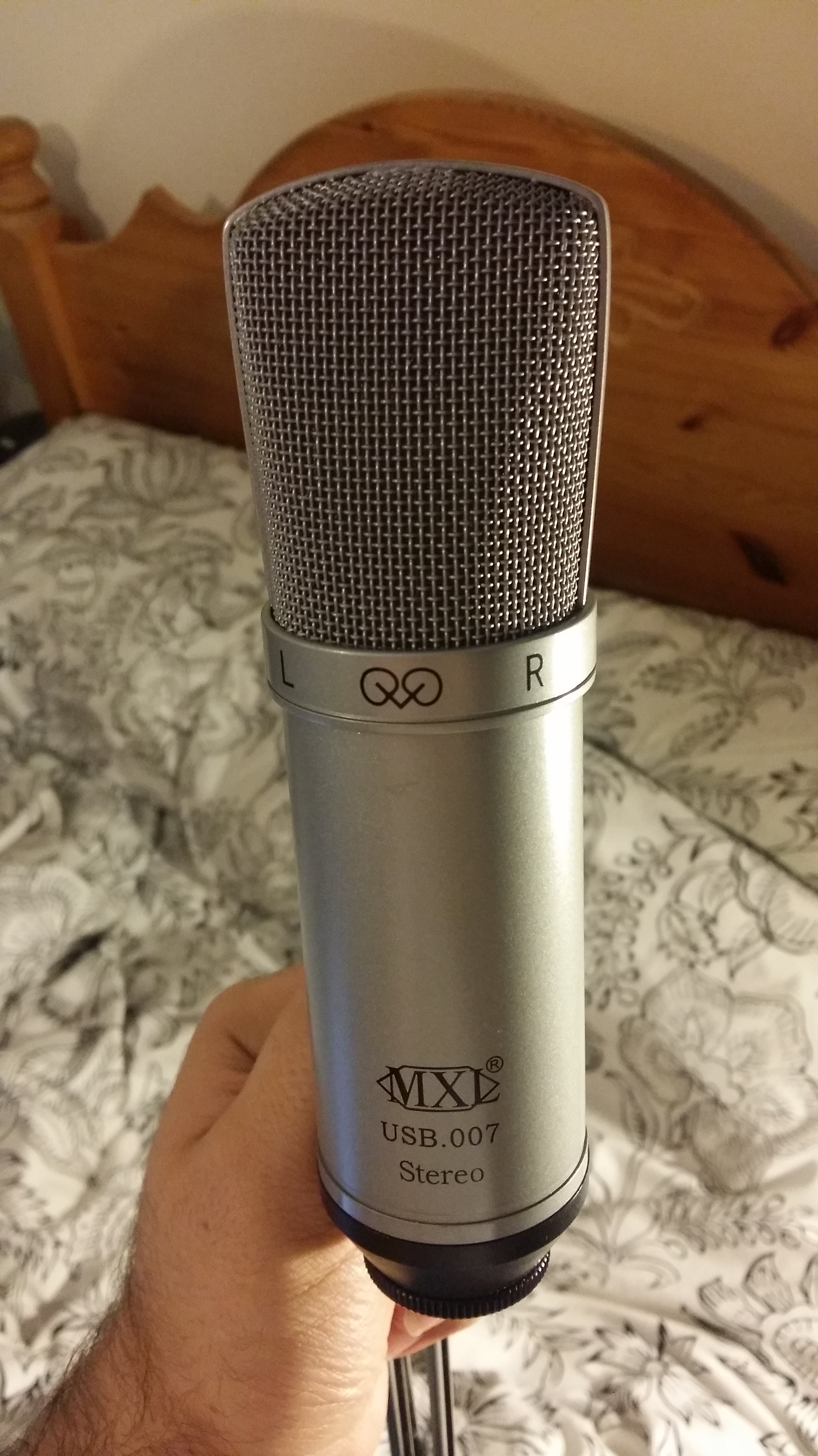
To use my microphone, you have to speak into the side. It connects to a PC with a USB cable, and works with no additional software.
Make sure everyone can hear you.
In my experience, smaller readings tend not to use a microphone, so you need to project. Avoid tilting your head down to read the piece; instead, hold your manuscript higher and off to one side so it doesn’t muffle your words, or look down only with your eyes. Always speak slowly than you would in normal conversation.
If you do have a microphone, ask the sound engineer if you can test it out beforehand, especially if you’re unfamiliar with using one.
Most microphones collect sound from the top, but some designs mean you need to speak into the side, like mine (pictured). Either way, make sure you know which one has been given to you. One of the biggest distractions for an audience is a sound level that vastly increases and decreases, especially at random. Whether the microphone is handheld or on a stand, keep it at the same distance from your mouth.
Avoid too much alcohol or a heavy meal before the gig.
I fully understand why many people need Dutch courage before going on stage. But a drunk speaker rarely makes a good impression, especially during a paid gig, so strictly control your alcohol intake. It takes some concentration to perform, and too much booze impairs that concentration.
My rule is not to take alcohol before speaking, only coffee. Afterwards, however, I sometimes enjoy a red wine. It’s also a good idea not to eat too much in the hours before the performance, as a heavy meal can also slow down your thought process.
Decide where in the room to look.
I know one poet who deliberately looks at individual audience members and delivers a few lines before moving on to the next person. However, this is not what most people do because it can be unnerving to make eye contact. Fortunately, there are some techniques to make this easier. One of my favourite methods is look between two people, so the person on the right assumes I’m looking at the one on the left, and vice versa. Another way, which is particularly good for a theatre setting, is to look beyond the back row. This has the advantage of keeping your posture correct.
Sometimesthe audience reacts wrongly.
I’ve had experiences where an audience didn’t laugh when I’d expected, or chuckled at a serious point. You have no control over this. Should it happen to you, don’t point out the anomaly or repeat it. Wait for the laughter to die down if there is any, then move on without comment. But if you find different audiences keep reacting in the wrong way to the same part, you might consider revising it or editing it out in future performances.
If there’s a cock-up, keep going.
In a live event, something is likely to go wrong. Perhaps the microphone fails, perhaps you forget the words, perhaps somebody walks out. The best course of action is to keep going. The audience will easily forget a slipup if they’re engaged with your narrative. Conversely, they’ll remember the person who stopped the show early, and they’ll remember for the wrong reasons. It’s true that there is no easy way to recover from forgetting your words, other than picking up from the last section you remember, but keep saying something.
Two years ago, I was invited to read at Dundee University Students Association. I was debuting a poem called Housekeeping. I now know this piece back to front, but if you’ll excuse the terrible picture quality, here was my first attempt at memorising the words:
Signalthat you’ve finished.
At the end of a piece, the audience doesn’t necessarily know whether you’re finished or simply pausing for dramatic effect. But an audience can pick up on your gestures. You can lower your manuscript, step backwards slightly, or say, “Thank you,” whereupon they’ll take the hint and applaud.
Do it again.
It’s an eye-rolling cliche, but the more you stand up and speak in public, the easier it becomes. Over time, you’ll learn little nuggets like which techniques work or don’t work for you, which pieces always or never provoke a reaction, &c. Ultimately, a good performance can sell more books.
Last week, a friend was complaining about a major writing competition that still only allows postal entries. I’d also submitted work because it’s a prestigious publication, but I agree with her point of view. Considering the hundreds of manuscripts that must be received – versus the tiny portion that makes the final cut – this seems a colossal waste of paper, not to mention the needless postage time and cost.
Many competitions offer the postal route as an alternative to an online submission, and there’s nothing wrong with that. Nor is there any issue with posting work that must be physically held to be appreciated. But there are still a bunch who want normal prose and poetry to be sent on paper.
English: A stack of copy paper. (Photo credit: Wikipedia)
Until the 1990s, this was how submissions were made. Internet access and e-mail accounts were generally the domain of academics and computer enthusiasts. Come the next decade, however, and newer technology began to creep into people’s homes. Nearly 17 years after the millennium, online access is nearly universal in the Western world, and postal submissions now look incredibly outdated.
That’s not to say I don’t like a paper book. In fact, some recent research has concluded that sales of e-books are falling. But a book is the final product; the process of gaining the interest of an editor or a competition judge ought to be as quick and cheap as possible.
Yet I would like to understand the other side of the argument. Do you run a publication that only wants submissions on paper? How does it benefit you? What would make you consider accepting online entries?
A couple of weeks ago, I received two copies of Is There a Book in You? by Alison Baverstock through the post. However, I have no memory or record of ordering them. They were professionally packaged in a grey polythene envelope with a printed address, but had no other identifying features.
Did you send me these books, or do you know who did? None of my friends have claimed responsibility, even the ones who are liable to such jolly japes.
There is one possible explanation. I’m a subscriber to Writing Magazine, and I ordered two extra copies of the September edition because it featured my release The Purple Spotlights EP. Perhaps whoever put the order through accidentally marked it as a new subscription and it triggered off a welcome gift. If it is, they’re not getting them back, because it’s a lovely surprise, and when I’m ready to edit my novel again, I’ll be sure to dip in.
This year alone, I’ve really enjoyed books I’ve been lent by friends. Never Let Me Go by Kazuo Ishiguro was a prime example, and the similar The Girl with All the Gifts by M R Carey. I would group these two books thematically with the P D James classic The Children of Men, although I bought that one for myself and didn’t find it quite as entertaining as the other two.
English: Stack of books in Gould’s Book Arcade, Newtown, New South Wales (NSW), Australia. (Photo credit: Wikipedia)
The Girl with All the Gifts has now been turned into a film, and I’m curious to see how well it’s been done. Ditto the Paula Hawkins novel The Girl on the Train.
Poetry-wise, it’s been a strong year of lending as well. I was given Tonguit by Harry Giles and What They Say About You by Eddie Gibbons. The former collection gave me lots to chew upon, especially in the poems Piercings and Your Strengths; the latter volume had me laughing right past the poems to the endnotes.
Word-of-mouth is always a strong marketing tool. The people who recommended all these books are good friends, and by extension, I trust what they recommend. By and large, this trust is well placed.
In fact, there has been only one recommended book where I didn’t enjoy it: The Rosie Project by Graeme Simsion. The main character is Don Tillman, a professor with autism, and that’s shown extremely well through the narrative. However, he’s at the peak of his career with a packed schedule that’s timed to the minute, so I felt he lacked a strong motivation for wanting to find a partner. There was a time I would have persisted with a disappointing book, but I stopped reading at page 41.
That said, I’m a strong believer that people should make up their own minds about which books they like and don’t like. Plenty of people love the novel, but it’s not for me. By the way, that referral came from my boss, so you can’t tell anyone I’ve admitted all this.
I’m pleased to report I’ll have two poems published in the forthcoming Seagate III anthology. The title is a reference to the oldest street in Dundee, Scotland, as each poet in the book has a connection with the city.
And what a line-up. I feel privileged to appear in the same volume as local poets that I know and admire. But what happened to Seagate I and Seagate II? The former was published in 1975 and the latter in 1985, so the trilogy has taken more than 40 years to complete. Yet in some ways, its timing couldn’t be better.
The Dundee waterfront is undergoing a major redevelopment that has brought in investment such as a new railway station, a five-star Malmaison, and the Victoria & Albert Museum. This sense of willingness has also seeped into other areas, including the literary scene.
2016 marks the tenth year of the Dundee Literary Festival, featuring poet Liz Lochhead, and X-Men actor Alan Cumming. But I believe you can have a richer experience at any festival by taking time to support less well-known authors and even taking a gamble on something you might not like. I can think of only two disappointments out of the dozens of events I attend each year, and neither of them were unknowns.
Most of the Dundee events take place in the Bonar Hall. No laughing at the back – it’s pronounced bonner. But an appropriate location can really bring out the flavour of the topic.
Yesterday, for instance, I was up a hill with a fantastic view of the city hearing poetry about the places we could see. And on Wednesday, Sandra Ireland went to Stockbridge in Edinburgh to launch her debut novel Beneath the Skin since that’s where it’s set.
The RRS Discovery in the Antarctic (Photo credit: Wikipedia)
And on Friday, I attended the launch of The Voyage Out, containing narratives of journeys, and featuring some of the Seagate III poets. The event was held on board the RRS Discovery, the ship which took Robert Falcon Scott and Ernest Shackleton to the Antarctic.
In preparing this week’s entry, I struggled to choose a topic: the singular ‘they’, ‘because’ as a position, past neologisms we now take for granted, the work-life balance, even the events of 11 September 2001.
I managed to start writing a couple of these topics, and I couldn’t even begin on the others. Either I ran out of material or lost my enthusiasm halfway through. I hesitate to use the term ‘writer’s block’, because I didn’t have trouble beginning these entries, only carrying on to form them into the shape of a coherent blog post.
I also couldn’t decide which picture would best illustrate my point, so here are two cats. I hear felines are perennially popular on the Internet. (Photo credit: Wikipedia)
In my experience, there are two main strategies for overcoming this difficulty. Strategy 1 is for when a deadline isn’t looming: I’ll leave it aside and go for a walk or do something else while the idea sorts itself out in my head.
However, I’m writing this on Sunday with the time fast approaching 3pm. Although it’s more than 24 hours until I publish, eight of these will be spent in bed, another eight will be spent at the office, and I would like to leave some time to proofread the text before it goes live. So Strategy 2 involves writing and writing until something usable appears on the screen. Just as you’re more likely to win a raffle prize if you buy more tickets – although it’s never guaranteed – you also have more chance of finding the right words when you write more of them.
As for the topics listed in the first paragraph, I’ll leave them aside for the moment and I might come back to them for a future entry.
Exactly 39 years ago today, the Voyager 1 spacecraft was launched; its twin, Voyager 2, had a 16-day head start. Each craft was built to last five years and return data only about Jupiter and Saturn. But incredibly, both of them continue to send useful data back to Earth.
Similarly, our words as authors will likely hang around long after they were written.
Most of The Pilgrim’s Progress was written in Bedford county jail; the author John Bunyan having been arrested for his beliefs during the Great Persecution. Although published in 1678, it’s still in print more than 330 years later, longer than anyone of the time could have imagined. The language has changed in this time, of course, but I find 17th-Century English quite accessible with the aid of a few footnotes. That’s if you have time to read the 108,000 words.
John Bunyan (Photo credit: Wikipedia)
Yet there is never a guarantee of longevity. George W M Reynolds was a contemporary of Charles Dickens who outsold Dickens during his lifetime, but whose readership disappeared after his death. We simply don’t know why, or indeed why some authors capture the public’s imagination at all, or why some never do.
Probably the closest modern equivalent we have to either of these writers is Jeffrey Archer.
Like Bunyan, Jeffrey Archer wrote a lot of material while serving a four-year prison sentence for perjury. Like Reynolds, he sells a lot of books but is not generally regarded as a top author. My feeling is that the coin could land on either side for Archer: revered or forgotten.
In light of this, I used to wonder whether to make a particular story timeless, or set it in a definite year or decade. While a contemporary reference can make a piece seem dated, I also feel the reader will often take into account the era in which the story was written: the killer that’s caught by a fingerprint rather than a DNA sample, or the science-fiction prediction that’s now yesterday’s news.
On balance, I reckon it’s not worth worrying too much about whether or not a particular piece needs to be accessible to people of the future; after all, your audience is alive right now. If your words remain in print when you’re no longer around, that’s a bonus.




 Gavin Cameron