Thanks to an invitation from the Amps network at Creative Dundee, I was invited to explore the archives at the city’s Central Library on Saturday morning. This should have happened back in March, but plumbing problems forced the place to close for the day.
While there is a wealth of historical documents on public display, there is far more behind closed doors, viewable only by appointment.
It proved challenging to squeeze ten people around the tightly-packed shelves, and it’s just as challenging to describe the breadth of stored material. It spans three centuries of historical newspapers, self-published poetry, local maps, building plans, posters for pantomimes, &c. Each piece tells its own story and can’t always be slotted neatly into one category or another.
Some of the shelves at Dundee Central Library.
My pal Dr Erin Farley led the tour, giving answers to every question posed throughout the two-hour visit. When booking the tickets, Amps members were invited to request any special documents they wanted to see. I seized the opportunity to mention my interest in railway infrastructure.
In response, I was rewarded with the original proposal for the first Tay Bridge, bound in a booklet of broadsheet-sized paper and listing Thomas Bouch as the author. As we know from history, the structure collapsed in 1879. Meanwhile, another member enquired about whether there was an LGBT+ collection. Erin explained that efforts were actively underway to develop one.
After the visit, we were treated to coffee and an overdue catch-up with others. Since most Amps events take place during office hours, I’m rarely able to attend, though this scheduling suits many of the self-employed creatives with more flexible routines. I especially miss the wonderful virtual breakfast events at 9am on Tuesdays, so I was keen not to miss a rare Saturday outing.
There’s so much more I could add about the organisation, but I’ve written so much over the past there years that it’s easier to read the relevant back-entries. Indeed, if you’re local and you think this might be for you, here’s how to sign up.
It was quietly announced last week that the organisation behind National Novel Writing Month was to close. Universally known as NaNoWriMo, or even NaNo, this was a challenge to draft a 50,000-word novel during November each year, later expanding to include smaller challenges in other months.
The announcement, made on Sunday 31 March, was so quiet that only those on the mailing list received it. There also exists a corresponding video from the Interim Executive Director, which has not gone down well with the commenters.
And yet, at the time of writing, the official website remains unchanged. So when I heard the news second-hand on April Fool’s Day, I had to double-check it, missing the chance to include the news as last week’s entry. Still, the week-long gap has allowed some time for reflection.
I joined NaNo in 2010. It had been around for 11 years at that point, and was arguably at the height of its popularity, as illustrated by Google search trends over the years. There were dozens of affiliate groups around the world, including one in Dundee city centre. At my very first meeting, my laptop ran out of battery, so I rushed out to buy a notepad and a mechanical pencil. The graphite rods kept breaking, rendering it next to useless.
Fast-forward five years, and I’d graduated from member to organiser in the natural flow of people leaving and joining. I stayed in that role for nine years alongside several different co-leads until we withdrew our affiliation in 2024 over the nonsense that had been happening.
By this time, I’d fallen out of love with the central November challenge, as I found myself with an increasing series of started but incomplete novels. I didn’t fall out of love with bringing writers together, so I’m pleased still to be co-leading the independent group we created to replace it.
So the big question: what caused the closure? It’s a complex story that can best be told by the NaNo Scandal website, which has documented the problems with the organisation from December 2022.
However, the simplest analogy is that of a Fortune 500 company, which will typically act to keep its stakeholders satisfied. In the case of NaNo, the stakeholders were the organisers on the ground who encouraged members to keep writing and to keep donating. After alienating these folks, the cash dried up.
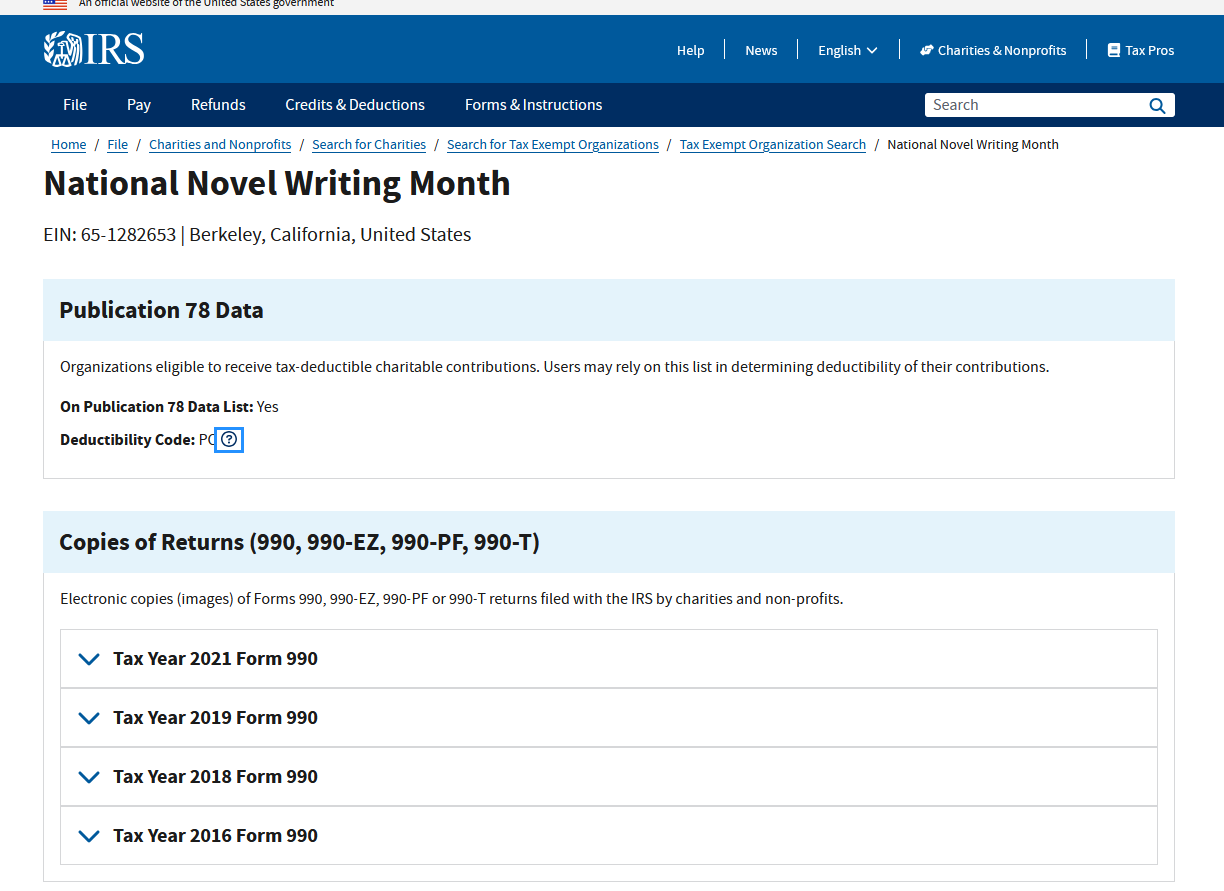
Speaking of cash, search information from the US Internal Revenue Service (IRS) website makes for interesting reading. From what I can gather, the nonprofit National Novel Writing Month should be filing Form 900 annually, which then becomes a matter of public record. However, the last document at the time of writing dates from 2021.
I’m absolutely no expert, so perhaps there’s a genuine reason why the last four years are missing from this list. But if you’re an accountant or you’re connected with the IRS, you can access the search function and enter the Employer Identification Number 65-1282653 to find out the details.
I really don’t want to leave this entry on a sour note. I was involved with the organisation in some capacity for 14 years, so more than half of its 26-year history. I had some wonderful experiences, and I still speak to so many former participants. So here are three memories that stand out:
I held a couple of midnight launch parties at my home, with the plan to start writing in the first hour of 1st November. I had only a two-seater couch at the time, so every chair and cushion was taken up with people, who were also dodging electrical extension cables. As the clock hit 12am, the entire room fell silent for an hour, aside from the tapping of keys.
I’d met someone in real life and was chatting to her via Facebook Messenger. I wanted to take a gamble and ask her out, so I enlisted the members of that week’s NaNo meeting for advice, all of whom were in long-term relationships themselves. They helped me to steer the conversation and figure out what to say next. She still turned me down.
A local organiser used to be known as a Municipal Liaison or an ML. As the pandemic was easing, the government was permitting people to meet up again, while NaNo was still warning MLs to hold only online meetings. To circumvent this, I told the group I would be in our usual venue at a certain time, and there were spare seats if anyone happened to be passing, but that this was not a meet-up. I even wore a sticker reading NOT ML, which became an in-joke for a long time afterwards.
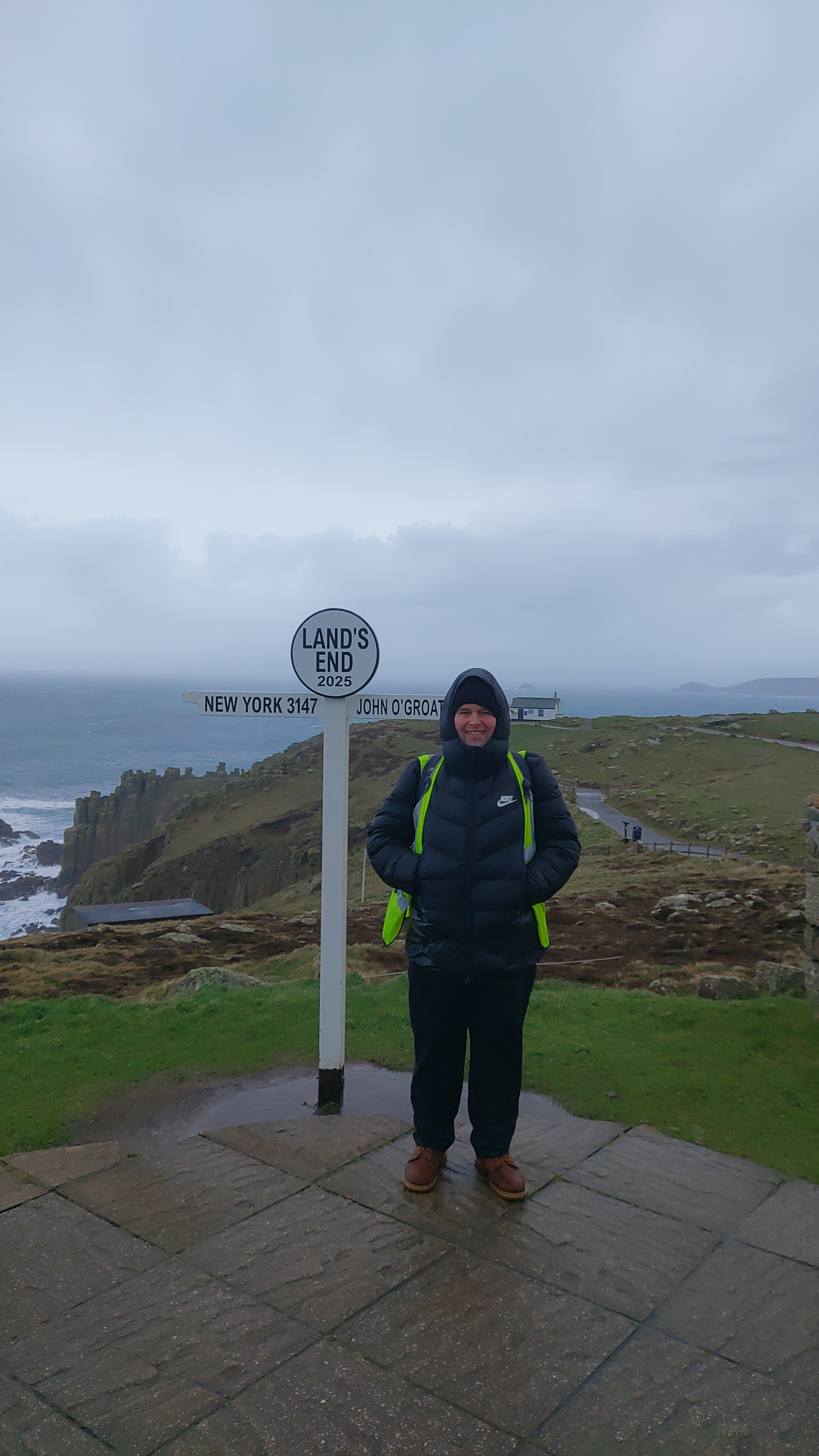
In an entry from 28 January this year, I spoke about visiting the Millennium Bridges in mainland Great Britain, making fleeting mention of a further visit to Land’s End.
The original plan was to pair that with a visit to John O’Groats a couple of days later. My train ticket would allow me to visit both places, but the storms did not, so I delayed my visit to Saturday just gone. My hotel booking couldn’t be cancelled without losing the payment; it could only be rescheduled.
From the January trip, I’d learnt a lot about the logistics of taking long-distance public transport and the luggage required for such a journey. It was almost perfect, but I forgot the charger for my laptop. With eight hours of total journey time between Dundee and Thurso, one of the nearest towns to John O’Groats, that would have been handy.
Yet it didn’t matter too much in the end. I had plenty of battery for the activities I absolutely needed to complete, plus Scotrail didn’t have many three-pin power sockets on this journey.
The trains did all boast USB type A sockets, but they didn’t appear to be at full voltage. This led to the discovery that my phone has an extreme battery-saving mode, so I could at least charge up faster than the power was consumed. If a story idea did occur, I always had a pencil and paper with me.
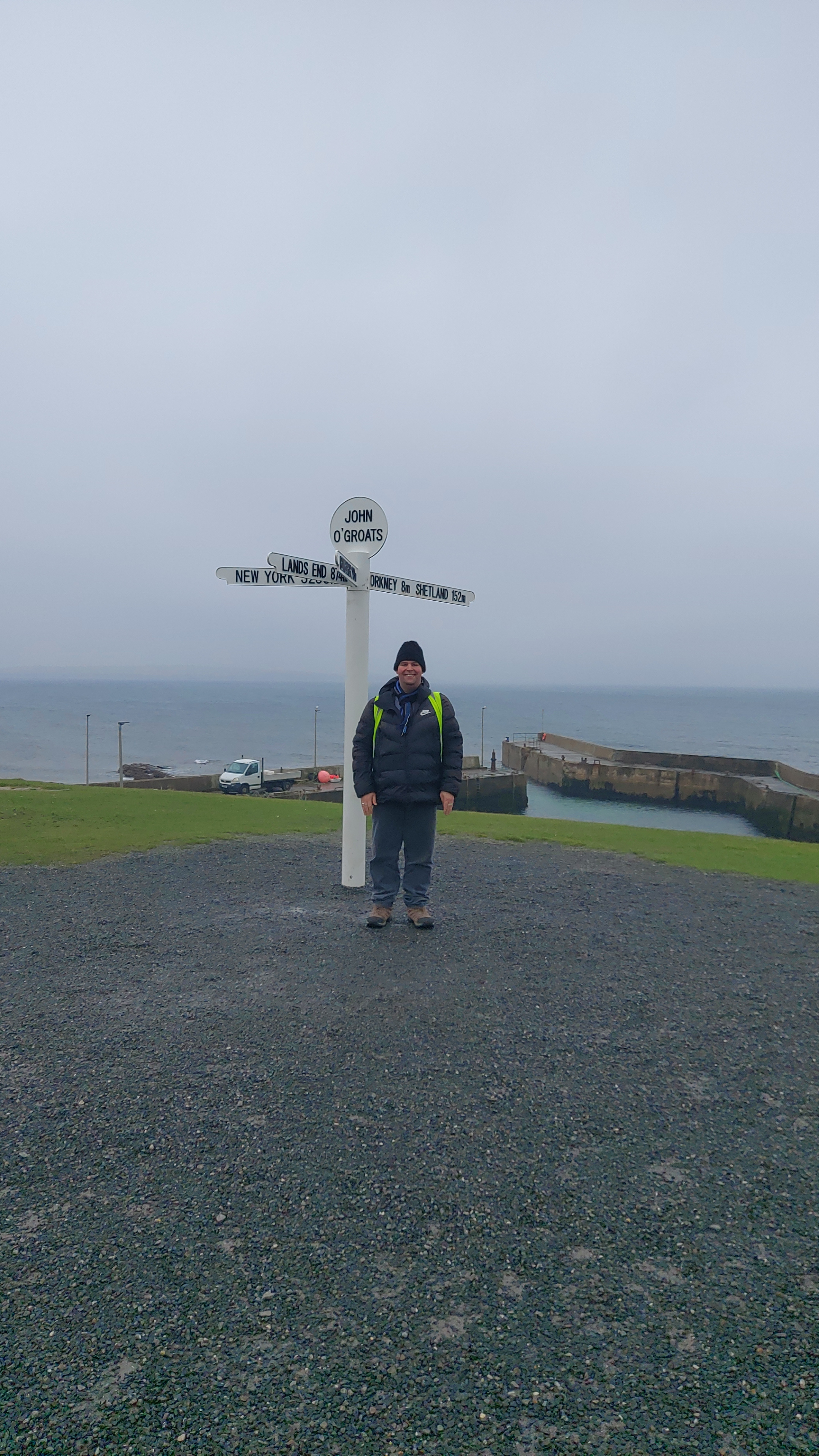
Once I’d reached John O’Groats, I found I didn’t particularly want to write, other than posting a card from the northernmost Post Office in the UK. I just wanted to wander about for a couple of hours, maybe take a couple of pictures for people back home. Unlike the Millennium Bridges, there was never a plan to chronicle this journey in detail.
I did, however, ensure I stood beside the signpost at each end.
On Saturday just gone, I was supposed to go on a tour behind the scenes at Dundee Central Library. The visit was organised by Creative Dundee and was only open to members of its Amps network, making it a rare opportunity, especially as their events often happen on weekdays when I’m working.
Fate had something to say about this rare opportunity, in the form of plumbing problems that forced the library to close for the day.
I’ve been to that section a couple of times before, and I subscribe to the city archives blog, so I have some idea of what they do there. Still, making the information available digitally requires thousands of volunteer hours, so I look forward to seeing that aspect when the tour is rescheduled.
So instead of coffee after the tour, that became the main event, with around a dozen attendees descending on an accommodating cafe nearby. This proved to be a time for fruitful discussion and not even necessarily about our creative work.
After a conversation about where we’d travelled last year and our plans for this year – in my case, the Millennium Bridges tour – I possibly have another project brewing which stems directly from that.
Either way, I look forward to the next Amps outing.
I’m a founding member of a monthly writing group called the Wyverns. Over the decade or so of existence, the format has remained relatively constant. A prompt or theme is agreed upon at each session and the members strive to write a poem on that theme for the following session, in return for constructive feedback.
These prompts are generally abstract or open to interpretation because our members write in a variety of styles. Recent themes include peace, cartoon characters and view or scene. I couldn’t make it to the last meeting, so I’m not aware of the conversation that happened, only that the resulting prompt was the more specific Devices that control our lives.
Importantly, the prompts are not mandatory but are treated as a springboard that members can use for their work. As such, this is one of the few instances where I’m considering not following it and instead submitting work on another topic.
On the one hand, I’m up for a challenge. Some of the most difficult prompts have resulted in superior work that I might not have achieved with a simpler one. On the other hand, I’m growing weary of hearing such endless discussions and debates, let alone contributing to them.
It’s not always wise to evade the brief. Try submitting a piece to a competition that isn’t within the rules and I guarantee the editor will have binned it by the time the ink dries on the rejection letter. But there are instances where it’s acceptable to change the nature of what you’re writing.
In 2019, I was looking to write a short joke about how YouTube originally started as a mail-order video-rental catalogue. The more I considered the idea, the more detail I kept adding. It turned into a 1,700-word short story. In the process, it morphed from a one-liner into a satirical alternate history, yet I was pleased with the outcome.
I’m still considering what to do with the Wyverns prompt, but I do intend to submit something before our meeting next month.
There are any number of everyday sayings that started out as phrases in literary works.
The example that comes most easily to mind is Hamlet. The script virtually acts as a Rosetta Stone of phrases that were probably fresh when first penned by William Shakespeare, but have since devolved into clichés. We won’t have time to explore all these in this entry; besides, Wikipedia has us covered.
Before introducing the two phrases I’d like to explore, a couple of honourable mentions:
The musician Alanis Morissette is credited in the Oxford English Dictionary as the first person to use the phrase friends with benefits. I’ll let you look that one up for yourself.
Monkey’s Paw
Last week at writing group, one of the members used the phrase monkey’s paw. Having never heard it before, I assumed this was the invention of the Internet era, perhaps in reference to some meme or another. As such, I was surprised to find it dates back to 1902, specifically a short story by W W Jacobs. With those initials, it’s a real shame he didn’t live to see the World Wide Web.
The story centres around a mummified monkey’s paw which has been cursed. The owner will be granted any wish by the paw, but always with unforeseen consequences. This has come to apply to any similar situation in real life where the positive effect is outweighed by the negative.
The Monkey’s Paw is now in the public domain and can be read on the Project Gutenberg website. On the whole, I feel it’s well-written, but I would like to have seen more time taken to ramp up the tension before the third wish was used.
Jekyll & Hyde
On Thursday of last week, I went with a couple of pals to a stage production of Strange Case of Dr Jekyll and Mr Hyde; a search reveals the title is apparently not prefixed with The.
The concept of a Jekyll and Hyde character is so widely known that even those unfamiliar with the Robert Louis Stevenson novel often understand his duality. I too wasn’t particularly familiar with the story, but I enjoyed its execution and I’d be interested in reading it in full.
This particular adaptation took the source material and turned it into a one-woman stage production. Additionally, I’m already acquainted with the writer (J D Henshaw) and the performer (Heather-Rose Andrews), and we had a brief discussion after the show about the staging of it.
There was, unfortunately, just one scheduled performance or I would urge you to go and see one.
It’s widely known in the theatre industry that Christmas pantomimes often keep venues financially afloat for the remainder of the year. As such, many companies take the opportunity to stage sure-fire hits, sometimes bringing in a celebrity to play one of the leads.
There are exceptions, however, like the Dundee Rep. They no doubt face the same financial pressures as any other theatre, as the Christmas production is generally a tried-and-tested hit, but they steer clear of traditional pantomime. Previous productions have included A Christmas Carol or The Snow Queen.
This year, the Rep has taken yet another approach with Oor Wullie: The Musical.
Like a pantomime, there’s a good guy and his sidekicks, a cruel baddie intent on causing mayhem, and a focus on laughs rather than plot. The script employs a similar technique to last year’s hit film Barbie, where the audience is invited to suspend their disbelief as characters transfer between the real world and the fantasy world at will.
Yet there are few of the traditional hallmarks. There are no crowd shout-outs and the action isn’t set at Christmas-time. Instead, the three main hooks are:
The character of Oor Wullie is owned and published by the Dundee-based DC Thomson, so the audience is familiar with the setting and the catchphrases.
It’s one of the few festive productions where a significant portion of the dialogue is in Scots.
The show has previously been staged and is a proven hit.
I’ve talked rather dryly about the production so far, but I had a lot of fun seeing this on Friday just gone. If you’re nearby and fancy it as well, there are just a few more shows left.
This morning, I attended a talk by Professor Angus Wallace. His name might not be immediately recognisable, but you’re likely familiar with his story. In 1995, he treated a passenger with a collapsed lung using improvised surgical equipment on a flight from Hong Kong to London.
Judging by the number of slides skipped, he probably brought twice as much material as he needed for the hour-long slot. The mid-air incident formed only a part of his speech, with the rest devoted to his many inventions in shoulder surgery and his later career as an advisor in major air and rail accident investigations.
All this could be a terribly dry subject, but the professor knew his audience was from a non-medical background. Any medical terminology was kept to a minimum or explained in simpler terms, and the whole structure of the presentation kept the audience engaged.
I suspect his rhetoric skill was developed through necessity. One of his earliest inventions was a tool for ingrown toenails which reportedly worked well, but was not marketed properly, so few people knew of its existence. From that point, he was sure to amplify his ideas more forcefully.
Quite by coincidence, I’ve been thinking more about my longstanding desire to start a group dedicated to helping people to overcome stage fright. I can tell you there are writers out there with some top ideas that will never make it onto a stage because they have no motive, whereas Professor Wallace did it as part of his job.
Just yesterday, I received an email from a local organiser, who brought to my attention that I’d been mentioned in an interview between two mutual pals. I started to compose a two-sentence reply, which quickly turned into several paragraphs outlining how I’d like this proposed group to look.
I have some definite ideas, such as aiming it at members who aren’t yet ready for more formal organisations like Toastmasters International. But there are many details that need input or experimentation. This organiser probably opened my reply this morning and thought What is this wall of text all about?
By writing about this proposal in such a public forum as this blog, and by speaking to the right folks, I hope to make it a reality and to help more people face their fear of the stage.
Since just before the pandemic, I’ve been involved in at least one Dungeons & Dragons (D&D) game. I’m currently in two: one every fortnight in Dundee, and another every six to eight weeks in Fife.
For those unfamiliar, D&D is a tabletop role-playing game where players create and improvise adventures, guided by the Dungeon Master (DM). Players describe what they want their characters to do, and the DM narrates the outcomes based on dice rolls and the game’s rules. The setting is usually a fantasy land where weapons can be wielded and spells can be cast.
Every D&D game is unique. In my case, the Dundee players are all in the same writing group and live in the same general area. As such, we know each other well and sessions tend to be filled with in-jokes. By contrast, the Fife players generally need to travel and won’t see each other from one week to the next. We make the most of our time with longer and more intense sessions than the Dundee game.
One of the few factors that unites both games is that I’ve volunteered to be the designated note-taker. I’ve long been able to touch-type, so I can keep an eye on the action at the same time.
But why is this important? The simple answer is: there’s a lot going on. It’s not necessary to capture every detail, but because campaigns can span multiple sessions, it’s easy to lose track of key names, plot points and locations.
It must also be stated that my notes are still predominantly from my character’s perspective, so I can’t stress enough that the other players should keep additional personal notes. For instance, while tidying up the Fife notes yesterday, I realised one character had encountered two others in a room we entered, but I hadn’t recorded what happened to them during or after that interaction.
It sounds like tedious admin, but I enjoy this process as it helps me out enormously with co-ordinating the two games.
A few weeks ago, I announced a show called the Virtual Nonsense Tour of Dundee. The premise was to present an audience with ten stories about the city and ask them to guess whether they were true or false, in the style of a pub quiz.
Just over a week ago, it finally happened. My co-host and I adopted the alter-egos Magdalen Green and Albert Street – named after real locations – and took the risk. It helped that most of the audience knew one or both of us, which helped the banter to flow.
We’d built in a lot of slack to allow for chat, delays and/or technical hiccups. It ended up being too much time and we finished early. Most shows run over, so it was a refreshing change in that sense. Of course, we weren’t the only act in town – far from it.
For the last four years, Sweet Venues has run the Dundee Fringe. It’s run on the same principle as its much larger and more famous Edinburgh counterpart, in that they provide space for acts rather than running shows or dictating the content. The scale, however, is very different. Approximately 70 acts were booked, which was huge for our single venue but dwarfed by the 3,700 acts who pack out the capital every August.
I made a point of going to other shows, with highlights including the student burlesque company Marvelesque taking their show off campus for the first time, Buckets of Blood featuring Grimm fairy tales told as they were originally written, and Tango the Pain-Proof Man who performed stunts such as chewing glass and lying on a bed of nails.
I can only speak for the shows I attended, but while crowds were small, they were loyal, and I’d often meet the same people at the box office. I hope there is a 2025 edition and that the enthusiasm continues, especially as I’ve now had time to reflect on our virtual tour and understand what to do differently next time.