The Looming Year

Every year, I take part in Fun a Day. I hesitate to describe it as a challenge or a contest because you’re only competing against yourself, but it’s an encouragement to create something during the month of January. This can be one project for the month or something you update every day, and/or some combination thereof.

I’m pleased to report the exhibition opened on Friday of last week, but more on that shortly.

In previous years, I’ve tackled projects involving writing, such as the fragments I penned in 2018. I’ve also come to realise that I don’t like keeping my work, instead preferring to recycle or reuse the materials after I’m finished with them.

The preparations for 2025 began earlier than ever: on 1 January 2024. I’m in the habit of weighing myself every day, although only the Monday figures are normally recorded.

So for every day in 2024, I tracked my fluctuations on a spreadsheet. A red cell represented an increase from the previous day, a green cell marked a decrease, while blue marked a stable weight or a day I didn’t have access to my scales. To save too much manual work, I quickly learnt how to program Google Sheets to show the colours automatically.

I then converted the colours into a corresponding chain of loom band. As I’m not artisitic in any way, however, I told the organisers to display it in any way they wished. It’s difficult to see in a picture, but it ended up in an M-shape on the ceiling of the café:
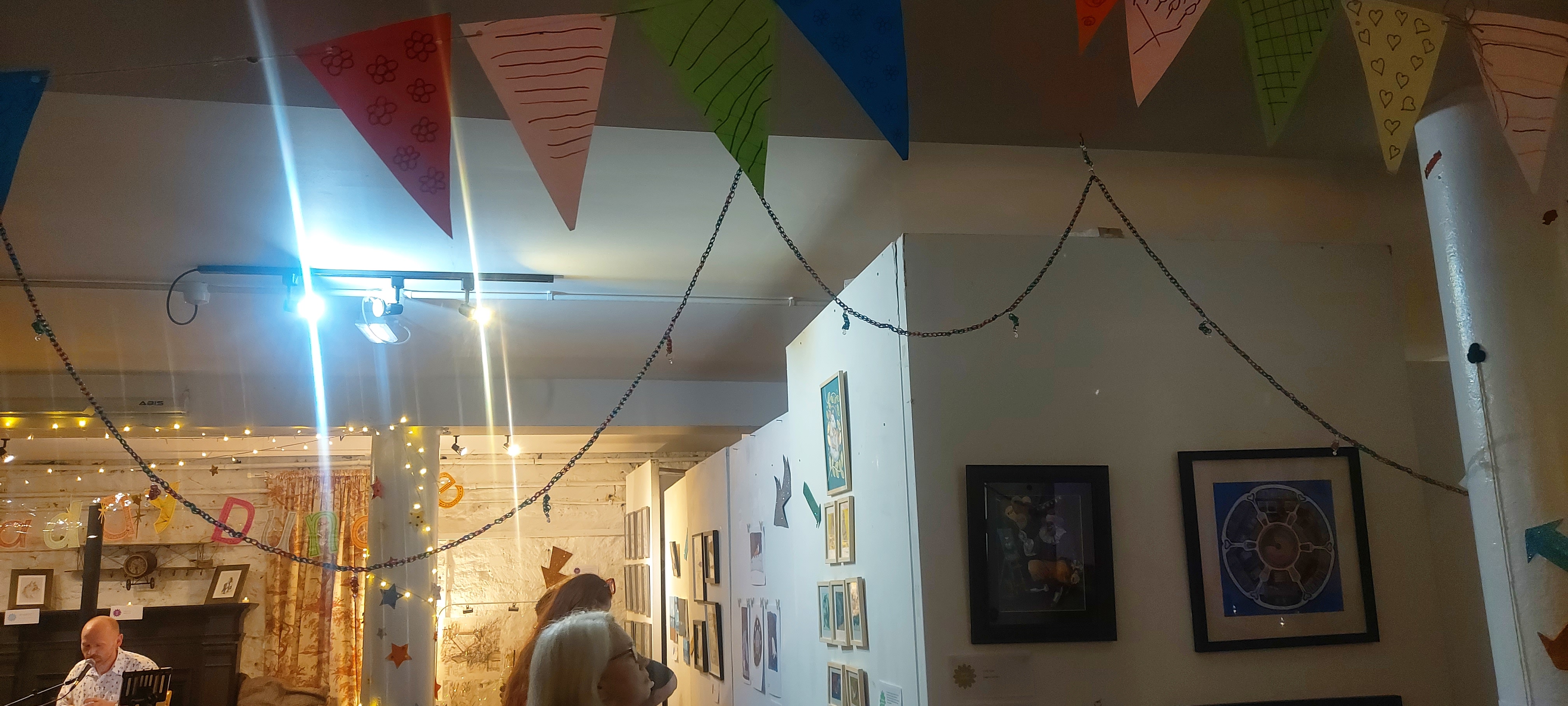
There was also an information panel on the side, along with rough notes about where I was in the chain.
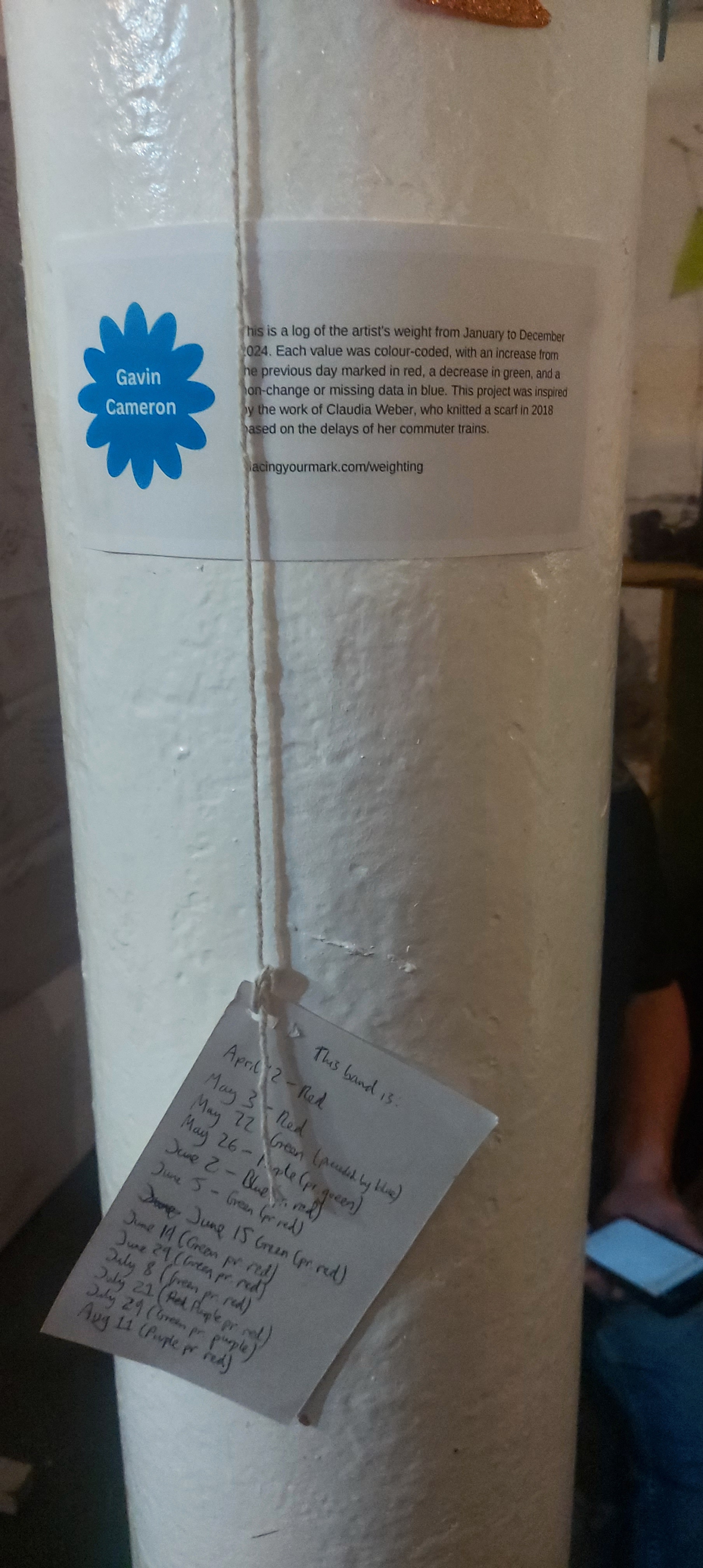
An information panel discussing the artwork, plus a postcard hanging from a string with rough notes about it.

You can see the exhibition at Blend on Dock Street all this month. The website on that panel takes you to the official website for the project, which will stay up all month, but I make no guarantees beyond that.

Cycling Around

On Thursday, realising I had a free evening, I took the opportunity to see some performance art. This was hosted by my pal Luke ‘Luca’ Cockayne, who was reading a series of autobiographical pieces over the span of 12 hours. I only had time to see around two hours.

I don’t want to focus on the performance itself, particularly because the aftermath is still on for the next five days. Rather, I want to look at something I did during that performance.

One of the organisers handed out pens and paper to the tiny audience with the intention that we could draw if we felt inspired. Much as Luca has tried to teach me some art, I’m still far more inclined to write by default.

I enjoy the challenge of improvising poetry on the spot, so my rough plan was to compose a rough version based on the performance I could see in front of me, and then extract a polished version from that. Yet after writing my so-called polished version, I felt it didn’t quite work, so I tried another.

I ultimately ended up with a total of seven poems. Put together, they form a cycle of sorts, each of which approaches what I want to say without being able to cut to the heart of the matter.

I feel there are diamonds to be dug out of the mess here, so I’m going to keep these drafts for the moment until I find some sort of home for them.

Uninspiring Prompts

I’m in a monthly poetry circle where we write a new poem each month. There is always a prompt to help with inspiration, but there’s no obligation to follow it.

For this month, it was suggested we write about public art. I thought this would be a simple task, as I live five minutes away from three separate sculptures on the same piece of land: one is a spiral, another is a vertical zig-zag, and the third is in the shape of a large egg.

I instead spent days trying to be inspired by one or more of these pieces. I tried rhyming poetry, free verse, a self-referential style, and a critical style, yet nothing was working. I eventually figured out the problem. I needed context for these sculptures, but there is absolutely none, not even a sign with a title or something about the artist. Without this background information, I found myself unable to engage.

Instead, I walked a few minutes up the road to a mural painted last year. It spans the height of a six-storey building, is attributed to a particular artist and there is background information available online. That poem took less than an hour to write and I’m more satisfied with it than any of my previous drafts.

There is no telling what’s going to be a prompt for your next poem, but if something isn’t working for you, there’s no shame in moving on to something else that does inspire you.

Acting as Gallery Assistant and Finding the Time to Read

I’m a regular visitor to the Dundee Contemporary Arts building, which holds around three major exhibitions per year. No matter what’s on display, I’m forever fascinated by the job of the gallery assistants. Aside from opening nights and special events, the pace is normally relaxed enough that some of them read novels while on shift.

Last week, I had the chance to experience this for myself on a smaller scale. First, a little background.

On Thursday, I visited an art exhibition called Funeral For My Deadname at Saltspace in Glasgow. This was run by an artist pal, and the highlight of the opening night was him completing and signing a document to legally change his name to Luke ‘Luca’ Cockayne in front of a crowd of visitors.

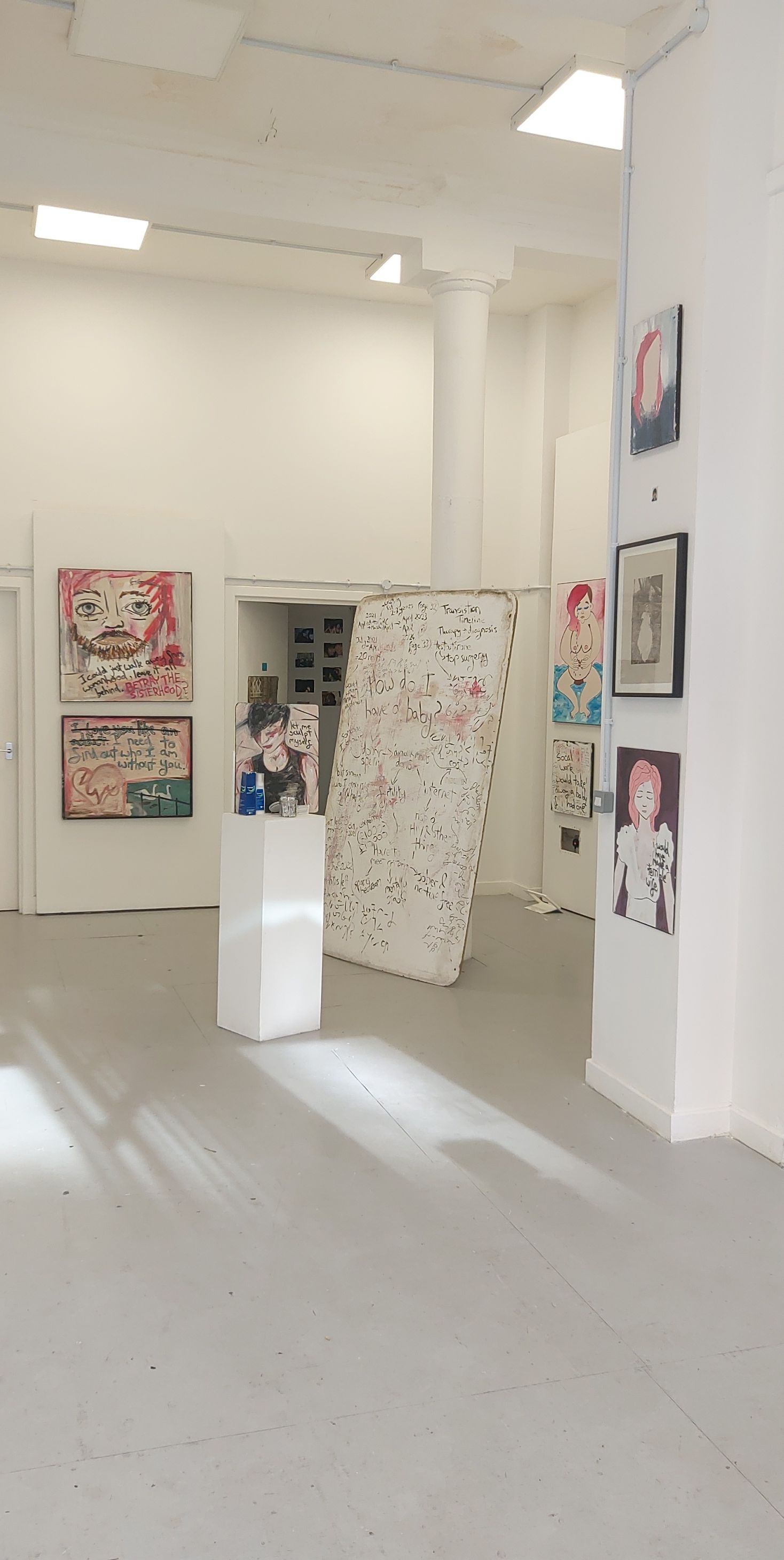
Luca also displayed a selection of his artworks in the gallery, some dating back more than a decade. These were available for viewing until Sunday, and some are featured below.

As I hadn’t originally planned to be there on the opening night, I’d already booked my travel for Saturday. I didn’t intend to waste it, so I visited again and spent the day at Saltspace. In contrast with the busy opening night, there was a mere trickle of visitors during the day.

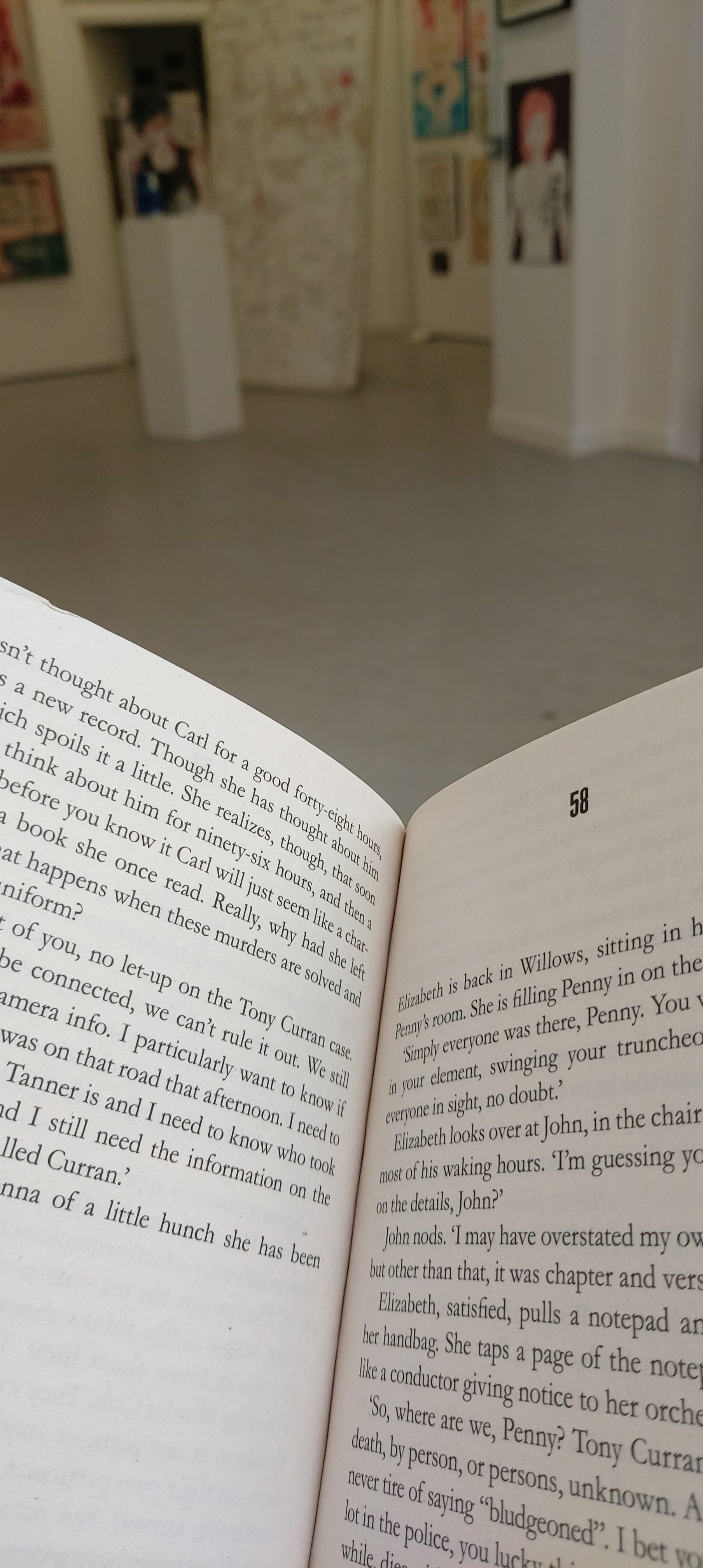
I’d brought with me the Richard Osman bestseller The Thursday Murder Club. It had been sitting in my bag for a long time, and by last week, I’d reached the halfway stage. With a combination of a long bus journey and quiet conditions at Saltspace, I was down to the last few pages by Saturday evening, then I finished it on Sunday.

I also promised my pal I’d dash off a quick clerihew in honour of the event:

Funeral for My Deadname.
I hereby proclaim,
announce and swear
that a change is in the air.

Quick on the Draw

If we must label it a party trick, one of mine is to write a short poem about a given subject in a short space of time, typically under five minutes.

This comes into its own at poetry shows with multiple performers, where I’ve been later in the bill. I’d pen a poem for each act while they’re still on stage and read mine at the end. I’ve occasionally been asked how it’s possible to write in such a short space of time, and the answer is simple: shortcuts.

The format I use is the four-line clerihew, and the first line is always the subject, so that’s 75% of it already written. The next line rhymes with the first, and then a different rhyme appears in the other two lines. Ridiculousness is encouraged with this style, making it ideal for a quick-and-dirty verse.

But much as people are impressed by my speedy poetry abilities, I’m similarly impressed by those who can churn out a drawing within the same time.

A few weeks ago, I found myself at a life-drawing class running by a pal. These sessions typically begin with a session of two- to five-minute poses to allow the artists to warm up, but I really struggle with these. By the time I’ve laid out the frame of the pose, there’s no time left to add in the details.

I’ve asked a couple of folk for advice about how to handle this, and there are some shortcuts, just as there are with clerihews: only draw part of the pose, construct the image in an abstract way, stick to the same colour of pen or pencil, &c.

The key to mastery, however, is to keep tackling these short poses. There was a time when I couldn’t write verse, never mind in such a short time, but I stuck at it and I’m sure I can stick at the life drawing.

Looking Ahead to Fun a Day

Every January, I take part in a project called Fun a Day Dundee that happens every January. There is no specific brief: you can write, draw, compose music, dance, or whatever your skillset us. The timing is designed to fill the void that artists often experience after the Christmas rush.

For the first time in a long time, we were able to meet up in person on Sunday. As I’d already arranged to do something else that day. I was only able to come along in the last 15 minutes, but it was great to see everyone again.

When I first started Fun a Day, my work was strictly writing, creating one new poem or story for each day of the month. One year consisted of writing a number of words each day that would combine to form a single sentence.

I’ve edged slowly into drawing, inspired by the other participants, and I’ve developed a style that includes recycled materials. Sometimes I use the recycled material in the work, other times I shred what I’ve created.

At the beginning of this year, I looked back at popular culture between 1998 and 2001, and writing was still an integral part of my projects. I kept a handwritten diary of my thoughts as I created each piece.

I don’t yet know what form this year’s project will take, but I know the title, and I know I’ll continue to log my thoughts in a notebook as it progresses.

Another t

Indefinite Ephemera

This week, I received a direct message on Twitter. It’s unusual for me to have one of these, so I wondered what was going on. It turned out to be from someone called Hayley.

Some background here: I’d met her six years ago at a feminist poetry evening in Dundee, and I’d performed a new poem that directly referenced my bisexuality for the first time. She’d enjoyed it and asked for a copy. However, the piece was so new that I had only one handwritten version in my notebook, so I copied out the piece and gave it to her, adding the date and place.

In the message, Hayley told me she had been 19 at the time, and had kept that paper for the last six years, adding that she found it just as validating and comforting at the age of 25.

The poem in question was then included in an anthology by the first publisher I sent it to, but it means more to me that someone has kept it for such a long time, and I hope it continues to bring such validation.

It’s not the first time someone has kept a piece of mine. A few years ago, I owed £1 to my pal Jen Robson, so I placed a coin in an envelope with a silly four-line verse on the front, expecting it to be discarded. To my knowledge, she still has it.

Building an Archive

Just before I settled down to write this, I spotted I’ve published exactly 400 blog entries since beginning in 2013.

On the one hand, that’s not surprising as it equates to approximately one post per week, yet it’s still a powerful demonstration of how regular and consistent writing can help to build a useful archive.

Let’s take my own work as an example. In the folders containing my poetry and short stories, I have more than 320 distinct pieces. I also like to keep revisions, so many of them house multiple copies showing the evolution of each piece: some complete and others abandoned.

If you’re a new writer, I strongly advise you to keep all your work, even if you don’t like it at the time. If there’s one lesson I’ve learnt from a decade of writing, it’s that some pieces need to be left in a drawer for a while and looked at again with fresh eyes.

Last year, I tasted this from the other side when I started taking art lessons last year. One recurring problem – especially at the beginning – was when I knew something was wrong with my drawing, but I didn’t know how to fix it. Perhaps one day I’ll be able to go back and see what’s wrong.

I’ve also had a hand in creating an archive of other people’s work.

Since March of last year, my open-mike night Hotchpotch has maintained a YouTube account in lieu of live events. I was initially disappointed that we receive perhaps five submissions per month compared to the 25 or so who would perform in person. But those small contributions each month have steadily built up to a library of 73 videos at last count.

When people now ask what our event is like, we can now direct them towards that page. For that reason, I’m keen to maintain it even once we can meet up again.

Yes We Scan

On this blog a couple of weeks ago, I talked about starting my yearly Fun a Day project. I’m drawing pictures inspired by the years around the Millennium, then publishing each day’s output on my old blog.

However, my that’s only one part of the story. My main activities can be roughly equally divided into:

  • Producing the drawings
  • Writing in my logbook by hand
  • Scanning the above documents to publish them online.

In previous years, the logbook would be displayed on a table at the exhibition, so there was no need to transcribe it. This time, it’s looking likely that we’ll need to exhibit online again, so I’ve been typing up my words in plain text to make them readable to others.

I soon found it was time-consuming to type up each day’s entry, so I wondered whether there might be a way to use automatic handwriting recognition. There is, and I already had the means of doing it.

Google Drive has a function that turns your phone camera into a scanner. The resulting PDF file can then be opened by Google Docs as text.

Logbook entry dated 12 Jan 2021 being scanned by Google Drive.

Some correction is always necessary, to a greater or a lesser extent, but most errors can be cleared up by using a spell-checker. Even a bad scan is marginally quicker to fix than typing the whole entry from scratch.

I don’t think I’m going to use this technology day-to-day, though. When I write by hand, I normally copy it into the computer by hand so I can make revisions on the fly. For a job that needs to be done quickly, however, it’s a great solution.

Bringing Back a Bygone Blog

Every January, I take part in a project called Fun a Day Dundee, which encourages artists to be creative throughout January. Most years, I have an idea what I’m going to do; this year, by contrast, I didn’t.

I have a tradition of keeping a handwritten logbook each year, which visitors are able to inspect at a weekend exhibition. With less than 5 hours until January 1st, I found an old notebook and began my log, and as I was writing, an idea began to form.

On the assumption that public events will still not permitted in two to three months’ time, I wanted to present my scans of my drawings and the logbook online. Instagram is the go-to site for many participants because it’s perfect for photos, and I’ll still be using it. Yet it’s not geared towards long-form explanations, which this project needs, so I set about looking for a secondary site.

The solution was to resurrect my old LiveJournal account, just for January. Recycling is one of my major recurring themes in Fun a Day, so reusing that page is very much in the same scope. When you visit it via the URL www.ladygavgav.com, it’s been set up to show only the Fun a Day posts.

I first used LiveJournal in the early 2000s, which in turn has inspired my Fun a Day art to be themed around Millennium nostalgia and pop culture as I remember it. The interface to post a new entry hadn’t been updated by the time I jumped ship to WordPress in 2013, but I was pleased to find it’s now more user-friendly, especially when embedding pictures.

Now I have a course of action, we now begin the real challenge of finding the time and motivation to update that site every day this month.