Paper boon.

Until a year or two ago, I didn’t do much writing on a notepad. It generally went straight into a computer unless one wasn’t handy.

I began to use a pad extensively for two reasons. Firstly, my small laptop has only just enough RAM to run Windows and was a pain to use. Secondly, I type extensively in my day job and my fingers began to hurt, whereas holding a pencil was a sufficiently different motion and it didn’t hurt.

Using a pad is also a different experience from typing: It slows down your thoughts so you become more focused on what to say next. It also looks less like a finished product and I’m more inclined to edit it. Furthermore, it’s easier on the eye to read paper than a screen.
Kids of the 22nd century: these are called books, which are a bit like websites on paper.

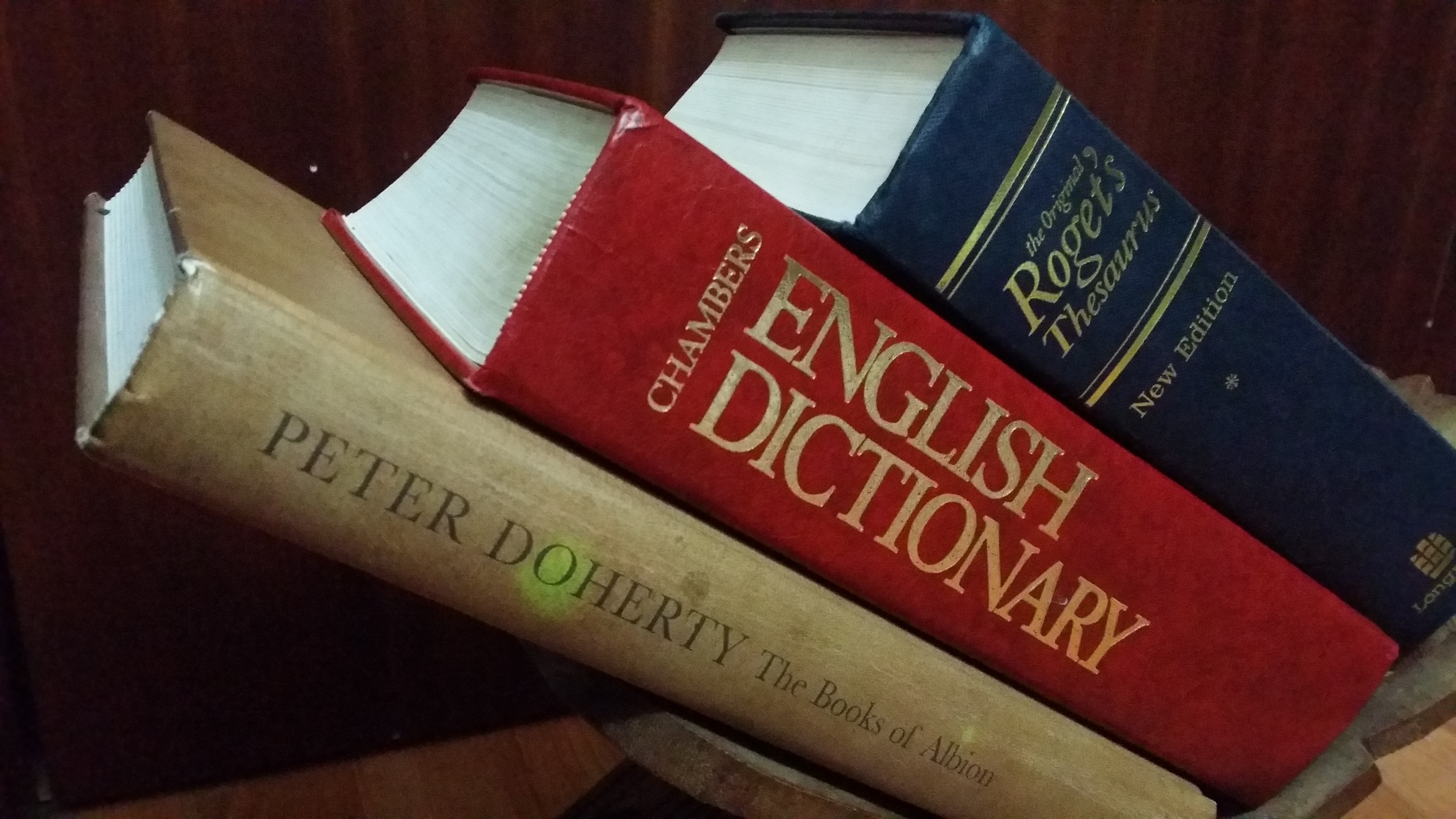
My fingers aren’t nearly so bad now, but I’ve kept up another habit I fell into during this time. I dug out my printed dictionary and thesaurus. Online references generally focus only on the words searched for, whereas flicking through a book can throw up possibilities from other pages. The trade-off is that paper references go out of date – mine are over 25 years old, but I rarely need new-fangled words.

On Saturday, it’s the 37th birthday of one of my influences, Peter Doherty. I feel compelled to point out that he prefers Peter over Pete. Last year, I bought The Books of Albion, containing writings from his many notebooks. I expected to read drafts of his poems and songs in there, and I wasn’t disappointed.

But he also includes a lot of diary entries, many of them with the dates on which they were written. He talks about what’s happening to him at the time, whether it be relationship problems, a budget trip to Germany, or his first professional poetry gig.

I stopped keeping a diary when I was about 20, and started a blog on the relatively young LiveJournal. Almost overnight, my style changed from private and unguarded to public and slightly more guarded. I still have some of the diaries but they’re unlikely to be available in the shops any time soon.

By contrast, Doherty’s diaries start when he was about 20, so there’s a maturity in them that mine don’t have. Yet it’s still clear he never intended them for publication, and it’s perhaps this honesty that makes his writing so compelling.

Initially, I found myself thinking back to what I was doing around the time he was keeping his notes. Then I began to wonder whether I could experiment with bringing back my pre-LiveJournal days and writing the occasional dated diary entry in my current pad. It contains mainly poem and story drafts, yet true events are at the heart of many literary works.

I would then have some events to draw upon when I need ideas.

The milestones of a masterpiece.

When you’re in the middle of writing a novel or compiling a poetry collection or some other big project, it can be easy to forget the end goal. One way to maintain your momentum is to remind yourself what will or might happen when it’s completed.

Try creating something that represents your aim, like a mock cover for the finished volume. Or find a trophy, even if it’s made of cheap plastic, and label it something like [Your name] – Forward Prize – 2017. Or even write the speech you plan to give at your first launch.

Now leave the artefact in a place you’ll see it every day, and that’ll remind you what you’re working toward. It’s not simply words on a page, but something people will buy and possibly admire.

Think how you’ll feel when it really does happen.

I’ve started so I’ll finish.

Normally, blog entries come to me easily. It might be prompted by a comment during the week, or be inspired by a particular problem I’m having.

This week, however, I’ve been struggling to complete an entry. I started on the topic of swearing, then about gaps in your writing CV, then about third-person biographies, but none of these topics were going anywhere. I might return to them in the future, but today’s entry is about finishing what you start.

I normally good at finishing stories and poems, but I have a few that have been untouched since the first draft. Most recently, I was asked to respond to an exhibition at Dundee Contemporary Arts. I abandoned my original idea after four verses because it was much too wordy and I wanted to take the narrative in a different direction. Here are those four verses:

We saw the archipelago of masts
while sailing over Dogger Bank in gale
force six conditions. They displayed full sails
like pirate vessels of the ancient past.
They numbered in the twenties. We informed
our captain. She immediately warned

them of our presence with a blast,
instructed us to try the radio.
All frequencies, all wattages, yet no
response was heard. When 30 minutes passed,
she ordered that her ship should deviate
of-course toward the masts, though gale force eight

was forecast. Once we had a closer view,
we noticed something out of place. The decks
were underwater. So it seemed. We checked
again. Correct. All decks submerged, no crew,
no skeletons, no personal effects,
just masts with sails and ragged flags. Perplexed,

we asked the captain where to go. Perplexed,
she stopped us by the archipelago.
Again we tried to use the radio
as gale force eight turned into 10. The next
the next we knew, the bow was pointing in the air.
It knocked us to the deck.

This needs a lot of work done. There are a number of options to breathe new life into it: cut out unnecessary words and phrases, continue to add verses, rewrite it as prose, recycle elements of it into other works, and/or cut it into individual phrases and shuffle them about.

To make what became the response, I used some elements of this story, cut out a lot of detail and rendered it as prose. The final result mimicked the shipping forecast on Radio 4.

I’ve done something similar for older pieces. Around 2011, I wasn’t writing much poetry and I thought what I had was quite a good piece. Four years later, I revisited it while answering a writing prompt and it wasn’t as good as I remembered. I took the same idea but structured the verse differently and I’m now happy with it.

Some writers seem scared to finish pieces, as if they’ll think of a better word or structure as soon as it’s been submitted to a publisher. But if its publication you’re looking for, there comes a time when you need to let go of it. Remember there will be every opportunity to amend it if it’s rejected, and some publishers will allow – or insist upon – amendments if it’s accepted.

I’ve been asked before how I know when I’ve finished a piece. That’s not an easy one to answer, but the best measure I have is when I stop thinking about it day-to-day. That’s when I leave it alone for a while, then revisit it with fresh eyes later on.

It’s a good idea to finish what you start, at least to the best of your ability. If you see the perfect outlet for your piece, it’s much easier to tweak it than to have to add or remove significant portions. You might then be able to submit it comfortably before the deadline.

That’s the place, uh-huh uh-huh, I write it.

I know you shouldn’t pay too much attention to those pictures that circulate around Facebook, but I recently saw one that deserves a response:

2016-02-13 09.53.43

It strikes me that the solution is hidden within the problem: why stare at a blank page if that doesn’t help you produce work? Go and lie down in bed, or have a shower, or drive around town. But be sure to have a safe way of recording your ideas as they occur.

The perfect spot for a writer is as individual as his or her work. I recently attended a workshop in a library. One of the organisers asked us to pick a spot in the building where we each felt comfortable, then to complete a writing exercise. Some participants preferred an open area, others preferred a little niche; one person lay on the floor while another nipped upstairs.

For my own part, I found a shelf at chest height and placed my work on top of it. When I’m using my computer at home, I prefer to stand up with my back to my bedroom window; I’ve experimented with other places in the house but they simply don’t have the same vibe.

It’s also timeworn advice to keep a notepad and pen by your bedside table in case a great idea occurs during the night. This has rarely worked for me; I find going for a walk for a walk, especially in the cold, is much more effective.

Consider also the sounds around you. I was writing a play a few years ago that had a rather dark theme, and I found the only music that helped me write this way was Radiohead. Any other time, I listen to the soundtrack from the film The Assassination of Jesse James, written by Nick Cave and Warren Ellis.

So be sure to experiment with your particular writing place. A lot of people believe that to be a writer you have to sit a mahogany desk for a set time each day in silence and write a certain number of words. That works for some people, but if it doesn’t do anything for you, find a method that does.

Think of it this way: if you weren’t receiving your milk delivery, you wouldn’t complain to the postman. Similarly, if your current actions aren’t helping you to place words on paper, it’s time to take new actions.

Patronising: that’s where you talk down to someone.

The other day, I saw a petrol tanker. It had a sentence painted on the side that said, as far as I can recall:

We take the petrol to the pump so you don’t have to go to the refinery to collect it.

I thought this rather insulted the intelligence of the audience. That’s how you might explain it if a child asked. But if you’re old enough to buy petrol, you’re old enough to understand what a tanker does. A friend’s daughter used to work in the media and often encountered this kind of tone. She brands it infantilisation.

It’s timeworn advice not to think about your audience while you’re writing fiction, but I do think it’s important while editing. Let’s say your character plays a musical instrument. It’s probable your audience would know what a balalaika is, but would they be familiar with a theremin?

If you’re unsure how a passage will be received by an audience, give it to other people. If it’s not clear to the majority of them, can your meaning be shown through dialogue or action rather than plain description? For the balalaika, you might only need the action:

Becky strummed her balalaika every evening, adding a fresh twist to popular rock classics.

Whereas the theremin might need more explanation, done here through dialogue:

An Etherwave-Theremin, assembled from Robert M...
An Etherwave-Theremin, assembled from Robert Moog’s kit: the loop antenna on the left controls the volume while the upright antenna controls the pitch (Photo credit: Wikipedia)

“What’s that aerial thingy?”
“This? It’s a theremin; it’s what I play.”
“How do you play that?”
“Put your hand near it and it makes a noise.”

Also ask yourself whether something actually needs to be explained. It’s a common habit of beginner writers to overexplain:

Jessica pushed down the door handle and pulled the door towards her. She stepped back as it opened and she saw Fiona in the room. Fiona was sitting in a chair and clasped in her hand a stack of £50 notes. When Jessica looked at her, she raised her eyebrows and opened her mouth wide, knowing she had been caught with the takings from the shop.

Whereas this could be made less flabby by allowing the reader to make the mental leap between actions:

Jessica entered the room. There was Fiona; £50 notes in her hand. The takings from the shop. “This is not what it looks like,” said Fiona.

Notice in the second passage that the focus is on the actions that drive the plot forward. Here, the facial expressions are of little relevance to the story; the reader wants to know what happened to the money. The question of relevance is key to pitching your text at the right level.

If anyone sees that oil truck, please pass on my comments to the company.

Meet your heroes.

Last week, it was announced that Colin Vearncombe had died after a car accident. He was noted for his hit single Wonderful Life under the stage name Black.

Of all the musicians that died last month, this one had the greatest impact as I’d met him in April last year. He was performing in a pub with Callum Maccoll; no backing band, no gimmicks, just them and their guitars.

The surprise of the evening was when he revealed he’d been asked to write a song for a young solo artist, but her career never took off. Instead, he started performing the song himself at gigs, complete with the chorus hook It would be so cool to be your girl.

He’d also brought along books of his poetry, and I bought one on the night. He seemed a genuinely nice person who was grateful for his fans’ support. Altogether, it was probably the best gig I saw in 2015, and it’s saddening that it’ll never happen again.

It’s well-worn advice never to meet your heroes or you risk being disappointed. I’m telling you the opposite: if you hear a favourite author is coming to town, go and see him or her.

A few years ago, I was privileged to be part of an audience with Iain (M) Banks on two occasions. He was an extrovert who loved taking questions from his fans while ‘threatening’ them that he would keep talking if nobody put up their hand. Regrettably, I couldn’t think of a question to ask him on either occasion, although a friend did.

In fact, go and see any author who’s nearby, whether or not you’re familiar with their work. Without having read their novels, I’ve met Roddy Doyle, Stuart MacBride, Irvine Welsh and most recently Paula Hawkins, plus many more. Out of dozens of writers, I can think of only two authors in whom I was disappointed: one of them simply parroted the contents of his book, while the other showed off with theatrics rather than being herself.

The easiest way to know about upcoming talks and launches is as you might expect: search it online. Or if you’re in or near a major city, there might be a central point of information, such as Literary Dundee where I live.

However you find out, my message is the same. Meet your heroes – while you can.

Irregular behaviour.

Anyone who’s attempted to learn English as a foreign tongue can tell you how weirdly different it is from other languages. I’d like to focus on just a few of these absurdities, prompted by the recent decision of the American Dialect Society to award their Word of the Year to the singular they.

To refer to yourself, you use I; to refer to a group you’re part of, it’s we. The English language has this sorted. However, a third party group is given the pronoun they, while a third party that’s not part of a group is given he, she or it. These latter three pronouns are often fine to use, but there can be problems.

English: Grammatical Person / Pronouns - third...
English: Grammatical Person / Pronouns – third person singular (Photo credit: Wikipedia)

Supposing you’ve received an anonymous letter. How would you refer to the author? It would be inappropriate to say it because it wasn’t written by an animal nor an inanimate object. Similarly, it’s unwieldy to keep saying he or she. So like a trooper, they steps up to the challenge.

To compound matters, there are people who are not necessarily transgender but who identify as a mixture of both genders or as neither, and therefore it would be incorrect to write he, she or it. Again, they volunteers for duty.

So on the whole, they fills the gender-neutral gap in our language, and it has done for hundreds of years. Yet it falls foul of another uniquely English grammar quirk.

Let’s use the verb to run. Substituting the to for a pronoun gives us: I run, you run, we run, but he, she or it runs. So when we use they as a singular, it ought to be correct to say they runs, but it sounds wrong.

Why, then, hasn’t anyone come up with with a suitable substitute? Folk have tried, but none have caught on. The Guardian gives a detailed account of the search for the magic word while the University of Wisconsin-Milwaukee provides a guide about using personal pronouns.

If you’re unsure about word usage, you could do worse than follow Hannah McCall. She’s a qualified proofreader who writes about the trickier points of English in her blog, yet in an accessible manner. I’m also aware she can probably find a dozen holes in this entry alone.

But I don’t want you to go away feeling that English is the worst language in the world. After all, we have some words that no other language has.

One of these is serendipity, when you make a beneficial or pleasing find by chance. Another biggie is trade-off, which won an award a few years ago as it’s so difficult to translate. It’s not a mere compromise, but where you exchange one quality for another, while understanding the advantages and disadvantages of each.

The element of

Last week, we lost one of the most flamboyant and enigmatic musicians of our generation. Yet you never hear David Bowie described as a 70s star or as retro; he managed to remain relevant throughout his 50-year career.

One way he achieved this was the use of surprise, from the Ziggy Stardust look, to Jareth In Labyrinth, to setting up an ISP in 1998. And that’s something other writers and poets can learn from.

Prior to 1992, PD James was known for writing detective novels. She was 72 when she published her only science fiction work, The Children of Men, earning positive reviews from many corners. Similarly, you would expect something funny from Clive James, but his poetry collection Sentenced to Life is thoughtful and poignant.

So how does a writer deliver something unexpected? It might be as simple as writing a short story when you usually pen poetry, or as radical as having a section of your novel made into an animated video.

Either way, the idea must still come naturally. If you’re writing poetry on a subject when you’d really rather be adapting it for the stage, it’ll be obvious your heart isn’t in it. It’s a good idea to revisit an idea that hasn’t worked its current form and see where it can be adapted to another, or experiment with different ways of creating ideas.

When I have the beginnings of an idea, for Screenshot from DCAexample, I like to go for a long walk and turn over the idea in my head before putting anything down on paper. Yet when I was asked to respond to an exhibition at Dundee Contemporary Arts in October, I had no ideas, not even the beginning of one. Instead, I sat on the yoga mats provided as part of the exhibition with a notepad and told myself I was staying until I put something down.

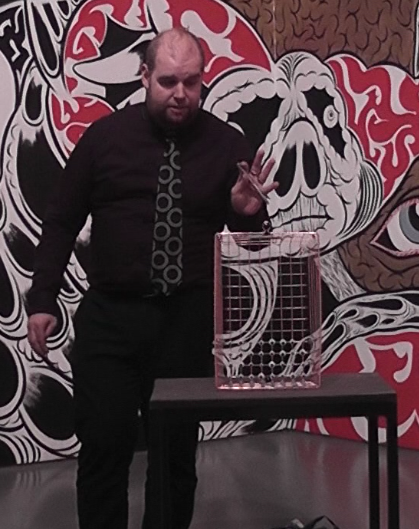
The result (pictured) was a visual response with a wire basket and 100 googly eyes. It was unusual and untested for me, as I’ve had no art training – and to my friends who know this, it was most definitely a Continue reading “The element of”

Think globally, act locally.

As this blog is about fiction and poetry, my chosen title is a correction of the phrase Think global, act local. Since think and act are verbs, I’ve added -ly to the other two words to change them from adjectives to adverbs. Now both clauses are paired up nicely.

The phrase has been around for decades, however you choose to word it, but it gained new currency at the dawn of the 21st century as more and more people had access to the Internet. For the first time, ordinary individuals could type a message and potentially have it seen instantly by a worldwide audience.

One problem this throws up is relevance. Unless I’m writing only for local folks, I somehow have to make my blog relevant to an audience much further afield, and that often means overlooking what’s happening in my own city to concentrate on our shared mass culture.

Photograph of Desperate Dan statue in Dundee c...
Photograph of Desperate Dan statue in Dundee city centre; behind it is City Square, the Caird Hall (straight ahead) and Dundee City Chambers (to the right) (Photo credit: Wikipedia)

Today, however, I’ll be turning the camera on my own city of Dundee in Scotland, with a population of around 148,000. This place has made its mark on the wider world in several ways. Grand Theft Auto was coded here, James Chalmers introduced the adhesive postage stamp, and the Beano is printed five minutes from my house.

From a literary standpoint, a number of notable works have been produced by its citizens, from William McGonagall’s terrible verse in the 19th century right up to Oliver Langmead’s 2015 novel Dark Star.

Mondays are a particular bottleneck for reading and writing events, with the Literary Lock-In at the end of each month, my own group Hotchpotch near the middle of the month, and a Silent Reading Party fitting in between the two. Literary Dundee helps to coordinate these, plus the regular author visits, not forgetting the major Literary Festival in October.

Altogether, Dundee is one of the best places for a writer to be at the moment, with a more active literary scene than its population figure might suggest. Later this year, two of my poems are also scheduled to appear in Seagate III, continuing from volumes I and II published in the 1970s and 1980s respectively. You can bet I’ll be telling you all about that when it happens.

Even your idols have idols.

It was reported last week that Lemmy from Motörhead has died at the age of 70. As you might expect, tributes flooded in from around the world. It was the messages from other musicians that interested me most. A number of them commented how much influence he had over their own sound and attitude.

It reminded me of an epiphany I had a few months back: that I like it when the people I admire also look up to other people.

Scroobius Pip on stage in 2010
Scroobius Pip on stage in 2010 (Photo credit: Wikipedia) PS: I am not obsessed.

For example, I recently developed a slight obsession with poet Scroobius Pip who looks up to his contemporary Kate Tempest, with whom I then developed a slight obsession. In a 2010 interview, Tempest stated that her influences include Virginia Woolf, Samuel Beckett, James Joyce, W B Yeats and W H Auden.

You will encounter the occasional person who claims to have done it all by themselves. Some years ago, I interviewed an up-and-coming Glasgow band. One of the questions I asked each band member was Who are your influences? One of them – I can’t remember which – rather grandly claimed that she wasn’t influenced by anyone as she didn’t want to copy anyone.

Firstly, there’s no way she had no influences. She would have learnt her instrument by playing other people’s music. And around the time of the interview, Franz Ferdinand were big and The Fratellis were breaking through. Every Glasgow musician was keeping an eye on these home-grown bands, even if it were only to make a deliberate move away from their sound. For a writer, even a bad novel can show you how not to pen a book.

Secondly, an idol might merely be different from the person who looks up to him or her, not necessarily better. Is it possible to compare Joyce or Yeats with Tempest? It would be difficult. But nobody writes in true isolation; any author you’ve ever read. regardless of genre or style, can potentially have a bearing upon your current work.

So next time you enjoy someone’s work, remember your idols also have idols. Find out who they enjoy, and see whether you can spot their influences.


PS: I am not obsessed