All the Fun of the Day

For the second year, I’ll be taking part in Fun a Day. This is a project where participants do something creative during January, either one project per day or something larger over the entire month.

I’ve already started to document my progress in a commonplace book. With the official hashtag now announced, I posted my first two pictures online. The first contained the three rules of my project. The second contained this quote from Monica Geller in Friends.
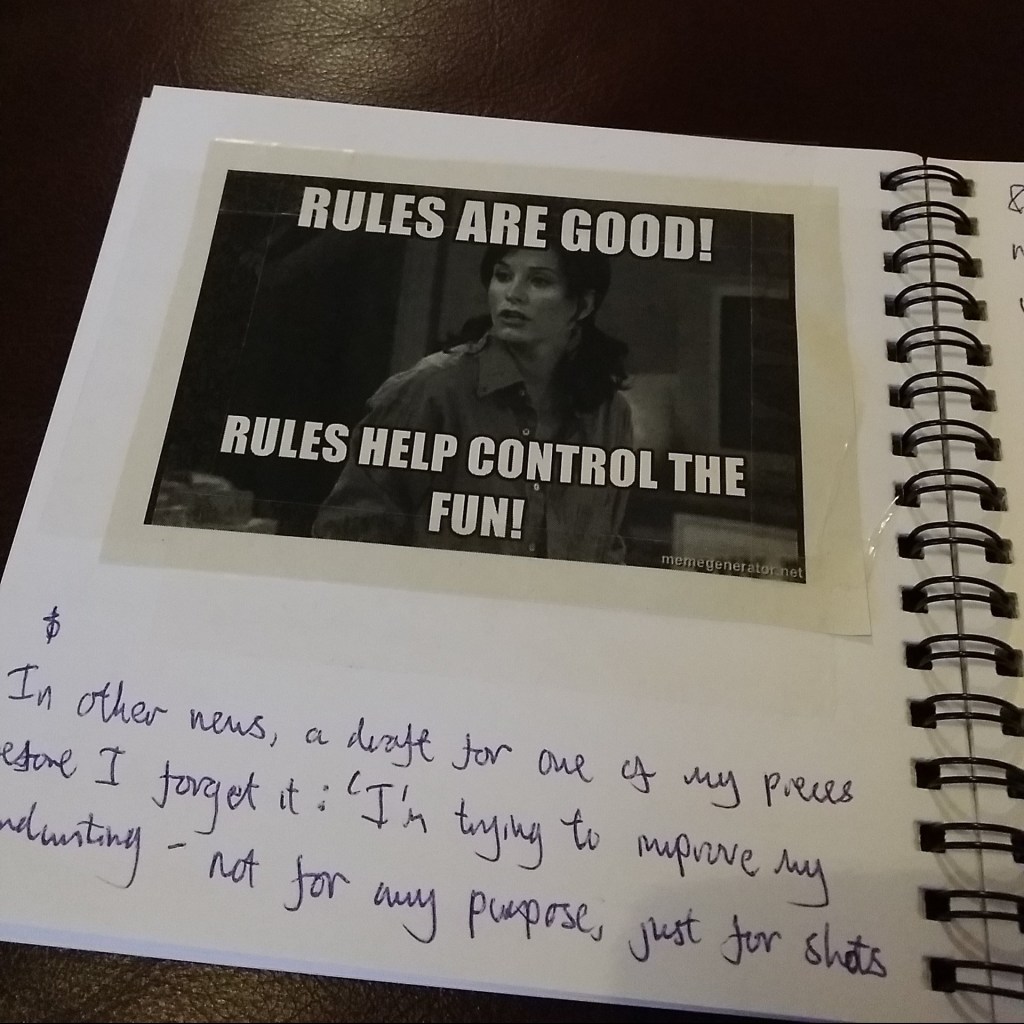
Rules are good! Rules help control the fun!

My main project will be text-based. I’ll be writing a fragment of 40 words on Day 1, 39 words on Day 2, and so on until I’m writing 10 words on Day 31. The text will form a complete circle so the fragment on the last day will join up with the fragment on the first.

That said, being around visual artists has had an effect on me. Last year’s project consisted largely of pen on lined paper, which looked somewhat out of place compared to the other participants’ installations. Poets think about how their work looks on the page; artists think about how it looks on the wall.

In fact, the proposed title is Line for a Walk, derived from a quote by the artist Paul Klee. Depending upon which source you read, he said, ‘A line is simply a dot going for a walk,’ or ‘A drawing is simply a line going for a walk.’ I actually used this analogy to explain to the organiser what it’s like to write a novel in a month, and the phrase stuck with me.

There are side projects planned alongside the main one, but these aren’t quite so rigorously defined yet. Even if they don’t happen, January will not be a dull month.

Giving the Right Direction

Whenever possible, I go to an event called Scrieve. Playwrights are invited to submit a 10-minute extract of their work, where it’s read out by volunteer actors.

Having recently revisited and edited my one-woman play Jennifer Goldman’s Electric Scream, I submitted scenes 1 and 3 for reading. I omitted scene 2 largely because of time constraints.

Some months ago, I’d submitted another extract from later in the play and I was pleased with the person who’d read it out, as it was in exactly the excitable manner I’d intended. I was fortunate to have the same person read it out in this instance. However, while scene 3 was satisfactory, scene 1 made the audience laugh – but it’s supposed to be more serious than the majority of the play.

Playwriting is not for the control freak. It’s a common rookie mistake for the writer to micromanage the actors. By convention, the writer supplies the dialogue and the bare minimum of stage direction, while the director has control over how the play looks and sounds to the audience. There were some great plays at Scrieve, but my script definitely allowed the characters the greatest freedom of movement.

So I’ve taken another look at the direction in scene 1. I can’t control the final outcome, but I can suggest how the dialogue is supposed to be delivered.

The misunderstanding probably arose with the phrase I’d used to describe the character at that point: ‘[…] FORMALLY DRESSED AND CONFIDENT’. The lines were definitely delivered with confidence, but also with humour. This has now been amended to: ‘[…] FORMALLY DRESSED AND SPEAKING IN A SERIOUS TONE’.

Unless I can rope in a willing volunteer, this will probably be the last time I’m able to hear my words spoken by someone else before I submit it to an upcoming event. Nonetheless, it proved invaluable for ironing out a small flaw that changed the nature of a whole scene.

Ramp up the Action

By convention, a stage play is written in three acts. The first act introduces the audience to the characters and their world, the next presents the protagonist with problems to solve, and the third makes those problems even worse until the climax near the end. The same structure can also be borrowed for screenwriting, novels and even short stories.

I’ve recently been editing my play in the hope of having it featured at a festival in April. When I started, it was an hour long, and I need to submit a 20-minute extract. I’ve decided to use the first 20 minutes, the equivalent of the first act.

When creating the extract, however, I realised there was too much exposition and not enough foreshadowing. So I’ve been working to tighten up that first act, eliminating subplots that aren’t referenced again while bringing forward those that are.

While my work isn’t finished yet, I’m now happier with the play than I was. That said, it comes at the cost of shortening the overall length, which will need to be considered at a later time.

The Mood of the Room

Before we begin the entry properly, one of my fellow bloggers has reported some difficulties leaving comments on my posts. If you’re having similar problems, let me know at purple@gavincameron.co.uk.

In 2001, the musician Darius Danesh failed to make it into the later stages of Popstars. When he announced this to the others, he tried to sum up their positive thoughts by saying, ‘How much love is there in this room?’ A clip of the incident is below:

Darius on Popstars in 2001much fun was made of this statement at the time

Much fun was made of this statement at the time, although his later career has been better received. He did have a good point about the mood of a room, as it’s something I think about when I’m performing.

On Friday of last week, I was invited to perform at a poetry night called Blend In – Stand Out. This was something of a risk on the part of the organiser because previous events had been held in Perth, whereas this one was half-an-hour’s drive away in Dundee.

However, I detected good vibes from the start. A number of the members already knew each other, and many had already started drinking, which some folk need before they feel confident. Every performer is allowed two turns. When I stood up, the audience reacted just as I’d wanted, especially the second time.

The following evening, I was again due to perform in a very different venue to a much wider audience as part of a community soul choir. This first involved a dress rehearsal for a total of more than three hours, including a technical run-through.

The show went marvellously, with the audience out of their seats by the final song, helped by our extroverted conductor. Many were there because they knew one of the 300 or so singers on the stage.

But sometimes, the mood of the room simply isn’t with the performer. At one event last year, I was on the bill between two musicians, so nobody was geared up to hear poetry. It also didn’t help that the audience hadn’t come specifically to hear the entertainment; rather, it was a place to rest as part of a wider arts event.

It’s unfortunate that even when the audience isn’t engaged, people will still look less favourably on the person who stopped halfway through. And if it’s a paid gig, the promoter might even withhold all or part of your fee.

So whatever the dynamic in the room is, my advice is to continue performing the set. A good technique is to identify one or two people who are paying attention and direct your words to them.

That is unless the mood is at the stage where you feel physically threatened. I’ve never seen that happen, though, and I hope it never will.


Moving On

On Friday evening, I finished National Novel Writing Month just over the target of 50,000 words.

But rather than look back and analyse the struggles of achieving that goal, I feel more inclined to tackle the tasks that had to be put aside in the meantime.

To that end, have a great week, and I look forward to updating you in a more complete fashion.

Dear Diary

Last Monday, our open-mike night for writers moved back to its old venue after a refurbishment. We had an excellent turnout and enough material for more than two hours, not including the two 15-minute breaks. A couple of the staff also said they enjoyed meeting us.

Then on Tuesday, it was our NaNoWriMo meeting where we sometimes write and sometimes chat and always exchange ideas and maybe fill in each other’s plot holes. After that, I spent a little time at a playwriting evening called Scrieve where playwrights get to hear their work performed by volunteer actors.

On Thursday, I was with my poetry group Wyverns where we each presented our poems about Frankenstein on the 200th anniversary of the publication of Mary Shelley’s novel. There is a local connection as she acknowledged in an essay that the grim Dundee climate inspired her creation. Our poems have been published in a slimline booklet.

Saturday was when we had our second NaNoWriMo meeting of the week, and despite not starting until the afternoon, it was one of my most productive days so far with 2,500 words written. However, at the end of Sunday, I only had 35,482 when I needed 41,666 to stay on target. If I don’t pull my finger out soon, I’m not going to manage the 50,000 words, but dear diary, you can tell anyone I admitted this.

I Didn’t Know You Could Do That

When I was around 15 or 16, I heard a track on Radio 2. It was unlike anything I’d encountered before.

There was no singing, yet it wasn’t recognisably rap music. Rather, someone was speaking words over an acoustic funk groove, telling us that The Revolution Will Not Be Televised. At this point, I knew nothing about Gil Scott-Heron and I didn’t understand the majority of his references. Nonetheless, in a little over three minutes, it had shown me something that I didn’t know could be done with words, a relentless stream of passion. When I was at university, I bought the album featuring the track. This was a good 10 years or so before I started to write poetry. But together with the first two albums by The Streets, my mind was stretched in a different direction. Fast forward to the present day, and I’m more selective about what I enjoy and more critical of what I hear. However, these eye-opening moments still happen every so often. Last week, I went to an event in Birmingham held by Out-Spoken Press. I’d initially heard about this through Harry Josephine Giles, who rotated the book while reading from it. I bought it afterwards, and I could see why. The words curled, or were set vertically, or were occasionally run together in a massive heap, whereas it would never have occurred to me to do anything other than start a new line. Birmingham is a more multicultural place than where I’m from, and racism is something that Anthony Anaxagorou tackles head-on, just as Scott-Heron did in the 1970s. Meanwhile, Ollie O’Neill spoke frankly about her experience of Britain’s mental healthcare system, a common theme among poets. Unfortunately, neither of their books are published until next year, so I’ll have to wait. However far my writing career goes, I don’t want to turn into one of these idiots who think they know it all and who stop learning or who taking constructive criticism on board. I want these moments to keep happening to me, the ones that hit me like Gil Scott-Heron did when I was a teenager.

To the Edge

Over the past week or so, I’ve had a lot of time to write while travelling on trains. In fact, I’m writing this from a hotel room in Birmingham that reminds me of an old-school Butlins chalet. That’s not a criticism; I think it’s marvellous.

Unfortunately, while writing, I haven’t had much time to write about writing. I only started this entry at 5:30pm and it’s due to be published at 6pm.

Douglas Adams is known for saying, ‘I love deadlines. I love the whooshing noise they make as they go by.’ I know he was trying to be funny, but I can’t get behind that mentality. To me, a deadline needs to be met, even if it’s a self-imposed one.

Last week, a friend needed a reference for a job application. I hadn’t read the e-mail properly and didn’t realise it needed to be done on the same night. I wrote it nonetheless on the grounds that the employer might be flexible. My friend agreed, so I submitted it the moment it was proof-read.

My top tip for meeting deadlines is to use a paper diary rather than a phone calendar; I favour a Moleskine. The pages are much larger than a mobile device allows, so you can see a week at a time, and you can refer to it while you’re speaking to someone on the phone.

It’s Gonna Be Epic!!

I was invited last week to be part of a one-off writing workshop. I knew little about the content in advance because it was brought to my attention by a third party. However, I believe improv keeps me sharp, so I was excited to go along and find out.

Martin O’Connor led us through the workshop. He’s interested in epic poetry, particularly in the Scots dialect, so he was holding these sessions around Scotland.

As part of the exercise, the eight or so participants were asked to complete several statements ranging from ‘My favourite holiday was…’ to ‘After death, I believe we…’ From these, we were asked to build a chronology of one aspect of our lives, before building up to the beginning of an epic piece of prose or poetry.

Martin invited us to send the work to him, either as it was written in the workshop or expanded into a full-length piece. The work didn’t necessarily have to be in Scots; in fact, none of the participants wrote that way.

Poetry is about boiling down big concepts into a few words, so for epic poetry, you need a lot of source material. Paradise Lost by John Milton is based upon Bible Scripture so he had a lot of material to draw up. Similarly, The Iliad and The Odyssey by Homer are both set over a 10-year period.

Prose allows a little more flexibility for expanding ideas. The classic example is War & Peace by Leo Tolstoy, which runs to 250,000 words. This took seven years to write, and is set during the Napoleonic Wars, which took place from 1803 to 1815.

This month, I’ve started upon my annual attempt at National Novel Writing Month, as well as leading the local region with the help of a co-host.

The target is 50,000 words, more modest than the works mentioned above, but the challenge is to write them all within 30 days. Fortunately, I’ll be spending a lot of time on trains, giving me ample time to boost that word count, and the region as a whole is nearly at the 300,000-word mark.

Of course, the new standard of epic literature is neither fiction nor poetry. In July 2016, Sir John Chilcot published his long-awaited report about the invasion of Iraq in 2003. It ran to 2.6 million words.

The Benefit of Experience

Last week, a friend sent me a poem she’d written about a recent bereavement, asking for some suggestions. I immediately agreed. I copied the piece into Microsoft Word and switched on Tracked Changes, then looked through the piece line by line.

The first thing I did was check whether she’d followed generally accepted conventions, such as placing a lowercase letter where the start of a line isn’t a new sentence, and making sure a significant word ends each line.

When you read poetry a lot, you begin to build up a template in your head of what you like and don’t like, and what looks ‘right’ and ‘wrong’. So aside from the conventions outlined above, I considered how the piece sounded overall, and omitted or added words accordingly.

I made it clear than anything I wrote was merely a suggestion and could be ignored if she felt it didn’t work. Indeed, the poem was great to begin with, but someone else could easily come along and make different suggestions in accordance with their experience.

I don’t know yet whether this friend took my suggestions on board, but if she does, I believe it would improve the piece.