When to Veer Off-Course

I’m a founding member of a monthly writing group called the Wyverns. Over the decade or so of existence, the format has remained relatively constant. A prompt or theme is agreed upon at each session and the members strive to write a poem on that theme for the following session, in return for constructive feedback.

These prompts are generally abstract or open to interpretation because our members write in a variety of styles. Recent themes include peace, cartoon characters and view or scene. I couldn’t make it to the last meeting, so I’m not aware of the conversation that happened, only that the resulting prompt was the more specific Devices that control our lives.

Importantly, the prompts are not mandatory but are treated as a springboard that members can use for their work. As such, this is one of the few instances where I’m considering not following it and instead submitting work on another topic.

On the one hand, I’m up for a challenge. Some of the most difficult prompts have resulted in superior work that I might not have achieved with a simpler one. On the other hand, I’m growing weary of hearing such endless discussions and debates, let alone contributing to them.

It’s not always wise to evade the brief. Try submitting a piece to a competition that isn’t within the rules and I guarantee the editor will have binned it by the time the ink dries on the rejection letter. But there are instances where it’s acceptable to change the nature of what you’re writing.

In 2019, I was looking to write a short joke about how YouTube originally started as a mail-order video-rental catalogue. The more I considered the idea, the more detail I kept adding. It turned into a 1,700-word short story. In the process, it morphed from a one-liner into a satirical alternate history, yet I was pleased with the outcome.

I’m still considering what to do with the Wyverns prompt, but I do intend to submit something before our meeting next month.
Pencil, Paper and Privacy

I’m in a poetry circle called the Wyverns. Each month, we write a piece and share it with the rest of the group, inviting constructive feedback from the others.

This month, the prompt was Cartoon characters. With only four days until the next meeting and a hazy idea about what to write, I churned out a piece and an introduction directly into an email. After checking it over for any obvious errors, it was then sent to the other members.

When I told the group about how I’d composed the poem, it started off a discussion about the writing process, primarily whether we used paper to start, or entered it straight into a computer.

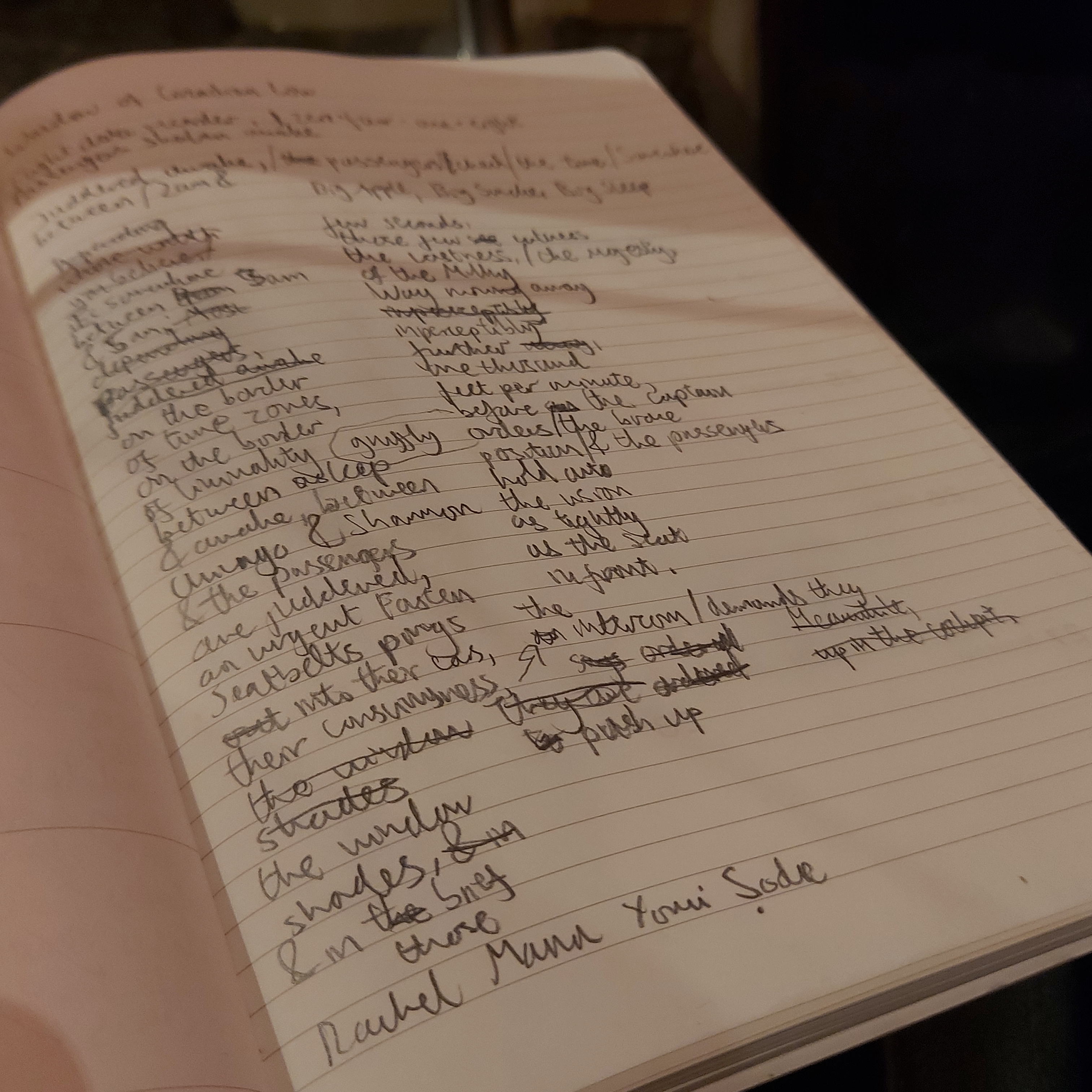
Typically, my pieces do start on paper. I make sure to buy a diary with plenty of note pages because these double as my notebook. It was a habit I developed a few years ago because I was typing all day at work, and it was a relief to pick up a pencil instead.

As I’m a touch-typist, writing by hand is considerably slower, but it can also allow more time to think about the text while composing. Paper also affords a less linear approach, freely allowing the addition of words with a carat mark or margin notes. A word processor, by contrast, typically likes to restrict the user to one line. There are odd exceptions like Microsoft OneNote, which can be used as a digital scrapbook.

I find writing by hand works best for prose and poetry. These blog entries are composed much more quickly, often in reaction to something that’s happened the same week, so these are entered straight into WordPress. I run a writing group every Tuesday and I often use that time to polish them off.

While we’re here, if you do a lot of writing on a computer in a public place, my advice is to buy a privacy screen immediately.

You can see the image straight on, or slightly to the left or right, while anyone looking at too steep an angle won’t be able to make anything out. Mine attaches with unobtrusive clear pads and stays permanently in place, but some other designs are removable.

Staying Away From My Usual Groups

Long-term readers will know that after nine years, I decided to stop hosting my open mic night Hotchpotch.

I’m far from the first host, but the previous handovers were typically haphazard. That didn’t matter so much when our events were smaller and more intimate affairs. As we now boast our largest-ever following, we needed a few months to make the handover go smoothly. That period has now elapsed, so I stayed away from last Wednesday’s event to emphasise this clean break.

That evening, I instead took the opportunity to attend an indoor labyrinth walk that clashes with Hotchpotch. It’s entirely a coincidence, as our schedules are independent of each other.

You don’t need to be religious or spiritual to go along. The organiser brings a massive canvas with the labyrinth pattern, setting up candles and relaxing music to generate the atmosphere. While I was still geographically close enough to help out with the open mic if it was absolutely necessary, the walk offered a distraction. By all accounts, however, the event went well.

I also missed my weekly Tuesday writing group, called What’s Your Story, but for different reasons.

My poetry circle, the Wyverns, produces a pamphlet every year in conjunction with the University of Dundee. The launch event was supposed to be on a different day, but there was an unexpected double booking that was – fortunately – spotted weeks in advance.

Our theme this year was the George Orwell novel 1984, marking the 75th year since its publication. Because the author died barely a year later, this has also led to the book entering the public domain, at least in the UK and the EU, which gave us considerable artistic freedom. My contribution was titled 1985 and imagined how the totalitarian regime might end, based on the real-life Jasmine Revolution of Tunisia, starting in 2010.

I’ll definitely be back at What’s Your Story tonight. I’ll probably also be back at Hotchpotch next month, but strictly as a punter rather than a host.

I’ve Started So I’ll Finish

On Saturday, I made my annual visit to StAnza in St Andrews, billed as Scotland’s International Poetry Festival.

I’ve been going for around a decade, but my commitment has varied from year to year. Sometimes I’ve been to as many events as possible during a day trip, and sometimes I’ve booked accommodation so I could stay for the late-night slam.

This year, I made a conscious decision to buy just one ticket for the Breakfast Poetry show. As part of the entry fee, the audience is offered light refreshments and a coffee. In the afternoon, I planned to take the opportunity to catch up with my pal Robert who lives in St Andrews.

My advice for going to StAnza – and poetry events in general – is always to carry a notepad and pencil. I always find little nuggets of information that would otherwise be forgotten afterwards.

I’m glad I did because I was trying to compose a poem for my monthly Wyverns group using the prompt ‘Stars and planets’. I’d been turning over two ideas but they’d been coming out as short stories.

But as I listened to our guests Rachel Mann and Yomi Ṣode, it started to come together. It’s hard to quantify, but just being around other poets can help the process along. I was able to complete the piece that morning.

The following day, I typed up the piece and sent it to the group. The meeting had already taken place a week before it normally does because of a scheduling conflict, but I did received generally positive feedback by email.

I don’t yet know what my next festival will be, but I’m looking forward to finding out what’s on.

Until the Last Moment

I’m a member of a monthly poetry circle called the Wyverns. We each typically write a piece ahead of the next meeting to be read aloud and discussed. There is always a broad prompt to assist with choosing a subject.

In most cases, I submit my work relatively quickly, but I’d let it go in October because I thought the focus of the November meeting was entirely given over to discussing an upcoming pamphlet project. Around 48 hours before the meeting, it transpired that I’d misunderstood what was said. We were discussing the project, but there would also be time for poetry.

It was time to knuckle down. The prompt was ‘Being Human’, which coincided with the theme of the aforementioned pamphlet and is also why I misunderstood the brief. By coincidence, I’ve been learning a lot recently about the disgraced Sam Bankman-Fried, so I wasn’t short of material.

Much of the online communication in the group is done using an email discussion list, so I posted my ten-line verse there as soon as I was satisfied with the wording. I also printed off several paper copies for those who might not have checked their emails.

As a result, I was able to gather feedback on it, which was more favourable than some pieces where I’d spent days thinking about the wording. Perhaps there’s a lesson to be learned there.

If you’re local to Dundee, incidentally, you can come and hear poems from the pamphlet being performed tomorrow at the Global Room in the University of Dundee.

Uninspiring Prompts

I’m in a monthly poetry circle where we write a new poem each month. There is always a prompt to help with inspiration, but there’s no obligation to follow it.

For this month, it was suggested we write about public art. I thought this would be a simple task, as I live five minutes away from three separate sculptures on the same piece of land: one is a spiral, another is a vertical zig-zag, and the third is in the shape of a large egg.

I instead spent days trying to be inspired by one or more of these pieces. I tried rhyming poetry, free verse, a self-referential style, and a critical style, yet nothing was working. I eventually figured out the problem. I needed context for these sculptures, but there is absolutely none, not even a sign with a title or something about the artist. Without this background information, I found myself unable to engage.

Instead, I walked a few minutes up the road to a mural painted last year. It spans the height of a six-storey building, is attributed to a particular artist and there is background information available online. That poem took less than an hour to write and I’m more satisfied with it than any of my previous drafts.

There is no telling what’s going to be a prompt for your next poem, but if something isn’t working for you, there’s no shame in moving on to something else that does inspire you.

Local Stories in the Global Room

Let me address first of all why you’re seeing this post on a Sunday when I’m accustomed to making them on a Tuesday.

I forgot to update on Tuesday, so my self-imposed punishment was to make two further entries this week: one on Friday just gone and one today. From Tuesday, we’ll go back to weekly posting.

In this entry, let me take you back to last Sunday.

Every year, the University of Dundee runs the Being Human festival, in celebration of the humanities. I’d signed up to join their Talking Bus tour, driving a round trip of approximately 75 miles to places in Angus. During the trip, we were told folk tales by Dr Erin Farley. She’s someone I’ve known for a long time, and last year she launched a collection of these stories.

This book has proved to be rather influential in my poetry group, the Wyverns. The group is not normally open to the general public, but we do have a history of tie-ins with the Being Human festival, so this is the one time of year we can showcase our work. Tuesday saw the launch of our seventh pamphlet at the university with accompanying readings.

In common with our previous publications, this took place in the Global Room on campus, used for social and cultural events rather than lectures. Each of the Wyvern poets stood up in turn to perform our poems, and the words were also displayed on a TV behind us for the audience to read along. The best perk, in my opinion, was the bowl of posh chocolates that was passed around the crowd to accompany the tea and coffee. Erin and a few others were in attendance, and it seemed to go down well.

In all that excitement, I simply forgot to update this blog. I only remembered early on Wednesday morning, when the moment had long passed.

After the event, the group exchanged a few emails on our discussion list. One member reported feeling exceptionally nervous about performing, which reminded me that not everyone is comfortable standing on a stage to read. I sometimes forget this because I read to an audience at least once a month, and I rarely think anything of it. While this is a subject I’ve addressed before on the blog, a casual search suggests I haven’t updated my advice since 2018.

I reckon that’s a topic to revisit next week, but in lieu of a more comprehensive entry, the best general piece of advice I can give is to treat it like learning any new skill.

Let’s say you know nothing about snooker, but you read up on the rules, buy a table on a whim and find a regular willing opponent. If you play three frames a day for twelve months, that’s well over a thousand matches. Within a year, you’ll know which moves work and don’t work, the optimum spin to place on the ball, how to block the other player effectively, and so forth.

In short, you’ll be pretty good at playing snooker by this time next year, just in time for our potential eighth pamphlet.

A Regular Writing Routine

I’m part of the Wyvern Poets group in Dundee, having been a founder member in or around 2015.

Unlike my other groups, this one does not actively recruit members but it does publish its work. Most notably, Dundee University has invited us to put together a pamphlet for the Being Human festival every November, and to perform our work on campus.

For the rest of the year, the members each write a poem ahead of our monthly meetings. There is always an optional prompt; normally a single word like ‘environment’, ‘pace’ or ‘journey’. The poems are then discussed on a peer-review basis and suggestions are made between members.

I find if I undertake no other writing in a given month, I always submit something for the group, even if it’s at the last minute or if I’m not entirely happy with it. As there’s only around a week until the next meeting, I’m going to crack on with this month’s prompt – villanelle – right after I finish this.

A Surprisingly Unpopular Event

I received a message from someone local who’s currently working on a community-focused project that launches this weekend. It’s aimed at encouraging people to think more about the clothes they have, the memories they represent, and imagining what might happen when these items are passed on.

One of the proposed events was to bring in local poets to respond to the above themes, but as the organiser didn’t know many poets, she wanted to tap into my connections. I was happy to help out, and I spoke to two of my poetry groups.

After a week, I was surprised to receive virtually no response to my messages, especially as the clothing event was intended to take place in person. As an organiser, I’ve found that people react to staged events more positively, as the public has become weary of so many virtual ones.

I explained this to the organiser but added that I would still like to contribute. My starting point was a T-shirt from 1996 that I still own, and the resulting piece became an exploration of when I met my first girlfriend at age 12, and how my approach to relationships has changed between then and now.

I don’t know whether I’ll actually be able to attend, as something more pressing has arisen, but I wish her all the best with the project.

The Evasive Verse

This week, I’ve been trying to write a piece for my poetry circle. Specifically, it had to be in some way related to the author Robert Duncan Milne, a forgotten contemporary of H G Wells.

As the reading for this has taken up so much of my time, I don’t have a full-length entry for this site.

However, I’ve often advised that going for a walk is a great way to sort out the ideas in your head, and that’s exactly what happened here. After days of reading, and trying to tie together a few of Milne’s concepts into a single verse, it was a lunchtime trip outside that gave me the final verse.

I’m about to read it over just now, maybe tweak it, and send them my work.