Looking at Loqueesha

There are plenty of films released each year that are given a lukewarm to negative reception. However, to make it onto the Wikipedia page titled List of films considered the worst, it has to be particularly bad.

At the time of writing, there are some predictable gems on there, like The Room (2003) and Cats (2019), along with forgotten and obscure features like Reefer Madness (1936) and Glitter (2001).

But one in particular caught my attention: Loqueesha, released about six months before Cats. It’s a vanity project directed, produced and co-written by its star Jeremy Saville.

The plot centres around a white barman who sends an audio recording to audition for an advice show on local radio. When his first attempt is rejected, he sends a second one pretending to be a black woman. After landing the job and fronting a successful show, he needs to maintain the illusion.

There are many reasons why it has a score of 1.6 out of 10 on IMDB and an astonishing 0% on Rotten Tomatoes. For a start, there aren’t enough plot points even to stretch to feature-length picture, and let’s skim over the borderline racism.

If there is one salvageable aspect of this film, it’s the dialogue. In the 98-minute running time, I don’t recall hearing much that I would describe as cliché. Yet it does need a lot of tightening to account for the lack of sub-plots. It could probably be shortened to a half or a third of its current running time, and be turned into a TV or radio drama.

There’s also a lesson here about lessening your control of a project. The staging or filming of a script is typically a collaborative process, with different people taking well-defined roles. The writing credits are shared, but perhaps doing the same for the other roles would have improved this film from bad to mediocre.

When the Pastiche Becomes the Product

In 2017, I went to see The Square at the cinema, knowing it was meant to be a postmodern send-up of the contemporary arts scene. However, with the disjointed narrative, I came away with the distinct view that the film embodied the very concept it claimed to parody.

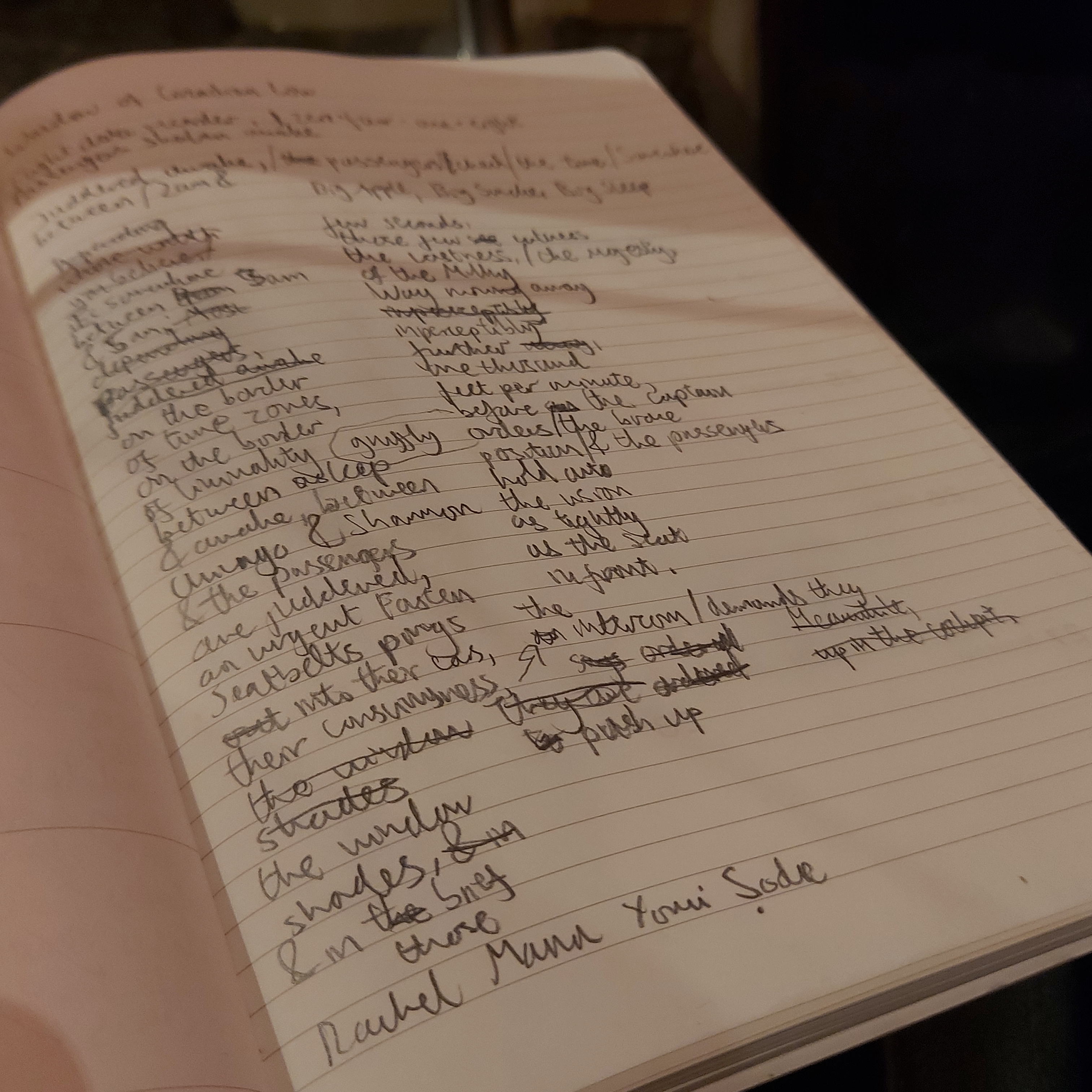
I’ve recently been thinking about this idea, but through a different medium. For my poetry circle, I wrote a verse intended as a pastiche of those ‘literary’ poets who often appear from nowhere and are showered with critical acclaim, frequently disappearing just as quickly.

The 19-line verse takes place on the third of January in an unspecified year. It’s from the point of view of two people who have moved to New York from Ireland and Scotland, and how the fantasy of living there has turned into reality. The last few lines were intended to be jarring, switching focus to an unrelated and overlooked secretary preparing to search for another job.

On submitting the poem, I asked the group members to consider the verse first and then to read the explanation. I wanted them to gauge whether – like The Square – the pastiche had become the product.

I think I’ve got away with it. Although there was constructive criticism of some parts, the consensus was that the abrupt change of focus didn’t come across as jarring as I’d intended, with one member saying it was a fitting ending to the piece.

I’m happy with the results of this most unscientific experiment, so I’m not inclined to repeat it for the moment. If I did have the chance to be one of those ‘literary’ one-hit wonders I talked about, though, I’d be inclined to grab it, however fleeting it proved to be.

No Fun ‘Til February

I really like January. It carries none of the bustle and hassle of December, but instead has a fresh feeling, as though the cellophane has just been removed from the new year.

There is a trade-off here, though. The relative stillness of the month means that nothing particularly literary is happening right now. We need to wait until March for both the St Andrews poetry festival – or StAnza – and the Scottish Poetry Slam Championship in Glasgow. Many other literary fairs and gatherings don’t happen until summer. Even the Scottish Book Trust has given participants until the end of this month to enter their December 50-word story competition.

Outside of the literary scene, I would normally take part in Fun a Day Dundee. This is aimed at artists rather than writers, but it’s to help them through the slump of January. I usually find a way to incorporate text. However, that event isn’t running in its usual form this year, although hopes are high for 2025.

The best I can do at the moment is to complete the books I borrowed for the readathon a couple of weeks ago and return them to the library.

Using the Shavian Alphabet for Scots

Over the last week, an alternative rendering of English has come to my attention: the Shavian alphabet.

The name is derived from the last name of George Bernard Shaw, who disliked silent letters and non-phonetic spellings, and argued that the existing alphabet is insufficient to represent its sounds. However, he had little to do with its creation as it was developed more than a decade after he died in 1950.

Much more detail is available on a dedicated website run by one of its proponents. In simple terms, its main purpose is to eliminate ambiguous spellings by creating just one symbol for each possible sound actually used in English. For example, the current alphabet reserves just five letters for vowels as written, whereas there are around 20 vowel sounds. The letters of Shavian are more akin to Arabic than Latin.

This blog has taken longer to research than I initially imagined it would. However, no source seems to have addressed what I think is an obvious gap. The variant of English spoken in Scotland shares a similar problem with standard English in that the letters don’t necessarily match the sounds, with the extra issue that more words have more than one spelling, depending on how the speaker pronounces it.

On top of that is an additional guttural sound, represented by ch in words such as loch or Auchterhouse. This is not unique to Scotland, also appearing in languages such as Spanish and German.

In my view, adding a representation for that sound would go some way towards making it suitable for Scots speakers. The International Phonetic Alphabet devotes the letter x to it, which is not already used in Shavian, but also can’t be drawn with one stroke like the rest of its characters.

As it stands, it’s unlikely we’ll see any widespread use of the Shavian alphabet in our lifetimes. But who knows what practical applications might be found for it in the future?

A Short Spell of Reading

I have a group of pals who hold a readathon approximately every three months, typically coinciding with the equinoxes and solstices. It used to be an intensive twelve hours but has settled down into a more relaxed two-day format.

Ahead of the most recent one on Friday and Saturday, I went to the library and found two short story collections, namely:

  • Her Body & Other Parties by Carmen Maria Machado.
  • The Rental Heart and Other Fairytales by Kirsty Logan.

I started with the Kirsty Logan one. I’d enjoyed her novel The Gracekeepers, and I even met her at a launch on its release. But the esteem in which I hold the novel didn’t translate to that collection.

Back in July, I wrote an entry about short stories and how readers need to feel satisfied before the end of the narrative. I also prophetically ended the entry by saying I would park the thought for the moment with the intention of returning at some point. This is that point.

In the case of the Logan collection, I’d like to turn to a different metaphor. Each story is a jigsaw puzzle rather than a picture. There’s nothing inherently wrong with that, and a few of the stories worked. However, it’s necessary to make sure all the pieces are there so the reader can mentally assemble them and this didn’t work in a lot of cases. A story about a coin-operated boy simply baffled me towards the end.

I’m only part-way through the other collection, but all the pieces are present, so I’m enjoying the stories much more.

Taking the time to read has also encouraged me to continue with other projects. For instance, I submitted a 50-word-story to a competition run by the Scottish Book Trust. I’ve then continued some overdue work on my stage monologue. Who knows what else I’ll manage to tackle when I next dislike a book?

Backing Dvorak

If you look at the keyboard settings in your operating system, you’ll often spot several different layouts that the computer can understand. For instance: a French keyboard has its letters in a slightly different order, while a Russian one uses a completely different alphabet. Among them, you might see one marked ‘Dvorak’.

Despite its Czech name, the layout was invented by an American educational psychologist for use in typewriters. It’s well-known that the QWERTY design was introduced to slow down typists and avoid jamming the mechanisms, but by the 1930s, machines had improved to the point where fast typing wasn’t a problem. That’s where August Dvorak came in.

About a year or two after I began writing fiction, I began to develop Repetitive Strain Injury in my fingers, so I wanted to explore other options such as writing by hand, voice dictation, and a different keyboard.

With the vowels and most common consonants on the middle row, and the least often used on the bottom row, your fingers don’t need to travel so much. This is also the principle on which Scrabble letters are scored, but that’s a topic for a different time.

Dvorak does have downfalls. When I started using the system, I needed labels on the keys as reminders, graduating to a custom-built external keyboard, before I was able to rely on muscle memory. I also can’t change the keyboard on my workplace computer so I need to switch mentally between that and QWERTY.

Additionally, I mentioned how the layout was designed by an American, so a few of the keys don’t operate as expected, especially the pound sterling symbol.

To circumvent this, I use a program called AutoHotkey. On start-up, it loads a script that maps keypresses to other keys or to a subroutine. So if I press Ctrl+3, Windows can display the missing ‘£’ symbol rather than the ‘#’ produced by Shift+3. I have a few similar shortcuts for these special cases, although I still rely heavily on memory.

On balance, using the Dvorak keyboard has been a help more than a hindrance, and I’ll probably be using it well into the future.

Deliberately Not Reaching the Target

The end of November signals the end of National Novel Writing Month, which is a global challenge to draft a 50,000-word novel in just 30 days. Regular readers will know I’ve run the Dundee & Angus region for the last eight years.

Although it’s a tough challenge, the only real competition is against yourself. It’s run largely on an honour system, where participants self-report their word counts, and there’s no sanction for not reaching the target. As such, we always remind members that there’s no shame in not hitting 50,000 words.

When I took over the group, I quickly realised that organising and encouraging group members is sometimes incompatible with achieving my own goals. I have previously managed to reach 50,000 words while running the group, but the quality of my leadership suffered.

So for the last few years, I’ve made more of an effort to focus on the running of the group. This is in the full knowledge that a decent word count is unlikely to be possible. At the time of writing, I’ve recorded just 1,178 words.

However, there has been a noticeable improvement in the running of the region. This has been particularly true in the pre-pandemic period as my co-leader and I have gradually developed and trialled different ways of working.

The way I see it, if the members are able to focus on their projects and don’t notice how we run the group, then we’re doing a good job.

Until the Last Moment

I’m a member of a monthly poetry circle called the Wyverns. We each typically write a piece ahead of the next meeting to be read aloud and discussed. There is always a broad prompt to assist with choosing a subject.

In most cases, I submit my work relatively quickly, but I’d let it go in October because I thought the focus of the November meeting was entirely given over to discussing an upcoming pamphlet project. Around 48 hours before the meeting, it transpired that I’d misunderstood what was said. We were discussing the project, but there would also be time for poetry.

It was time to knuckle down. The prompt was ‘Being Human’, which coincided with the theme of the aforementioned pamphlet and is also why I misunderstood the brief. By coincidence, I’ve been learning a lot recently about the disgraced Sam Bankman-Fried, so I wasn’t short of material.

Much of the online communication in the group is done using an email discussion list, so I posted my ten-line verse there as soon as I was satisfied with the wording. I also printed off several paper copies for those who might not have checked their emails.

As a result, I was able to gather feedback on it, which was more favourable than some pieces where I’d spent days thinking about the wording. Perhaps there’s a lesson to be learned there.

If you’re local to Dundee, incidentally, you can come and hear poems from the pamphlet being performed tomorrow at the Global Room in the University of Dundee.

Writing Just Enough

As writers, I think we’ve all had the experience of starting a poem or a story with a great idea, but it fails because there simply isn’t enough material to sustain a complete story.

I remember one instance when I was invited to write a poem inspired by a botanic garden. I was particularly taken by a species of tree where the seed is sealed with a natural glue that can only be opened when it melts with heat. As such, in a natural environment, it requires a forest fire to reproduce. Despite writing many lines to this effect, I found only the first two and last two were strong candidates, so the end piece was much shorter than expected, but much punchier as well.

I’ve also experienced the opposite effect at least once. I set out to write a little joke for my online pals about how YouTube videos used to be sent out to customers by post. The fictional history of the company became so detailed that I eventually turned it into a 2,000-word short story.

The same unpredictability also happens in non-fiction. The Wikipedia page for Kirkton, Dundee is relatively short because it’s mainly a residential area, albeit with four schools and excellent transport links. On the other hand, the riot that erupted there at Hallowe’en in 2022 is given a separate page that’s around twice as long as the main article, simply because there is so much to be written about the incident.

Having written this blog for a decade now, I can generally predict how long my entries will be. Something else will occasionally occur to me while writing that extends their length. Every so often, I’ll run out of steam, leaving me with a draft entry that goes nowhere.

As these drafts are beginning to build up again, I’m going to see whether I can revisit them and add enough to create a fully-fledged topic.

Inform the Troops There Has Been a Complete Breakdown in Communications

Because of other commitments, I sometimes don’t write my blog entries until the last few hours. Most of the time this isn’t problem; I usually have at least one idea ready to go.

Today, however, the Internet connection isn’t co-operating. As such, I’m going to write this short entry and keep trying the Schedule button until 8pm.