In the early hours of Saturday morning, National Novel Writing Month kicked off. As I’m the organiser for Dundee, I’ve been in the thick of it since then, and I’ve had other work on top. It’s left me little time to compose a full WordPress update.
So far, we’ve held our Kick-Off Event and our first meet-up, and our word count continues to rise. When I checked it at 4:30pm tonight, we’d managed to register 168,000 words. My own words make up about 0.5% of that.
So I’m going to crack on with this, and aim to come back with a fuller entry next week.
When you’re a writer, and one of the country’s best literary festivals is on your doorstep, you can’t help but pop your head around the door. The Dundee Literary Festival closed yesterday after five days of events.
If you only look at one thing, make it The News Where You Are by James Robertson (below). I had a debate with one of the DURA bloggers over whether it was a story or a poem, but it’s a hilarious satire about what is implied when the national newsreaders hand over to the local newsrooms.
This year, I’ve become Municipal Liaison for National Novel Writing Month in Dundee. I arranged our Kick-Off Event to coincide with the festival. It’s impossible to tell how many people will come to a given event, but we ended up with ten members altogether, and we listened to last year’s MLitt graduates each reading his or her magnum opus. Our regular write-ins will begin on Saturday, and I’ll no doubt write more about these throughout November.
The cast of Avenue Q performs “It Sucks to Be Me” at Broadway on Broadway, September 10th 2006. (Photo credit: Wikipedia)
In between all that, I found time to see Avenue Q, the show that’s broken out of Broadway and crossed the Atlantic. The actors stand on stage and sing alongside the puppets, but this soon ceases to be a distraction as they settle into the story of a new graduate coming to town, Kate Monster’s fight to have monsters recognised in society, and Rod’s reluctance to admit his sexuality. Content-wise, there is very little actual swearing. If this was a film, it’s the adult concepts that would probably earn it a 15 classification.
It’s also hard to see why Teenage Mutant Ninja Turtles, which I also caught this week, was given a 12A rating, when I could find nothing that would it earn it any more than a PG.
I don’t often swear in my own writing. The intention is often to shock, but when everyone does it, the words lose their impact. Comedian Bill Bailey summed it up nicely when he compared effing and jeffing to road humps: one or two isn’t an issue, but a constant barrage is. By contrast, Quentin Tarantino takes the view that, “I’m a writer, no word is in jail,” but from watching his films, I do see the F- and C-words being given more parole than any other.
That said, I’m not above including blasphemy, as that’s commonly used and – generally speaking – is no longer thought of as swearing. There’s a 90-page study from Ofcom on the matter if you have the time, but the relevant sentence is: “There were a small, but vocal number of participants who found the use of holy names unacceptable.”
But in the right hands, swearing can be done well. I’m thinking mostly of John Cooper Clarke’s Evidently Chickentown, in which the F-word appears 83 times to produce an onomatopoeic effect of a chicken’s squawking. When he recorded it in the early 1980s, though, he had to replace 80 of these with bloody.
I was going to end this entry with a word that sounds a bit rude, but I shan’t.
I promised in my last entry that if I had the opportunity, I would memorise one of my poems and perform it the following Friday. Speakerbox is a new event for writers and poets at Dundee University union. During a chat with the organiser, she told me she hopes to hold it every month. She has also been to the existing Hotchpotch meetings to share her material.
I was asked to read first, and I have some footage of how it went. The purple mood lighting made this stage look fabulous in person, although not so much through a camcorder.
That’s right, I fluffed my lines. However, I managed without any further cock-ups in, “Take two,” along with another piece from memory, and two others from notes. I like to use an e-reader to save paper. I was followed by several other acts, mainly poetry but interspersed with prose and music. There were innovations I hadn’t seen before: one man walked between two microphones while delivering a monologue, another gave out chocolate bars to whomever he dubbed, “awesome.”
I hope this event continues, as I plan to be back next month. During the week, I also had a much rarer opportunity to be in the audience at a recording of a Mrs Brown’s Boys Christmas episode. Although the story is set in Ireland, it’s filmed in Glasgow.
BBC Scotland broadcasting centre in Glasgow. (Photo credit: Wikipedia)
In many respects, it’s a standard sitcom, except that many of their bloopers and ad-libs make it into the final programme. There were a number of these during the three hours we were in our seats. Many scenes were recorded twice in succession. I found I was watching the monitors rather than the action on the set, so I deliberately tried to keep my eyes away from them to catch the full experience.
Agnes Brown is played by Brendan O’Carroll who also writes much of the material, but it’s accessible scripting that doesn’t require the audience to understand any particularly Irish references, so it plays very well to a BBC1 viewership. It’s less well-known that he is also a novelist. In 1999, his book The Mammy was made into film called Agnes Browne, starring Anjelica Huston as the eponymous character. Unlike the sitcom, these take a sombre tone.
Also worth a look is What We Did On Our Holiday, starring David Tennant and Billy Connolly. It’s written by Andy Hamilton and Guy Jenkins, the force behind Outnumbered, although I’ll always remember them primarily for satirical comedy Drop The Dead Donkey. The duo have found a particular niche in giving the child characters all the best lines, often relentlessly, while the adults fumble for an answer.
The coming week is a busy one for me. Not only is the aforementioned Hotchpotch happening tonight, the Dundee Literary Festival also begins on Wednesday and runs to Sunday. At the same time, I’m organising the first meeting of the local National Novel Writing Month group, finishing my library books, and still taking time out to see Teenage Mutant Ninja Turtles at the cinema.
WordPress informs me that I’ve been writing on this site for exactly a year now. Thank you very much for joining me over the last twelve months. I’d like to start today with a little more recent history.
Two weeks ago, I watched a TED lecture about the techniques anyone can use to improve their powers of recall. It seems that humans are kitted out with excellent spacial and visual memory, and it’s much easier to remember something when it’s associated with a journey or the layout of a building. TED lectures themselves are traditionally delivered without notes.
I’ve read it several times but that is the first and only occasion I’ve heard the recording so far. Yet a fortnight on, I can recall the journey.
Allen Ginsberg (Photo credit: Wikipedia)
I remember where I was when I heard the best minds of his generation destroyed by madness.
I remember where I was when the saintly motorcyclists appeared.
I remember where I was when Moloch! appeared over and over.
I remember where I was when I was with him in Rockland.
One piece of advice often given to writers is to keep a notepad by the bed for good ideas. I’ve done this for years and I can still count on one hand how many flashes of inspiration I’ve had at 2am. What works for me is being active, particularly going for a walk.
I think the spatial memory concept is part of the reason why walking works wonders for ideas. As you amble, the brain is observing everything around you, which makes associations and triggers off memories. Please do ask for a second opinion about that theory from someone who’s qualified in these matters.
One of the great elements of being a poet – or indeed a prose writer – is that you aren’t normally expected to memorise your work. A rock musician doesn’t look at the chords as he’s performing to Wembley Stadium, a dancer on the West End stage doesn’t refer to the steps in her hand, but a poet is permitted to read from the page.
I have seen poetry recalled successfully from memory many times, but the occasion that stands out most was Alan Bissett. He not only performed two or three pages of a play without prompting, but acted out both parts by just the tone of his voice. Last place goes to Labour Party leader Ed Milliband MP, who forgot to mention immigration or the deficit in a recent speech.
I know only one of my poems by heart, but it’s the manageable length of eight lines with eight syllables each. My longest poem is a 120-line free verse piece called Anatomy of a Party.
In the first draft of this post, the last sentence of that last paragraph was, I could, and probably should, learn it using the Memory Palace technique as described in the TED talk, but there seems little point as I’d usually have it in front of me. But then I took a second thought. There’s an event on Friday where I plan to read Anatomy of a Party and two much shorter pieces, time permitting. I wonder whether I could memorise one of the shorter pieces for that day.
I offer no guarantees, but I think I’ll make an attempt. I’ll report back next Monday.
From Thursday to Saturday this week, Nassim Soleimanpour’s experimental play White Rabbit Red Rabbit will be performed at the Traverse Theatre in Edinburgh. Siobhan Redmond, Phill Jupitus and Ewen Bremner will have had no direction, no rehearsals, and no idea of what their lines will be. Instead, the script is placed in an envelope that will be opened in front of the audience just before the performance begins.
The play’s structure was influenced by the sanctions against the writer. He is a conscientious objector against military service in his native Iran, and is not allowed to leave that country. A symbolic empty seat is left in the front row of each performance.
I’m in the habit of listening to The New Yorker fiction podcast, where authors perform other authors’ short stories and are interviewed about why they like what they’ve just read. A couple of months ago, I encountered Donald Bartheleme for the first time through his story Concerning the Bodyguard. This piece is experimental in a different way, narrated through a series of questions, repeating nouns where a pronoun would normally suffice. Salman Rushdie read it, lending an extra edge through his measured baritone voice.
It took until the post-reading interview before I really understood what the story was saying, although the penny might have dropped had I listened to it one more time. It’s very much snagged my interest in Bartheleme, and if I encounter his books in my travels, I will definitely place them on my reading list.
It’s a safe bet that many of us have one or two pieces that don’t conform to the accepted norms, and it can be difficult to find a suitable home for these.
One of mine is a work called The Executive Lounge which takes the form of a list of statistics describing a place, but that place only becomes clear in the last two lines. I don’t know whether to classify it as prose or poetry, as a list usually contains line breaks like a poem, but this has the metre of a prose piece.
Whichever way you consider it, it’s most definitely for the page, not performance. My only public reading of it so far was in front of an audience who are accustomed to my work, and it’s the only one of my pieces they didn’t understand until I explained it. To date it’s been rejected by several publishers. Regardless, I consider it to be a completed work in which I still have faith.
However difficult it is to find a home in a mass-market world, never be afraid to experiment. With an ever-increasing number of small publishers springing up, at least one of them is bound to be on your wavelength. The next time I identify an editor who might appreciate The Executive Lounge, I’ll send it straight to them. If nobody took a risk from time to time, we’d all be reading bland and unchallenging literature.
Incidentally, the place I read out that piece was Hotchpotch, an open-mike night for writers rather than musicians. If you live in or near Dundee, the next event is on Monday 20 October at The Burgh Coffeehouse on Commercial Street from 7pm to 9pm. Bring along your best work, experimental or not.
On 4 December 1956, an extraordinary coincidence happened. Elvis Presley, Jerry Lee Lewis, Carl Perkins and Johnny Cash all happened to drop by Sun Record Studios in Memphis, which resulted in an impromptu jam session. The engineer had the foresight to record the session, and it’s now a celebrated event among rock ‘n’ roll fans.
On Wednesday of last week, I experienced a similar such meeting. I arrived 15 minutes early for a particular class, but nobody else had arrived after a five-minute wait. I then doubted myself and thought I should perhaps be in another class on the other side of the campus. I immediately headed there.
I had to excuse myself through hundreds of other students, coming the other way, aware that time was ticking away rapidly. When I reached the entrance, I happened to meet Classmate A and explained the situation. As we made our way through the crowds, we met Classmate B by chance and brought him with us. As we approached our destination, we happened to see Classmate C, who joined our small group.
Had you written either of these situations into a novel, the reader might have some difficulty suspending their disbelief. In short, coincidences don’t work particularly well in fiction, even though they happen all the time in real life. It’s related to the broader deus ex machina, when a seemingly unsolvable problem is abruptly resolved by some unexpected intervention.
One way to help the reader maintain that disbelief is to set a few parameters. This could be as simple as dropping a few hints earlier in the story. To demonstrate this, let’s break down my classroom anecdote.
My three classmates and I knew we could only be in one of two particular classrooms, so Classmate D had gone to the second room first, since she was just as unsure as me. And although the rooms were at opposite sides of the campus, there is a main thoroughfare that most students would use to travel from one to the other. So the crowds were not a hindrance to the four of us meeting, rather they were subconsciously leading us to each other.
If I included this incident in a fictional story with that background detail worked into it – Show, don’t tell, said Elmore Leonard – it’s more likely that the reader would see the meeting as quite a reasonable coincidence. It might even be possible to deconstruct the Million Dollar Quartet in a similar fashion. For a start, the label’s owner had brought along Jerry Lee Lewis as an instrumentalist for Carl Perkins, and Johnny Cash later wrote that he had already planned to see Perkins’ recording session that day.
Identify the parameters to help the reader believe those coincedences.
Many authors find it difficult to name characters. It’s not just a case of finding a name you haven’t used before; it has to be consistent with the person’s age, region, class, &c.
My names normally come very quickly, but in my novel The Government Artist, it took weeks to find the right moniker. The main character is a man born in 1943 who could potentially have gone to Oxford University. His name became Malcolm St Clement, which has a certain easy rhythm and suggests he’s from a fairly well-off family. But what about the names given by peers rather than parents?
In the TV series NCIS, Dr Donald Mallard is universally known as Ducky, an affectionate term that plays on his first and last names. By contrast, Agent Gibbs is the boss, and addressed only by his last name as a mark of respect. The only exception is Ducky, who is allowed to say Jethro. It implies the two have a relationship that predates Gibbs’s appointment, and perhaps his tolerance of being addressed so informally is a mark of his own respect to Ducky.
It can also speak volumes about a character whose nickname is not used, at least not to his or her face. In another of my books, Fifty Million Nicker, Josh “Speedy” Rush works in an office where affectionate titles are given to everyone. However, his colleague calls himself Pressure Pete as he’s proud of his harsh sales tactics. Nobody else calls him this, preferring to use names that range from Pete the Pain to Pete the Prick. One of their bosses is also unkindly known as Tart, taken from her first name Flanella.
In a few cases, the nickname can say more about the person who bestowed it than the recipient. I have a real-life example from people I knew a few years ago, so I’ll have to change the actual names used. Person 1 was called Callum, but Person 2 had only just met him and struggled to remember his name. One day, P2 accidentally called him Logan. Even though this was an isolated mistake and he finally learnt Callum’s correct name, P2 continued to nickname him Logan, trying to make it catch on. He persisted for three years, and nobody else ever used it.
If there is one name I should use more often, it’s Jeffrey Archer. I don’t know exactly why, but last week’s post gained twice as many views as normal. Do keep it up.
Firstly, let’s move some issues out of the way. There are many people who don’t like Jeffrey Archer, either as a person or as a novelist. But he is a very popular author, with at least 250 million books sold worldwide, and his advice regarding editing is faultless.
He’s stated in the past that he likes to redraft his work up to 14 times, and he usually does so in longhand. I wondered what would happen if I subjected my own words to the Archer treatment. To do this, I needed a passage that had never been edited, and I found one in notes from an old writing class. I’ll label that passage Revision Zero. The prompt was a photograph of a baby in a sidecar.
I wanted that bike, that particular one, the shiny black Yamaha, with the sidecar. You rarely see sidecars these days, so there was only one place that could help me with that, but it was worth the trip. Six months ago, I was driving in the countryside and I had my son with me. As we were finally picking up speed, I swerved to avoid a pothole and the nearside wheel hit a deep ditch. We both went flying into a field and only missed the fence by a few inches. We were lucky we didn’t suffer bad injuries, but it was the first accident I’d had in thirty years of driving. So with this new bike, the identical one, I go up and down that road with him again as often as I can, being careful at that part. I’m trying my hardest to block it out. The more I do it, the more I drive that route, the more it never happened.
For each redraft, I copied out the passage from start to finish into my notebook (pictured), making corrections as I went along.
My handwritten drafts
This was an unusual and quite time-consuming method for me, as I generally make only first drafts in the notepad then copy my work into a computer. Often I simply type the first draft. Let’s see how this passage has changed by Revision 3.
You rarely see motorcycles with sidecars these days, so when I needed a new machine, only one place could help me out. I ordered a model as close as possible to my old one: a black two-litre Yamaha. 3 months previously, I’d been riding in the countryside with my son beside me. When we reached the speed limit, we hit a pothole. It sent us flying into a field, & we came away with a few injuries. The worst part was having the first blot on a 20-year record of safe driving. No matter how much I explain this to my wife, she won’t let my son near the new bike. Instead, I pack the sidecar with the equivalent of his weight & travel along that same road as often as possible. Every time I do, I make sure I’m travelling at the same speed but swerve to avoid the pothole just as I should’ve done on the day of the accident. I’m trying my hardest to reduce its impact statistically & mentally. If I make this journey safely another 99 times, it means I’ve only had an accident on 1% of them; 999 journeys & that decreases to 0.1% & so on. Eventually, I want to be able to ride up that road without thinking of the accident. The more I do this, the more it never happened.
Revision Zero was written in May, and all subsequent revisions were made in August, during which time I hadn’t thought about the piece.
Already there are improvements. I’ve expanded on his inner conflict between his want to be a perfect driver and the accident that overshadows this.
The introduction of his wife creates a second conflict, this time over whether his son is allowed to ride with him. That conflict isn’t explored quite so much, but its outcome is clear. Perhaps the character is too caught up in his inner conflict to care much about the external one? He might even be in denial about it, which seems consistent with his mindset.
Now let’s explore Revision 6.
You rarely see motorcycles with sidecars these days, but I wanted exactly the same model as my wrecked one. Only one company could help me out, and even then, I had to make do with an approximate match. Three months previously, I’d been riding in the countryside with my son beside me. When we reached the speed limit, we hit a pothole. It sent us flying into a field. We were lucky to escape with few injuries, but the bike was a write-off. What hurts more was the stain on my clean 20-year driving record, which meant my wife wouldn’t let my son near the new machine. Instead, I pack the sidecar with the equivalent of his weight & travel that same road as often as possible. Every time I do, I make sure I’m going exactly the same speed, but I swerve to avoid the pothole just as I should’ve done on the day of the accident. I’m trying my hardest to reduce its impact by statistically & mentally. When I make this journey 99 times, it means I’ll only have crashed on 1% of these trips. When I make 999, that reduces to 0.1%, & so forth. Eventually, I want to be able to ride up that road without thinking about the accident whatsoever. The more I do this, the more it never happened.
I was initially aiming for 14 revisions. By the time I reached that point, however, I began to feel I would be revising for its own sake when the point of the exercise was to make only necessary improvements.
I finished Revision 6 a few days ago. Plot-wise, it doesn’t differ terribly from Revision 3, but the sentence structures do. Looking at it today, I would only change the ampersands into proper words and make minor alterations to some of the sentences.
And that’s one of the key techniques for revision: leave it a few days. Many writers are keen to submit their work as soon as it’s rewritten, but it’s a good idea to leave it for a day or two and revisit it. Archer might revise his work 14 times, but not at one sitting.
The rewriting process will help to tighten up any first draft, and you’ll probably find errors you didn’t realise were there. A good way of checking the punctuation and grammar is to read the paragraphs in reverse order so you don’t follow the story. The very best way of picking up all kinds of mistakes is to ask someone else to read it. A professional proofreader is best, but even a friend’s insight can be invaluable, and less expensive.
After all, a publisher or an agent needs to be hooked from page 1, and if the first thing they notice is careless writing, that piece will go straight to the rejection pile. On the other hand, a little revision now might set you on the road to selling 250 million of your own books.
A couple of weeks ago, I went to see a special screening of Local Hero. It’s an excellent film, and if you have the opportunity, you should see it.
The director Bill Forsyth was brought in at the end to hold a question-and-answer session with the audience. He mentioned at the beginning that he hadn’t seen the film in years, and an audience member asked why this was. He answered that he wasn’t ashamed of his work, simply that he wasn’t interested in looking back, and questioned whether – for example – a writer would be interested in rereading their old stories.
Contrary to the director’s opinion, my answer is a definite yes. I openly admit that being a writer wasn’t a childhood dream, and I therefore don’t have notepad upon notepad of embarrassing teenage musings. Rather, I wrote my first fiction in late 2010, just before I turned 27, and looking back enables me to keep a weather eye on how I’ve improved.
Even if I come across an old piece that I find jarring, I know I only need to rewrite it, or in extreme cases, deconstruct it, to bring it up to my current standards.
A prime example of such a jarring piece is one of the first poems I wrote, called The Cooler, a short verse about a character’s self-imprisonment. Looking at it now, it needs to be longer to fully convey the situation, as it’s currently unclear, and the clumsy language needs to be trimmed, eg, “It stays cold all night like a fridge.” Now I’ve looked back at it, I can think about these issues and improve the work.
In my next entry, I intend to cover the issue of rewriting in a more in-depth fashion.
I mentioned I’ve been writing fiction for less than four years, but I was a blogger long before that, discussing the issues on my mind at that moment, much as I do here. That writing is a little embarrassing, but it’s only by looking back that I can see how much I’ve moved on. Here’s a typical entry from almost exactly ten years ago.
There are many writers who started later in life, and I found out recently that John Grisham is one of them. He didn’t write his first novel until he was in his 30s, and didn’t give up his work as a lawyer until his second was published.
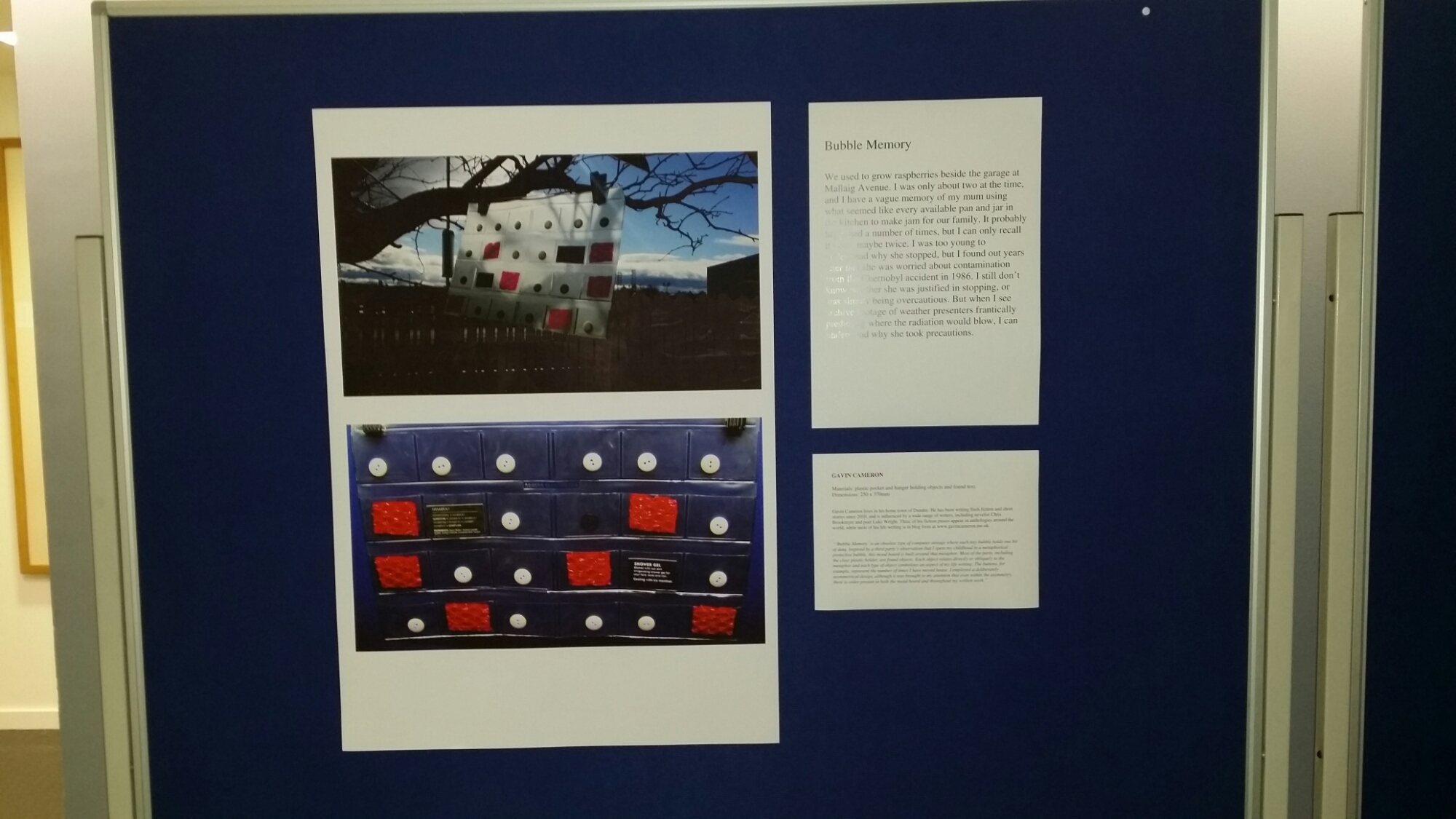
Last year, I joined a Life Writing class at the University of Dundee. One week, the tutor asked us to make mood boards to represent the themes of our writing. I didn’t look forward to this at all. As I’ve mentioned in previous entries, I’m not naturally gifted in visual expression.
But having consulted an artist for advice, I acquired materials from a nearby recycling plant, and pieces gradually fell into place. This task led to a short exhibition at the University where most of the class displayed their boards, with explanatory text and a personal story alongside each one.
In the mood
My mood board came to be titled Bubble Memory, constructed of a 35mm slide holder with buttons and other found materials in each pocket. The photograph shows how it was displayed in the exhibition, which closed on Friday of last week, although we are in talks to extend it. Despite my initial dread, I was pleased with the all-round results.
This is not the first time I’ve experimented with alternative formats. Text-based artist Gerry O’Brien was also a member of the Life Writing class, and submitted a piece of homework on a thumb drive. It contained a PowerPoint presentation that told the story of meeting a man from Honduras in text, interspersed with photographs. The presentation runs automatically at a slow savoury pace, allowing the viewer to absorb every detail.
Inspired by this, another class member created a similar project, speaking about the dolls she makes and collects. And inspired by both their achievements, I converted an existing poem of mine into the format, but with no pictures and no audio. The text is displayed to the reader at approximately the speed I would speak it, but there is freedom on their part to imagine the emphasis and inflections.
I started experimenting with formats a couple of years ago when I took part in the Sketchbook Project at Brooklyn Art Library. I broke down one of my short stories into fragments of one or two sentences, then converted each fragment to a QR code. This is a square barcode that can be read by many mobile devices. When it’s scanned, the device shows the fragment of text.
I then glued each of these codes into the sketchbook in the right order to tell the story, and sent it back to the Library. It was then scanned and placed online, while the original sketchbook was taken on a tour around America. This is the finished sketchbook. The following year, I submitted an apology for the artwork in that first book.
I don’t think I will ever move completely away from text on paper, but the occasional piece in another format or another medium can engage the reader in a different way. I’ll leave you with the story of the world’s first hypertext novels, a form that would be challenging to reproduce on paper.