The Update to The Update.

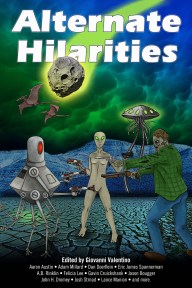
Alternate Hilarities

Over the last few entries, I’ve posted that Strange Musings Press would be printing my story Amending Diabolical Acronym Misuse, subject to raising enough money through their Kickstarter page.

I’m pleased to report that the $1,100 target has been reached, and the anthology will absolutely and definitely be going ahead.

The Kickstarter campaign is still open, and there are extra bonuses for reaching $2,200 and above.

An Update on @Strange_Musings, and Some Transatlantic Translations.

Alternate Hilarities

Around three weeks ago, I was pleased to report that I’ve had a third short story accepted for publication. Strange Musings Press of New York will be printing Amending Diabolical Acronym Misuse, subject to raising enough funds through their Kickstarter page.

There’s still around a week left to raise the $1,100 required for it to go ahead. You can donate at several different levels from $1 to $150, each of which buys you into the project with increasing levels of reward, including electronic and/or paper copies, autographs, and your name in the Contributors’ section.

My story is called Amending Diabolical Acronym Misuse, and it’s about a man who wants to rid the world of badly-constructed acronyms. Although I’m Scottish, my dialect is British English so that’s how most of my stories are written, including this one.

If I’m sending to an American publisher, I often change the grammar and spelling to suit; at least, I have a decent stab at it. In one case, I even wrote the whole story in US English because the character was so strong in my head: a cross between Jason Gideon from Criminal Minds, and Adrian Monk. In Amending…, I took the decision to keep it in my natural dialect as there are a number of references to British places and companies, and I felt it would look odd if I, “translated” it.

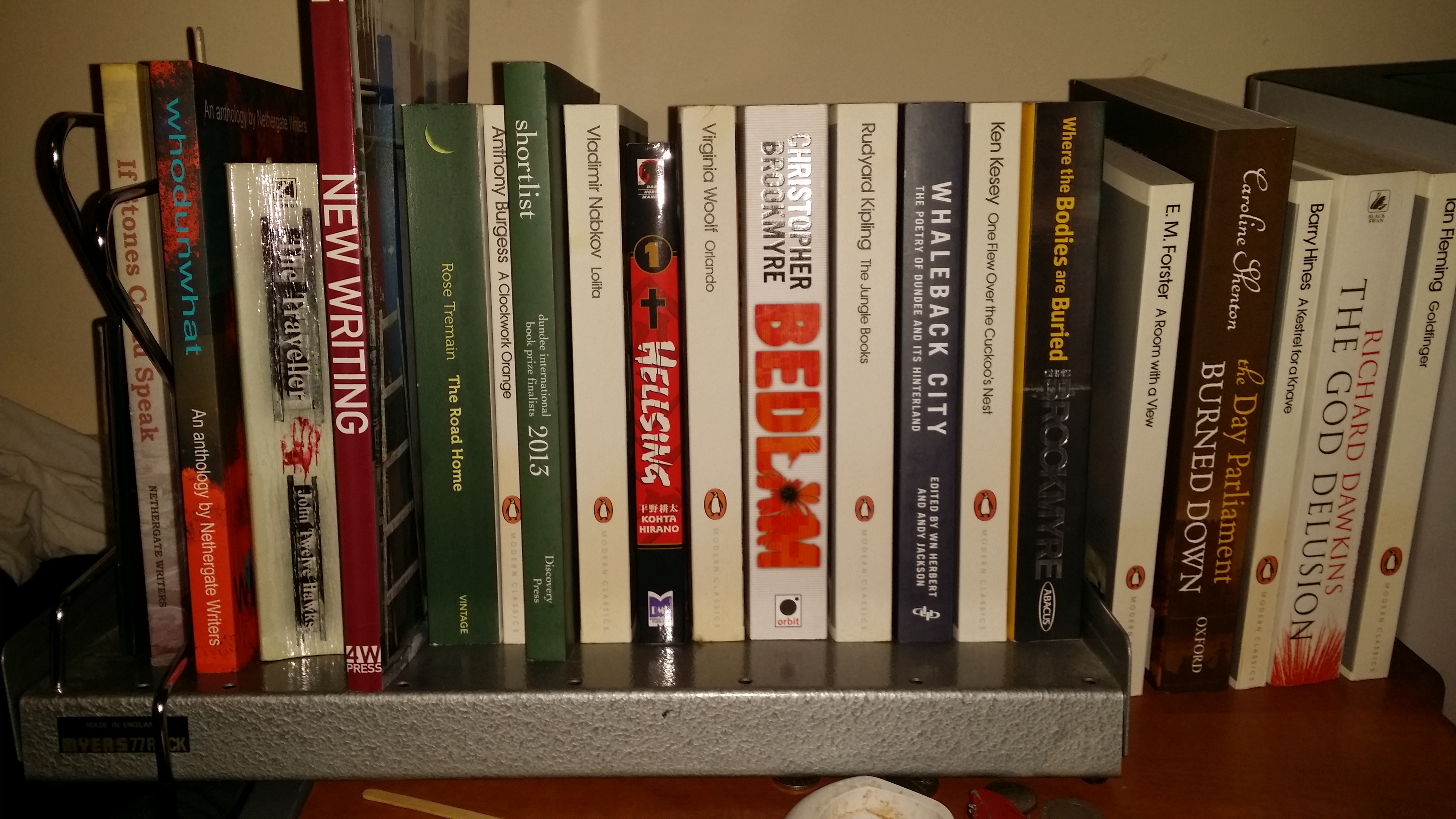
A couple of weeks ago, I began reading The Traveller by John Twelve Hawks. The narrative is written with a curious mix of dialects. For instance, the title is spelt with two Ls and there’s a reference to a pub, but the colour gray and an SUV appear in other parts. The SUV would be known as a 4-by-4 in Britain. The story is set in several countries so I expect it’s difficult to settle on one standard spelling, yet it’s not a distraction here, and I’m thoroughly enjoying the story.

Conversely, my mentor Zöe Venditozzi released her debut novel Anywhere’s Better Than Here in 2012. When a US edition hit the shelves, she told me there were no spelling changes made. When you buy a copy, watch out for the character whose initials match mine.

So is it important to adapt your dialect depending on which side of the Atlantic you’ll be published? I expect most Internet users will be accustomed to reading both, but at the same time, people will still write in whichever they feel comes most naturally.

Perhaps one day in the future, the two will merge and we’ll have one way of spelling each word, one form of grammar for all. It would be more practical, but probably rather dull.

Helping @SuitedSorted Improve His Blog, and Hints for Everyone Else.

I hadn’t written a response blog for years, and now this is my second in a fortnight. But this time, it was requested.

Scott Graham runs Suited Sorted on Blogspot, where he has recently re-focused on Android technology, although he has back entries discussing music, television, holidays, and weight loss. He has asked for some constructive criticism about the page, and with ten years’ blogging experience, I reckon I’m qualified to pass on some tips.

Tone, spelling, and grammar

Scott wonders if he’s a little too conversational. There’s a certain style that many bloggers go for, whether they mean to or not. The closest off-line equivalent is an opinion column in a newspaper. You’re telling the reader your view on a particular matter, but using everyday spoken words. For instance, you’ll say asked for rather than requested, or use contractions like can’t instead of cannot.

Cartoon about spelling mistakes in blogs
Thats verry true

But this isn’t a licence to spell words any old way, or leave out punctuation where it’s needed. Almost every piece of blogging software has a spellchecker. Spelling extensions are available for Firefox and Chrome, most mobile phones have the facility built-in, and the latest edition of Microsoft Word even lets you post to WordPress directly. If the reader doesn’t have to decode what you’re trying to tell them, your message will come across much stronger.

Scott, you’re doing fine on that front.

Layout

Newspapers and magazines learnt early on that long articles do not translate well to the Web. When you’re reading a three-page printed interview, your neck automatically moves downwards as your eyes follow the text, where scrolling down with your hands requires more conscious effort. A normal screen – not an e-ink display – is also brighter than a page, so it’s harder to read from.

That’s why I restrict my paragraphs to about three to six lines, and leave a clear line between each one. A lot of people will give up reading a wall of text, if they attempt it at all.

Your paragraphs can be quite long, Scott, but certainly not the dreaded wall.

Attracting attention

Using the site analytics tools on WordPress, I’ve found that my posts attract more attention and reaction if I post them between around 6pm and 10pm Monday to Friday. Entries made at any time on Saturday or Sunday simply don’t seem to be noticed. Certain tags also seem to generate interest, while others have no effect.

For years, I posted with LiveJournal and tagged my entries. I very much accepted that hardly anyone except my friends read the page, as they were the only ones to comment. But when I moved to WordPress, I realised I’d been missing out on this vital piece of analysis. Everyone will be different, and some will find that daytime or weekend posts work for them.

So keep tagging your entries, Scott, and have a look at Blogspot’s analysis tools to find out exactly when people are reading you. I hope you’ve found this critique helpful.

To everyone else, I’ll be pleased if any of my suggestions help you with your own blogging.

Happy World Book Day: A Response to @MostlyYummy.

It’s a rare occasion that Mostly Yummy’s blog topics will intersect in any way with mine, but today it’s happened.

I didn’t realise until this morning that World Book Day was such a big deal among the nation’s schoolchildren. They’re encouraged to dress up as their favourite fictional character.

The theory of this is quite sound. A child’s imagination can be sparked and expanded by his or her early reading choices. The other part of the theory is peer pressure. If a child knows that everyone else will be dressing up, they’ll likely want to do the same.

Like many children, I loved Roald Dahl’s slightly twisted novels, but I also enjoyed the stories from Antelope Books. I can’t find any relevant references to Antelope online, so do comment if you remember these guys.

But as Yummy points out in today’s post, the reality of the aforementioned theory can be very different. She tells us how she tried to cobble together outfits for two of her children, while making a valid point that the dressing up can overshadow the intention of World Book Day which is to read.

I must’ve mentioned this before, but being asked to do anything artistic scares the bejesus out of me; even seeing the words Daler Rowney brings me out in hives. I disliked the subject at school since I could never make the final product look anything like what the teacher asked. I did know what I wanted to draw, paint, or construct, but it became lost somewhere between my head and my arm. In essence, I sympathise a great deal with my fellow blogger.

I’ve been upfront from the start that I’m a latecomer to writing fiction. I didn’t pen a single piece between my last high school English class, when it was mandatory, and just before I turned 27. Despite the long gap, I find writing comes naturally to me, although I still had to learn the rules and conventions of the craft, whereas expressing myself with a paintbrush just isn’t me.

I recognise that some people won’t be able to relate to this as they have the exact opposite talents. I would like to learn, as it could complement my writing. Perhaps someone suitably gifted could put together a Complete Ninny’s Guide for me, and throw in a copy for Mostly Yummy.

Can you help @Strange_Musings fund an anthology?

Alternate Hilarities

I’m pleased to report that I’ve had a third short story accepted for publication. New York publisher Strange Musings Press will be printing Amending Diabolical Acronym Misuse. However, it will only go ahead if enough people contribute.

To this end, a Kickstarter campaign has been set up to raise $1,100 by Tuesday 25 March. You can donate at several levels from $1 to $150, each of which buys you increasing levels of acknowledgement, privilege, and general bragging rights.

I wouldn’t ask you to do something that I’m not prepared to do myself, so I’ve donated $22 under my legal name Gavin Cruickshank. That amount includes $10 overseas postage for a copy of the book, due out on Thursday 1 May. You can see my contribution on the backers’ page.

I would be most grateful if you could give whatever you can, and the editor Giovanni Valentino will be delighted. Don’t forget to share this blog post on WordPress and/or your preferred social networks.

If this comes off, I’ll have been published in the UK, Australia, and the US. Canada, I have my eye on you.

Tabletpunk.

Nothing marks out a generation more than the slang it uses.

If we concentrate on right now, February 2014, you’ll hear people say they’ve, “taken a selfie,” or say, “because,” followed by a single word rather than an explanation. Back fifteen years, and it wasn’t unusual to, “tape that programme,” or answer the phone with, “WASSU-U-UP?”

So when writing a piece that’s going to hang around for a while, most notably a novel, it’s a good idea to decide whether you want to incorporate the slang of the day to make it a period piece, or create a more timeless tale by using more generic terms.

If you want a photo taken properly, do it your selfie.

I recently wrote a story where a major plot element is a pager. This immediately sets it in the 1980s, and I felt safe using the term data bank to describe the device’s storage, rather than the more modern memory. I tried not to overload the piece with dated words, but I did allow myself a yuppie, as the pager’s owner described himself.

But while the eighties is over and we know what it was like, writing a story set in the future is different. One day, selfie and because _____ will be as embarrassing as fab and groovy. For my first novel, where the action takes place in the 2500s, I used, for instance, sound system rather than iPod or even MP3 player. I decided not to try predicting the future term, and write something a little more bland, as would distract from what I was trying to say.

There is an elegant solution to this problem, and those of you who write steampunk know what I’m talking about. This genre imagines modern or relatively recent technology as people in the 19th century might have seen it. There are many literary examples of this, but an accessible non-literary one is the TV series Warehouse 13.

Which leads me to wonder if there’ll be a genre of the future where writers of the 2110s envision their everyday gadgets as we in the 2010s might have viewed them. This decade’s most popular invention is probably the touchscreen computer. So, a hundred years in advance, I’m going to label this predicted genre as tabletpunk.

I’d like to be around to see the look on some geek’s face when they unearth this entry.

The C-Word.

I’ve seen Chris Brookmyre twice already, and tonight was my third time. I’m a big fan of his work after All Fun and Games Until Somebody Loses an Eye, and most recently, a signed copy of Flesh Wounds. Tonight, he was promoting Bedlam, which also has his autograph.

Brookmyre does not fit the stereotype of the introverted author, much like the late Iain Banks, whom I had the privilege of seeing twice. Rather, Brookmyre takes centre stage and spills out anecdotes full of swearing. He’s so well known for it that he’s now been forced to apologise in advance. Indeed, the first time I saw the guy, he read out an e-mail he’d received by a previous organiser, effectively banning him from appearing several years ago.

Tonight, he brought along a guest. Barry Phillips started a parody blog of a local footballer and found it attracted the attention of readers around the world. Now he’s written a book called The Tartan Special One about a 17-year-old who is snapped up by Dundee FC. I don’t follow the game, and I didn’t buy a copy tonight, but it still appeals to me so I might so do in the future.

I’ve started back at two writing classes: a short course in fiction run by published author Zöe Venditozzi, and Level 2 of the Life Writing course at the University of Dundee. A couple of new people have joined us, one of them from Life Writing, and she says she’s having trouble thinking of ideas for passages in the five- to ten-minute exercises we’re given in class.

By coincidence, I was discussing this issue with one of the other short course stalwarts earlier the same evening. We realised we’re so used to thinking on our feet that we don’t even hesitate over it any more. But when we began in 2011, it would be tiring trying to think of stories.

Most of our Life Writing class knew each other from Level 1, and we really bonded over this week’s homework, which was to write a summary of our life, then pick one part and make it into a vignette. The ideas for this class also come to me rather quickly, and I can sometimes think of one before I’m on the bus home.


Finally, I didn’t realise until tonight that there’s a reminder feature on WordPress. If you want to post at least once a week, or once a month, it’ll send you an e-mail.

Three Good Apples and a Lemon.

I’ve read a number of books this year, and the majority of them were well worth it, including the classics The Day of The Triffids and Breakfast at Tiffany’s. So I’ve only selected a few notable ones for this entry. The links go to Amazon, but to paraphrase the BBC disclaimer, other websites are available.

My choice of lemon proves the idiom that you shouldn’t judge a book by its cover. Crawling Round South Oakwood by Stephen Slaughter has amazing artwork, with the words in the title becoming more and more blurred as the rows of pint glasses become emptier and emptier. I thought a story about a group of friends going on pub crawls would be a sure-fire winner.

How wrong could I be? The book seems to be a first draft, going into such minutiae as the details of the TV programme the group watches, and their exact route to the pub. Later in the book, a fight breaks out between the group members, yet no tension is shown to have built up in any other part of the book. I finished it, but I was disappointed.

Now let’s look at what went well. The Dog Stars by Peter Heller had an arresting concept. In a post-apocalyptic world, Hig and Bangley are survivors. The former owns a small plane with enough fuel for years of short reconnaissance missions. When he picks up a long-range radio transmission, he is determined to find its source, but it means using up all his fuel without enough for a return trip.

As well as the immediate problems, it explores the philosophical differences between Hig and Bangley. One asks questions then shoots, the other takes the opposite approach. I also like that the author doesn’t write needless pages dwelling on the causes of the apocalypse, but shows it throughout the story.

I was fortunate to see Iain (M) Banks at two live events before hearing of his illness and death this year. He didn’t fit the stereotype of the introvert writer mumbling answers to questions. Rather, he made a short speech then actively encouraged the audience to join in.

I haven’t read any of his science fiction, although I hear it’s excellent. Having read The Wasp Factory after his first appearance, I then tackled The Crow Road. I have two criticisms about the book: that the flashbacks aren’t as clearly marked as they could be, and some of the writing isn’t as tight as it could be, but once you become accustomed to it, you really believe in those characters and their views on life, as Prentice tries to piece together his family secrets.

I’ve also seen another Scottish author at live events, Chris Brookmyre, who signed my copy of Flesh Wounds. Like Banks, he’s very confident in front of an audience, his main topic discussing the merits of the phrase, “Taking a s***”

As in The Crow Road, the flashbacks are a little confusing, and the Glasgow dialect can be a little alienating. But it’s the attention to detail in a many-stranded story that really drives it forward. I really ought to read more of his novels, as the only other one I’ve tackled is All Fun and Games Until Somebody Loses an Eye.

But if I was giving out awards for the best book I’d read this year, it would have to go to Layer Cake by J J Connolly, only £1 from a charity shop. As Flesh Wounds is set firmly in Glasgow, this is set in London, and the first-person narrator sprinkles in some Cockney rhyming slang, often without explanation. A, “Mars bar,” for instance is a scar, but it took me a few pages before I realised this.

My enjoyment wasn’t dampened in any way by the Daniel Craig film, in fact they complement each other, sharing several direct quotes. It’s difficult to judge the unnamed narrator for dealing drugs because he has the attitude of a businessman, just one whose activities are illegal. As he sees it: “Until Prohibition ends, make hay whilst the sun shines.”

I hope to read many more excellent books next year.

The Real Slim Shady.

Recently, an editor accidentally sent me some documents with my legal name in the byline. It was half my fault for not making it clear enough, but it brought home just how important it is to separate the two.

I started using my pseudonym before I took up writing. Until recently, I presented a show on hospital radio and promoted my middle to my last name, becoming Gavin Cameron. It sounds clearer through a microphone than my actual name Gavin Cruickshank, and more people know how to pronounce the written form correctly.

Let me point out that this was before David Cameron was elected. Despite the connections, it’s proved useful in writing because I work full-time and it helps keep a clear separation between the two.

I do think that if a writer uses a pen name, for whatever reason, he or she should inhabit the name and adopt the character. I occasionally read authors introducing themselves as, for instance, John Smith writing as Joe Public. Why craft a pen name if you’re going to break the illusion? I did it in this entry purely to demonstrate a point, but in a book or story, I would never explain Gavin Cruickshank writing as Gavin Cameron.

But I can think of one person who has done this successfully, and with a double pseudonym. Rapper Marshall Mathers goes by the stage name Eminem, but refers to himself as Slim Shady in his music. When you’re listening to his albums, he does it so naturally that you simply don’t question it.

I don’t think Mathers/Eminem/Shady reads this blog, but if he does, well done those men.

More E-Rejection™ Slips.

A couple of months ago, I discussed the content of rejection slips, or their modern electronic equivalent, which I’ve dubbed E-Rejection™ slips. In that entry, I discussed the feedback to one of my stories, The Strange Case of Mr Brown. I felt the editors had missed the point of the story by their response.

Last weekend, I received another E-Rejection™ from a local publication, and the sender told me that one of the two pieces had been discussed until a late stage in the decision making process, but both had ultimately been refused. That piece was The Strange Case of Mr Brown.

The latest slip didn’t provide any other information about either piece, but I had faith in Mr Brown. It’s written from the point of view of a lawyer in the late 1800s, so it has a certain period style that needs to be believable but understandable to a 21st century audience.

Yet there is such a fine line between self-belief and self-delusion, and not just in writing. It’s terrifically difficult to judge yourself honestly. Just look at the singers on talent shows who are so convinced they’re the next big thing while missing every note.

I’ve considered the question of how to decide whether your self-belief is justified or not. There is probably no single good way, but it’s worth examining any recurring themes in your feedback. If editors or reviewers have different negative comments to make, you probably haven’t made a complete hash of it. But if they all focus in on one or two negative aspects, then there’s a chance you need to put it more work.

One recurring theme I find is that editors like my writing style, but feel that the plot never took off. That often spurs me on to add twists that I otherwise wouldn’t have felt the need to include.

But if you have a better way of using feedback to your advantage, I’d like to hear it.