Second chance saloon.

In 1951, the acclaimed novel From Here to Eternity was published. Many readers were unaware that James Jones fought to keep in sexual content and profanity, but he was forced to give in to the demands of his publishers.

It was only in 2011 that the deleted content was restored by e-publisher Open Road, who also released his book To the End of the War for the first time. Unfortunately, it came too late for Jones as he died in 1977.

In the same month in 2011, Kate Bush was allowed to use text from Ulysses in an album, having originally been refused permission in 1989. A little-known Tennessee Williams play from 1983 was also given its premiere.

Perhaps it was just a golden year for second chances. But attitudes and standards are constantly reshaping, editors come and go, and even individuals change their minds. What was unacceptable or clichéd several decades ago might be in fashion right now.

Major delays are extremely common in the screenwriting industry, where ideas can knock around for several years waiting for the right producer and director to pick up the project, not to mention the protracted process of re-drafting the script – often dozens of times – plus the actual filming.

Phone Booth (film)
Phone Booth (film) (Photo credit: Wikipedia)

In the 1960s, Larry Cohen first had an idea for a film set entirely inside a phone booth and he pitched it to Alfred Hitchcock. At the time, neither of them could think of a good reason to keep the character in the same place for an entire movie. When Cohen revisited the idea in the 1990s, he had the idea of using a sniper; the mobile phone had also been invented by then, and this is a major plot point. Within a month, he’d written the script for Phone Booth.

I’m aware that last week I discussed when to let go of work. But if you’ve had a manuscript languishing in a drawer or an unopened computer file from years ago, bring it out. Can you look over it with more experienced eyes? Have those who rejected it now moved on? Is the subject matter acceptable today, or perhaps even more pertinent than when it was written?

If you’ve answered yes to these, it might be worth another shot.

A minor word of warning, however. If Victor Nabokov had written Lolita today, it’s unlikely any publisher would have taken it on. And when an uncensored version of The Picture of Dorian Gray was published in that aforementioned golden year, many critics felt it inferior to the original.

The hardest goodbye.

For a writer, receiving a rejection letter is one of the hardest things you’ll have to face. But probably the second hardest is realising that what you’re writing is going nowhere, or that it has no place within the context of a longer work.

Earlier this year, I began to edit a novel I wrote four years ago because the current storyline wasn’t working. This meant cutting out several sections I liked, such as the 10,000 words where the main character arranges to rent a minibus with six football fans when their plane is cancelled.

Once I decided on a new plot direction, I needed to fill in the gaps. But around 2000 words into what I thought was a great idea, I found I was bored while writing it. These will therefore be cut on my next edit. And I still don’t know the exact direction I’m going to take the book.

Nevertheless, always keep the parts you cut out; you never know when they might be handy in the future.

I was given a writing group challenge to come up with a story that included an A to Z structure, however loose that structure might be. My story was called The Eternal Student, and it centred around a young man from a family of accountants who had been sent to university to gain the formal qualifications. As he knows it all, he enrols in evening classes through boredom, each with a name one letter higher than the last. It would then have gone on to describe his disillusionment with university management and how he set up his own institution.

With 1500 words on the page, there was no more mileage left in the idea, so I put it to one side. A few months later, An Abundance of Apples was born, using the idea of an A to Z structure.

A year after The Eternal Student was penned, I rediscovered it in my files. Using a fresh cast and a different situation, I borrowed the element of disillusionment and wrote another story called Plans that ended with the main character setting up a new university. This then inspired another novel starring the same character and borrowing some elements from Plans.

And to date, I still haven’t been able to do anything else with my trainee accountant.

The work-work balance.

I’m on annual leave from my day job at the moment, but that won’t stop your weekly blog post from being delivered.

From Friday to Sunday, I planned to have three late nights at the T in The Park music festival. Then tonight, I’ll be running a writers’ open-mike before seeing a friend’s band in town. Tomorrow, I’m up early doors for the launch of Go Set a Watchman at Waterstone’s – Please note, warn the organisers, Harper Lee will not be in attendance – then a play by MLitt students at night, with a day of writing in between.

The rest of the week is packed in a similar fashion. The only thing that didn’t happen was Sunday at the festival, but I made sure to fill the time with more writing.

But why not rest up? Because as I’ve become older, I’ve realised that being idle doesn’t suit me. I won’t stop unless I absolutely have to, otherwise I would never manage to do anything. To demonstrate this, imagine I had to go to the Post Office and send a parcel.

If that were the only task I needed to do all day, I might wake up at 7am, realise there were two hours until the Post Office opened, start doing something else and be distracted by it until midday, tell myself there were five hours left and do something else to fill the time, and be distracted by that instead. The net result is that the parcel wouldn’t be posted.

On the other hand, let’s suppose the parcel was just one more thing I needed to fit in. I might go to work at 8am, leave the office at 4pm, visit the Post Office, then head to the gym and crack on with writing when I returned home. Net result: I’ve done my task.

It’s unfortunate that almost all UK employees are required to take 5.6 weeks of leave every single year, as I would be far more productive without a break, and I’m sure the economy would benefit too. If I ever reached a stage when I was able to be a novelist full-time, I would probably still rise at the same hour as I currently do and churn out a target number of words over a certain number of hours.

Stephen King has this one right: he produces 2000 words every morning, including his birthday and holidays, and spends time in the afternoons catching up on his correspondence. And that’s why you’re receiving this blog post as normal, and next week, and the next, until I no longer feel productive by producing them.

You are here. ↓

If you’re a fan of The Big Bang Theory, you’ll know that Sheldon Cooper is particular about which seat he chooses, particularly in his own apartment. Writers can be similarly picky about where they pen their works.

Among my writer friends alone, there is one who writes better with absolute silence and another who penned most of her novel in a noisy student pub. There is no right or wrong way. For my own part, I’m typing this entry in one of my favourite places: at the bottom end of my bed, standing with my back to the window. But when I’m stuck on a project, I sit on the mezzanine floor of a particular cafe in town and it usually unblocks my flow.

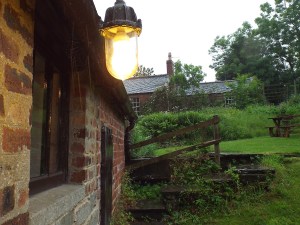
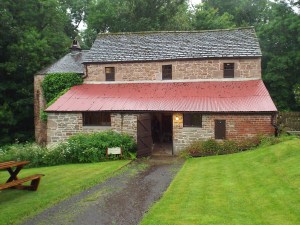
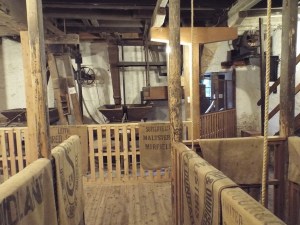
On Saturday, I was given the opportunity to attend a one-off writing group at the secluded Barry Mill near Carnoustie to raise funds for its restoration. After a tour and a demonstration of its working waterwheel and machinery, the nine or so attendees followed the stream back to the weir through acres of wild flora.

The tranquillity, location and history of the place was supposed to serve as inspiration for a poem or prose piece – and it worked. It took me some time to put something together, but I managed to write three verses, using the mill as a starting point, and nearly everyone had written something for reading out. It didn’t help, however, that it was raining onto our notepads for much of the visit, or that two of the chairs collapsed – mine included – before the session even began.

So if you feel your writing is becoming a little stale, try going somewhere else. Not everyone is able to escape to the countryside, of course, but it might work even to move location within the same general area or even the same building. Before I discovered my current spots, I experimented with a number of places before finding one that felt just right.

I’ll leave you with an electronic postcard of Barry Mill.

Do you know who I am?

Last week, I had the opportunity to show my published and soon-to-be published pieces to my work colleagues. Some of them were aware of my writing through reading this page, while it was news to others.

I don’t talk about my fiction writing much when I’m doing my day job. Although it certainly isn’t a secret, I believe there is a time and a place for promotion, and I was given that time and place on Thursday lunchtime, so I took advantage of it.

On Twitter and Facebook, it’s particularly important to keep a balance between ordinary updates and promotional copy. How often have you seen an account post exactly the same message four or five times a day? It makes people switch off, like that one individual you avoid at the party as you know they’ll talk about their pet subject ceaselessly. Besides, if you say everything upfront, what is there left to have a conversation about?

Two great places for advice about promotion – and there are dozens of others – include the writer Rayne Hall, and the marketer Wilco Wings whose advice can be adapted for writers.

And now I have your attention through our implied conversation, it’s time to launch into the self-promotion.

To date, three of my short stories have appeared in the following anthologies: Because of What Happened by The Fiction Desk, FourW Twenty-Four by Booranga Writers’ Centre (I’m not credited on the website, only in the book), and Alternate Hilarities by Strange Musings Press. While looking out materials for my work event, it seems I’ve misplaced my copy of Because of What Happened, so I’ll have to hunt it down like JR Hartley and his book about fly fishing.


I’m also due to have two poems published in an upcoming anthology called Seagate III when the last tranche of funding comes through, and one in a promotional leaflet for the MLitt Writing Practice and Study programme at the University of Dundee.

By coincidence, I received an e-mail last week from Giovanni Valentino, editor of Alternate Hilarities. In each of his anthologies, he likes to run a reprint from the magazine of the same name from the 1990s, but it’s becoming harder and harder to find the authors.

To this end, he’s asking the Internet for help. On the off-chance that you’re one of the following people, or that you know their whereabouts, please e-mail him forthwith at giovanni.valentino@strangemusingspress.com.

Issue 2

  • Alex MacKenzie, The Elvis Wars
  • Dana Cunningham, The Man Who Could Communicate with Animals
  • Buzz Lovko, The First Dinosaurs (a near Myth)

Issue 3

  • Dan Crawford, X-0001
  • Ken Goldmen, The Devil and Myron Rabinowitz
  • Michael Eugene Pryor, Irreconcilable Instructions

Issue 4

  • E. Jay O’Connell, Until the Tuna Runs Out
  • Alex MacKenzie, The Real Me

Issue 5

  • Tomas Canfield, Learning the Ropes
  • Leonard Jansen, Old ’99

Issue 6

  • Greg Costikyan, They want our Women!

Can I Have a P Please, Bob?

Plagiarism

Hot on the heels of my copyright post the other week, a case of poetic plagiarism was brought to my attention. Remaining copies of Laventille have been pulped after Sheree Mack admitted to including others’ work in her own inadvertently, although fellow poets have accused her of stealing work deliberately.

In this instance, it’s not only the original poets who have been hurt by her actions, but the pulping will wipe out the profit margin that Smokestack Books would otherwise have made.

The one positive aspect we can salvage from this mess is that this type of plagiarism is relatively rare. If it happened every day, this story wouldn’t have been reported and nobody would have kicked up such a stink.

Postgraduates

I’m a firm believer that every writer ought to learn the skill of public performance. More on that story later. But last Wednesday marked the first time I would be performing to an audience of academics, rather than the general public or other writers.

The University of Dundee has run a Postgraduate Conference for the last four years where students set the agenda by presenting papers. Students were also free to respond creatively to this year’s theme, Lost in Translation. When I saw the final running order, I appeared to be the only person giving a creative response, and I seriously considered withdrawing as I didn’t feel it would fit in with the other presentations.

The upshot is that I did go ahead with it, although I was moved to a different slot with theatre students and a novelist. I felt it flowed more smoothly, and I received an excellent response, both verbally and on the anonymous feedback slips. My tutor was also sure to stop by and ask a couple of tough questions.

Performance

Shortly after the Postgraduate Conference, I went along to a workshop… on performance; unfortunately, it had to be in that order. Jenny Lindsay, one half of poetry duo Rally & Broad, was hosting, and they’re one of my favourite contemporary acts. She asked each of us why we were there. I told her I was quite comfortable with public speaking, but I felt there was always more to learn.

Blockbusters (UK game show)
Blockbusters (UK game show) (Photo credit: Wikipedia)

She took us through the process of preparing for an event, including how we might introduce ourselves, putting together a set list, and we even took turns at walking out in front of an audience. The organiser is hoping to put on another event in the near future but using an actual stage.

If you have the chance to hone this skill where you live, I recommend signing up. What many writers don’t realise is that if you’re snapped up by a publisher, you’ll be expected to read excerpts to a live audience. I’m not going to pretend it’s easy to stand up and entertain people, but the only way to make it easier is to keep practising, and prepare your materials thoroughly in advance. Remember, most audiences aren’t sitting waiting for you to slip up – they’re willing you on.

Promotion

Although National Novel Writing Month and its offshoot Camp NaNoWriMo are over, an enthusiastic band of us have continued to meet each week. The most recent meeting was yesterday, but we left after an hour to visit Waterstones where Kirsty Logan was promoting her novel The Gracekeepers.

I’d seen the posters across town, but I hadn’t heard much else about it until that evening. By the time I’d listened to the excerpt, learnt about the background of the world in which it’s set, and was told were some characters written as gender-neutral, I decided I wanted it. The issue of gender is something I become interested in since my feminist friends talk about from time to time.

And our group each spoke to Kirsty Logan for a couple of minutes each as she signed our books. I wish I’d thought to take a photo, as her dress contained pictures drawn in the same style as the book jacket. If I ever have a novel published, that’s a touch I’ll think about adopting, although I might settle for a shirt rather than a dress.

Find your niche.

Where and how you write is as individual as the work you ultimately produce. There are many examples of writers who need a particular space, certain items on their desk or a strictly-observed time of day, and there are others who can churn out stories in the back of a taxi. Shortlist gives a few examples. I fall into the back-of-a-taxi category.

When I’m at home, I prefer to stand up while writing, normally using an ironing board to rest my materials. I sit all day in an office and it’s a relief to be on my feet, plus the health benefits have been known for some years. In February, for instance, Tom O’Donnell took a satirical look at the health dangers of sitting down all day.

Minimal modern writing desk
Minimal modern writing desk (Photo credit: Wikipedia)

However, it’s also my least favourite place to write as there are many distractions around the house, such as tidying or loading the washing machine. To that end, I sometimes write in a cafe or a library. Unfortunately, I’m not often able to stand up there, but I find I concentrate better as I only have one desk, and there are no chores needing done.

The background noise is also a consideration, as there’s a fine balance to be sought. When I write in the University of Dundee library, I always choose the Group Study area. I find silence quite conducive to writing, but I’m also on edge because every rustle of paper or drink of water then stands out a mile, whereas a consistent ambience can more readily be tuned out. The opposite is also true. I’ve tried to write in Dundee Contemporary Arts, but the noise is loud then quieter as the audience enters and leaves the cinema, and this is just as distracting.

Of course, such distractions can be overcome with headphones. For the last year or two, I’ve written to the soundtrack from the film The Assassination of Jesse James by the Coward Robert Ford. It’s an unwieldy title, but the Nick Cave music helps my writing along no end.

The need for writers to use their personal rituals makes me wonder whether there’s a market for a dedicated studio nearby. I have a few artist friends who rent individual rooms in a converted mill and can work undisturbed at their convenience.

Considering the average size of the studios, I reckon it would be possible to squeeze up to four soundproofed booths in one of them, allowing each writer to stay in his or her own customised bubble. An Internet search shows the nearest dedicated writers’ studio is in Nottingham, with a handful scattered around the US, and that’s a long way to travel from Dundee just to find the ideal environment.

However, if you are in the city of Discovery, Hotchpotch is taking place tonight at The Burgh Coffeehouse on Commercial Street. It’s an open mike night for writers, where you can read your own material or come along to listen. More information about Hotchpotch on the Facebook page.

The Finish Line.

Every April, there’s a contest called Camp NaNoWriMo, an offshoot of November’s National Novel Writing Month. In November, the aim is to write a 50,000-word novel in 30 days. Camp, by contrast, allows participants to choose a word goal starting at 10,000 and to work on any type of writing.

I intended to do more work on one of my unpublished novels, which is mostly written but needed extra scenes. I did write a few thousand words of it, but I didn’t feel the same enthusiasm as I did when I edited it a couple of months ago. Rather than bore myself stupid with it, I changed focus.

A piece of advice often given to new writers is Finish what you start. It’s rare that I don’t finish work, but I did have a few short stories that had gone nowhere. I therefore used the opportunity to finish two of them.

One had started off as a little self-indulgence but rereading it after this time allowed me to work out and deliver the message I was trying to convey. The other one should have been written in one session, but I was interrupted and never went back to it. I now have a satisfactory ending for both pieces and they’re ready for a second redraft – and a ruthless reduction in their word counts. As for the novel, I will redraft it when my enthusiasm returns.

Camp NaNo is traditionally done without a group leader and without meet ups in person. In Dundee, however,  we’ve been fortunate enough to have active members who have met up every Tuesday in April to work on their respective pieces. I set my own target at 10,000 words as I also had a university paper to hand in around the same time, but thanks to these meetings, I managed to reach the goal.

If you’re also in Dundee, by the way, there’s a new monthly Literary Lock-in at the George Orwell up the Perth Road. There are no speeches or readings, just an opportunity for writers to mingle and speak with each other. The next one is on 25 May.

©

Open the front cover of most books and one of the first pages you’ll encounter contains paragraphs that begin something like:

  • First published in Great Britain in [year] by [publisher];
  • The right of [author name (s)] has been asserted by [him/her/them]…;
  • and All rights reserved. No part of this publication may be reproduced, stored in a retrieval system, or transmitted…

This legal text is effectively saying that the author and publisher, and/or anyone else involved in making the book, have created an original piece of work and that the reader is not permitted to do anything with it other than enjoy the text. The modern copyright system began with the Berne Convention in 1886 and has evolved over the intervening decades, and it’s now something we take for granted.

It was brought to my attention this week that there is a manifesto proposal by the Green Party to shorten copyright terms to a maximum of 14 years, a move that is causing anger among authors. In most cases, the current system guarantees copyright control for the rest of an author’s life, with control transferred to his or her estate for 70 years after death. If the 14-year proposal were already in operation, this would mean anything produced in the 20th century was now in the public domain.

Incidentally, following a change in the law last year, comedians are less likely to be sued successfully if they produce a parody version of an existing work.

With so much at stake, there’s a good reason to make it plain who owns the copyright. To this end, many emerging authors place a large copyright and/or © on their manuscript before sending it to a publisher, or on the cover of the book if it’s self-published.

There is no need to do this for two reasons:

  1. Making a big show of copyright is the mark of a nonprofessional. A publisher isn’t going to steal your manuscript unless they’re a dodgy outfit, and if you do self-publish a book, a discreet copyright notice inside will suffice. Make sure it’s drafted by a lawyer or someone who knows what they’re doing; don’t make up your own wording.
  2. In any case, copyright exists the moment a work is created, at least in the UK and in the USA. The purpose of the notice is merely an affirmation of the copyright.

If you have had something published in a book or in a magazine, make sure you’re receiving the appropriate money from it. Register with the Authors’ Lending and Copyright Society to check whether you could be paid secondary royalties from photocopying, scanning and digital copying. If your book is in a library, royalties are generated each time it’s borrowed, so consider joining the Public Lending Right scheme to collect any money owed.