The Weakest Ink

This month, I’ve been taking part in Fun a Day Dundee, a project to create whatever you like in or throughout January. Mine is called Line for a Walk, where I’m writing fragments every day to form a circular sentence by the end of the month.

Back in 2015, I made a post where I talked about my creative response to an exhibition where I wasn’t happy with my own work. This month, I’ve had a similar experience – particularly from Day 20 onwards – as I’ve realised my project is running out of steam. I did have a lot of ideas at the beginning of January, which I’ve now used.

I will finish the project as planned, but I’ve realised I need more focus. This doesn’t mean taking a prescriptive approach, merely setting some type of restriction or theme. A blank page is harder to tackle than a brief which reads something like ‘In 500 words, write about two characters on a boat’.

Where I have enjoyed some success is in my handful of side projects – those that are part of Fun a Day but don’t fall under Line for a Walk. These spontaneous side projects have included poetry and visual art experiments, but relying on spontaneity for a month is a tough request.

Meanwhile, I need to realise that I’ve yet to see the end of the project and that those perceived weak links might not be as flimsy as they now appear. I also need to remember it’s supposed to be a slice of fun.

Unpicking Suits

Over Christmas and New Year, I had the chance to catch up on legal drama Suits up to and including season 7.

So far, it’s been an engaging watch, and I think that’s down to the strong writing. The characters are motivated by what they want, whether that’s money, power, or – especially in the case of Louis Litt – petty one-upmanship.

It’s also clear that the writers have lived the experience of being a lawyer rather than simply researched it. In that sense, it has a similar feel to The West Wing. But the writing does have some flaws.

It is reasonable that characters will think in a similar way because they work in the same field, but they often express themselves with identical turns of phrase, sometimes down to swearing in the same manner.

The other piece of dialogue that often appears is: ‘What are you talking about?’ Used sparingly, this allows a character to explain the point in a different way and allow the viewer to understand it more clearly. In Suits, however, it’s used as a crutch.

That said, I’m still looking forward to season 8, whenever I have a chance to watch it.

Slam Up

Having taken a break from my poetry group to join a choir, I jumped back in on Thursday. The Wyverns meet up every month to give each other feedback on our latest work. In my absence, they’d acquired a new member and set up a Twitter account.

The great strength of the group is the freedom to write in your own style. One member tends towards long and thin poems; another usually has a political undertone; a third normally writes no more than ten lines. I aim to produce something original for each meeting.

This month, one of our suggested prompts was ‘memory’. I received positive feedback from the piece, with one commenting that it had more impact when read aloud instead of on the page, although it wasn’t specifically written for either page or stage.

Speaking of performance poetry, however, I had the opportunity to watch the Scottish Slam Championship in Glasgow yesterday. The participants are all winners of other slams that took place around the country over the last twelve months.

Unlike a rap battle, as seen in the film 8 Mile, these performers don’t go head to head. Instead, they’re each allowed to perform two pieces for up to three minutes apiece in front of a panel of judges. The three who score the most combined points for their poems – four if there’s a tie – then perform another one. The best one of those is invited to the Poetry World Series in Paris.

Robin Cairns is the perennial host of the Scottish Slam, this year introducing more than a dozen contenders covering all manner of subjects, including mental health, feminism, self-worth and many stations in between. Each was so strong so that a clear winner wasn’t evident to me; however, the judges awarded most points to Calum Rodger, so he’ll be heading to France in May.

One of the other poets that particularly inspired me was Gray Crosbie, who talked about struggling to find a gender-neutral barber. I already had a poem with a related theme, but I’d left it aside months ago as it wasn’t working out as I intended.

As I sat on the bus home, I rewrote it in around an hour, and this time I’m much happier with the result.


It’s Been a Good Week

It’s been a good week for completing some writing. It has, in fact, been a terrific week for this activity. However, it’s left me with no time for writing a blog entry.

I therefore refer you to my Fun a Day project on Instagram . The captions of the last ten or so posts talk more about the fragments of text in the pictures.

I’ll be back here next week with a full entry.

All the Fun of the Day

For the second year, I’ll be taking part in Fun a Day. This is a project where participants do something creative during January, either one project per day or something larger over the entire month.

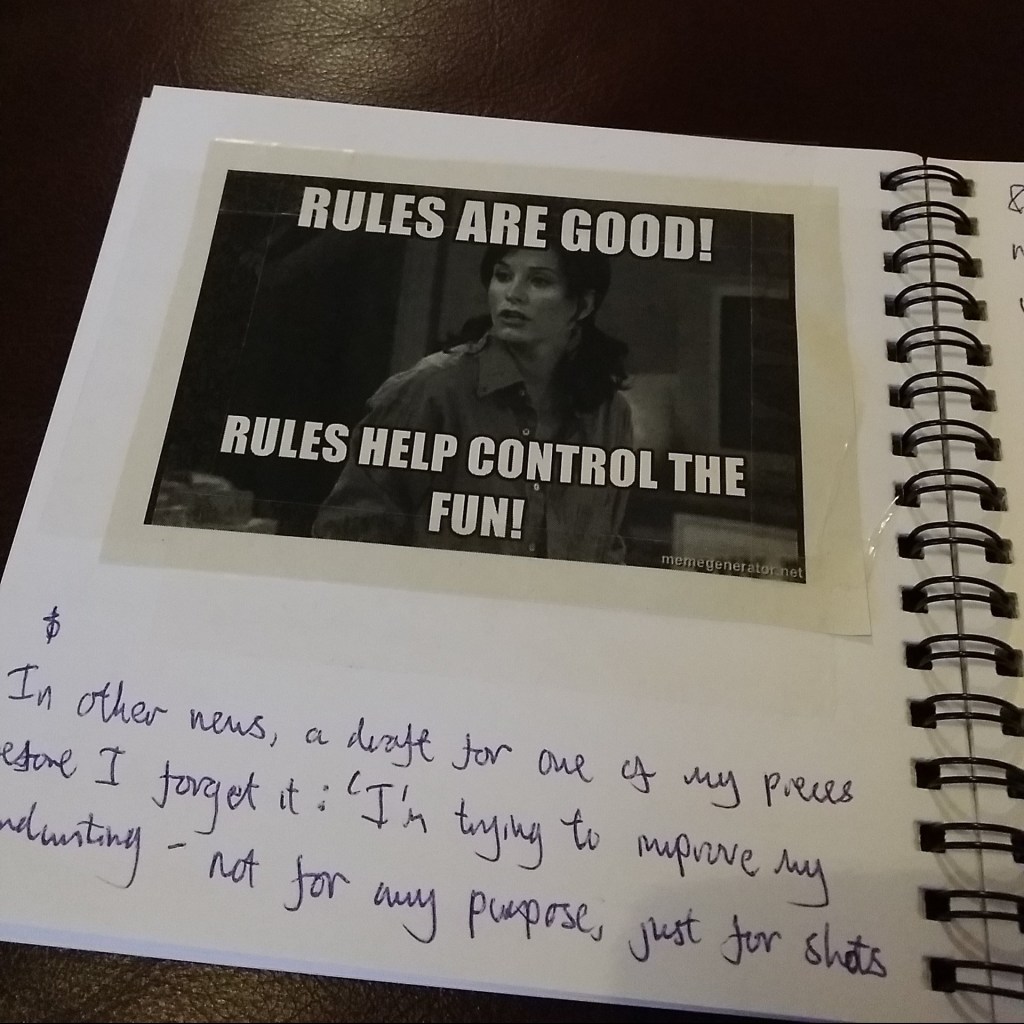
I’ve already started to document my progress in a commonplace book. With the official hashtag now announced, I posted my first two pictures online. The first contained the three rules of my project. The second contained this quote from Monica Geller in Friends.

Rules are good! Rules help control the fun!

My main project will be text-based. I’ll be writing a fragment of 40 words on Day 1, 39 words on Day 2, and so on until I’m writing 10 words on Day 31. The text will form a complete circle so the fragment on the last day will join up with the fragment on the first.

That said, being around visual artists has had an effect on me. Last year’s project consisted largely of pen on lined paper, which looked somewhat out of place compared to the other participants’ installations. Poets think about how their work looks on the page; artists think about how it looks on the wall.

In fact, the proposed title is Line for a Walk, derived from a quote by the artist Paul Klee. Depending upon which source you read, he said, ‘A line is simply a dot going for a walk,’ or ‘A drawing is simply a line going for a walk.’ I actually used this analogy to explain to the organiser what it’s like to write a novel in a month, and the phrase stuck with me.

There are side projects planned alongside the main one, but these aren’t quite so rigorously defined yet. Even if they don’t happen, January will not be a dull month.

Dear Diary

Last Monday, our open-mike night for writers moved back to its old venue after a refurbishment. We had an excellent turnout and enough material for more than two hours, not including the two 15-minute breaks. A couple of the staff also said they enjoyed meeting us.

Then on Tuesday, it was our NaNoWriMo meeting where we sometimes write and sometimes chat and always exchange ideas and maybe fill in each other’s plot holes. After that, I spent a little time at a playwriting evening called Scrieve where playwrights get to hear their work performed by volunteer actors.

On Thursday, I was with my poetry group Wyverns where we each presented our poems about Frankenstein on the 200th anniversary of the publication of Mary Shelley’s novel. There is a local connection as she acknowledged in an essay that the grim Dundee climate inspired her creation. Our poems have been published in a slimline booklet.

Saturday was when we had our second NaNoWriMo meeting of the week, and despite not starting until the afternoon, it was one of my most productive days so far with 2,500 words written. However, at the end of Sunday, I only had 35,482 when I needed 41,666 to stay on target. If I don’t pull my finger out soon, I’m not going to manage the 50,000 words, but dear diary, you can tell anyone I admitted this.

To the Edge

Over the past week or so, I’ve had a lot of time to write while travelling on trains. In fact, I’m writing this from a hotel room in Birmingham that reminds me of an old-school Butlins chalet. That’s not a criticism; I think it’s marvellous.

Unfortunately, while writing, I haven’t had much time to write about writing. I only started this entry at 5:30pm and it’s due to be published at 6pm.

Douglas Adams is known for saying, ‘I love deadlines. I love the whooshing noise they make as they go by.’ I know he was trying to be funny, but I can’t get behind that mentality. To me, a deadline needs to be met, even if it’s a self-imposed one.

Last week, a friend needed a reference for a job application. I hadn’t read the e-mail properly and didn’t realise it needed to be done on the same night. I wrote it nonetheless on the grounds that the employer might be flexible. My friend agreed, so I submitted it the moment it was proof-read.

My top tip for meeting deadlines is to use a paper diary rather than a phone calendar; I favour a Moleskine. The pages are much larger than a mobile device allows, so you can see a week at a time, and you can refer to it while you’re speaking to someone on the phone.

It’s Gonna Be Epic!!

I was invited last week to be part of a one-off writing workshop. I knew little about the content in advance because it was brought to my attention by a third party. However, I believe improv keeps me sharp, so I was excited to go along and find out.

Martin O’Connor led us through the workshop. He’s interested in epic poetry, particularly in the Scots dialect, so he was holding these sessions around Scotland.

As part of the exercise, the eight or so participants were asked to complete several statements ranging from ‘My favourite holiday was…’ to ‘After death, I believe we…’ From these, we were asked to build a chronology of one aspect of our lives, before building up to the beginning of an epic piece of prose or poetry.

Martin invited us to send the work to him, either as it was written in the workshop or expanded into a full-length piece. The work didn’t necessarily have to be in Scots; in fact, none of the participants wrote that way.

Poetry is about boiling down big concepts into a few words, so for epic poetry, you need a lot of source material. Paradise Lost by John Milton is based upon Bible Scripture so he had a lot of material to draw up. Similarly, The Iliad and The Odyssey by Homer are both set over a 10-year period.

Prose allows a little more flexibility for expanding ideas. The classic example is War & Peace by Leo Tolstoy, which runs to 250,000 words. This took seven years to write, and is set during the Napoleonic Wars, which took place from 1803 to 1815.

This month, I’ve started upon my annual attempt at National Novel Writing Month, as well as leading the local region with the help of a co-host.

The target is 50,000 words, more modest than the works mentioned above, but the challenge is to write them all within 30 days. Fortunately, I’ll be spending a lot of time on trains, giving me ample time to boost that word count, and the region as a whole is nearly at the 300,000-word mark.

Of course, the new standard of epic literature is neither fiction nor poetry. In July 2016, Sir John Chilcot published his long-awaited report about the invasion of Iraq in 2003. It ran to 2.6 million words.

The Benefit of Experience

Last week, a friend sent me a poem she’d written about a recent bereavement, asking for some suggestions. I immediately agreed. I copied the piece into Microsoft Word and switched on Tracked Changes, then looked through the piece line by line.

The first thing I did was check whether she’d followed generally accepted conventions, such as placing a lowercase letter where the start of a line isn’t a new sentence, and making sure a significant word ends each line.

When you read poetry a lot, you begin to build up a template in your head of what you like and don’t like, and what looks ‘right’ and ‘wrong’. So aside from the conventions outlined above, I considered how the piece sounded overall, and omitted or added words accordingly.

I made it clear than anything I wrote was merely a suggestion and could be ignored if she felt it didn’t work. Indeed, the poem was great to begin with, but someone else could easily come along and make different suggestions in accordance with their experience.

I don’t know yet whether this friend took my suggestions on board, but if she does, I believe it would improve the piece.

Years In The Making; Weeks In The Tweaking

It’s sometimes the case that an idea exists in the mind of a writer years before it’s published, or sometimes long before it’s even committed to paper.

Larry Cohen, for instance, pitched his screenplay Phone Booth to Alfred Hitchcock three decades before it was made, but neither of them could think of a reason to keep the main character in the booth. Jilly Cooper lost the original manuscript for Riders in 1970, and it took until 1985 before the novel was finally published.

One of my own pieces took around 15 years to write. When I was in high school, I had a fragment that was supposed to be set to music:

Have I known you too long?
Are we too far gone
as just friends?

But I could do nothing with the fragment. I hadn’t begun writing poetry or even short stories at that point, and I didn’t pursue my interest in playing music.

It wasn’t until 2013 that I revisited the fragment, just when I was beginning to feel confident to call myself a poet. With help from online friends, I shaped it into its current form and it appeared on The Purple Spotlights EP in 2016.

I didn’t mean to write a companion piece. Over the last few months, I’d thought of another fragment I’d initially been unable to use, though I knew it would make a good refrain:

Let’s shag each other senseless.

The catalyst for the companion piece was when I found out something surprising about a couple of friends, which put me into a strange mood and then became entangled with the fragment above. The next day, I was due to take a train journey of 5½ hours each way, and I’d have access to pencils and paper, so I had the means, the motive and the opportunity.

On the trip, I remembered that Tied Up was about platonic friendship, and that the poem I was writing would be about a couple who couldn’t go back to being that way. The first draft was completed in around 24 hours; I named it Tied Down.

Some pieces feel finished once they’re on paper. By contrast, I pulled out this one every day and simply looked at it, trying to make sense of my own words, perhaps because it isn’t a sentiment I normally express in my work. Sometimes I’d score something out; sometimes I’d shuffle around the words.

It currently sits at 67 lines, longer than what I usually write. I haven’t modified it for around a week now, but I’ll probably come back to it in a month and see what changes need to be made.