I’ve had little time to put together a full entry, but there is something I want to show you.
A few weeks ago, I attended writing workshops run by the poet Imogen Stirling, who took the theme of the lockdown as inspiration for her prompts. I’m pleased to report that the amalgamation of the work done by the class has been featured in The Scotsman Sessions.
It was a pleasure taking part in these classes because that’s exactly how I started writing a decade ago: here’s a prompt, and you’ve got five minutes to write something inspired by it.
Come to think of it, that’s much how this entry has been put together.
When I first began writing in 2010, my output was exclusively prose. I was in a writing prompt group where I would regulary produce short stories. Around the same time, I was producing longer works through National Novel Writing Month, normally known as NaNoWriMo.
My step into poetry happened around three years later. It coincided with being single for six months after a long-term relationship, but I can’t say how much that influenced me. Since then, I’ve crafted my poetry more and more to the point where I almost exclusively write verse.
Recently, however, that has started to reverse, perhaps because my poetry group is taking a one-month break. I’ve drafted one piece that will probably end up being no longer than 150 words, and I’m planning another with five characters who will likely dictate the length of the story before I know it myself.
NaNoWriMo is a contest to write 50,000 words in November. It’s not widely known outside this circle that there is a less formal contest at other times of the year known as Camp. April saw the last one, and we’re currently in the July edition. In these months, you pick your own word count and type of long-form piece.
However, I’m not writing these stories as part of Camp as I don’t intend them to be terribly long. What I’ll be doing instead is keeping aside my existing longer pieces and working on them during November.
What I have to do now is find a way to keep up my prose momentum from now until then. That said, the excitement in the group tends to swell around November, and that helps a lot.
I haven’t had time to write a proper blog entry this week. Instead, have a look back at my entries from this time in years gone by and I’ll write something for next week.
Last week, I mentioned that I’m not a lifelong fiction writer nor poet, having started in 2010. However, I had kept a non-fiction blog for some years before this.
Although WordPress was around in 2003, the most popular blog host at the time was LiveJournal, known among its users as LJ. My first entry was on 19 December of that year, when I was studying at what is now the University of the West of Scotland, although my profile has – for some reason – always said my account was created on 15 March 2004.
I was reminded of my these days though my pal Katy Jones, who not only joined a year or two before me, but still uses it. She was interviewed for a podcast recently, in which she spoke about the appeal of LJ compared to other sites.
However, we’d actually become acquainted through a media forum, entirely separate from LJ, as we were active in different hospital radio stations around the same time. In fact, we’ve never met and I don’t think we’ve spoken by phone or video chat, yet Katy remains one of my most enduring online friendships. We might even be starting pen-pal correspondence soon.
So what of my old LJ account? It still exists, and it served as a good sandbox in which to practice for this WordPress blog, which began in 2013. At that time, the paid-for features of LJ matched the free features of WordPress, so it was an obvious choice to switch for me.
But there were also duds along the way, like this one that’s disjointed and uninteresting, asking a question about football and then rambling about Firefox and the bit-rates of MP3 files. Years later, we see a desperate attempt to keep the LJ page alive with tedious #MusicMonday entries.
So one thing I’ve learnt over the years is to look at my entries from outside of my own head. If a topic only makes sense to me, then there’s no point in making it public.
Judging by the reactions and the viewing statistics I receive from this WordPress page, I do manage to engage people. I can even look back at entries from six years ago and still be satisfied with them, other than spotting an occasional sentence that needs rephrasing.
I do hope I’ll be able to read this in May 2026 and feel the same way.
I periodically remind people that I’m not a lifelong fiction writer nor poet. I started in 2010, when I was around 27 years old.
As such, I’ve now gained an decade of intensive experience that I reckon brings me up to a similar level compared to those who have been writing for far longer.
That said, I don’t ever want to be that writer who feels they’re too good to learn something new. When I took part in Imogen Stirling’s classes recently, I knew I could manage the work, yet I was still pushed in new directions that I wouldn’t have walked by myself, such as kennings and univocal poetry.
In the same spirit, I’ve been taking art lessons from my pal Ana Hine over the last couple of months, who is offering weekly classes via Patreon. This is a major deal for me because I’ve always had a mental block with art: I wouldn’t do it because my drawing wasn’t of a high standard, yet it wasn’t of a high standard because I wouldn’t draw.
I had a problem with the way I was taught at school. The focus was on making a finished work rather than going through the process or making a rough draft first. Yet that same criticism also applied to my poetry teaching. I should note that I’m talking about the 1990s, so their methods might have improved since then.
I have once before attempted drawing lessons with another pal, Jen Robson. Last year, she ran an afternoon class called Scared of the Paper, and my picture is still on her website. That was a great experience, and I learnt techniques that I’ve carried over to Ana’s lessons, such as correcting mistakes by adding lines rather than erasing them, and listening to music as I work.
However, I didn’t ride the wave of enjoyment and instead let the mental block build up again. Now, with being asked to stay indoors, I decided to give art another shot.
With six of Ana’s lessons under my belt, I’ve only once burst into tears and I’ve only once thrown away my eraser in frustration, so that’s progress. I’m still clouded by The Dread before I start, and it’s something I need to fight through.
When it comes to poetry, I no longer care whether people see my half-done work as I know I can go back and improve it. With art, by contrast, I sometimes can’t properly capture a particular scene and I don’t know how to fix it, so I’ve shown only Ana and my partner thus far.
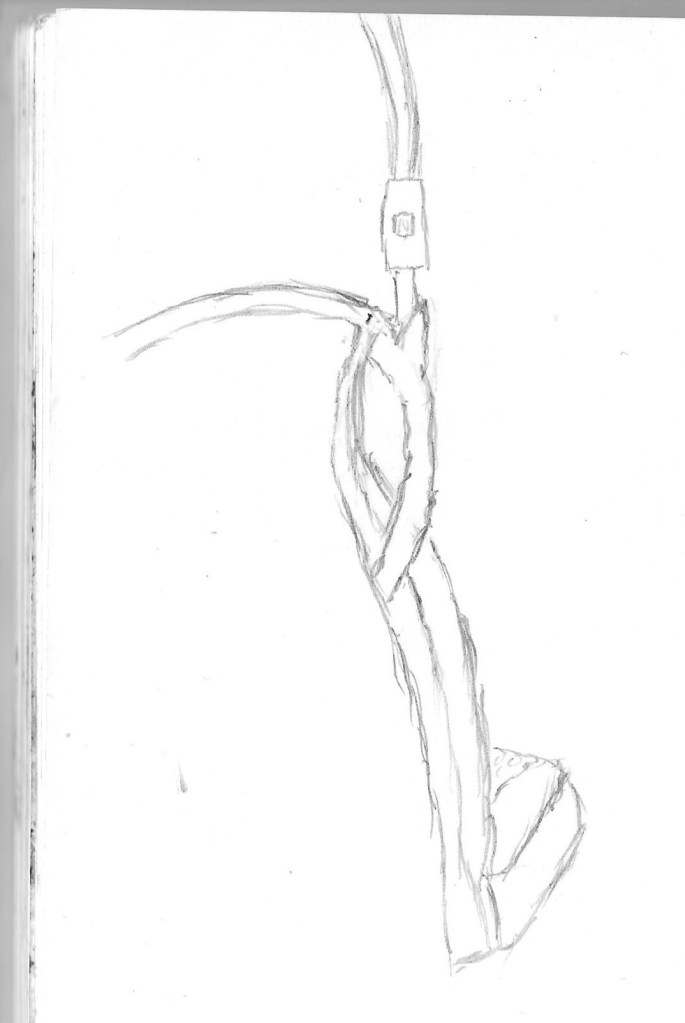
Indeed, there’s only one drawing I’m willing to pull out in public just now. This is a drawing of a bus seat done while on the bus:
Sketch of bus seat
It’s a fluke that everything looks roughly the same here as it did in real life, so I need to work on achieving a decent image by skill rather than luck.
Be advised that today’s deviation from writing is a one-off event, and that this page will not turn into an art blog. Meanwhile, as I’m shining the spotlight on pals, Eilidh Morris is a visual artist who doing the opposite of me by including more spoken word in their practice.
For the last three years, I’ve lived in a block of flats just out of town, and I’ve become rather well acquainted with my neighbours below me and beside me.
Just after the lockdown was announced on 23 March, I recieved notes through my letterbox from both households, offering assistance if necessary. I didn’t require any help, but it gave me an opportunity to write letters back to them.
Since then, I’ve also received notes from two other neighbours that I’d seen en passant but didn’t know by name. One of them apologised for dropping soil onto my balcony, while the other wanted to talk about a noise issue from another flat.
I keep a special notepad for letters, styled as ‘nu:elite‘. The pages are ringbound A5 sheets that tear off along perforations, leaving a smooth edge. It’s also a heavier weight of paper, which I favour, although I do have a lighter weight, styled simply as ‘nu‘. if I’m not trying to impress the other person.
While I had the notepad to hand, I penned one to a friend in Florida, enclosing some commemorative David Bowie stamps that I rediscovered while clearing up. Shortly after that, a pal in California wondered whether I could send her a pen I’d had custom-made for my open-mike Hotchpotch.
Then I had a birthday card returned undelivered from Dublin; this had been posted before the lockdown. I’d bought and printed my postage online rather than visit the Post Office, but I’d messed it up. Reading back the letter I’d originally enclosed with the card, it seems I’d been pushed for time and hadn’t written much. I therefore decided to send it back with a longer letter, as the first had gone out of date because of the movement restrictions. I was sure to learn how to properly affix self-printed postage.
The letter-writing bug must also have hit my Canadian pen-pal, whom I met through National Novel Writing Month. She apologised via a private Twitter message that she hadn’t managed to write back. I, of course, said not to worry about it.
I remember learning at school how to write letters by hand in the mid-1990s. Looking back, it seemed a little dated even then: word processing software was near-universal, though e-mail was not.
In sixth year, however, I learned how to touch-type and to format a document correctly. The teacher was near retirement age, but she’d moved with the times: there were no double-spaces after full-stops.
Despite my love of letter-writing, I’m also doing it sparingly, as we don’t yet know exactly how the current virus is transmitted. The aforementioned neighbours now have my phone number, so as to reduce physical contact as soon as possible.
The daily pictures on my Instagram page are devoted to a particular theme that changes every month. Previous ones include photographing red objects, finding signs containing numbers, and completing a 1000-piece jigsaw.
This month’s theme is called Fifty Shades of May, an exploration of the influential but largely mocked E L James novel, which has turned into more of a literary analysis than I’d expected.
Let me tell you in a nutshell how it’s going: my copy is 514 pages long and I’ve already managed to eke out five days of criticism from the first 10% of the story.
On day two, for instance, we looked at how some words didn’t carry much weight and could have been trimmed. On day four, we explored the character background of the 21-year-old Anastasia, through her assertion that nobody had ever held her hand before, and her reaction when Christian Grey does it without asking her first.
At some point, I will have to read past page 50, but if these initial reactions are representative of the rest of the novel, it’s going to be a painful ride.
I attended my first writing class in 2011. On a Saturday morning, we would meet in a craft shop.
For two hours, with a cup of tea in the middle, the leader would give us exercises to complete. She might provide a sentence, or five randomly-chosen words, or even a photograph. Our challenge was to write a passage inspired by that prompt and share it with the group. It’s understood that this is a draft, not a finished product.
Over the next few years, our class moved from the craft shop to different cafes in town. At one point, we were even able to use a private dining room in a four-star hotel.
The type of exercises, however, remained similar: here’s a prompt, go and pen something. It’s a format I enjoy because it encourages the writer to make decisions and solve problems quickly. I think this has made me a better writer, just as actors take part in improv classes to help their skills along.
I’ve recently taken the opportunity to revisit this type of practice. Under the banner Poetry in Turbulent Times, Imogen Stirling is running a weekly class via Zoom.
One particular area of focus is a concept I knew little about: the kenning, using two words where only one would normally appear. The run is currently scheduled for four weeks, but if it’s extended, I’m interested in still taking part.
Even though I’ve now had nearly a decade of experience since 2011, I find I’m still being challenged almost as much as when I was a beginner.
A casual look at my archive suggests I’ve made a reference to the supermarket Asda in at least three different pieces. I’ve been figuring out why I love mentioning this supermarket so much.
If a brand is worth talking about, it’s usually because it’s either iconic or notorious. You’re likely to hear a stand-up comic talking about Lidl for its unthemed selection of goods, or Tesco for its dominance. But Asda fits between the two on the spectrum. It is, in a word: bland.
There are several brands that fit in the bracket of blandness. BBC One might be iconic and Channel 4 notorious, but ITV fits squarely in the middle. Microsoft is iconic, Apple is notorious, but who cares about Linux?
I care about it, at least for the purposes of my writing. I find that a bland reference deployed in the right place allows me to illustrate a point without having the brand overshadow it.
One poem talks about a narrator’s hypothetical plan for euthenasia if their health deteriorates too much. It sounds like a serious subject, and it is, but it’s treated in a light tone by the narrator.
There’s a reference to an Asda bag in the text that fits nicely into that tone. The same reference might work with Lidl or Tesco, but Asda adds a little drop of the absurdity into the piece that might be missing with an iconic or notorious supermarket.
Regular readers will know I run Hotchpotch, an open-mike night for writers.
Earlier this month, we not only celebrated ten years as a group, but we managed to have our last gig before all the pubs were ordered to close on Monday 23 March. This attracted a sizeable crowd under the circumstances.
We’d planned to reconvene on Monday 13 April, but that’s almost definitely off the table. I’d always half-joked that if we ever had no venue, we’d meet up in the street. It’s not something we’ve ever needed to do, and – considering the nature of the threat – wouldn’t be appropriate.
So if we want this night to continue, we need to move temporarily online, as many poets and musicians have done. Our challenge is somewhat larger: we don’t just have one or two writers, but easily 30 or 40.
While mulling over the problem, I remembered we use a GMail account and that Google gives us a YouTube profile with that. So over the next two weeks, we’ll invite members to send in videos of themselves reading their work and post it to the channel.
It won’t be a patch on the vibe that happens when we all assemble, but it’ll keep us going until this lockdown is eased.
I also run a separate writing group every Tuesday evening as part of National Novel Writing Month; this also can’t meet because of the restrictions.
In this case, we’d already set up a Discord server where members can chat via text. Last week, we set up a voice channel alongside the text, and we were able to speak to each other, almost as if we were in the same room.

 Gavin Cameron