Parallel to this, I’ve been taking part in online life drawing classes. At the beginning, the model poses for three minutes as a warmup exercise before moving onto 10- and 20-minute poses.
I felt defeated before I’d even started: three minutes simply wasn’t long enough for me to make a decent attempt. That’s about as long as it takes to read this post twice over, according to http://readtime.eu/. What’s more, I spoke to artists who not only liked these short poses, but sometimes preferred them.
But then I began to make a comparison with the poetry I write, specifically the clerihew form. I’ve written these for so long that it’s now relatively simple to pen an original one on the spot. For instance, my personal trainer asks me to send a food and exercise report every evening, and I always include one with the e-mail.
I reasoned that if these three-minute poses were as simple to some artists as clerihews are to me, then there must be some value in persisting with them.
With Ana’s help, I’ve been drawing people passing in the street or sketching characters from a film without pressing Pause. One day, I aim to churn these out as quickly as those clerihews.
In her autobiography Sex and Shopping, the novelist Judith Krantz talks about a professor from her college days. In the anecdote, he’d reduced her grade from an A to a B on account of her spelling. That incident put her off writing for more than 30 years.
Rationally, it seems like an overreaction: one comment by one person on one day set her career back three decades. Yet negativity is a powerful weapon.
Some years ago, I had a job where I spoke to the public by phone for 37 hours a week. On any given day, the interactions that I remembered most vividly were not from the friendly and co-operative callers, but from the rude and obstructive ones. And it works in reverse: one disrespectful sales assistant on one day can mean a shop losing a customer.
There is research to suggest that it takes five positive events to cancel out a negative one. In the case of Krantz, she was also of college age at the time and therefore in learning mode, so it’s likely she would have taken this more personally than if she’d already been producing work.
Last week, a friend finally showed me some of her poetry after we’d talked about it for weeks. She hadn’t shown anyone before, so I’d promised to take it seriously and to provide constructive feedback.
Dismissing someone’s work without good reason is at best unproductive and at worst unprofessional. If a writer hasn’t received feedback before, how can they improve? I’ve never seen a piece that couldn’t be improved by restructuring the narrative or removing words.
After our discussion, I hope the aforementioned friend will feel encouraged to show future work to me and to others.
When I’m stuck for a blog post idea, I check my Drafts folder on WordPress to see whether I can resurrect a half-written idea. At the time of writing, however, there is little material in any of the drafts.
One of them covers the concept of life writing, which I’d already discussed last week. Another was placed there by WordPress about how to use their Guttenberg editor interface. A third entry simply contains the words ‘Jesus wept’, and I’m not certain what caused me to exclaim this.
While considering these entries, I began thinking of the prose and poetry I’ve started but not fully finished. Sure, I generally finish a first draft of what I write, but that doesn’t mean I’ve gone back to edit it. However, I do keep everything I write because sometimes it comes in useful.
A few years ago, I was reaching the end of a Masters degree in Writing Practice & Study. The course had worked its magic, encouraging me to move in different directions with my writing, which wasn’t a problem until it was time to compile the dissertation. With 80% of the mark resting on a creative portfolio, I was faced with the challenge of bringing together my disparate work into one unified piece.
I had a meeting with two tutors to discuss the matter, bringing along samples of my work to figure out how to present it. As we were coming to the end of the pile of samples, we looked at a short story written in diary form about a first-year student with a horrible flatmate. I’d written the story as a homework piece for a writing group, falling back on the diary form because I was so short of time.
One of the tutors suggested incorporating my pieces into the form of that story, presenting it as though someone else had written my work. This character was rather flighty anyway, so she could feasibly have written in different styles over a short space of time.
I went back to the draft of this writing homework, converted it into a script, and beefed out the story. It solved the problem nicely and helped me to bag an A-grade for that part of the dissertation.
I’ve since gone on to refine this into a one-hour dramatic monologue, which is now more or less finished.
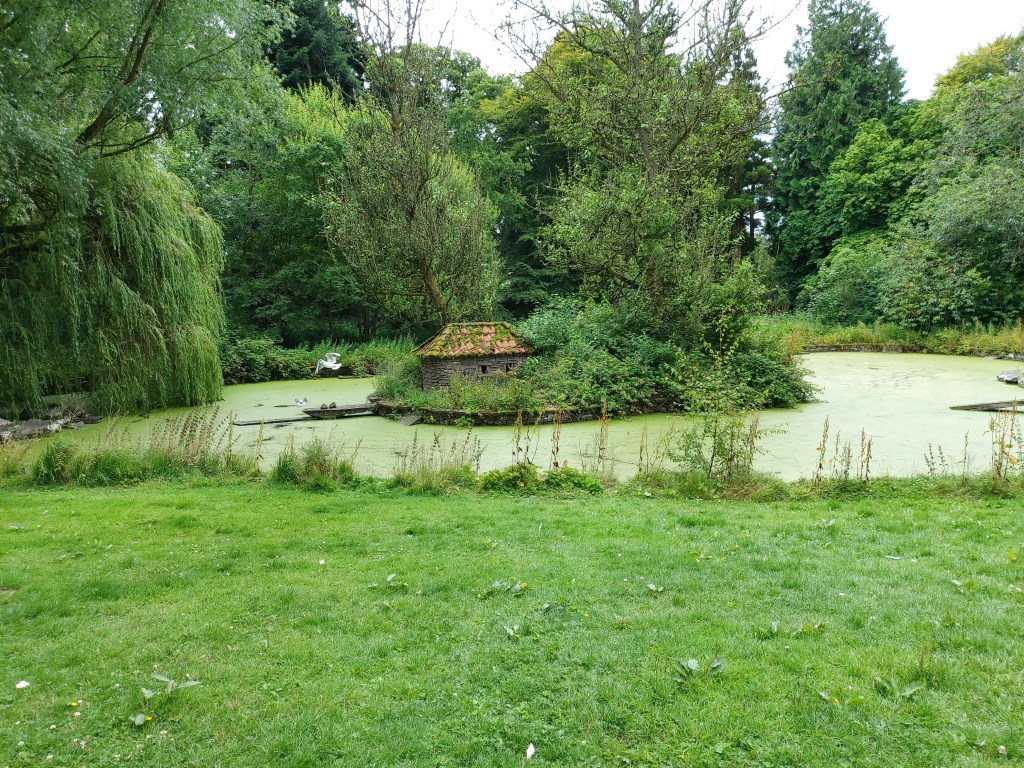
I wrote the first draft of this entry in Camperdown Park in Dundee.
It’s a place I visited many times when I was young, often for the playpark or the boating lake, or sometimes the zoo. Its 400 acres leaves plenty of room for a large expanse of grass and – until last year – a golf course. But I chose to sit beside the duck pond, tucked away between the trees.
It’s hard not to compare my memory of Camperdown from childhood to how it currently appears. On the whole, the whole area is recognisably the same, although some parts don’t appear quite as massive now. I do feel the playpark has suffered from the loss of the pirate-ship climbing frames, even if the new modern equipment is less of a death-trap.
The chances are that most people reading this won’t know where this park is or my connection with it, and frankly, won’t care. Yet memoir and biography are two genres that consistently sell well, so it must be possible to draw the reader into someone else’s nostalgia.
In my experience, the key is to give as much context and description as possible, and tell it as if it were a fiction story.
In this case, I might expand upon specific memories, like playing a golf game on my GameBoy near the duck pond or becoming annoyed with somebody who deliberately splashed me on the boating lake. I’d also look a little wider, perhaps that a school friend lived nearby or how we’d often visit the Little Chef while in the area.
Even when writing fiction, I find it useful to base made-up places on real ones, as it helps to keep the description consistent. If I ever need to set a story in a zoo or on a climbing frame shaped like a pirate ship, I know where I’ll use as a model.
As I’ve been writing for so long, I sometimes forget that less experienced writers still struggle with the initial hurdles that I overcame a long time ago.
Earlier this month, my partner sent me a poem she’d written, after we’d spoken about her interest in developing her craft. She’d always been reluctant to revisit and redraft her work, yet that’s arguably the first step to improving your writing. When you’ve just placed something on the page, you’re not reading it fresh like the next person will.
We discussed the sent poem, in which I suggested trimming many words and restructuring the stanzas. It’s not unrecognisably different from the first draft, but it now flows significantly better.
And now a friend has asked me for help. She has no problem redrafting her work, but is reluctant to show it to anyone. It’s a real fear among some people that their work will be disrespected. I’m currently working with this person to encourage her to open up a little.
When I’m asked to look over someone else’s piece, I sometimes ask whether there’s a particular aspect I should focus on; for example, grammar, structure, themes, &c. I also make it clear that whatever suggestions I make are optional. This sometimes means letting go of aspects that break convention: a couple of poets, for instance, like to capitalise the beginning of each line, even though the widespread practice died out a century ago.
When someone has asked me to look over a piece I might not understand it, or it might not be to my taste. But what I won’t do is sneer at, ridicule or dismiss someone’s work when they’ve taken the time to request constructive feedback.
I’ve had little time to put together a full entry, but there is something I want to show you.
A few weeks ago, I attended writing workshops run by the poet Imogen Stirling, who took the theme of the lockdown as inspiration for her prompts. I’m pleased to report that the amalgamation of the work done by the class has been featured in The Scotsman Sessions.
It was a pleasure taking part in these classes because that’s exactly how I started writing a decade ago: here’s a prompt, and you’ve got five minutes to write something inspired by it.
Come to think of it, that’s much how this entry has been put together.
When I first began writing in 2010, my output was exclusively prose. I was in a writing prompt group where I would regulary produce short stories. Around the same time, I was producing longer works through National Novel Writing Month, normally known as NaNoWriMo.
My step into poetry happened around three years later. It coincided with being single for six months after a long-term relationship, but I can’t say how much that influenced me. Since then, I’ve crafted my poetry more and more to the point where I almost exclusively write verse.
Recently, however, that has started to reverse, perhaps because my poetry group is taking a one-month break. I’ve drafted one piece that will probably end up being no longer than 150 words, and I’m planning another with five characters who will likely dictate the length of the story before I know it myself.
NaNoWriMo is a contest to write 50,000 words in November. It’s not widely known outside this circle that there is a less formal contest at other times of the year known as Camp. April saw the last one, and we’re currently in the July edition. In these months, you pick your own word count and type of long-form piece.
However, I’m not writing these stories as part of Camp as I don’t intend them to be terribly long. What I’ll be doing instead is keeping aside my existing longer pieces and working on them during November.
What I have to do now is find a way to keep up my prose momentum from now until then. That said, the excitement in the group tends to swell around November, and that helps a lot.
I haven’t had time to write a proper blog entry this week. Instead, have a look back at my entries from this time in years gone by and I’ll write something for next week.
Last week, I mentioned that I’m not a lifelong fiction writer nor poet, having started in 2010. However, I had kept a non-fiction blog for some years before this.
Although WordPress was around in 2003, the most popular blog host at the time was LiveJournal, known among its users as LJ. My first entry was on 19 December of that year, when I was studying at what is now the University of the West of Scotland, although my profile has – for some reason – always said my account was created on 15 March 2004.
I was reminded of my these days though my pal Katy Jones, who not only joined a year or two before me, but still uses it. She was interviewed for a podcast recently, in which she spoke about the appeal of LJ compared to other sites.
However, we’d actually become acquainted through a media forum, entirely separate from LJ, as we were active in different hospital radio stations around the same time. In fact, we’ve never met and I don’t think we’ve spoken by phone or video chat, yet Katy remains one of my most enduring online friendships. We might even be starting pen-pal correspondence soon.
So what of my old LJ account? It still exists, and it served as a good sandbox in which to practice for this WordPress blog, which began in 2013. At that time, the paid-for features of LJ matched the free features of WordPress, so it was an obvious choice to switch for me.
But there were also duds along the way, like this one that’s disjointed and uninteresting, asking a question about football and then rambling about Firefox and the bit-rates of MP3 files. Years later, we see a desperate attempt to keep the LJ page alive with tedious #MusicMonday entries.
So one thing I’ve learnt over the years is to look at my entries from outside of my own head. If a topic only makes sense to me, then there’s no point in making it public.
Judging by the reactions and the viewing statistics I receive from this WordPress page, I do manage to engage people. I can even look back at entries from six years ago and still be satisfied with them, other than spotting an occasional sentence that needs rephrasing.
I do hope I’ll be able to read this in May 2026 and feel the same way.
I periodically remind people that I’m not a lifelong fiction writer nor poet. I started in 2010, when I was around 27 years old.
As such, I’ve now gained an decade of intensive experience that I reckon brings me up to a similar level compared to those who have been writing for far longer.
That said, I don’t ever want to be that writer who feels they’re too good to learn something new. When I took part in Imogen Stirling’s classes recently, I knew I could manage the work, yet I was still pushed in new directions that I wouldn’t have walked by myself, such as kennings and univocal poetry.
In the same spirit, I’ve been taking art lessons from my pal Ana Hine over the last couple of months, who is offering weekly classes via Patreon. This is a major deal for me because I’ve always had a mental block with art: I wouldn’t do it because my drawing wasn’t of a high standard, yet it wasn’t of a high standard because I wouldn’t draw.
I had a problem with the way I was taught at school. The focus was on making a finished work rather than going through the process or making a rough draft first. Yet that same criticism also applied to my poetry teaching. I should note that I’m talking about the 1990s, so their methods might have improved since then.
I have once before attempted drawing lessons with another pal, Jen Robson. Last year, she ran an afternoon class called Scared of the Paper, and my picture is still on her website. That was a great experience, and I learnt techniques that I’ve carried over to Ana’s lessons, such as correcting mistakes by adding lines rather than erasing them, and listening to music as I work.
However, I didn’t ride the wave of enjoyment and instead let the mental block build up again. Now, with being asked to stay indoors, I decided to give art another shot.
With six of Ana’s lessons under my belt, I’ve only once burst into tears and I’ve only once thrown away my eraser in frustration, so that’s progress. I’m still clouded by The Dread before I start, and it’s something I need to fight through.
When it comes to poetry, I no longer care whether people see my half-done work as I know I can go back and improve it. With art, by contrast, I sometimes can’t properly capture a particular scene and I don’t know how to fix it, so I’ve shown only Ana and my partner thus far.
Indeed, there’s only one drawing I’m willing to pull out in public just now. This is a drawing of a bus seat done while on the bus:
Sketch of bus seat
It’s a fluke that everything looks roughly the same here as it did in real life, so I need to work on achieving a decent image by skill rather than luck.
Be advised that today’s deviation from writing is a one-off event, and that this page will not turn into an art blog. Meanwhile, as I’m shining the spotlight on pals, Eilidh Morris is a visual artist who doing the opposite of me by including more spoken word in their practice.