Running a Readathon

For the last six years or so, I’ve been involved in a small readathon that takes place on Discord. Over time, it’s been scheduled on various dates and has been run by different people.

In its current incarnation, I help my pal Jenny to run it once a year, approximately around Yuletide. This year, it was set to start at 8pm on Saturday, finishing at 8pm on Sunday. This left us both enough time for a screening of It’s a Wonderful Life first.

For the avoidance of doubt, the intention of the readathon is not to stay up and read for 24 hours straight. Instead, it encourages participants to ringfence some time over these 24 hours to settle down with a book.

We provide regular prompts throughout the event. These might include:

  • Sharing how you discovered the book you’re reading.
  • Telling the group three facts about the author.
  • Writing a haiku about an event or character in the story.

There are also reminders to stand up, stretch, eat and drink. We established early on that some participants were in different time zones, so we could say, Depending on your side of the Atlantic, it’s likely to be approaching either breakfast-time or lunchtime, so be sure to stop and fill up.’

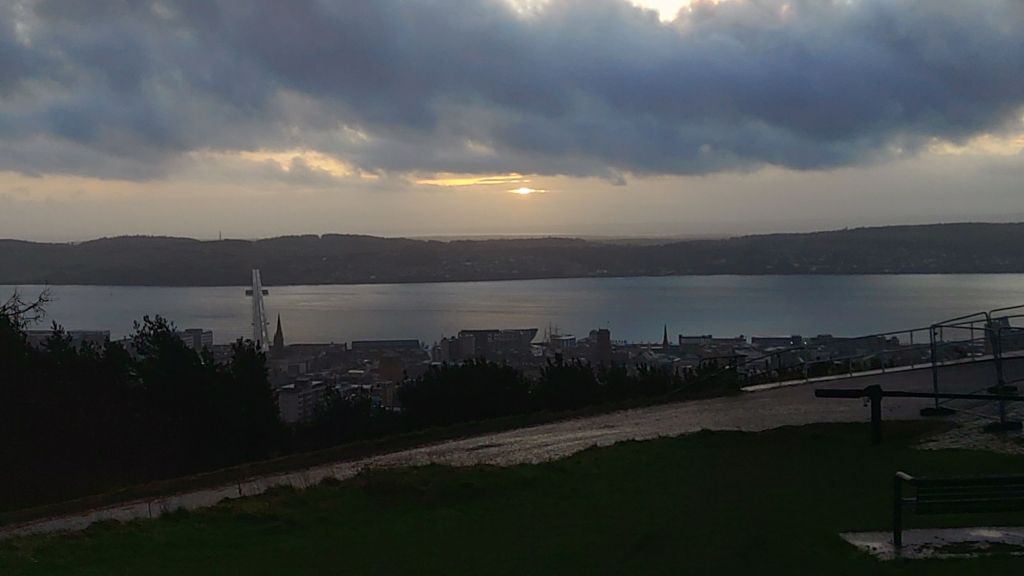
Because Jenny is a night owl and I’m more of an early riser, it was relatively easy to coordinate the full 24 hours., particularly as I had a half-baked plan to watch the winter solstice sunrise from the Law Hill in Dundee. This meant it would pair nicely with the summer solstice six months earlier, even if the cloud cover meant there wasn’t particularly much sun.

Winter solstice sunrise as seen from the Law Hill in Dundee. There is thick cloud cover partially obscuring the sun. The sky glows softly behind dramatic clouds, casting muted light across the water and buildings. A bridge spans the river, and a bench in the foreground sits beside a damp path and grassy verge.

So what of the actual stories?

I’ve become a lot more interested in audio storytelling over the last 12 months, so rather than reading paper books during the readathon, I listened to a drama on BBC Sounds based on the Fukushima nuclear accident in 2011, a radio drama called Cat and Mouse Game by R D Wingfield on YouTube, and an audiobook of The Time Machine by H G Wells.

The participants’ reading lists incorporated a variety of authors such as Ayn Rand, Becky Chambers, Iain M Banks and George Orwell.

I was a somewhat tired by the end of Sunday, but the event was very satisfying to run. It goes at an easy pace with just enough interaction to keep the server ticking over. I look forward to holding it again next year.

Friday Poetry in St Andrews

It’s the time of year for StAnza, the annual poetry festival in St Andrews. I’ve made a point of going for some years now, as it’s only half an hour away by bus.

I would normally go on a Saturday and/or a Sunday, but I could only attend the launch party on Friday instead, and this also meant missing a visit to a pal who lives nearby. Before the pandemic, I would set aside the weekend, typically staying in the town. I’ve fallen out of that habit, but next year would be a good time to resurrect it.

During the same period, the festival length has been reduced from six days to three. I’ve heard grumbles from poetry pals about this cut-down programme, this would work in my favour. By omitting weekdays other than Friday night, there’s less chance of events clashing with work, and I’d be able to attend late-night readings with a finishing time dangerously close to the last bus home.

The next email I’m expecting from StAnza is a feedback form. They’ve nothing to worry about on that front, as I enjoyed the launch. Half of it was improv, calling poets at random to read poetry themed around colours, with the other half a structured reading from Ruth Padel.

The more important aspect is that such festivals often rely on sponsors for their continued operation. The more customer reaction the organisers receive, the easier it is to convince funders to back it the following year, so always fill these in.

The other two places I would like to visit for the first time, ideally this year, are the Wigtown Book Festival and the Orkney Storytelling Festival. These start in September and October respectively, but it’s a good idea to start planning now.

A Weekend of Reading

I’m in a few different literary groups that meet on a monthly or weekly basis. There is also one that’s active only a few times a year, set up by a pal who is a particularly enthusiastic reader. The group has come to be known as the Seasonal Readathon.

From its inception until earlier this year, its format had been largely the same: we would reserve a Saturday or a Sunday and spend time reading between the hours of 8am and 8pm. The leader would also give out optional prompts every hour, ranging from ‘Predict what happens next in your book’ to ‘Don’t forget to eat dinner’.

The most recent event took place on Saturday 24 June, with a radical difference. We would still spend 12 hours reading, but these would be spread over two days without necessarily having prompts every hour. As it was summer and unusually warm, we also arranged a meet-up in a nearby park.

Initial feedback suggests that while members didn’t manage a full 12 hours of reading, it still spurred them on to read more than they otherwise would have. Also, the slower pace seems to have been a hit with those who were working or had other difficulties being present for the usual 8am to 8pm period. For my own part, Saturday was booked solid, so it helped to have the Sunday reserved as well.

Our next readathon will be in autumn. As this is Scotland, an open-air meet-up is unlikely at that point, but there remains the possibility to congregate indoors and carry on our reading.

A Little Poetry

Every year, I take time to visit StAnza, the poetry event in St Andrews. The festival is typically spread over the course of around a week, so I normally book a few events on the same day. This year took a significantly different form but it was no less literary.

I booked just two events: the breakfast poetry in the morning plus the slam competition on Saturday evening. I’d planned to use the middle of the day to visit a pal I haven’t seen for around three years.

He introduced me to a game called Bananagrams. It’s easier to demonstrate than explain, but fans of Scrabble will likely enjoy it. We played four games and discussed a few of the books on his shelf.

By the end of the afternoon, I’d decided to skip the slam. It goes on late into the evening and I was too tired to stay up. Instead, I used the time to compose an overdue card to a pal in Dublin, complete with a handwritten letter that ended up being four A5 pages long.

If I were one of these people who posted these vapid inspirational quotes, I’d end with something like ‘The serves as a reminder that even when plans change, there are always opportunities to connect and create meaningful moments.’ And yet that very much expresses how I feel. Just this once, let’s lean into this sentiment.

The work-work balance.

I’m on annual leave from my day job at the moment, but that won’t stop your weekly blog post from being delivered.

From Friday to Sunday, I planned to have three late nights at the T in The Park music festival. Then tonight, I’ll be running a writers’ open-mike before seeing a friend’s band in town. Tomorrow, I’m up early doors for the launch of Go Set a Watchman at Waterstone’s – Please note, warn the organisers, Harper Lee will not be in attendance – then a play by MLitt students at night, with a day of writing in between.

The rest of the week is packed in a similar fashion. The only thing that didn’t happen was Sunday at the festival, but I made sure to fill the time with more writing.

But why not rest up? Because as I’ve become older, I’ve realised that being idle doesn’t suit me. I won’t stop unless I absolutely have to, otherwise I would never manage to do anything. To demonstrate this, imagine I had to go to the Post Office and send a parcel.

If that were the only task I needed to do all day, I might wake up at 7am, realise there were two hours until the Post Office opened, start doing something else and be distracted by it until midday, tell myself there were five hours left and do something else to fill the time, and be distracted by that instead. The net result is that the parcel wouldn’t be posted.

On the other hand, let’s suppose the parcel was just one more thing I needed to fit in. I might go to work at 8am, leave the office at 4pm, visit the Post Office, then head to the gym and crack on with writing when I returned home. Net result: I’ve done my task.

It’s unfortunate that almost all UK employees are required to take 5.6 weeks of leave every single year, as I would be far more productive without a break, and I’m sure the economy would benefit too. If I ever reached a stage when I was able to be a novelist full-time, I would probably still rise at the same hour as I currently do and churn out a target number of words over a certain number of hours.

Stephen King has this one right: he produces 2000 words every morning, including his birthday and holidays, and spends time in the afternoons catching up on his correspondence. And that’s why you’re receiving this blog post as normal, and next week, and the next, until I no longer feel productive by producing them.