Performances and Housekeeping.

On Monday of last week, I debuted a new poem at Hotchpotch. This is a local open-mike night for writers. While I’m far more of a prose writer than a poet, I thought this particular piece would go down well.

I’ve been to enough live events to know the standard housekeeping message that’s given before the performance. This poem was a version of the announcement that made it sound as though the speaker was having a mental breakdown. It did indeed attract a positive response, while a second poem and a short story were also well-received.

At last month’s Hotchpotch, I had a picture taken of me. I didn’t particularly like it because my neck was too far forward reading the piece. This time I was sure to stand up straighter and look up at the audience from time to time. I’m not saying my pieces came across better because of it, but I certainly felt better by paying attention to these factors.

I’m an advocate of people reading out their work in public, and of course in private while proofreading. If you know of a nearby group, go along and support it. There are actually two such groups around here, but I didn’t take to the other one since the focus there is mainly on folk tales, whereas Hotchpotch has a more literary flavour. Some groups even allow you simply to listen without contributing for the first meeting.

But what if there isn’t a group, or it’s not the right style for you? Have you ever thought about starting your own? There’s no reason why you should wait for someone else to do it, as it probably won’t happen.

The meeting place doesn’t have to be anywhere with a stage. We meet on the upper floor of a café, and we create an informal Poets’ Corner near the top of the stairs. Some pubs and coffee shops are happy to donate their space provided the participants are putting money in the till, so we hold at least one break during each evening. Just bear in mind that the venue could back out or change their terms at any time. A pub we used to use free of charge suddenly wanted £50 a session, even though we probably spent double that in drinks alone.

The other element you need to decide is the ethos. Should the audience offer constructive criticism to the readers, or is it solely for writers to try out new material? At Hotchpotch, the latter approach is taken, although there’s nothing to stop people giving feedback to each other privately afterwards.

But above all, it’s for writers to meet and talk to each other. Every time we meet up, I usually hear about an upcoming event or two that I wouldn’t otherwise have known about. The actual writing process is generally a solitary pursuit, but we all still need that connection.

What’s The Story?

A couple of entries ago, I mentioned that I rarely post my work on the Web. This is because I enter competitions and contact publishers. The rules invariably state that any story submitted should never have appeared either in print or online.

I have one story that’s already in the public domain, and I’m going to share it with you below. I wrote it for a Twitter friend, and it gives you a flavour of my style, although I don’t usually write in American English.

#

Text In The City
By Gavin Cameron

Monday, and for the third week in a row, I took to the streets of downtown Ladymill. I had made some acquaintance with a few of the commuters, one of whom had bought me a cup of coffee every day last week.

But as pleasant as it was to meet these people, I wasn’t doing this for the friends. I desperately needed something that nobody seemed able to give me. I perhaps should explain why I attracted so much attention. I’d been carrying two dry-erase boards attached by two ropes over my shoulder.

The one on my front read: NEED A JOB. CAN’T GET MORE WELFARE. Oftentimes, the rain washed off the semi-permanent ink and I had to rewrite it two or three times.

The blank board on my back allowed potential employers to write down their details. So far, I had only attracted a couple of comments, including KICK ME and I’M WITH STUPID.

But I believed this Monday would be different. Perhaps it was the optimism from the sunnier weather, or that the commuter’s coffee had gone straight to my head after an inadequate breakfast, but I definitely felt a new sense of being.

As the commuters thinned out at around six o’clock, no doubt rushing home for a well-earned beer, I considered finishing up for the day. But I had no beer, just leftover Chinese food.

I walked to the train station, when a man in an expensive-looking suit approached me. Over these three weeks, I developed an ability to tell when someone was about to speak to me, and I spoke first to show I wasn’t afraid to take the lead. “Good evening. I’m Rachel Morton. Can you help me?”

The man nodded. “I think I can.”

Excited, I replied, “Oh that’s great. What kind of work can you offer?”

“I work in advertising and marketing. Have you any experience of the industry?”

“No,” I replied, “but I’m a fast learner. You can even give me a week’s trial, but I’ll only consider a paid trial.”

“Don’t worry,” replied the man, “I would pay you, although it’s minimum wage. And to be fair, you don’t need much experience.”

“I’ll consider any reasonable offer.”

“I have an office a couple of blocks from here. How about you come in tomorrow morning? Here’s my card. Bring a resumé and some ID.”

I arrived as instructed wearing my most professional outfit. The office looked very glassy and modern, and didn’t contain many staff, so I could work almost uninterrupted. Yes, I could do this. No more rainy days wandering around town. I was now an office worker. I signed a month-long contract that day.

I soon found out why there were so few staff. This advertising company wasn’t offering a desk job. They wanted people to walk around the streets with billboards strapped to us.

<<<>>>

The Final Cut.

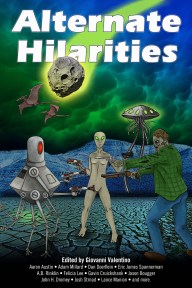
Further to the publication of the Alternate Hilarities anthology, I’ve been interviewed by Strange Musings Press. I’ve also received two paper copies of the book, but I’ll read the electronic version and keep the physical copies pristine and flat.

The story in that anthology is 1,160 words long, but in fiction, as in food, it’s sometimes necessary to cut down. I’m a great fan of reading work aloud. It’s a very good way of finding where one clause would be better than two, or where a semicolon could replace several words.

I only half-follow Elmore Leonard’s advice to Kill your darlings. In other words, to cross out any lines you particularly like. I think that’s fair game if the line in question has been squeezed in where it’s inappropriate, but if it’s the perfect means of expressing what you mean, I say jolly well leave it in.

But what if the problem is not just a line or two, but whole chunks of text? I encountered this problem with a 1,000-word story I wrote well over a year ago. I simply couldn’t make it work to my satisfaction. I shuffled round a few of the characters, who are all introduced as they enter a house, but I still couldn’t make the story flow.

In the end, I cut out the first 700 words, and I’m much happier. All the characters are still there, but it works by starting when they’re already in the house. The dialogue explains the immediate situation, and the twist makes the reader fill in the gaps.

But what to do with the cut part? Don’t delete or bin it, whatever you do. You’ve worked your hardest on it, and it deserves to be seen. I’ve recently started to maintain a list of story stems, those ideas that have thus far gone nowhere. Some are mere seeds, others are massive chunks, but they’re waiting with their jackets on in case the right alternative idea comes along.

Since constructing my list, I’ve used three of the stems. Once I use them all, I’ll need to start actually thinking again.

Alternate Hilarities Released by @Strange_Musings Press.

I’m pleased to report that my short story Amending Diabolical Acronym Misuse has been released today by Strange Musings Press in its Alternate Hilarities anthology, along with a number of other comedy pieces.

It’s available in both paper and electronic formats. You can buy a copy from Amazon UK, from Amazon US, or from Smashwords. Find out more about the book, and enter their Rafflecopter gift card giveaway, at the official website.

I’d also like to give thanks to the editor, Giovanni Valentino. Book publishing takes months of work, and throughout it all, he has been in regular contact with the contributors, and kept us up-to-date with its progress.

A Sense of Time

I’ve recently started watching old episodes of the comedy show Drop the Dead Donkey. At the beginning of each episode, an announcer now explains some of the topical references. As the series ran from 1990 to 1998, it’s likely a lot of them will have been forgotten.

A similar rule applies to fictional writing. If you want to set a story in a particular era, there might need to be some explicit or implicit reference to the timeframe in which the story is set.

For instance, one of my novels is set in 1964. This is introduced to the reader when a 21-year-old character is revealed to have a birth year of 1943. There are plenty of other era references throughout, but this avoids the dull initial statement that, “The year was 1964.” In one of my short stories, the 1980s is drawn more subtly, since the main character possesses a Filofax and a pager. It falls under Elmore Leonard’s classic advice to show, not tell.

To me, it’s important to avoid jarring the reader by letting them assume the story is set in the modern day if it isn’t. If a character is described as arriving home by car, then watching TV, that could have happened any night in the last fifty years. But tell the reader that the character arrived home in a Ford Capri, or watched Popstars: The Rivals, and that says they belong to the 1970s or the 2000s, especially when they go on to look up a number in the Yellow Pages and dial it from a wall phone. There will, of course, be occasions when you’re already aware the author lived in or wrote about a particular era.

The alternative is to make this story timeless. It’s hard to do in an urban environment since architecture and technology change, but it can still be done very successfully. If you’re describing a natural scene, it’s much easier to imagine it being any time over the last thousand years.

For anyone reading this well beyond 2014, this entry was set at a time when David Cameron was Prime Minister, coffee-lovers went to Starbucks for their fix, and people still thought Twitter was a good idea.

Extrovert Through The Gift Shop.

There’s no escaping the truth that writing is a solitary occupation. Authors can spend hours of their life alone in attics, sheds, and cafés, immersed in the land, world or universe they’re trying to create. It’s therefore tempting to imagine that this breed of people are shy introverts. Actually, of the majority I’ve seen, I’ve found the reverse to be true.

These days, it’s important for a writer to be able to self-promote, as many publishers’ marketing budgets are not massive. A prime example is Man Booker Prize winner Eleanor Catton, whom I had the privilege to see at a live event last week. She was interviewed about her book The Luminaries and gave some excellent, confident answers. Doug Johnstone also illustrates my point, as he’s forever looking for an opportunity to crack out his guitar. Chris Brookmyre dispenses entirely with an interviewer in favour of his own speech, while Iain (M) Banks usually invited questions from the word go.

This space reserved for Banksy's next piece
This space reserved for Banksy’s next piece

Have you considered trying it yourself?

Public reading and question-fielding is not reserved exclusively for established authors. Anyone can do it, and I believe they should. Like many authors, I read my work out loud when there’s nobody around, as it’s a valuable tool for ironing out clumsy phrases and misplaced punctuation.

I also consider myself an extrovert. I might spend time alone in front of a PC churning out short stories, but I’m perfectly at home in front of a microphone or camera. I volunteered at hospital radio for a long time, and used to keep a video blog. I’m also lucky enough to have a writers’ open-mike night nearby, where I can try out new material. The audience is made up of fellow authors and poets.

That’s not to say I don’t find it terrifying standing in front of them. I’ve never made a complete hash of it, but I have stumbled, and that’s something I need to work on. But even if you’re an introvert, find a willing audience and push through that barrier. It’s valuable for seeing how well the piece goes down with the public, particularly if they’re laughing when they should be shocked, or vice-versa.If you do, your work will almost certainly improve, and if you become published, you’ll already have the experience of making public readings.

While I was writing this, I thought of one introvert who always causes a fuss whenever he exhibits a new piece. I refer you to Banksy in his iconic film Exit Through The Gift Shop. He seems uncomfortable with the camera being near him, but his self-promotion skills are second-to-none. I know he’s an artist, but if he were a writer, I wonder what type of work he would produce?

The Update to The Update.

Alternate Hilarities

Over the last few entries, I’ve posted that Strange Musings Press would be printing my story Amending Diabolical Acronym Misuse, subject to raising enough money through their Kickstarter page.

I’m pleased to report that the $1,100 target has been reached, and the anthology will absolutely and definitely be going ahead.

The Kickstarter campaign is still open, and there are extra bonuses for reaching $2,200 and above.

An Update on @Strange_Musings, and Some Transatlantic Translations.

Alternate Hilarities

Around three weeks ago, I was pleased to report that I’ve had a third short story accepted for publication. Strange Musings Press of New York will be printing Amending Diabolical Acronym Misuse, subject to raising enough funds through their Kickstarter page.

There’s still around a week left to raise the $1,100 required for it to go ahead. You can donate at several different levels from $1 to $150, each of which buys you into the project with increasing levels of reward, including electronic and/or paper copies, autographs, and your name in the Contributors’ section.

My story is called Amending Diabolical Acronym Misuse, and it’s about a man who wants to rid the world of badly-constructed acronyms. Although I’m Scottish, my dialect is British English so that’s how most of my stories are written, including this one.

If I’m sending to an American publisher, I often change the grammar and spelling to suit; at least, I have a decent stab at it. In one case, I even wrote the whole story in US English because the character was so strong in my head: a cross between Jason Gideon from Criminal Minds, and Adrian Monk. In Amending…, I took the decision to keep it in my natural dialect as there are a number of references to British places and companies, and I felt it would look odd if I, “translated” it.

A couple of weeks ago, I began reading The Traveller by John Twelve Hawks. The narrative is written with a curious mix of dialects. For instance, the title is spelt with two Ls and there’s a reference to a pub, but the colour gray and an SUV appear in other parts. The SUV would be known as a 4-by-4 in Britain. The story is set in several countries so I expect it’s difficult to settle on one standard spelling, yet it’s not a distraction here, and I’m thoroughly enjoying the story.

Conversely, my mentor Zöe Venditozzi released her debut novel Anywhere’s Better Than Here in 2012. When a US edition hit the shelves, she told me there were no spelling changes made. When you buy a copy, watch out for the character whose initials match mine.

So is it important to adapt your dialect depending on which side of the Atlantic you’ll be published? I expect most Internet users will be accustomed to reading both, but at the same time, people will still write in whichever they feel comes most naturally.

Perhaps one day in the future, the two will merge and we’ll have one way of spelling each word, one form of grammar for all. It would be more practical, but probably rather dull.

Can you help @Strange_Musings fund an anthology?

Alternate Hilarities

I’m pleased to report that I’ve had a third short story accepted for publication. New York publisher Strange Musings Press will be printing Amending Diabolical Acronym Misuse. However, it will only go ahead if enough people contribute.

To this end, a Kickstarter campaign has been set up to raise $1,100 by Tuesday 25 March. You can donate at several levels from $1 to $150, each of which buys you increasing levels of acknowledgement, privilege, and general bragging rights.

I wouldn’t ask you to do something that I’m not prepared to do myself, so I’ve donated $22 under my legal name Gavin Cruickshank. That amount includes $10 overseas postage for a copy of the book, due out on Thursday 1 May. You can see my contribution on the backers’ page.

I would be most grateful if you could give whatever you can, and the editor Giovanni Valentino will be delighted. Don’t forget to share this blog post on WordPress and/or your preferred social networks.

If this comes off, I’ll have been published in the UK, Australia, and the US. Canada, I have my eye on you.

The Real Slim Shady.

Recently, an editor accidentally sent me some documents with my legal name in the byline. It was half my fault for not making it clear enough, but it brought home just how important it is to separate the two.

I started using my pseudonym before I took up writing. Until recently, I presented a show on hospital radio and promoted my middle to my last name, becoming Gavin Cameron. It sounds clearer through a microphone than my actual name Gavin Cruickshank, and more people know how to pronounce the written form correctly.

Let me point out that this was before David Cameron was elected. Despite the connections, it’s proved useful in writing because I work full-time and it helps keep a clear separation between the two.

I do think that if a writer uses a pen name, for whatever reason, he or she should inhabit the name and adopt the character. I occasionally read authors introducing themselves as, for instance, John Smith writing as Joe Public. Why craft a pen name if you’re going to break the illusion? I did it in this entry purely to demonstrate a point, but in a book or story, I would never explain Gavin Cruickshank writing as Gavin Cameron.

But I can think of one person who has done this successfully, and with a double pseudonym. Rapper Marshall Mathers goes by the stage name Eminem, but refers to himself as Slim Shady in his music. When you’re listening to his albums, he does it so naturally that you simply don’t question it.

I don’t think Mathers/Eminem/Shady reads this blog, but if he does, well done those men.