News Round-Up

My normal method of writing blogs is to pick one subject and write a few paragraphs about it. However, nothing major has happened over the last week so no single topic could be extended to a full entry. Instead, here’s a round-up of what’s been occurring.


At the end of last month, I spoke about the open-mike night I run for writers and that we’d found a new venue. I’m pleased to report we had a marvellous time, with a record 17 people reading stories and poetry, and many more eager ears in the audience. It would be great to see this sustained over the coming months.


Last week, I mentioned I was redrafting a one-woman play I originally wrote for my Masters dissertation. Since then, I’ve boosted the word count to 11,000 and it now lasts for an hour, even delivered at a reasonably fast pace. This means it can be stripped back if necessary.

In the same entry, I mentioned I was redrafting a short story. I haven’t had a chance to send this away yet, but I will soon. I have an annual target to submit 53 pieces to publishers – an average of one a week, plus one for good measure – and I’m nowhere near on par.


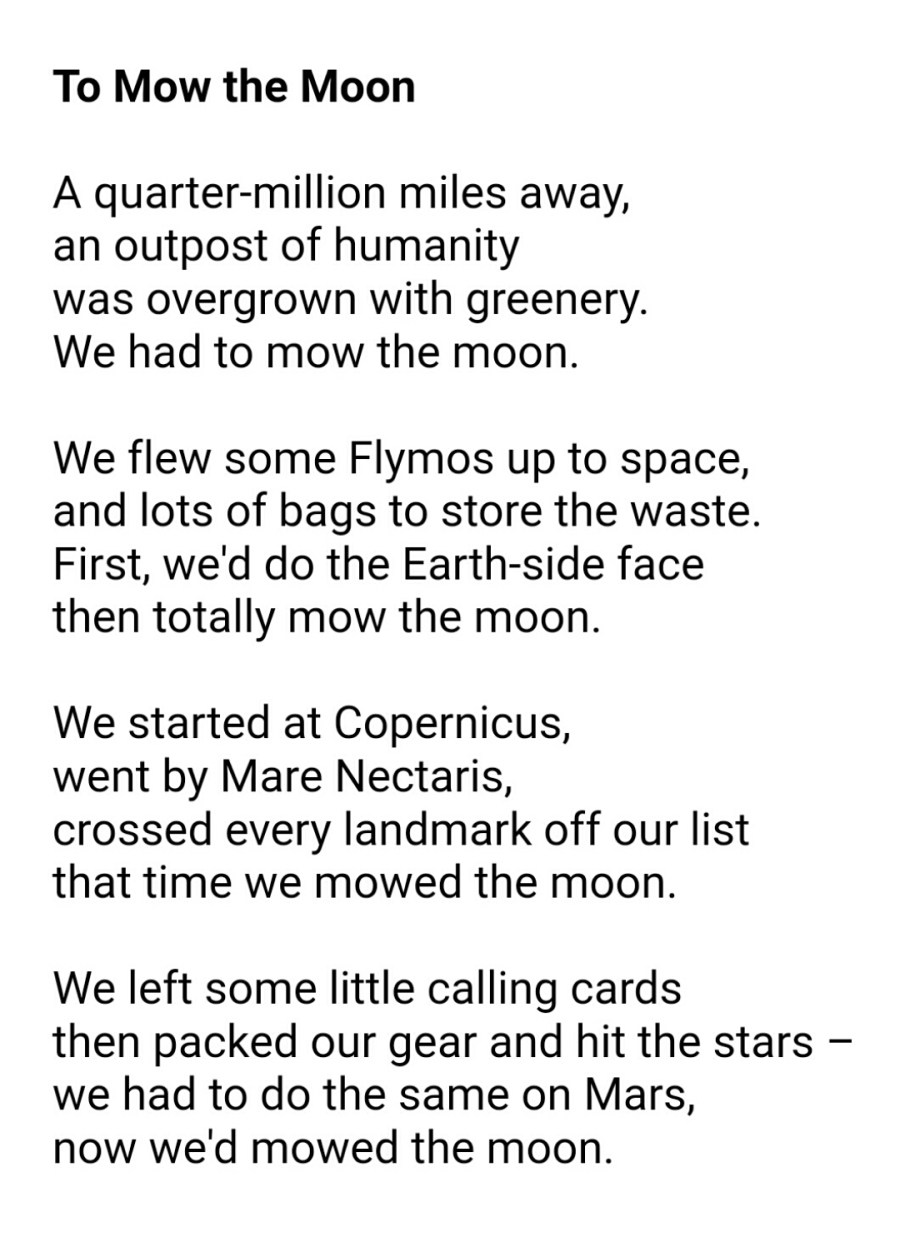
Yesterday, a friend reposted a short piece called Humans Are Adorable, written from the point of view of an alien looking at the human race. Number 12 is about reaching the moon, described as humanity having ‘made it to the end of their yard’. A mutual friend then quipped, ‘Thank [goodness] I don’t have to mow it.’ And this image stayed with me, so I simply had to make it into a poem:

I’m Falling Further Behind

It’s an implicit expectation from you, the reader, that I’ll post an entry every Monday at 5pm. This means you should have seen it here yesterday, and it wasn’t. Since yesterday was a public holiday, it felt like a Sunday and it slipped my mind until after the due time. But that’s an excuse rather than a reason.

To this end, I owe you an apology and an entry, and I think an appropriate punishment for missing the deadline would be to would be to whip my own back with a knotted rope. I have, however, settled for making a second entry of at least 500 words on Friday at 5pm. Then I’ll update as normal from Monday of next week.

Last time, I promised to make a little progress on each of my outstanding works. Let’s go through them all.

“I can’t remember the last time I sent something away to a publisher”

On checking my submissions tracker, I found it was 23 February, or nearly eight weeks ago when I last send something away. It was difficult to find a publisher who was accepting submissions; I looked right through my usual sources, and most of the reading periods were closed.

However, I did find one publisher who would accept up to five poems. By coincidence, I’d sent five poems to another publisher in December who had turned me down at the beginning of March. With only a few minor changes, I was able to send them to the new place. Even better: my aim is to send away an average of one piece per week, and this submission brought me bang up-to-date.

“I can’t remember the last time I typed up something from my notebook”

It’s virtually a truism that inspiration strikes in the most bizarre of places; in my case, in McDonalds at 9:30am on a Friday. I found myself able to finish two poems – one of which I’d been struggling with for a while – and I typed them up later that day.

“I’m tackling Camp NaNoWriMo. … I have around half as many words as I should”

I’m not up-to-date with this, plus I’d increased my word target from 10,000 words to 11,000 as an extra challenge. I intended to write a series of interlinked stories, but I changed my project name to Any old nonsense to reflect the diverse pieces I’ve actually written. Despite this, there is now a ray of hope as I’ve figured out a structure for one of the stories that I was finding difficult to write, and it’s practically pulling itself along.

During Camp, you can enter an online virtual cabin with up to 11 other participants to help and encourage each other. I have only one other person in our regional cabin, and an honourable mention must go to them. I relayed the thoughts I expressed in last week’s entry and they helped me to regain my focus and perspective.

“I need to finish a stage play I’d like to bring to the Edinburgh Festival or Fringe in 2018”

Last week, I happened to meet the university tutor who was going to help me bring this to the stage. Unfortunately, the theatre he wants to use was undergoing a change of management and he was uncertain when we would have a chance to go there.

The play is a one-woman sequence of monologues that looks back over her university days. The running length is currently around 30 minutes to give a potential test audience a flavour of its content. To reduce it to that length, I had to cut out the poetry supposedly written by the character. I’d like to extend it to between 50 and 55 minutes by reintroducing the poetry and unpacking it in other areas. Having looked at the manuscript again a few days ago, I now have an idea how I’m going to achieve the expansion.

Tonight, after this entry should have been published, I received an e-mail from another tutor who wants to include a brief excerpt in a promotional leaflet for the MLitt course I studied. I’m more than happy to give that permission.

“I need to rewrite that novel I’ve been working on since 2010.”

The bad news is that there’s a scene in the novel which simply isn’t working, and it’s a pivotal scene because the main character needs to be left in an unknown location to fend for himself. I’m probably finding it difficult as I’ve never experienced this myself, so maybe I’ll need to go on a training weekend.

The good news is that I’ve finally fixed an annoyance. When I first wrote Fifty Million Nicker, the novel Fifty Shades of Grey was released a little while later. It was a coincidence, of course, but the number has become so iconic that I wanted to end the association. So I’ve now gone through the manuscript and changed it to Sixty Million Nicker to reflect that the main character is now competing for £60,000,000.

“I’d rather like to put together a poetry collection around a single theme”

I have been working on a few poems along the same theme, and they do fit well together. I’m still working on one of them, and I took it along to a new poetry group that a friend is starting. I received useful feedback, particularly on one point, and I implemented the relevant change.

If I hadn’t gone along, I might not have met the tutor who’s helping me with the play. And one of the pieces I finished in McDonalds was the homework for the next meeting.


And thus, I’ve done what I set out to do in the last entry, albeit 24 hours later than scheduled. Whatever happens between now and my next one on Friday, I promise you the title will not be I’m Falling Even Further Behind.

Across The Page

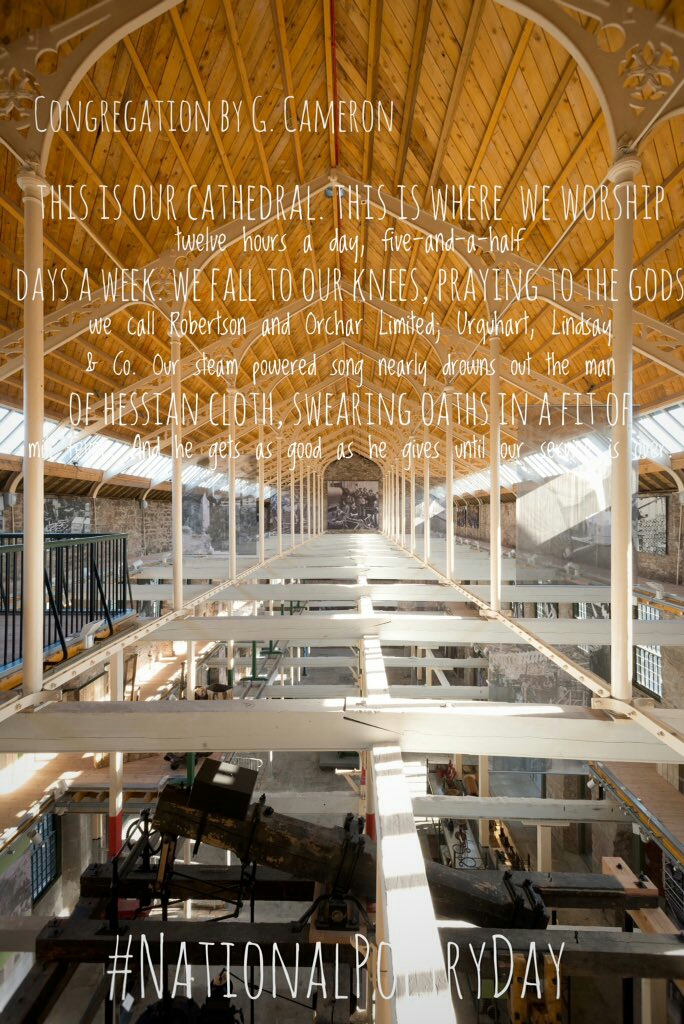
A couple of years ago, I was invited to pen a poem inspired by the former jute mill Verdant Works. I wrote the piece in situ. I later edited it, gave it the title Congregation, and sent it to the mill’s current owners to use as they wished.

Many months afterwards, the poem was published online for National Poetry Day. My original line breaks had been removed, however, so the piece was laid out more like prose. The image is below; the partially obscured words in the bottom line are mill fever and service is over.

I decided I liked this format better than the original.

Fast forward to the present day, and the question of typographical layout has occupied me again. Generally, I steer clear of contests with an entry fee, but I make the occasional exception, this time for the NYC Midnight Short Story Competition.

There are three rounds. At the starting whistle, every entrant is assigned a genre, a character, and a situation. In my case: a comedy about an art teacher and a mid-life crisis. We’re then given eight days to construct a story around these elements, and the winner progresses to the next round.

I struggled to start a story with my elements as they failed to inspire me. So I began to write down some thoughts as poetry, but using paragraph breaks rather than line breaks. I’ve also limited the number of rhymes that appear.

The final piece treads a line between prose and poetry that I would like the judges to pick up on. The other notable feature is that it runs to only 131 words, although there’s no minimum specified in the rules, only the maximum of 2,500.

Moreover, I’m happy with the result, especially since I now have something out of virtually nothing. If it’s enough to make it into the second round, all the better.

Publish and Be Careful

As I’ve no urgent writing projects on the go right now, I’ve turned my attention back to submitting work to publishers. There are never any guarantees in publishing, but I have a few tips to help ensure the process is as painless as possible.

Keep a close eye on what you submit and when

I maintain a spreadsheet with the following columns: Publisher, Submission guidelines, Closes, Date entered, Decision notified, Title(s) entered, Entry method, Overall submission count (target 52 per year).

Most short story and poetry publishers insist that you don’t submit a given piece to any other place until they’ve accepted or rejected it. If a piece is rejected, I use the strikethrough font effect so I know it can be sent elsewhere; if accepted, it’s noted on a separate spreadsheet. Note that agents looking for novelists usually don’t mind if you send to several places at once.

Be early

Right now, we’re heading into the Christmas and New Year period. Publishing lead times can be so lengthy that it’s far too late to submit festive pieces, as editors will now be planning for Easter or even summer. Yet there’s also an opportunity here: if you’re inspired to write a piece this December, there’s plenty of time to refine it and submit it in summer next year for next December.

Unless instructed otherwise, use a standard manuscript format

On his website, writer William Shunn offers a range of templates that contain all the information publisher needs, such as your contact details and pen name. Occasionally, you might be asked to use a certain font or a different layout. In those instances, always read the instructions carefully and follow them precisely.

A printing press in Kabul, Afghanistan
A printing press in Kabul, Afghanistan (Photo credit: Wikipedia)

Be selective about entering competitions

This is perhaps a contentious point, but it’s a purely personal point of view.

When you send work to a publisher, there is almost never a charge. For a competition, there’s almost always a fee, and it can be up to £5 or sometimes more. Assuming an average fee of £3, entering even one competition a week can cost more than £150 per year. Aside from the financial aspect, I’ve had experiences where competition rules have been badly phrased or even self-contradictory, leaving me unsure how to enter.

That said, there are a few competitions I make a point of entering because they’re so prestigious or because the potential payoff would be worth it, which brings me to my final point.

Look at the reward offered

It’s a fact of a writer’s life that some publishers want your work without payment or other reward, usually with the well-worn line that they can offer exposure. If you do simply wish to make your name known, then by all means enter your work, but be clear about this from the beginning. I generally take no payment only when it’s for someone I know personally, or if it’s for charity.

Otherwise, the least I’d expect is a contributor’s copy of the finished book and/or a cash fee, however nominal. It takes a lot of effort and a lot of time to create a publishable piece, so never be afraid to charge for your work.

Paper View

Last week, a friend was complaining about a major writing competition that still only allows postal entries. I’d also submitted work because it’s a prestigious publication, but I agree with her point of view. Considering the hundreds of manuscripts that must be received – versus the tiny portion that makes the final cut – this seems a colossal waste of paper, not to mention the needless postage time and cost.

Many competitions offer the postal route as an alternative to an online submission, and there’s nothing wrong with that. Nor is there any issue with posting work that must be physically held to be appreciated. But there are still a bunch who want normal prose and poetry to be sent on paper.

English: A stack of copy paper.
English: A stack of copy paper. (Photo credit: Wikipedia)

Until the 1990s, this was how submissions were made. Internet access and e-mail accounts were generally the domain of academics and computer enthusiasts. Come the next decade, however, and newer technology began to creep into people’s homes. Nearly 17 years after the millennium, online access is nearly universal in the Western world, and postal submissions now look incredibly outdated.

That’s not to say I don’t like a paper book. In fact, some recent research has concluded that sales of e-books are falling. But a book is the final product; the process of gaining the interest of an editor or a competition judge ought to be as quick and cheap as possible.

Yet I would like to understand the other side of the argument. Do you run a publication that only wants submissions on paper? How does it benefit you? What would make you consider accepting online entries?


Keeping on Track

It’s great having a polished story or poem ready to be sent to a publisher or entered into a competition, but then comes the difficult part: waiting for a response. Often it takes months, sometimes it takes weeks, and a select bunch answer in a few days. This is unavoidable.

But here’s what separates a beginner from a seasoned pro: the former often sits and waits for a response, while the latter almost always uses the time to work on another piece. It’s desirable to build up a portfolio because many publishers, and almost all competitions, say you can’t send the same piece to two or more different places simultaneously.

Novel submissions are different in this respect. Most agents recognise that a book is an all-consuming work, and that it could be sent to a number of other places. It’s good practice to inform the other agents if one takes it on.

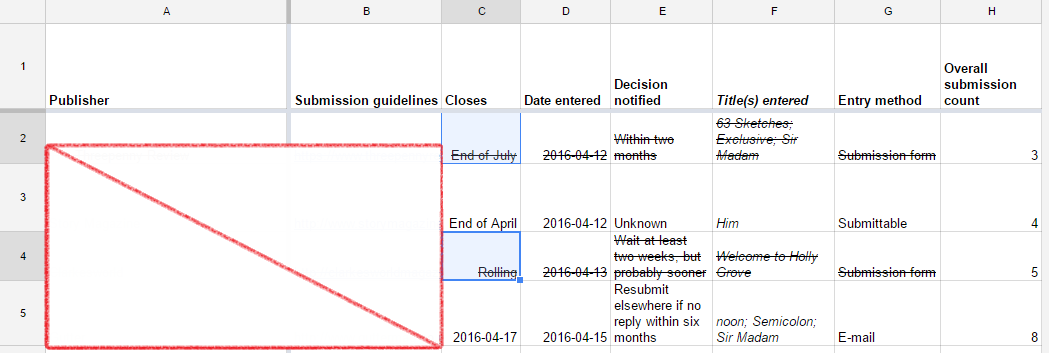
Whichever situation you’re in, it’s important to keep track of what you’ve submitted to where. It might be a simple as keeping a list if you’ve only a few pieces, but I have dozens in different places, so I use a spreadsheet to record the details:

Submissions tracker

I’ve edited out the names of the publishers and the links to their submission guidelines as I might want to resubmit in the future. The last column keeps track of how many pieces I’ve sent out during the year. My target is at least one piece per week on average; I have a poet friend whose target is an average of at least one piece per day. Otherwise, the tracker is self-explanatory.


It’s also important to keep track of what you’ve had published. These appear on another spreadsheet, and I keep the manuscripts in their own directory.

In many cases, the rights revert back to the author after a period of around six months to a year, so the same piece could potentially be sent to another publisher further down the line. If you’re unsure, ask the editor.

The milestones of a masterpiece.

When you’re in the middle of writing a novel or compiling a poetry collection or some other big project, it can be easy to forget the end goal. One way to maintain your momentum is to remind yourself what will or might happen when it’s completed.

Try creating something that represents your aim, like a mock cover for the finished volume. Or find a trophy, even if it’s made of cheap plastic, and label it something like [Your name] – Forward Prize – 2017. Or even write the speech you plan to give at your first launch.

Now leave the artefact in a place you’ll see it every day, and that’ll remind you what you’re working toward. It’s not simply words on a page, but something people will buy and possibly admire.

Think how you’ll feel when it really does happen.

I’ve started so I’ll finish.

Normally, blog entries come to me easily. It might be prompted by a comment during the week, or be inspired by a particular problem I’m having.

This week, however, I’ve been struggling to complete an entry. I started on the topic of swearing, then about gaps in your writing CV, then about third-person biographies, but none of these topics were going anywhere. I might return to them in the future, but today’s entry is about finishing what you start.

I normally good at finishing stories and poems, but I have a few that have been untouched since the first draft. Most recently, I was asked to respond to an exhibition at Dundee Contemporary Arts. I abandoned my original idea after four verses because it was much too wordy and I wanted to take the narrative in a different direction. Here are those four verses:

We saw the archipelago of masts
while sailing over Dogger Bank in gale
force six conditions. They displayed full sails
like pirate vessels of the ancient past.
They numbered in the twenties. We informed
our captain. She immediately warned

them of our presence with a blast,
instructed us to try the radio.
All frequencies, all wattages, yet no
response was heard. When 30 minutes passed,
she ordered that her ship should deviate
of-course toward the masts, though gale force eight

was forecast. Once we had a closer view,
we noticed something out of place. The decks
were underwater. So it seemed. We checked
again. Correct. All decks submerged, no crew,
no skeletons, no personal effects,
just masts with sails and ragged flags. Perplexed,

we asked the captain where to go. Perplexed,
she stopped us by the archipelago.
Again we tried to use the radio
as gale force eight turned into 10. The next
the next we knew, the bow was pointing in the air.
It knocked us to the deck.

This needs a lot of work done. There are a number of options to breathe new life into it: cut out unnecessary words and phrases, continue to add verses, rewrite it as prose, recycle elements of it into other works, and/or cut it into individual phrases and shuffle them about.

To make what became the response, I used some elements of this story, cut out a lot of detail and rendered it as prose. The final result mimicked the shipping forecast on Radio 4.

I’ve done something similar for older pieces. Around 2011, I wasn’t writing much poetry and I thought what I had was quite a good piece. Four years later, I revisited it while answering a writing prompt and it wasn’t as good as I remembered. I took the same idea but structured the verse differently and I’m now happy with it.

Some writers seem scared to finish pieces, as if they’ll think of a better word or structure as soon as it’s been submitted to a publisher. But if its publication you’re looking for, there comes a time when you need to let go of it. Remember there will be every opportunity to amend it if it’s rejected, and some publishers will allow – or insist upon – amendments if it’s accepted.

I’ve been asked before how I know when I’ve finished a piece. That’s not an easy one to answer, but the best measure I have is when I stop thinking about it day-to-day. That’s when I leave it alone for a while, then revisit it with fresh eyes later on.

It’s a good idea to finish what you start, at least to the best of your ability. If you see the perfect outlet for your piece, it’s much easier to tweak it than to have to add or remove significant portions. You might then be able to submit it comfortably before the deadline.

Bang for your buck.

I realised recently that I hadn’t sent off any work to publishers for rather a while, and now I’m beginning to make up for it.

When you submit short stories or poetry on a regular basis, you quickly realise there are two broad types of market.

  1. Directly to publishers. This is where an publishing house invites submissions of single poems or stories for an anthology, often on a set theme, and an editor decides what’s included. There are usually no charge to send in work and the author is often paid a flat fee or a rate per printed word.
  2. Competitions. This is where an organisation invites submissions, often on a set theme, and a judge or panel of judges decide who wins. There is often a charge to send in work, and the winner usually receives a cash prize along with publication.
English: Wil Wheaton at the 2011 Phoenix Comic...
English: Wil Wheaton at the 2011 Phoenix Comicon in Phoenix, Arizona. (Photo credit: Wikipedia)

At least that’s how it should work. However, I’ve been involved in more discussion of late about places that aren’t giving a fair deal to their contributors. This includes Star Trek actor Wil Wheaton, who was asked to write for the Huffington Post in return for ‘exposure’.

I’ve heard anecdotal evidence from a couple of poet friends that a popular magazine follows a similar ‘exposure’ model with the claim that they’re a small press and are unable to pay. At least one of these friends has been professionally published elsewhere and will no longer submit to this magazine.

I’ve also recently spotted an advert for a competition with a £10 entry fee or £11 if submitting online, and the prize is to read your work at their event. To me, there’s a lot wrong with this.

Firstly, the price difference is not explained; contributors appear to be penalised for not wasting paper. Secondly, it’s still around double what you would expect to pay to enter a competition. Thirdly, there’s not so much as a nominal cash prize offered, nor any mention of a contributor’s copy.

My advice is to be clear about your reason for sending your work to a particular place. Ask yourself whether the reward is proportionate to its quality and to the financial position of the publisher.

That principle still applies to charity or fundraising work. This year, for instance, I’ve been invited to perform at local landmarks to raise funds for the maintenance and restoration. As I know the organisers, I’m clear that I’m donating my time and work to these causes. One of them even offered me travel expenses, which I declined.

But don’t think everywhere is out to get you. Gutter magazine offers a two-year subscription rather than cash payment, which I consider to be fair, while feminist zine Artificial Womb is a tiny operation but makes a point of paying every contributor.

And a final piece of advice: Wil Wheaton wrote that the exchange he had with the editor wasn’t unpleasant, and that he didn’t blame her for company policy.

Echoing this, it’s always a good idea to be civil to editors no matter how the conversation ends. We’re used to reading about authors and other celebrities who act like divas, but if you develop a reputation for being difficult – especially at the start of your career – word will get around quickly and potentially close off avenues you hadn’t yet explored.

Can I Have a P Please, Bob?

Plagiarism

Hot on the heels of my copyright post the other week, a case of poetic plagiarism was brought to my attention. Remaining copies of Laventille have been pulped after Sheree Mack admitted to including others’ work in her own inadvertently, although fellow poets have accused her of stealing work deliberately.

In this instance, it’s not only the original poets who have been hurt by her actions, but the pulping will wipe out the profit margin that Smokestack Books would otherwise have made.

The one positive aspect we can salvage from this mess is that this type of plagiarism is relatively rare. If it happened every day, this story wouldn’t have been reported and nobody would have kicked up such a stink.

Postgraduates

I’m a firm believer that every writer ought to learn the skill of public performance. More on that story later. But last Wednesday marked the first time I would be performing to an audience of academics, rather than the general public or other writers.

The University of Dundee has run a Postgraduate Conference for the last four years where students set the agenda by presenting papers. Students were also free to respond creatively to this year’s theme, Lost in Translation. When I saw the final running order, I appeared to be the only person giving a creative response, and I seriously considered withdrawing as I didn’t feel it would fit in with the other presentations.

The upshot is that I did go ahead with it, although I was moved to a different slot with theatre students and a novelist. I felt it flowed more smoothly, and I received an excellent response, both verbally and on the anonymous feedback slips. My tutor was also sure to stop by and ask a couple of tough questions.

Performance

Shortly after the Postgraduate Conference, I went along to a workshop… on performance; unfortunately, it had to be in that order. Jenny Lindsay, one half of poetry duo Rally & Broad, was hosting, and they’re one of my favourite contemporary acts. She asked each of us why we were there. I told her I was quite comfortable with public speaking, but I felt there was always more to learn.

Blockbusters (UK game show)
Blockbusters (UK game show) (Photo credit: Wikipedia)

She took us through the process of preparing for an event, including how we might introduce ourselves, putting together a set list, and we even took turns at walking out in front of an audience. The organiser is hoping to put on another event in the near future but using an actual stage.

If you have the chance to hone this skill where you live, I recommend signing up. What many writers don’t realise is that if you’re snapped up by a publisher, you’ll be expected to read excerpts to a live audience. I’m not going to pretend it’s easy to stand up and entertain people, but the only way to make it easier is to keep practising, and prepare your materials thoroughly in advance. Remember, most audiences aren’t sitting waiting for you to slip up – they’re willing you on.

Promotion

Although National Novel Writing Month and its offshoot Camp NaNoWriMo are over, an enthusiastic band of us have continued to meet each week. The most recent meeting was yesterday, but we left after an hour to visit Waterstones where Kirsty Logan was promoting her novel The Gracekeepers.

I’d seen the posters across town, but I hadn’t heard much else about it until that evening. By the time I’d listened to the excerpt, learnt about the background of the world in which it’s set, and was told were some characters written as gender-neutral, I decided I wanted it. The issue of gender is something I become interested in since my feminist friends talk about from time to time.

And our group each spoke to Kirsty Logan for a couple of minutes each as she signed our books. I wish I’d thought to take a photo, as her dress contained pictures drawn in the same style as the book jacket. If I ever have a novel published, that’s a touch I’ll think about adopting, although I might settle for a shirt rather than a dress.