A Time for Writing

When I started this blog over a decade ago, the first dozen entries or so were posted at seemingly arbitrary intervals. It was an experimental venture that took a few months to settle into a regular cycle, initially every Monday at 5pm.

It made sense, considering my schedule at the time. I could write the blog over the weekend and then make any tweaks during the day on Monday. These are now posted around 8pm every Tuesday, which coincides with the end of my writing group, so I can use that time to make amendments.

The purpose of this schedule is to keep me producing at least one piece of prose per week. I don’t always manage a full entry, but I always post some text, even if it’s to explain I haven’t managed to write that full entry. Additionally, my Wyverns group membership encourages me to produce at least one piece of poetry every month.

I hear about too many writers – especially beginners – who feel they aren’t real writers unless they set aside a certain length of time every day. Of those, there is a sizeable subset who feel the well-known writing routine of Steven King is the One and Only True Way.

I find this frustrating to hear. One man’s method is not everyone’s method, and it shouldn’t be treated as such.

Some authors swear by keeping a notepad and pen by the bed, or writing in the morning, whereas neither of these work for me. There are a few who consider the activity seasonal, doing the bulk of their work in the summer or winter months.

There are also environmental factors. Bizarrely, one of my favourite places to write used to be in a certain branch of McDonald’s, and I can’t explain why. Maybe I should go back there and see whether it still works.

Once you experiment with your times and figure out what schedule works for you personally, the process will probably become easier.

When the Pastiche Becomes the Product

In 2017, I went to see The Square at the cinema, knowing it was meant to be a postmodern send-up of the contemporary arts scene. However, with the disjointed narrative, I came away with the distinct view that the film embodied the very concept it claimed to parody.

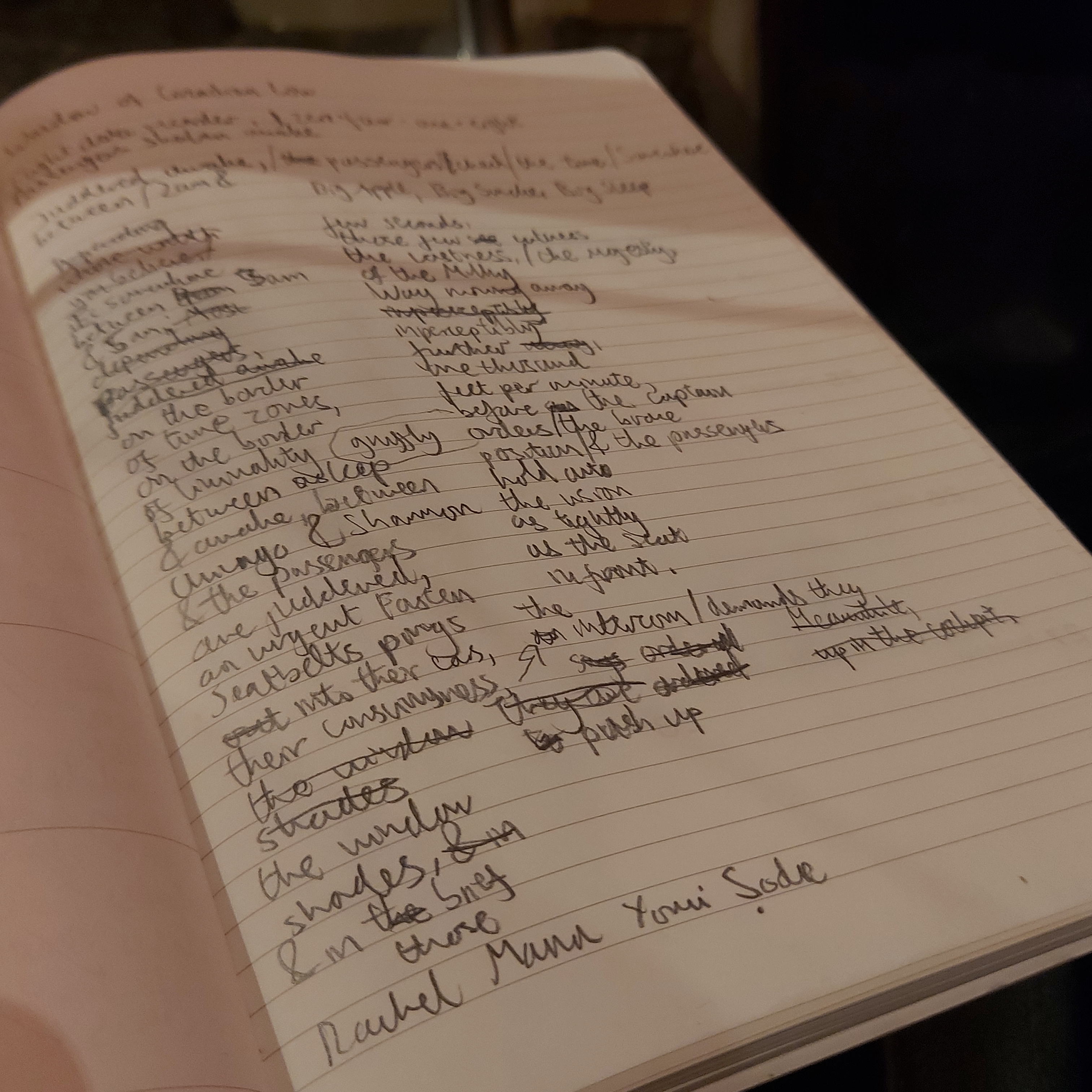
I’ve recently been thinking about this idea, but through a different medium. For my poetry circle, I wrote a verse intended as a pastiche of those ‘literary’ poets who often appear from nowhere and are showered with critical acclaim, frequently disappearing just as quickly.

The 19-line verse takes place on the third of January in an unspecified year. It’s from the point of view of two people who have moved to New York from Ireland and Scotland, and how the fantasy of living there has turned into reality. The last few lines were intended to be jarring, switching focus to an unrelated and overlooked secretary preparing to search for another job.

On submitting the poem, I asked the group members to consider the verse first and then to read the explanation. I wanted them to gauge whether – like The Square – the pastiche had become the product.

I think I’ve got away with it. Although there was constructive criticism of some parts, the consensus was that the abrupt change of focus didn’t come across as jarring as I’d intended, with one member saying it was a fitting ending to the piece.

I’m happy with the results of this most unscientific experiment, so I’m not inclined to repeat it for the moment. If I did have the chance to be one of those ‘literary’ one-hit wonders I talked about, though, I’d be inclined to grab it, however fleeting it proved to be.

No Fun ‘Til February

I really like January. It carries none of the bustle and hassle of December, but instead has a fresh feeling, as though the cellophane has just been removed from the new year.

There is a trade-off here, though. The relative stillness of the month means that nothing particularly literary is happening right now. We need to wait until March for both the St Andrews poetry festival – or StAnza – and the Scottish Poetry Slam Championship in Glasgow. Many other literary fairs and gatherings don’t happen until summer. Even the Scottish Book Trust has given participants until the end of this month to enter their December 50-word story competition.

Outside of the literary scene, I would normally take part in Fun a Day Dundee. This is aimed at artists rather than writers, but it’s to help them through the slump of January. I usually find a way to incorporate text. However, that event isn’t running in its usual form this year, although hopes are high for 2025.

The best I can do at the moment is to complete the books I borrowed for the readathon a couple of weeks ago and return them to the library.

Backing Dvorak

If you look at the keyboard settings in your operating system, you’ll often spot several different layouts that the computer can understand. For instance: a French keyboard has its letters in a slightly different order, while a Russian one uses a completely different alphabet. Among them, you might see one marked ‘Dvorak’.

Despite its Czech name, the layout was invented by an American educational psychologist for use in typewriters. It’s well-known that the QWERTY design was introduced to slow down typists and avoid jamming the mechanisms, but by the 1930s, machines had improved to the point where fast typing wasn’t a problem. That’s where August Dvorak came in.

About a year or two after I began writing fiction, I began to develop Repetitive Strain Injury in my fingers, so I wanted to explore other options such as writing by hand, voice dictation, and a different keyboard.

With the vowels and most common consonants on the middle row, and the least often used on the bottom row, your fingers don’t need to travel so much. This is also the principle on which Scrabble letters are scored, but that’s a topic for a different time.

Dvorak does have downfalls. When I started using the system, I needed labels on the keys as reminders, graduating to a custom-built external keyboard, before I was able to rely on muscle memory. I also can’t change the keyboard on my workplace computer so I need to switch mentally between that and QWERTY.

Additionally, I mentioned how the layout was designed by an American, so a few of the keys don’t operate as expected, especially the pound sterling symbol.

To circumvent this, I use a program called AutoHotkey. On start-up, it loads a script that maps keypresses to other keys or to a subroutine. So if I press Ctrl+3, Windows can display the missing ‘£’ symbol rather than the ‘#’ produced by Shift+3. I have a few similar shortcuts for these special cases, although I still rely heavily on memory.

On balance, using the Dvorak keyboard has been a help more than a hindrance, and I’ll probably be using it well into the future.

Until the Last Moment

I’m a member of a monthly poetry circle called the Wyverns. We each typically write a piece ahead of the next meeting to be read aloud and discussed. There is always a broad prompt to assist with choosing a subject.

In most cases, I submit my work relatively quickly, but I’d let it go in October because I thought the focus of the November meeting was entirely given over to discussing an upcoming pamphlet project. Around 48 hours before the meeting, it transpired that I’d misunderstood what was said. We were discussing the project, but there would also be time for poetry.

It was time to knuckle down. The prompt was ‘Being Human’, which coincided with the theme of the aforementioned pamphlet and is also why I misunderstood the brief. By coincidence, I’ve been learning a lot recently about the disgraced Sam Bankman-Fried, so I wasn’t short of material.

Much of the online communication in the group is done using an email discussion list, so I posted my ten-line verse there as soon as I was satisfied with the wording. I also printed off several paper copies for those who might not have checked their emails.

As a result, I was able to gather feedback on it, which was more favourable than some pieces where I’d spent days thinking about the wording. Perhaps there’s a lesson to be learned there.

If you’re local to Dundee, incidentally, you can come and hear poems from the pamphlet being performed tomorrow at the Global Room in the University of Dundee.

Writing Just Enough

As writers, I think we’ve all had the experience of starting a poem or a story with a great idea, but it fails because there simply isn’t enough material to sustain a complete story.

I remember one instance when I was invited to write a poem inspired by a botanic garden. I was particularly taken by a species of tree where the seed is sealed with a natural glue that can only be opened when it melts with heat. As such, in a natural environment, it requires a forest fire to reproduce. Despite writing many lines to this effect, I found only the first two and last two were strong candidates, so the end piece was much shorter than expected, but much punchier as well.

I’ve also experienced the opposite effect at least once. I set out to write a little joke for my online pals about how YouTube videos used to be sent out to customers by post. The fictional history of the company became so detailed that I eventually turned it into a 2,000-word short story.

The same unpredictability also happens in non-fiction. The Wikipedia page for Kirkton, Dundee is relatively short because it’s mainly a residential area, albeit with four schools and excellent transport links. On the other hand, the riot that erupted there at Hallowe’en in 2022 is given a separate page that’s around twice as long as the main article, simply because there is so much to be written about the incident.

Having written this blog for a decade now, I can generally predict how long my entries will be. Something else will occasionally occur to me while writing that extends their length. Every so often, I’ll run out of steam, leaving me with a draft entry that goes nowhere.

As these drafts are beginning to build up again, I’m going to see whether I can revisit them and add enough to create a fully-fledged topic.

Inform the Troops There Has Been a Complete Breakdown in Communications

Because of other commitments, I sometimes don’t write my blog entries until the last few hours. Most of the time this isn’t problem; I usually have at least one idea ready to go.

Today, however, the Internet connection isn’t co-operating. As such, I’m going to write this short entry and keep trying the Schedule button until 8pm.

Rewriting the Handbook

As mentioned in the last entry, our open-mic night for writers – Hotchpotch – held its first event in four months.

The bottom line is that the evening went well: we attracted a sizeable crowd, the event ran on schedule, and people embraced the new donations system. While there were a lot of variables outside our control, it helped to have a robust plan to remove as much guesswork as possible.

When I brought an assistant on board earlier this year, I composed a document to show her the structure of our events, as I’d previously done it from memory.

This is not an exhaustive textbook, but rather a handbook to give an overview of how the event is run, plus best practice gained from years of experience. For example, it reminds the host to recap the introductory speech after the first break for the benefit of those who arrive later.

Because our format evolved on the pub circuit, where we could finish later in the evening. I rewrote the handbook to include a stricter end time and added in revised best practice advice.

As the handbook is a living document, it will likely be updated every month or two with new tweaks, but it really did help with our event last week.

Fragments of a Whole

If you’re a fan of the 1996 film Trainspotting, you’ll be familiar with the opening Choose Life voiceover.

Here, the phrase is repeatedly used to describe aspirations such as owning a large television and having fixed-rate mortgage repayments. It almost tells a story, but not one with a linear narrative. We as listeners have to mentally join the dots.

Later on, the film also features the dance track Born Slippy .NUXX by Underworld, and that takes a similar approach. In an interview from 2010, the lyricist Karl Hyde reported struggling with alcoholism while recording the vocals, so they were presented almost as snapshots rather than a complete image.

I’ve recently been experimenting with similar stream-of-consciousness work. A few months ago, on the way home from an event, I thought up a couple of lines of poetry that I quickly noted down. Over the following month, I added and added to it, one fragment at a time, creating a non-linear piece that straddles the line between prose and poetry.

When I’m performing it, I would normally omit any explanation, instead allowing the audience to interpret it.

When I submitted the piece to my poetry circle, however, I included some further details to aid their analysis. I wasn’t deliberately emulating the style of the Beat Generation, who actively fought against convention in poetry, yet it ended up taking that path.

The difference between my piece and the examples from Trainspotting is that mine doesn’t have music behind it. The Choose Life segment likely wouldn’t work as well without Iggy Pop in the background, while Born Slippy .NUXX would be markedly different if spoken at an open-mic night.

In fact, as I was writing that, I considered I might try it. If I do, I’ll let you know what happens.

The Poetry of JavaScript

Despite our social media presence, a sizeable chunk of our Hotchpotch open-mic members still rely on our email bulletin. Almost exactly a year ago, I started the task of building up a new distribution list after the collapse of the old system. Here’s the story of what’s happened since.

After emailing everyone on the list individually, many people wanted to stay on it, a lot wished to stop receiving bulletins, and several never responded at all. The initial technical hiccups have long been ironed out and the number of subscribers almost doubled from 34 to 63 over the past 12 months.

The old list was not compliant with GDPR regulations, so it was important to ensure the new one was up to scratch, and that includes the ability to unsubscribe at any time. The easiest way is to have a public Web page with this functionality.

As we now had a basic website, there was an opportunity to publish more information there, such as our meeting times and standards of behaviour.

When I started this endeavour, I would copy open-source templates and simply strip out any unnecessary sections. One principle I like to follow is what YouTube creator Tom Scott calls the art of the bodge: cobbling together just enough code to do what you need it to, making refinements as you go along.

After a while of doing this, I slowly began to refresh and update my knowledge of HTML. Alongside that, I learned when and how to deploy CSS and JavaScript. The last time I dabbled in coding was many years ago before such elements were commonplace.

Perhaps I’ve been influenced by writing verse for so many years, but I can see a correlation between writing poetry and writing computer code. Every word has to be precisely the right one, each section is demarcated by curly brackets into its own ‘stanza’, and a detail as small as an incorrect line break can change how it’s interpreted.

But unless something in this current system breaks and has to be recoded, I”m leaving it alone, however poetic it reads.