Some time ago, On the advice of Writing Magazine, I joined the Authors’ Licensing and Collecting Society (ALCS). If you’ve ever had an article, script or book published, or if you’ve made a contribution to a book, this not-for-profit organisation collects and pays the secondary royalties. Two-thirds of the money is generated by photocopying, scanning and digital copying.
English: A small, much used Xerox photocopier in the library of GlenOak High School in Canton, Ohio, USA. (Photo credit: Wikipedia)
Lifetime membership of the ALCS costs a one-off fee of £36, but you don’t have to pay anything upfront as it’s deducted from your royalty payments. Likewise, you won’t pay anything if they don’t collect any money for you.
The payments are sent out twice a year, and the March one arrived last week. I was surprised to find I was in profit from the three works I’d registered up to that point.
I debated whether or not to reveal the actual figure. I’ve decided to do so on this occasion by way of encouraging others to register. After the £36 fee was deducted, I was left with £84.12. This isn’t a massive sum, but it’s money that would otherwise have been given to someone else or never have been paid. By contrast, The Purple Spotlights EP has only earned me a total of £7.10 from sales, most of that from the first month after release.
I therefore urge you to join the ALCS today and potentially start receiving those missing payments for your work.
In 2014, there was a referendum on whether Scotland should be an independent country, in which 55% of the voters wanted to remain part of the UK. Over the last week, the issue has again raised its head.
Image of Scotland in the UK (Photo credit: Wikipedia)
At almost every literary event I attended ahead of the poll, I found the issue raised again and again in prose and poetry. Some of what I heard was heavy-handed polemic, while others crafted nuanced satires of the situation.
Regardless of quality, though, it encouraged all sorts of people to express their views through the spoken word and to believe that others might be influenced by their writings.
In my experience, much of the creative work was pro-independence. Such was the mood in the country that the National Collective sprung up, bringing together different types of artist to campaign for a Yes vote under one umbrella.
So the prose and poetry that stems from a potential second referendum will likely be even more passionate: from Yes voters who’ve been granted a second chance and from No supporters who believe the question was settled in 2014.
And further to my last entry, the 18-to-22 age group was considered to be the most apathetic generation when I first attended university in 2002. Maybe it was because we had a Labour government back then; maybe it was because George W Bush hadn’t yet invaded Iraq.
Whatever the reason, the situation today couldn’t be more different. Some of the most active campaigners are those of college age, and I barely go a week without seeing a university literary event responding to current affairs.
At Christmas, BBC Four broadcast the last stand-up show by Bob Monkhouse before his death in 2003.
He was already one of my favourite comedians, but my respect for him increased as it became clear he liked to look to the next generation as well as his own. At one point, he made a complimentary reference to The League of Gentlemen. The invited audience at the gig included comics such as Mark Steel and Jon Culshaw, who were both breaking into television at the time.
Franciabigio’s Portrait of a Young Man writing (Photo credit: Wikipedia)
As I only began writing when I was nearly 27, I’ve frequently met others who are younger but had been expressing themselves that way since they could hold a pen. In 2016, I completed a Masters degree. I found most of my classmates were in their early to mid-20s, so up to ten years younger than me.
Yet the work they produced was often outstanding, even from those who hadn’t completed an ordinary English degree: some created elaborate fantasy worlds, others wrote short pieces with incredible punch. My favourite writer in the class would produce prose and poetry on themes such as feminism or family. These themes wouldn’t normally excite me, but she’d been writing for a long time and had personal experiences to draw upon. Shortly before we graduated, I told her how much I enjoyed her work.
Incidentally, the course leaders’ personal library was stocked with at least as many contemporary books as classics, partly because they were sent for the student magazine to review.
Last week, I was invited to operate the microphone for a group of 14- and 15-year-old writers as part of Dundee Women’s Festival. The girls – and one boy – read stories written by themselves and their friends. Despite their age, what struck me were the heavy topics they chose to cover: suicide, kidnap, the care system, and so forth. I do think many of the stories needed redrafting and editing, but each had potential and none of them shied away from speaking to the audience.
As some writers age, they declare that anything written after a certain year is rubbish, often without so much as looking at it. Conversely, I’m excited about the authors of the future. Of course it’s important to look back at the classics, but times change and I’m satisfied there are young folk out there ready to document that new world through their storytelling.
For a few years now, I’ve been going to the StAnza poetry festival in St Andrews. On Saturday, I was invited to compete in the Slam, hosted by Paula Varjack. Although I’d applied some time ago, I was only told that week I’d been granted a place.
There are a few simple rules:
The running order is drawn from a hat.
In round one, everyone is allowed to read a poem for up to two minutes. You’ll be stopped if you run over.
In round two, after the interval, the top four scorers from round one are given 2½ minutes each to read another poem.
The 2017 Slam Champion is crowned.
English: Textbox at the Casa Encendida (2008) – Textbox is a performance space for spoken word poetry and literature. (Photo credit: Wikipedia)
The first poem was always going to be Crossing the Road, published last year; it’s punchy and takes less than a minute to perform. The strength of this Slam is that there’s no ‘house style’, so the contenders spoke on subjects as diverse as ageing, love, insomnia and contemporary politics. Just about everyone put in a sterling performance, including the other first-timers, and I thought I made a good job of mine.
The exact number of points given by the judges were not revealed, but five people progressed to round 2 because two contenders had scored exactly the same, none of which where me. The ultimate victor was Kevin Mclean, who goes on to compete in the Scottish Slam.
I’m not disheartened by my placing. I’m accustomed to performing in front of large audiences, but not with a competitive element. So what I want to do now is sharpen my skills even more by studying what other poets do and how they appeal to the audience.
Elsewhere at the festival, I witnessed excellent performances from Jackie Kay and Sarah Howe, and I chatted to the latter for a while. I also bought Paula Varjack’s book, and filmed performances from poets inspired by looking around St Andrews.
A few weeks ago, I started a subscription to Grammarly. As I sometimes churn out my writing work quickly, especially blog posts, it’s a useful tool to pick up any spelling or grammar errors that creep in.
There’s already a proprietary checker in Microsoft Word, and it’s possible to download browser extensions that perform a similar function. But Grammarly software is consistent in Word, in your browser, and anywhere else you type on your computer. It doesn’t, however, seem to be available for mobile devices.
Every week, I’m sent a summary of how well or badly I’ve performed in my spelling and grammar. Here are selected stats from 06 February to 12 February.
You wrote more words than 96% of Grammarly users did.
You were more accurate than 82% of Grammarly users.
You have a larger vocabulary than 97% of Grammarly users.
So far, I feel like a latter-day Shakespeare. However, it’s not all happy news:
Top 3 grammar mistakes
1. Missing comma in compound sentence: 44 mistakes.
2. Incorrect use of comma: 15 mistakes
3. Missing comma(s) with interrupter: 10 mistakes
Grammarly and I can’t seem to come to an agreement on this issue.
Sometimes it allows the use of the Oxford comma in a list, but sometimes I’m told to take it out. Similarly, I’m often shouted at for placing a comma before and in a sentence, but it’s occasionally required to stay in.
I’ve also discovered a problem with the verb form in the following sentence:
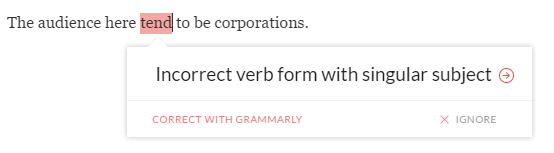
The audience here tends to be corporations.
I’m advised this isn’t correct:
So I duly drop the final letter to make the verb agree with the plural subject corporations. Then I’m told:
Now the verb form is incorrect because it doesn’t agree with the singular audience. And so we go around in a loop. There is a facility to add custom spellings or to ignore a suggestion, but no way to let the software learn your writing style or to flag up false positives.
Ultimately, the writer has to determine whether the words that are written, or the way in which they’re written, are suitable for the intended purpose. Grammarly is a tool that uses algorithms to apply the conventional rules of English; it’s not a textbook that must be followed precisely.
Exactly 12 months ago, I was given a chance to attend a masterclass at the Scottish Poetry Library in Edinburgh.
Performance poet Francesca Beard led the weekend class, with the aim of helping the participants form a full-length spoken-word show. Like many performers, she believes revealing part of your inner self on stage – or indeed on a page – makes for compelling work.
One year on, I’ve completed a few projects as a result of that fabulous weekend:
The Purple Spotlights EP
Before I had enough material for a full-length show, I did have enough poetry for a four-track EP.
I chose three existing pieces around the theme of friendship. Additionally, I wrote Seven Months especially for the release, which takes more than five minutes to perform. In print, that would be too long for most magazines, but ideal for audio.
The recording process taught me a little about performance and a lot about packaging my work for an audience who aren’t in front of me.
The EP was released in April 2016 and is available on Amazon, iTunes and Spotify, plus many other outlets.
Scottish Poetry Library, Crichton’s Close, Canongate, Edinburgh Designed by Malcolm Fraser Architects, frequented by many excellent writers. (Photo credit: Wikipedia)
Crossing the Road
On the second day of the masterclass, Beard asked us to identify the subject or theme we were scared to write about. Then she asked us to write about it, and I did. We all did.
This gave me the confidence to interest the publisher in a previously-written work called Crossing the Road that deals directly with my bisexuality. It was then included in the Aiblins: New Scottish Political Poetry anthology; the first publication I approached. I was pleased to be invited back to Edinburgh, then to Aberdeen, for the launches.
I felt this poem would have more impact if it weren’t read from a sheet of paper, so I committed it to memory. From that point on, I’ve tried to do the same with all my performed work.
Sir Madam
Over the weekend, I became acquainted with the other participants, and I remain friends with most of them. One introduced me to the intense and angry work of Andrea Gibson and, by coincidence, I happened upon the Kate Tempest poem The Woman the Boy Became.
These influences helped me to shape an idea I’d had for years, but hadn’t been able to commit to paper. Sir Madam is a character who identifies as somewhere between male and female. Owing to the subject matter, I was particularly nervous about performing it. However, I received several positive comments afterwards, some from quarters I hadn’t expected.
Jennifer Goldman’s Electric Scream
The main aim of the workshop was to form a full-length spoken-word show. I’ve used some of the techniques taught to write a series of monologues that I’m seeking to turn into a one-hour play.
That isn’t finished yet, but it might not exist at all if it hadn’t been for that weekend with Francesca Beard.
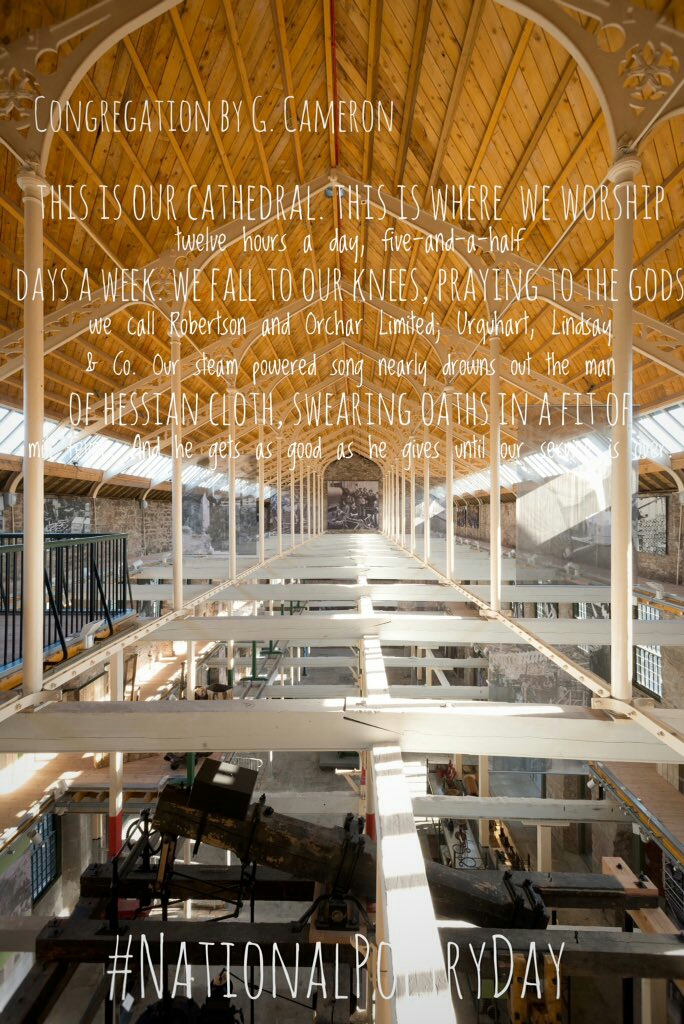
A couple of years ago, I was invited to pen a poem inspired by the former jute mill Verdant Works. I wrote the piece in situ. I later edited it, gave it the title Congregation, and sent it to the mill’s current owners to use as they wished.
Many months afterwards, the poem was published online for National Poetry Day. My original line breaks had been removed, however, so the piece was laid out more like prose. The image is below; the partially obscured words in the bottom line are mill fever and service is over.
I decided I liked this format better than the original.
Fast forward to the present day, and the question of typographical layout has occupied me again. Generally, I steer clear of contests with an entry fee, but I make the occasional exception, this time for the NYC Midnight Short Story Competition.
There are three rounds. At the starting whistle, every entrant is assigned a genre, a character, and a situation. In my case: a comedy about an art teacher and a mid-life crisis. We’re then given eight days to construct a story around these elements, and the winner progresses to the next round.
I struggled to start a story with my elements as they failed to inspire me. So I began to write down some thoughts as poetry, but using paragraph breaks rather than line breaks. I’ve also limited the number of rhymes that appear.
The final piece treads a line between prose and poetry that I would like the judges to pick up on. The other notable feature is that it runs to only 131 words, although there’s no minimum specified in the rules, only the maximum of 2,500.
Moreover, I’m happy with the result, especially since I now have something out of virtually nothing. If it’s enough to make it into the second round, all the better.
I think all writers have pieces that, for some reason, don’t have maximum impact or aren’t coming together in the way we want. In this entry, I have some suggestions for these pieces based on my own experience.
In 2013, I was given homework from a writing group to pen a story inspired by lines from a poem. As it wasn’t coming together, I spent the afternoon in the library writing until it made some sort of sense. I eventually created a flash fiction piece that became my first published story.
A couple of years later, I was working on a poem for performance at an upcoming gig. When it wouldn’t come out in a way I liked, I went for a walk in the cold. By the time I returned home, all the elements began to settle into a list poem. The finished product gained a positive reaction on its début, and has done on each reading since.
Broken mirror (Photo credit: Wikipedia)
Which brings me to my most recent difficulty. This was another list poem, in response to a friend’s work, that wouldn’t flow no matter the order in which the lines were arranged. I ended up writing each line on a separate slip of paper and drawing them out of a bag like raffle tickets. That method helped to identify which lines felt out of place and could be removed, then the remaining fragments naturally joined together.
The most recent poem hasn’t been heard by an audience yet, as I think it needs to be left aside for a while. I’ll revisit the piece in the future with fresh eyes and decide whether I still like it as it stands. And time is one of the best ways to fix non-urgent work.
In 2014, I came home from the aftorementioned writing group having been unable to think of a story from the prompts given. I was so annoyed with myself that I typed up my frustrations in short sentences with plenty of negative space between the paragraphs, then closed the document. Thinking it would be embarrassing, as it was never intended to be seen by others, I didn’t reopen the file until earlier this year.
I was jolly surprised to find that it might actually work as a poem, and I’m also more inclined to figuratively bleed onto the page than I was two years ago. So it might yet be seen before an audience.
As I’ve no urgent writing projects on the go right now, I’ve turned my attention back to submitting work to publishers. There are never any guarantees in publishing, but I have a few tips to help ensure the process is as painless as possible.
Keep a close eye on what you submit and when
I maintain a spreadsheet with the following columns: Publisher, Submission guidelines, Closes, Date entered, Decision notified, Title(s) entered, Entry method, Overall submission count (target 52 per year).
Most short story and poetry publishers insist that you don’t submit a given piece to any other place until they’ve accepted or rejected it. If a piece is rejected, I use the strikethrough font effect so I know it can be sent elsewhere; if accepted, it’s noted on a separate spreadsheet. Note that agents looking for novelists usually don’t mind if you send to several places at once.
Be early
Right now, we’re heading into the Christmas and New Year period. Publishing lead times can be so lengthy that it’s far too late to submit festive pieces, as editors will now be planning for Easter or even summer. Yet there’s also an opportunity here: if you’re inspired to write a piece this December, there’s plenty of time to refine it and submit it in summer next year for next December.
Unless instructed otherwise, use a standard manuscript format
On his website, writer William Shunn offers a range of templates that contain all the information publisher needs, such as your contact details and pen name. Occasionally, you might be asked to use a certain font or a different layout. In those instances, always read the instructions carefully and follow them precisely.
A printing press in Kabul, Afghanistan (Photo credit: Wikipedia)
Be selective about entering competitions
This is perhaps a contentious point, but it’s a purely personal point of view.
When you send work to a publisher, there is almost never a charge. For a competition, there’s almost always a fee, and it can be up to £5 or sometimes more. Assuming an average fee of £3, entering even one competition a week can cost more than £150 per year. Aside from the financial aspect, I’ve had experiences where competition rules have been badly phrased or even self-contradictory, leaving me unsure how to enter.
That said, there are a few competitions I make a point of entering because they’re so prestigious or because the potential payoff would be worth it, which brings me to my final point.
Look at the reward offered
It’s a fact of a writer’s life that some publishers want your work without payment or other reward, usually with the well-worn line that they can offer exposure. If you do simply wish to make your name known, then by all means enter your work, but be clear about this from the beginning. I generally take no payment only when it’s for someone I know personally, or if it’s for charity.
Otherwise, the least I’d expect is a contributor’s copy of the finished book and/or a cash fee, however nominal. It takes a lot of effort and a lot of time to create a publishable piece, so never be afraid to charge for your work.
National Novel Writing Month ends this week, thus potentially freeing me up to make longer blog entries.
However, I woke up to the news yesterday morning that our main meeting venue – a Wetherspoon’s pub – closed permanently on Saturday night. As such, we’ll need to find a new place; this is a problem I’ve encountered before, and I’m sure it’ll work out for the best.
For the moment, I’ll leave you with a poem I wrote on the day that Donald Trump was elected. It’s called Hell’s Marksmen.
Our satire
can fire
more shells
than Hell’s
marksmen.
And when
deployed
sweetly,
can vanquish
completely.





 Gavin Cameron