A Surprisingly Unpopular Event

I received a message from someone local who’s currently working on a community-focused project that launches this weekend. It’s aimed at encouraging people to think more about the clothes they have, the memories they represent, and imagining what might happen when these items are passed on.

One of the proposed events was to bring in local poets to respond to the above themes, but as the organiser didn’t know many poets, she wanted to tap into my connections. I was happy to help out, and I spoke to two of my poetry groups.

After a week, I was surprised to receive virtually no response to my messages, especially as the clothing event was intended to take place in person. As an organiser, I’ve found that people react to staged events more positively, as the public has become weary of so many virtual ones.

I explained this to the organiser but added that I would still like to contribute. My starting point was a T-shirt from 1996 that I still own, and the resulting piece became an exploration of when I met my first girlfriend at age 12, and how my approach to relationships has changed between then and now.

I don’t know whether I’ll actually be able to attend, as something more pressing has arisen, but I wish her all the best with the project.

When You Find the Words

I’m pernickety about keeping backups of my stories and poems, even if I ultimately don’t end up doing anything further with them. Each is given its own folder, and the different versions appear in date order. The oldest files go back more than a decade.

As such, I was most surprised that I couldn’t find a certain light verse I’d written in 2018. I tried searching by title: Too Chicken. I then tried searching by first line: I’m in love with the woman from Nando’s. I tried searching again with other words I recalled from the text, but no results appeared.

I thought I would have to reconstruct the piece from memory. I knew a reasonable chunk of the text, and it was written in a triolet form, so some lines would be repeated at predictable points.

The other day, however, I was looking at Snapchat. The app has a Timehop-style section where you can look back at pictures you sent in years gone by. I don’t often use that feature, but I’m glad I did, because I’d taken a picture of the original handwritten draft.

A lot of my pieces are first jotted down in pencil, and are then typed up and edited to create a second draft. That critter had somehow escaped the net, but it’s now safely on my computer and can be easily found.

The Energy of the Beginner

Having run events for so many years now, it’s always interesting to watch the folks who are new to writing.

Some have an idea, but don’t know how to start off. Others need constant reassurance that they’re doing a good job. There are even some who fill every spare moment with writing classes and courses.

It’s not only inevitable that everyone will go through this process, but it’s necessary. All the experimentation allows you to figure out your preferences and dislikes. From my own perspective, I figured out early on that I like sending my work to publishers but entering it into competitions. I then worked out that I like to pen monologues or plays rather than novels.

If you do have that kind of energy, my advice is to use it while you have it. Bluntly, once your motivation goes, it might never return.

Redrafting the Unredraftable

Exactly six years ago, I made the first draft of a poem called Sir Madam. The gender identity of the main character is undefined, and the narrative takes a condensed look at this person’s life, culminating in an incident that happens on a train.

This is the only one of my pieces I’ve been genuinely scared to perform, fearing I’d hit the wrong wording, tone or point of view. However, it’s become a piece that I’ve performed at slams and other gigs, and it does receive a positive reaction.

Until a few weeks ago, the text seemed set in stone, but the title started bothering me. Not only has terminology has moved on in the last six years, I now felt the character needed to be given a name, and that name is Shannon, so the title has also been revised.

I also took the opportunity to rearrange and redraft the rest of the text. Although I’ve been writing poetry for nearly a decade now, I still made a rookie mistake on Sunday when I started redrafting just before a gig, held online by Poets, Prattlers and Pandemonialists. I thought once I’d shuffled around a few lines, that would be it, but it still didn’t look how I wanted it.

As my turn rapidly approached, I decided to read out something else. Besides, the tone of Shannon might have brought down the light mood of the room. But I will return to the piece and I will redraft it to my liking once more.

Note to Self – Don’t Call This Entry ‘A Walk Down Memory Lane’

Yesterday, a pal had planned to come and visit me, but she had to call off through ill-health. I used the time instead to go for a long walk, which ended up being more than 11 miles.

I’ve always found walking to be useful for sorting out ideas, but when wandering around certain areas, I also remember fragments of what happened there. Sometimes it’s a conversation with a primary school teacher, or where I first heard a certain song, or a memory of what the place formally looked like. There’s even an area of town I associate with Moby-Dick because I regularly read it on the bus while travelling through.

As I talk about all these memories, it also strikes me that while they’re reasonably interesting snippets, few of them hold enough substance to be an anecdote in their own right.

That’s one of the key differences between nostalgia and memoir. Nostalgia can be as simple as a reminiscence about a happy time, whereas memoir typically tells a story.

One of my favourite memoirs is Toast by Nigel Slater, where each vignette is titled as the food he was eating or cooking at that period in his life. All the stories are strong enough to be self-contained while still sticking to the subject.

That’s not to say my wandering memories are completely useless. If I were in a writing class, and the prompt warranted it, I could pick one of these as a starting point for a poem or a fictional story, just not a biographical one.

How The Live Scene is Doing

This entry serves as a kind of companion piece to last week, where I talked about still being able to hold the open-mike night Hotchpotch.

It did indeed go ahead, but with substantially reduced attendance. On any other night, we can normally welcome upwards of 30 people in the room, with more than half of the attendees taking a turn on stage. But last week, we saw less than ten readers.

To be fair, a few of them had called off in advance because they were either away for Christmas or didn’t want to catch anything before seeing relatives, so we made the best of it. Dispensing with the timer, anyone who wanted to read was allowed two turns, with a drinks break in the middle. I’d encouraged the absentees to come instead to the virtual version that Sunday, called Hotchpotch Beyond.

But a smaller pub attendance didn’t translate to a larger online presence. There, we welcomed two genuine readers – one Scottish, another from Russia – while two troublemakers were booted out and reported to Zoom. In November, the Beyond event had to be abandoned altogether because only one other person turned up.

Yesterday morning, I made an executive decision to suspend Beyond, and I told the pub regulars before the wider membership. Nonetheless, our previous online presence has shown we’ve been able to reach an otherwise untapped market.

I can’t stress enough that it’s never the fault of the audience if they don’t turn up. It’s up to me as an organiser to attract attendees, and to show them a good time once they’re through the door, so it’s us who needs to adapt. It’s a much bigger question how we’re going to adapt to reach that otherwise untapped market, but it’s one that we’ll work on.

When The Muse Strikes

As I sit down to write, it feels like a continuation of the last entry, where I talked about inspiration appearing at 5am. This time, however, the inspiration happened near the end of the day.

I’ve been asked to provide a poem for a 12 Days of Gratitude project. As late as Saturday of last week, I’d absolutely run dry of ideas. There were plenty of people to thank, but nothing that fitted into a structure.

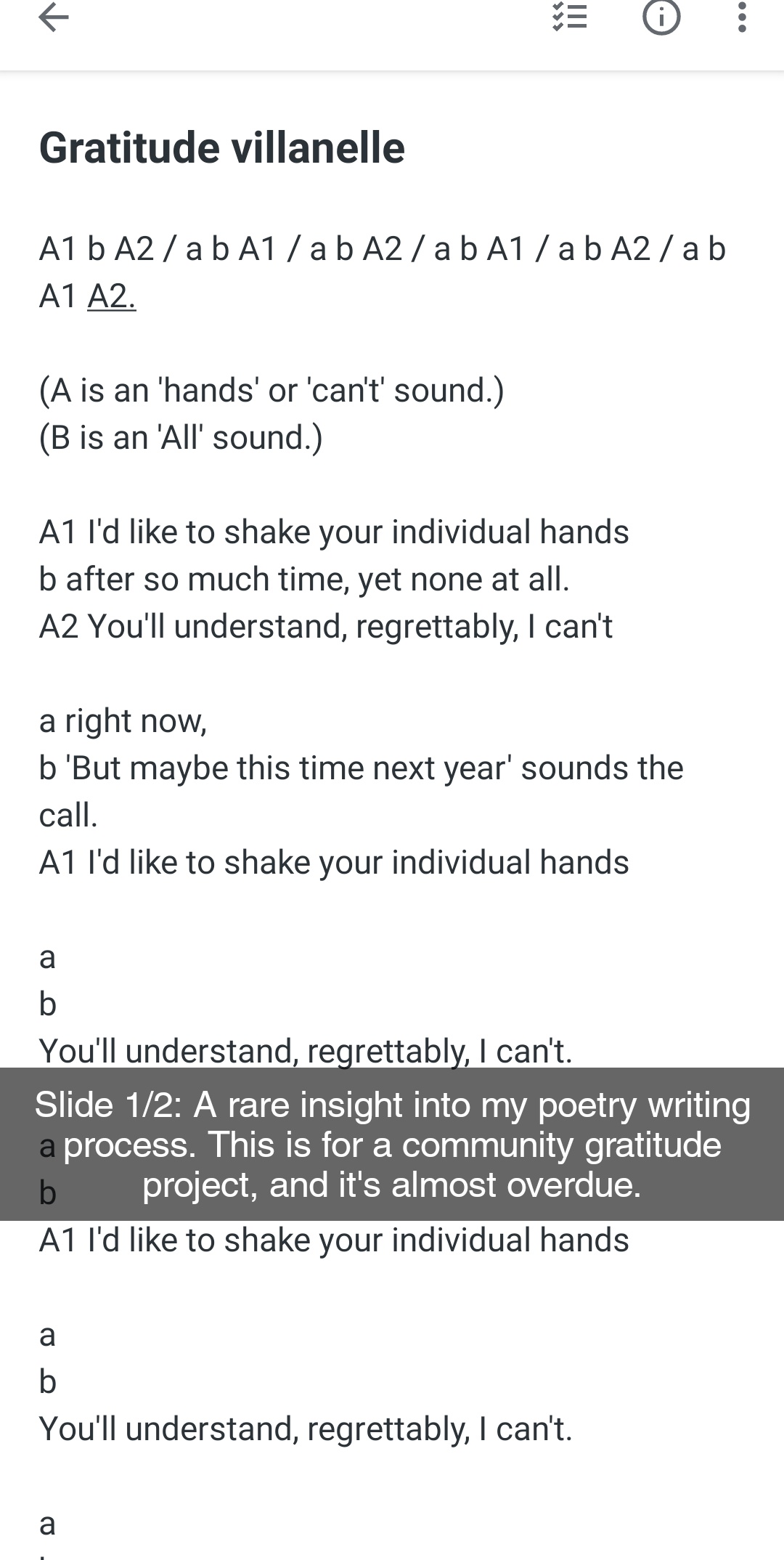
While I do find walking helps with the process, I wasn’t having much luck – and over an hour later, I thought of my first line and the structure. I even took a couple of pictures to document this. It’s rare that I would show such an incomplete draft so early, but it happened by surprise.

Half-completed villanelle about gratitude

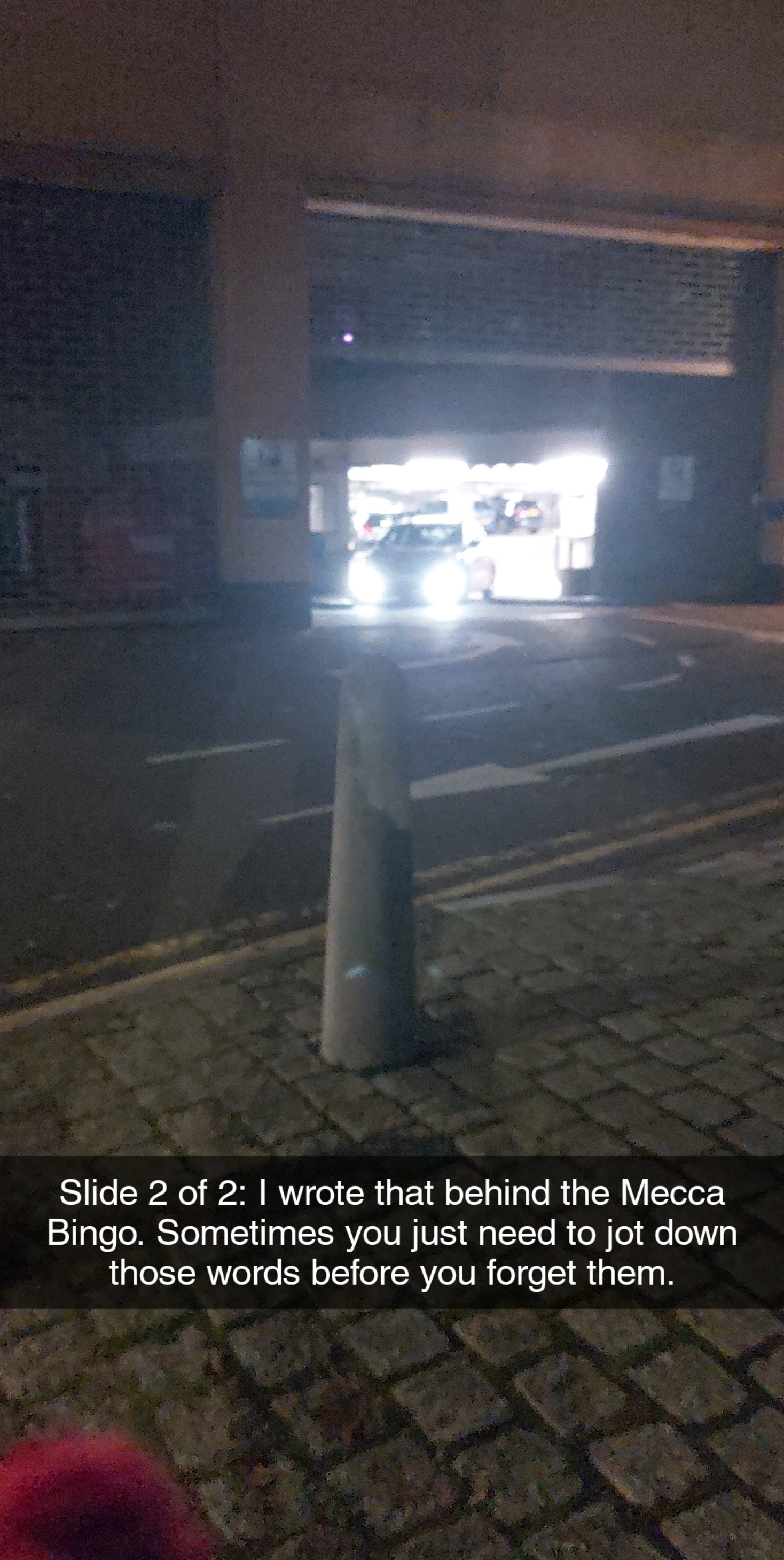
My walk had taken in river views and grassy areas, but when I wrote those lines, I was probably the least inspiring place I’d been that evening: behind the Mecca Bingo.

Picture of Mecca Bingo where villanelle was written

What I need to do now is finish the piece and make a recording of it, but arguably the hardest part is over, so the rest should be plain sailing.

The Evasive Verse

This week, I’ve been trying to write a piece for my poetry circle. Specifically, it had to be in some way related to the author Robert Duncan Milne, a forgotten contemporary of H G Wells.

As the reading for this has taken up so much of my time, I don’t have a full-length entry for this site.

However, I’ve often advised that going for a walk is a great way to sort out the ideas in your head, and that’s exactly what happened here. After days of reading, and trying to tie together a few of Milne’s concepts into a single verse, it was a lunchtime trip outside that gave me the final verse.

I’m about to read it over just now, maybe tweak it, and send them my work.

Not Raining, Just Pouring

It sometimes happens that a number of writing projects need to be completed at the same time, and that’s exactly what’s happened over the last week.

Some of these are self-imposed, like two job applications and writing a private blog entry for a closed group. But the others have been opportunities like supporting a funding application for an Edinburgh poetry organisation, and an invitation to write a public blog post for Creative Dundee.

This deluge has been a prime lesson in prioritising, some pieces due on sequential dates. I’m making headway, with only the Creative Dundee post still outstanding, but at the time of writing, I haven’t been given a definite submission date.

It does, however, pay to hit a deadline. Just yesterday, I heard I’ve had a piece selected to appear in Poetry Scotland and I can’t wait to see it in print.

Looking Ahead to Fun a Day

Every January, I take part in a project called Fun a Day Dundee that happens every January. There is no specific brief: you can write, draw, compose music, dance, or whatever your skillset us. The timing is designed to fill the void that artists often experience after the Christmas rush.

For the first time in a long time, we were able to meet up in person on Sunday. As I’d already arranged to do something else that day. I was only able to come along in the last 15 minutes, but it was great to see everyone again.

When I first started Fun a Day, my work was strictly writing, creating one new poem or story for each day of the month. One year consisted of writing a number of words each day that would combine to form a single sentence.

I’ve edged slowly into drawing, inspired by the other participants, and I’ve developed a style that includes recycled materials. Sometimes I use the recycled material in the work, other times I shred what I’ve created.

At the beginning of this year, I looked back at popular culture between 1998 and 2001, and writing was still an integral part of my projects. I kept a handwritten diary of my thoughts as I created each piece.

I don’t yet know what form this year’s project will take, but I know the title, and I know I’ll continue to log my thoughts in a notebook as it progresses.

Another t