The Abridged Pecha Kucha

A couple of weeks ago, I mentioned I was invited to give a talk in Pecha Kucha format at the Dundee Rep theatre. I chose the topic of my Millennium Bridges tours from 2023 and 2025. It’s worth looking back at that previous entry to find out about my preparations.

A few days beforehand, I was told the running order. I didn’t mind where I would be placed on the bill, but going second allowed me to relax for the rest of the event. The theatre was set up like a cinema, with a large screen at the back of the stage, plus two TV screens at the back of the auditorium for

I was initially sceptical about being able to commit the entire speech to memory in such a short space of time. Assuming an average of 50 words per slide for 20 slides, that multiplies to 1,000 words. Instead of learning the script word for word, I found the pictures became an aide memoire, giving me a general idea about the next part of the speech.

There are legitimate times to learn by rote – such as acting roles – but I felt this wasn’t one of those occasions. As such, the script was slightly different each time and that gave it a more natural flow. There was no rule against reading from a page, and some of my fellow speakers did just that.

I also warned the organisers in advance that I would be performing while wearing my jacket and bag, as if I’d just come in from the cold, and I wasn’t about to run away.

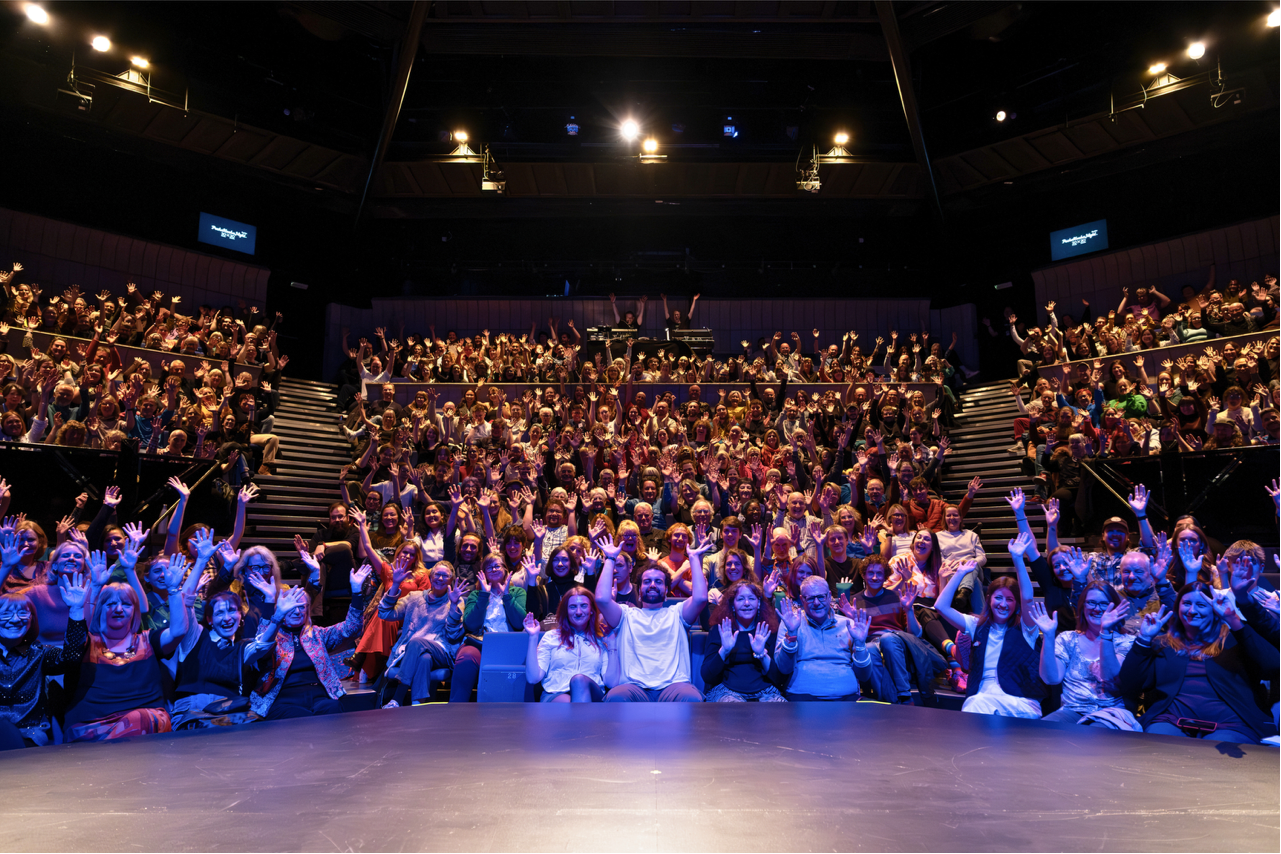
The event was filmed, but the footage isn’t yet available. In previous years, the organisers would usually stream it online, but that didn’t happen this time. For now, all I can offer is a still image of the audience:

Credit: Aylish Kelly

Topics covered by other speakers included: gardening, pub quizzes, an assortment of community and social engagement projects, and even an interpretative dance to cap off the evening.

Afterwards, a few members of the audience congratulated me on the talk. One man noted that I’d managed to time the end of my speech for exactly when the last slide left the screen. I thanked him but emphasised that it was a coincidence and I could easily have overshot the mark.

A long-term ambition is to help people find the confidence to speak in public, whether it’s for a social event like Pecha Kucha or convincing a boardroom of directors to fund a business project. Heck, maybe that could be my next talk. For the moment, I’ll drip-feed you one piece of advice for free:

Going on stage produces a rush of adrenaline, especially if you’re not used to it. Since it can take up to 30 minutes for this to deplete, and up to an hour for the effects to wear off, it’s best not to go straight to bed. Instead, I recommend spending that time winding down: take a walk, read a book, or listen to the radio.

Accepting One Invitation and Declining Another

I’m pleased to report I’ve been invited to take part in a Pecha Kucha event on Friday 7 November at the Dundee Rep Theatre.

These talks follow a rigid format. Speakers need to prepare 20 slides, which will be projected for exactly 20 seconds apiece, so the accompanying speech must match the time available. Less rigid is the choice of topic, which can be almost anything, provided it’s suitable for a family audience.

I’ll be talking about my trips around the Millennium Bridges in 2023 and 2025.

My challenge here was to take the complex story of the two trips and weave them into a story that the audience could easily follow. This meant indentifying suitably strong start and end points, while needing to eliminate a lot of detail along the way. If unconstrained, I could easily make the story into a half-hour speech.

I thought the accompanying pictures would be the easy part, since many of the were already taken. However, they all needed to be JPEG files converted to a specific resolution and dots-per-inch value. I’m not arty at all, so I relied on online tools with hit-and-miss results; one in particular kept converting pictures at random from JPEG to PNG.

The hard work won’t be over until the night of the presentation. While I have a good idea what my script says for each slide, I need to rehearse and make sure I hit all the relevant points.

But I can’t take every opportunity.

At the end of last week, an event organiser offered me a ten-minute slot to read poetry at his regular spoken-word event near the end of November.

I’ve wanted to go to this event for a long while, but it always clashes with my weekly writing group on a Tuesday. I was even inclined to write a new piece to fill the ten minutes.

Realistically, our own event has to take priority because our members expect us to be there. If my co-host or I know we can’t make a session, we try our best to cover or to make it an online-only event, depending on the type of interruption.

This time, it wasn’t possible to clear the day because of our other commitments. I reluctantly had to turn down his generous offer, with the caveat that I’d be happy to consider other days of the week.

Hotchpotch Moves to Groucho’s

Regular readers will know that I used to run a monthly open-mic event called Hotchpotch, which I handed over to my pal Eilidh in October 2024.

At the time, the event had been running at a café in Dundee until an upcoming permanent closure was suddenly announced in July 2025. The August event was able to go ahead, but she had to find somewhere to hold it in September.

Fortunately, it didn’t take long to find a suitable replacement: a live music venue called Groucho’s that was once a second-hard record shop. For context, Hotchpotch has probably moved ten times in 15 years for one reason or another.

Unlike a typical music gig, however, Hotchpotch has a particular set of requirements for accessibility. There are people constantly entering and leaving the stage area, plus the environment needs to be quiet enough for the audience to hear clearly. Often, you just need to try out the place to find out what fits and what needs improvement.

Aside from a fixable incompatibility with our microphone and the house PA system, the maiden event yesternight went marvellously and attracted some positive feedback. I took the opportunity to read a piece that was specifically written for the occasion.

Being back on the pub circuit feels like a homecoming in a way because that’s where the format evolved. A couple of members even returned after a few years away. The event also made me realise I’ve missed one aspect in particular.

Two venues ago, we were in the basement of a pub called the Hunter S Thompson. At the end of each event, I would pack up and go home soon afterwards because I was always working the following morning. It took me some time to realise members weren’t simply chatting and dispersing; they were instead heading upstairs and drinking together for an hour or two.

From then on, I encouraged folks to do that, as the more cash we could put through the tills, the more likely we were to secure our bookings for the future. I even joined them on occasion, but not every month.

When we moved to a café in 2023, we were given a 9pm curfew to allow the staff to finish at a reasonable time. But with Groucho’s open until at least 1am, I look forward to seeing the return of this particular element.

Reaching Fever Peach

On Saturday just gone, I was given the opportunity to perform a 15-minutes of poetry at the Keiller Centre in Dundee. This was organised by local comedy band Fever Peach as part of their Monthly Indulgence event and here’s how they announced the event.

That said, I only learned of the opportunity on Wednesday and I didn’t have a themed set ready to go. After looking through my collection, the structure came together quickly, with the verse generally moving from more serious to more frivolous.

The actual reading time clocked in around 12 minutes. This was helpful as I knew there would need to be time left for applause and possibly banter with the hosts and the audience; I even gave out Biscoff biscuits as part of the performance.

And there was one other factor at play. When I go to events, I often like to write verse in situ. On one occasion, I wrote clerihews for all the performers who had gone before me. On another, I offered a poetic critique of all the art on the wall of the café. This time, I scribbled a short poem during the soundcheck, based on the, ‘One-two, one-two,’ that sound engineers often use to test microphones.

While the Fever Peach duo kept the show together, the other act on the bill was a travelling Mexican musician called Ed Stone. Despite breaking two different strings on two guitars, he acted as a melodic counterpoint to my poetry.

These shows always end with a complicated improv game, during which my mind went blank more than once, and Ed struggled a little because he was playing in a second language. Still, it was all a bit of fun.

The only downside was the size of the audience, with just five tickets sold. While it is true that the venue is quite hidden away, they always go down a storm and they deserve more eyeballs.

I would happily perform for Fever Peach again, and I look forward to similar opportunities in the future.

Closing Times

On Saturday, I was sitting in Blend on Dock Street and thinking about what to write for this entry. During my visit, I found out the café itself was about to cease trading at some point next month.

The following day, Blend released a more detailed statement on Instagram, confirming the end date as Sunday 10 August. From the pespective of its customers, it’s not just the closure of a handy city centre café, it’s the loss of an ideal place to run events. Off the top of my head, I can think of at least three pals who use the place for shows or gatherings, including the Hotchpotch open-mic I used to organise.

However, there are two factors in its favour:

Firstly, this is not the first time Blend has closed. In 2023, after a few years on another street, it was offered its current location and was quickly able to re-open. I’m not privy to the details of that arrangement, but who knows what the next 19 days might hold.

Secondly, there’s a second branch in the middle of Baxter Park, a largely residential area, that will remain open. This is handy if you were visiting the park anyway, but it requires a bus trip or an uphill walk from Dock Street.

From a personal perspective, I’ve already booked to be in Lancaster on the day of closure. As such, I won’t be there to see the shutter pulled down for the last time, but I will keep an ear out for this emerging story.


Separately from this, the publisher 404 Ink announced its upcoming closure earlier this month.

This is different from Blend because it won’t be an abrupt end. Rather, it’s a gradual process until summer 2026. Any upcoming launches will still be going ahead, and there will be discussions with authors about retention of rights.

As such, there isn’t much else to report on this situation at the moment, but it sounds like it’s all in hand and I’m sure we’ll hear more over the next 12 months.

Discovering Andrea Gibson

It was announced via Instagram yesterday evening that the poet Andrea Gibson had died.

A few years ago, I had the privilege of seeing Gibson live on stage. You can read the write-up from the first time in 2018, at the Mash House in Edinburgh. Unaccountably, I haven’t covered the second time; for my own future reference, this was on 20 May 2019 at the Queen Margaret Union in Glasgow.

Yet I’m struggling to add anything further than what I wrote in that first entry.

What I really want to do is encourage you to pick up one of their albums, from Bullets and Windchimes (2003) to Hey Galaxy (2018) and just listen to a few tracks. The imagery and the metaphors are delivered at a machine-gun pace, so don’t be surprised if you need to pause for breath. You can also seek out one of their collections, but – cards on the table – I think there’s more to be gained from listening rather than reading.

Andrea Gibson was someone who would never dream of demanding plaudits, but conversely, won so many fans by simply speaking about the world as they saw it. Had they lived past 49, I have the feeling we would have heard so much more over the coming decades.

Going Off-Script

From 2002 to 2005, I studied for a BSc Music Technology degree at what is now called the University of the West of Scotland. The course taught us how commercial music is recorded, along with related skills such as composition, Web design, and making promotional videos.

Last week, I had cause to rake out a short film I’d made as part of the degree. It dates from around 2003 or 2004, but nobody had thought to write the date on the box.

Although DVD was fast becoming the dominant format, we had to submit the piece on VHS. I wish I’d at least kept a disc-based copy. I can’t say for sure whether the tape has been partially wiped or whether my video recorder is at fault, but the picture is almost unwatchable.

The sound, by contrast, is more or less intact. Hearing this for the first time in years unexpectedly reminded me of the scriptwriting process. I distinctly remember sitting in the student union discussing ideas before someone flippantly said, ‘Why don’t we make it about four students who fall out making a film?’ That flippant suggestion became the backbone of our script.

At this point, I wasn’t routinely writing any fiction, but I recall enjoying the process. This should have been a foreshadowing of where my interest would ultimately lie in the future.

Some of the lines were a little clunky, aside from gems like He’s about as much use as a mic stand, yet the structure was spot-on. Each character blamed one or more of the others for the failure of the film, whether it was the director having a go at the others for not understanding his vision, the technician who kept forgetting to charge up the camera batteries, or an unseen ex-girlfriend who split up with one character to date another.

It really does leave the viewer guessing, and I’d be pleased if I managed to pull off that complexity in a current piece. What’s more, the action takes place in a span of well under five minutes. I vaguely recall our brevity cost us some marks, but it was a self-contained story.

I haven’t yet returned the tape to the cupboard, so my plan is to find someone with another video recorder to test whether my equipment or the tape is at fault. At a minimum, it would be prudent to make a safety copy of at least the audio portion and figure out whether the drama could be adapted into a longer piece.

Friday Poetry in St Andrews

It’s the time of year for StAnza, the annual poetry festival in St Andrews. I’ve made a point of going for some years now, as it’s only half an hour away by bus.

I would normally go on a Saturday and/or a Sunday, but I could only attend the launch party on Friday instead, and this also meant missing a visit to a pal who lives nearby. Before the pandemic, I would set aside the weekend, typically staying in the town. I’ve fallen out of that habit, but next year would be a good time to resurrect it.

During the same period, the festival length has been reduced from six days to three. I’ve heard grumbles from poetry pals about this cut-down programme, this would work in my favour. By omitting weekdays other than Friday night, there’s less chance of events clashing with work, and I’d be able to attend late-night readings with a finishing time dangerously close to the last bus home.

The next email I’m expecting from StAnza is a feedback form. They’ve nothing to worry about on that front, as I enjoyed the launch. Half of it was improv, calling poets at random to read poetry themed around colours, with the other half a structured reading from Ruth Padel.

The more important aspect is that such festivals often rely on sponsors for their continued operation. The more customer reaction the organisers receive, the easier it is to convince funders to back it the following year, so always fill these in.

The other two places I would like to visit for the first time, ideally this year, are the Wigtown Book Festival and the Orkney Storytelling Festival. These start in September and October respectively, but it’s a good idea to start planning now.

Stories That Spawned a Saying

There are any number of everyday sayings that started out as phrases in literary works.

The example that comes most easily to mind is Hamlet. The script virtually acts as a Rosetta Stone of phrases that were probably fresh when first penned by William Shakespeare, but have since devolved into clichés. We won’t have time to explore all these in this entry; besides, Wikipedia has us covered.

Before introducing the two phrases I’d like to explore, a couple of honourable mentions:

Monkey’s Paw

Last week at writing group, one of the members used the phrase monkey’s paw. Having never heard it before, I assumed this was the invention of the Internet era, perhaps in reference to some meme or another. As such, I was surprised to find it dates back to 1902, specifically a short story by W W Jacobs. With those initials, it’s a real shame he didn’t live to see the World Wide Web.

The story centres around a mummified monkey’s paw which has been cursed. The owner will be granted any wish by the paw, but always with unforeseen consequences. This has come to apply to any similar situation in real life where the positive effect is outweighed by the negative.

The Monkey’s Paw is now in the public domain and can be read on the Project Gutenberg website. On the whole, I feel it’s well-written, but I would like to have seen more time taken to ramp up the tension before the third wish was used.

Jekyll & Hyde

On Thursday of last week, I went with a couple of pals to a stage production of Strange Case of Dr Jekyll and Mr Hyde; a search reveals the title is apparently not prefixed with The.

The concept of a Jekyll and Hyde character is so widely known that even those unfamiliar with the Robert Louis Stevenson novel often understand his duality. I too wasn’t particularly familiar with the story, but I enjoyed its execution and I’d be interested in reading it in full.

This particular adaptation took the source material and turned it into a one-woman stage production. Additionally, I’m already acquainted with the writer (J D Henshaw) and the performer (Heather-Rose Andrews), and we had a brief discussion after the show about the staging of it.

There was, unfortunately, just one scheduled performance or I would urge you to go and see one.

Oh No, It’s Not a Panto

It’s widely known in the theatre industry that Christmas pantomimes often keep venues financially afloat for the remainder of the year. As such, many companies take the opportunity to stage sure-fire hits, sometimes bringing in a celebrity to play one of the leads.

There are exceptions, however, like the Dundee Rep. They no doubt face the same financial pressures as any other theatre, as the Christmas production is generally a tried-and-tested hit, but they steer clear of traditional pantomime. Previous productions have included A Christmas Carol or The Snow Queen.

This year, the Rep has taken yet another approach with Oor Wullie: The Musical.

Like a pantomime, there’s a good guy and his sidekicks, a cruel baddie intent on causing mayhem, and a focus on laughs rather than plot. The script employs a similar technique to last year’s hit film Barbie, where the audience is invited to suspend their disbelief as characters transfer between the real world and the fantasy world at will.

Yet there are few of the traditional hallmarks. There are no crowd shout-outs and the action isn’t set at Christmas-time. Instead, the three main hooks are:

  1. The character of Oor Wullie is owned and published by the Dundee-based DC Thomson, so the audience is familiar with the setting and the catchphrases.
  2. It’s one of the few festive productions where a significant portion of the dialogue is in Scots.
  3. The show has previously been staged and is a proven hit.

I’ve talked rather dryly about the production so far, but I had a lot of fun seeing this on Friday just gone. If you’re nearby and fancy it as well, there are just a few more shows left.