Six Vital Writing Items

Since becoming a writer, I’ve found I’ve come to rely on a several useful items and resources. Let’s look at six of the more important ones, divided equally into two lists.

Related to technology

  1. Privacy screen
    If you regularly use a laptop in a public place, such as cafés or trains, grab a privacy screen yesterday. These narrow the field of view so anyone looking from the next seat is unlikely to see your screen. I used to own one that was stuck to the screen with near-invisible tabs, although dirt found its way behind that, so I think I’ll buy a removable one next.
  2. Text shortcuts
    When I’m writing, there are certain words, phrases and symbols that I often use, so I’ve set the AutoCorrect in Microsoft Word to generate these; for example, the letters ‘wr’ type out ‘whether’ into the document. In tandem, I have an AutoHotkey script, allowing me to generate a en-dash with a simple key combination, among other useful symbols. Finally, if you press Win+V on a Windows machine, you can access the multiple copy-and-paste feature to save time when transferring a lot of different items.
  3. Mobile hotspot or tethering
    After a decade of running a writing group, the one constant is a hit-or-miss Wi-Fi connection, sometimes from week-to-week in the same venue. I recommend finding a mobile phone plan that allows you to use your own Internet connection where the house Wi-Fi fails, perhaps even a cheap one seperate from your normal phone. Indeed, some tablet devices support a SIM card, which does the same job.

Unrelated to technology

  1. Diary with note pages
    For many years, I’ve kept an A5-sized paper diary with a week spread over a page or two pages. When you’re on the phone to organisers, it’s much easier to check your availability. I also make sure there’s plenty of note space, as many of my pieces begin life as pencil on paper. Speaking of which…
  2. Sharpener with shavings container
    These days, I never buy a pencil sharpener without a little bin attached to it. It keeps all the shavings contained so I don’t need to move away from my desk to deal with a blunt pencil.
  3. Subscription to Writing Magazine or similar
    I feel obliged to point out that other magazines are available; this is simply my go-to publication. I haven’t grouped this under technology as printed magazines still appear to be thriving, even if the content is also available digitally, including Writing Magazine. I like their sheer breadth of featured publishers and competitions, although only a handful will be suitable for my work.

Pencil, Paper and Privacy

I’m in a poetry circle called the Wyverns. Each month, we write a piece and share it with the rest of the group, inviting constructive feedback from the others.

This month, the prompt was Cartoon characters. With only four days until the next meeting and a hazy idea about what to write, I churned out a piece and an introduction directly into an email. After checking it over for any obvious errors, it was then sent to the other members.

When I told the group about how I’d composed the poem, it started off a discussion about the writing process, primarily whether we used paper to start, or entered it straight into a computer.

Typically, my pieces do start on paper. I make sure to buy a diary with plenty of note pages because these double as my notebook. It was a habit I developed a few years ago because I was typing all day at work, and it was a relief to pick up a pencil instead.

As I’m a touch-typist, writing by hand is considerably slower, but it can also allow more time to think about the text while composing. Paper also affords a less linear approach, freely allowing the addition of words with a carat mark or margin notes. A word processor, by contrast, typically likes to restrict the user to one line. There are odd exceptions like Microsoft OneNote, which can be used as a digital scrapbook.

I find writing by hand works best for prose and poetry. These blog entries are composed much more quickly, often in reaction to something that’s happened the same week, so these are entered straight into WordPress. I run a writing group every Tuesday and I often use that time to polish them off.

While we’re here, if you do a lot of writing on a computer in a public place, my advice is to buy a privacy screen immediately.

You can see the image straight on, or slightly to the left or right, while anyone looking at too steep an angle won’t be able to make anything out. Mine attaches with unobtrusive clear pads and stays permanently in place, but some other designs are removable.

It’s Your Letters

Earlier this month, I received a handwritten letter from my pal Katy. We’ve known each other online for nearly two decades, ever since LiveJournal was the dominant blogging site.

However, this letter was one of the few times our friendship has seeped into the real world. We haven’t even spoken by phone before. I think our last piece of written correspondence was when I surprised her by sending a birthday card to a radio station where she volunteered.

This month’s letter was actually the second one she’d sent recently. The first went AWOL en route from Wales – and has never turned up.

I occasionally speak here about the enjoyment I gain from writing by hand. I keep a particular style of notebook with perforated A5 pages, plus several blue pens of the same type so I can carry on if one of them runs out. Even when I’m working on a non-handwritten project, the first draft is usually done in pencil and only transferred to a computer at the second stage.

I’ll reply to Katy when I have the opportunity. She’s given me eight optional questions to think about, but I reckon I have an answer for each one.

Pencil to Paper, Mouth to Microphone

Margaret Atwood launched her latest novel The Testaments last Tuesday with a worldwide cinema broadcast. This included a short biographical film, long readings by three actresses, and an interview with the author herself.

I discovered she likes to write her first draft on paper, although she says her spelling is terrible. It’s then passed to a typist who makes the necessary corrections. I also make my first draft by hand, then enter it into a PC.

I don’t, however, pass my writing to a typist. What I do is speak my words using Dragon NaturallySpeaking software. As you can hear in the recording below, the software reacts best when you speak in a monotone – although it can handle variations in speech rather well. There are also seemingly awkward gaps while the software catches up with what I’m saying.

You’ll notice I have to say which punctuation I want; this can be done automatically, but I prefer to specify. At 1m 15s into the recording, you can also hear me make a correction, as the software had misunderstood the word ‘pass’ as ‘passed’. I then say ‘choose two’, where I’m selecting the correct word from a list of other possibilities.

Admittedly, dictating can take longer than typing, but there are two advantages. Firstly, since I type every day in my job, my hands are given a rest from the same repetitive motion. Secondly, I can make corrections when it’s transferred into the computer, creating a more refined second draft. For a longer piece, I might then print it off and make further corrections by hand, then return to the PC.

However you choose to write and edit your work, my best piece of advice is to leave time between one draft and the next. On my next reading, I invariably find spelling errors, plot holes, and self-indulgent passages. If even an experienced author like Margaret Atwood can make mistakes, then we should definitely rewrite and rewrite until it’s as good as it can be.

That’s the place, uh-huh uh-huh, I write it.

I know you shouldn’t pay too much attention to those pictures that circulate around Facebook, but I recently saw one that deserves a response:

2016-02-13 09.53.43

It strikes me that the solution is hidden within the problem: why stare at a blank page if that doesn’t help you produce work? Go and lie down in bed, or have a shower, or drive around town. But be sure to have a safe way of recording your ideas as they occur.

The perfect spot for a writer is as individual as his or her work. I recently attended a workshop in a library. One of the organisers asked us to pick a spot in the building where we each felt comfortable, then to complete a writing exercise. Some participants preferred an open area, others preferred a little niche; one person lay on the floor while another nipped upstairs.

For my own part, I found a shelf at chest height and placed my work on top of it. When I’m using my computer at home, I prefer to stand up with my back to my bedroom window; I’ve experimented with other places in the house but they simply don’t have the same vibe.

It’s also timeworn advice to keep a notepad and pen by your bedside table in case a great idea occurs during the night. This has rarely worked for me; I find going for a walk for a walk, especially in the cold, is much more effective.

Consider also the sounds around you. I was writing a play a few years ago that had a rather dark theme, and I found the only music that helped me write this way was Radiohead. Any other time, I listen to the soundtrack from the film The Assassination of Jesse James, written by Nick Cave and Warren Ellis.

So be sure to experiment with your particular writing place. A lot of people believe that to be a writer you have to sit a mahogany desk for a set time each day in silence and write a certain number of words. That works for some people, but if it doesn’t do anything for you, find a method that does.

Think of it this way: if you weren’t receiving your milk delivery, you wouldn’t complain to the postman. Similarly, if your current actions aren’t helping you to place words on paper, it’s time to take new actions.

The Paper Trilogy.

I intended to make only one entry on the theme of paper, which turned into a second post. This entry will be a short third and final update on this topic, as I just keep finding more material.

I’ve discovered more notebooks, including some early drafts from my second novel, and a review of Tron: Legacy for my old LiveJournal blog. Once again, I’ve never reached the last pages of these pads. I find this rather strange, as I’m not the sort of person to leave a job half-finished. Once, I would have preserved them as they were, but I’ll use the other pages in the future if I need to.

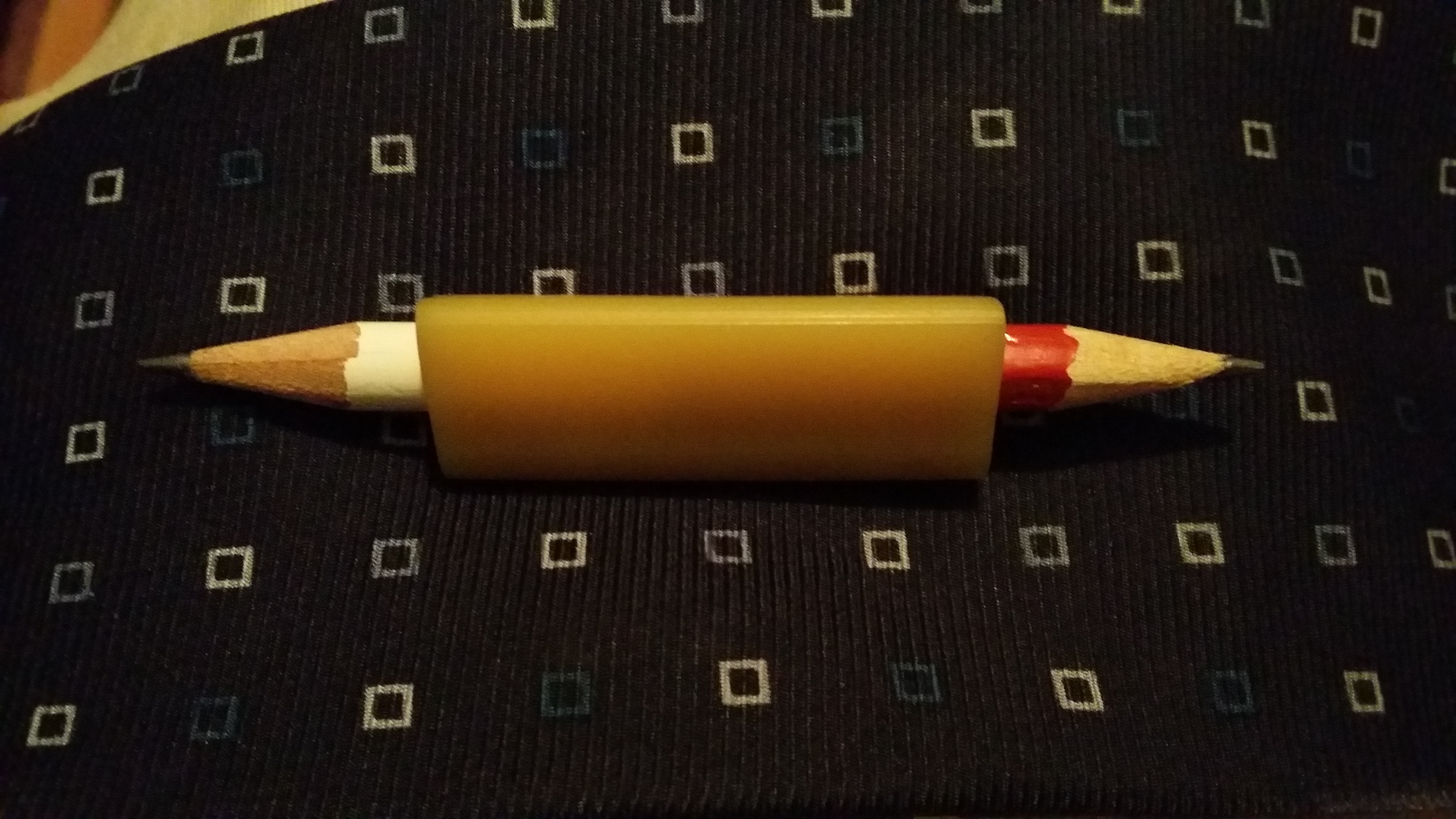
My pencils are a different story. I have dozens of them around the house, and I don’t like to waste them. In fact, here are my two smallest ones joined by a rubber grip. I’ll use them until I physically can’t hold them any more:

The world's smallest pencil

I’ve also discovered from Mental Floss that every new prime minister leaves a handwritten letter about what to do in the event of a nuclear conflict if both he and his assigned second-in-command are dead. It seems a little strange that such a format is still used. If I was PM, I’d make sure I spelled it out in 16-point Helvetica so the commanders aren’t standing around asking, “Does that say, ‘load weapons,’ or, ‘lower weapons?'”

More poignantly, ListVerse posted a collection of last words written by people facing certain death. Not all of them had the luxury of pen and paper, including the prisoner of war who scratched out a memorial on a rock, and a diver who wrote his on a slate.

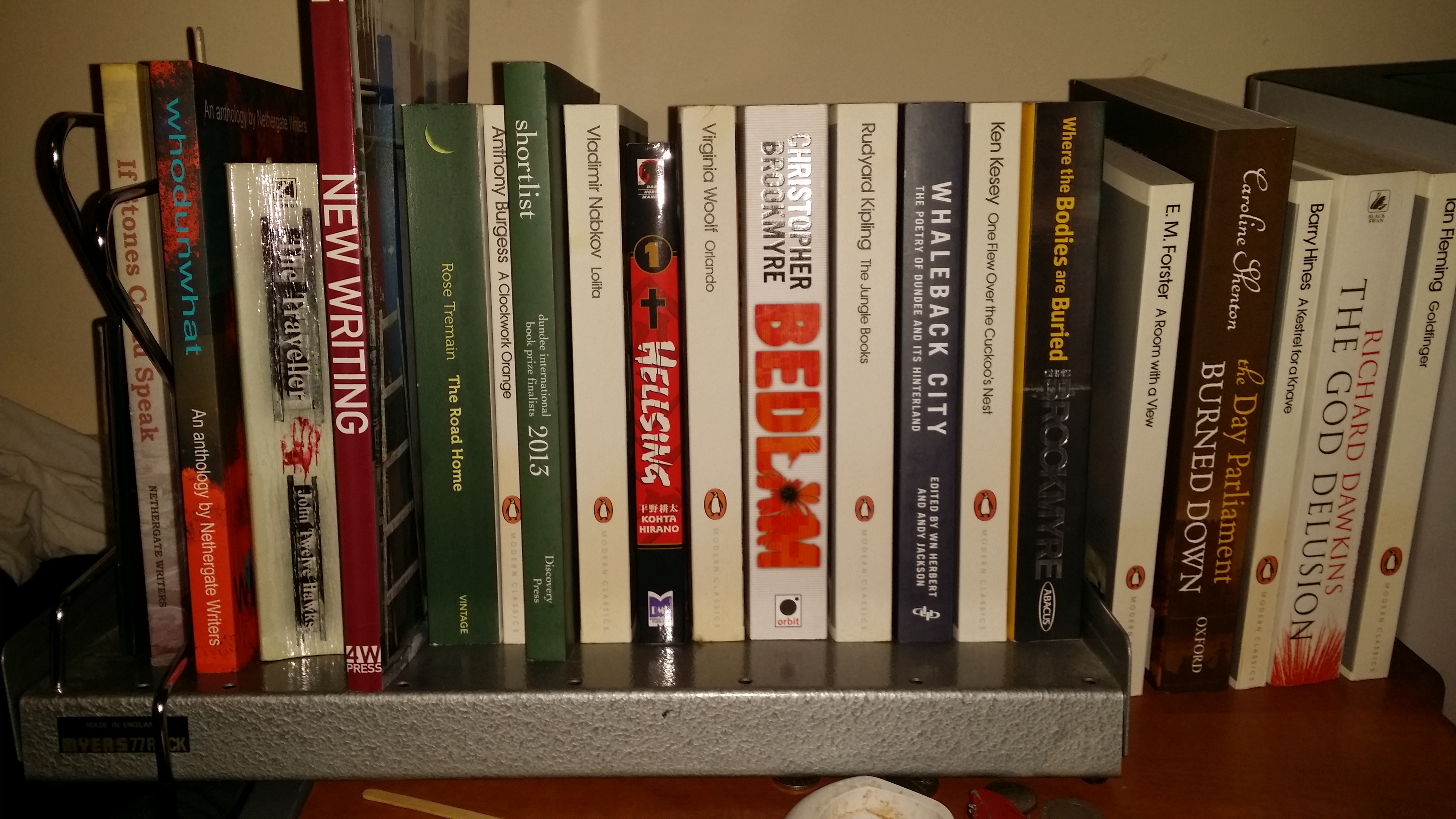
Lastly, I’d like to show you the paper books I plan to read throughout the rest of the year, including modern writers such as John Twelve Hawks and Richard Dawkins, a selection of Penguin Classics, and a number of local anthologies:

Paper books to read this yearIf you want more information on any of these, let me know.

Some Salvaged Scribbles.

A few days after my handwritten entry last week, I was looking for something in my bottom drawer, when I discovered an old notepad. It’s nothing special; it’s a Tesco Value spiral-bound A4 pad with a slightly ripped cover.

I’ve used a quarter of its 80 pages, and most of it is taken up with attempts to expand on a fragment of poetry that I tried to expand into a song, although there is also a brief novel idea, pages of free writing, and a poem on the topic of my own handwriting.

Of these, I only consider the poem be a decent piece of work. As for the rest, I know what I was trying to express, but I didn’t have the techniques at my disposal to do it properly. But looking at the content, I’ve calculated that I last wrote in this notebook in September 2009, more than a year before I began writing. I’m therefore not surprised about the quality.

My filing system
My filing system

Yesterday, I discovered other half-completed notebooks, but none as full or detailed as this one. I’ve noticed I rarely reached the last page, although I’m more than likely to complete my current ones. Also, there are hardly any drawings or even doodles, just text.

But the one notebook I would like to look at again is missing, believed lost. At my very first National Novel Writing Month meeting, my laptop battery died. I had to rush out and buy a notepad and mechanical pencil so I could continue my story. I had it about a year before its disappearance, and it contains drafts of my first novel, and some of my earliest stories. I don’t think I’ve lost anything, but I might have.

I know I’m not the only writer with notepads dotted about, and I’d like to hear about yours. Do you have any hidden in a drawer somewhere? What did you discover when you pulled them out again? Have you misplaced an important story you wish you could recover?