Running a Readathon

For the last six years or so, I’ve been involved in a small readathon that takes place on Discord. Over time, it’s been scheduled on various dates and has been run by different people.

In its current incarnation, I help my pal Jenny to run it once a year, approximately around Yuletide. This year, it was set to start at 8pm on Saturday, finishing at 8pm on Sunday. This left us both enough time for a screening of It’s a Wonderful Life first.

For the avoidance of doubt, the intention of the readathon is not to stay up and read for 24 hours straight. Instead, it encourages participants to ringfence some time over these 24 hours to settle down with a book.

We provide regular prompts throughout the event. These might include:

  • Sharing how you discovered the book you’re reading.
  • Telling the group three facts about the author.
  • Writing a haiku about an event or character in the story.

There are also reminders to stand up, stretch, eat and drink. We established early on that some participants were in different time zones, so we could say, Depending on your side of the Atlantic, it’s likely to be approaching either breakfast-time or lunchtime, so be sure to stop and fill up.’

Because Jenny is a night owl and I’m more of an early riser, it was relatively easy to coordinate the full 24 hours., particularly as I had a half-baked plan to watch the winter solstice sunrise from the Law Hill in Dundee. This meant it would pair nicely with the summer solstice six months earlier, even if the cloud cover meant there wasn’t particularly much sun.
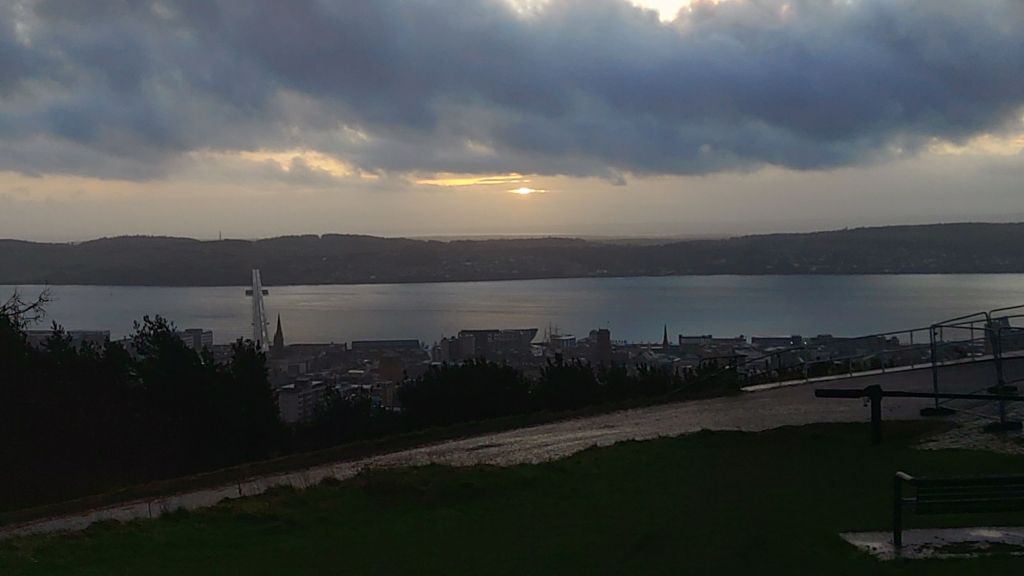
Winter solstice sunrise as seen from the Law Hill in Dundee. There is thick cloud cover partially obscuring the sun. The sky glows softly behind dramatic clouds, casting muted light across the water and buildings. A bridge spans the river, and a bench in the foreground sits beside a damp path and grassy verge.

So what of the actual stories?

I’ve become a lot more interested in audio storytelling over the last 12 months, so rather than reading paper books during the readathon, I listened to a drama on BBC Sounds based on the Fukushima nuclear accident in 2011, a radio drama called Cat and Mouse Game by R D Wingfield on YouTube, and an audiobook of The Time Machine by H G Wells.

The participants’ reading lists incorporated a variety of authors such as Ayn Rand, Becky Chambers, Iain M Banks and George Orwell.

I was a somewhat tired by the end of Sunday, but the event was very satisfying to run. It goes at an easy pace with just enough interaction to keep the server ticking over. I look forward to holding it again next year.

Deliberately Not Reaching the Target

The end of November signals the end of National Novel Writing Month, which is a global challenge to draft a 50,000-word novel in just 30 days. Regular readers will know I’ve run the Dundee & Angus region for the last eight years.

Although it’s a tough challenge, the only real competition is against yourself. It’s run largely on an honour system, where participants self-report their word counts, and there’s no sanction for not reaching the target. As such, we always remind members that there’s no shame in not hitting 50,000 words.

When I took over the group, I quickly realised that organising and encouraging group members is sometimes incompatible with achieving my own goals. I have previously managed to reach 50,000 words while running the group, but the quality of my leadership suffered.

So for the last few years, I’ve made more of an effort to focus on the running of the group. This is in the full knowledge that a decent word count is unlikely to be possible. At the time of writing, I’ve recorded just 1,178 words.

However, there has been a noticeable improvement in the running of the region. This has been particularly true in the pre-pandemic period as my co-leader and I have gradually developed and trialled different ways of working.

The way I see it, if the members are able to focus on their projects and don’t notice how we run the group, then we’re doing a good job.

Helping Novelists Through November

National Novel Writing Month is a not-for-profit initiative that encourages people to draft a 50,000-word novel during the month of November. In 2023, NaNoWriMo – as it’s affectionately known – celebrates its 25th anniversary

As the organisation operates globally, it relies on hundreds of volunteer co-ordinators around the world to welcome members, arrange meet-ups and raise donations. After joining the Dundee & Angus region as a punter in 2010, I’ve been running it since 2015.

During my time in charge, we’ve started additional weekly meetings during the rest of the year. As such, I like to have a co-organiser to help with tasks such as sending out bulletins, reorganising our Discord server, and covering for each other if we’re busy on a given week.

Even with this, November still remains our busiest month ahead of the novel-writing. By tradition, we organise a launch party in October, a Thank Goodness It’s Over party in December, and an additional weekly meeting on each Saturdays in November.

From our members’ point of view, NaNoWriMo will start on Wednesday 1 November. For us, those conversations need to start right now, and that’s what we’ll be doing over the next four weeks.

Preparing for November

For the last eight years, I’ve had the privilege of running the Dundee & Angus region of National Novel Writing Month. The name is usually shortened to NaNoWriMo.

My official title is Municipal Liaison (ML) and I’m just one of an army of volunteers around the world who run local regions of differing sizes. Dublin, for instance, is one region. By contrast, the entirety of Italy is also its own region for NaNoWriMo purposes, although that’s not uncommon outside the Anglosphere.

The poster child of NaNo is the challenge to draft a 50,000-word novel over the 30 days of November. Regions are not required to meet year-round, but ours does every Tuesday. November sees an increase in membership, so we’ve learnt to plan accordingly.

In addition to our Tuesday meetings, we have an additional one each Saturday in November. Traditionally, this is at a different location. I always like to have a co-ML as a backup, and she organised that alternative venue.

But why meet year-round in the first place?

It’s less well-known that the organisation also runs standalone challenges during April and July where you choose your own goal.

The idea came about after the 2015 November challenge, when there was an enthusiasm to keep meeting up into December. A previous co-ML and I decided to extend it on a trial basis each month, and we eventually met up every week until April 2016.

At that point, it was clear the weekly meetings were a winner. These allowed our members to come along during the off-season to work on other projects or prepare for the next challenge.

When the pubs were closed during the pandemic, we already used Discord as a meeting place, and this was stepped up. Our meetings now take a hybrid form, where members have the alternative to engage in our private server.

The in-person element, however, will always remain central for as long as I’m in charge of the Dundee & Angus NaNoWriMo region.

A Surprisingly Unpopular Event

I received a message from someone local who’s currently working on a community-focused project that launches this weekend. It’s aimed at encouraging people to think more about the clothes they have, the memories they represent, and imagining what might happen when these items are passed on.

One of the proposed events was to bring in local poets to respond to the above themes, but as the organiser didn’t know many poets, she wanted to tap into my connections. I was happy to help out, and I spoke to two of my poetry groups.

After a week, I was surprised to receive virtually no response to my messages, especially as the clothing event was intended to take place in person. As an organiser, I’ve found that people react to staged events more positively, as the public has become weary of so many virtual ones.

I explained this to the organiser but added that I would still like to contribute. My starting point was a T-shirt from 1996 that I still own, and the resulting piece became an exploration of when I met my first girlfriend at age 12, and how my approach to relationships has changed between then and now.

I don’t know whether I’ll actually be able to attend, as something more pressing has arisen, but I wish her all the best with the project.

Venues

I often speak about Hotchpotch on this blog. This is an open-mike night I run, with an ethos of no judgement and no criticism.

Yesterday, we heard that the venue we use is closing down, so we currently have nowhere to hold our next session, scheduled for Monday 15 July.

A few of the regulars are working on a stopgap venue, and we hope a permanent place can be found for August. We’ve also sent a message to members, advising them of the situation and asking for help.

So I’m afraid this entry has not much style nor substance, as this conundrum will be taking up much of my time this week.

Nonetheless, we’ve endured a number of venue closures over our ten-year history, and we’ve bounced back every time.

EDIT: In the time since this entry was written, we’ve found a stopgap place. This will give us breathing time before August.