Some Salvaged Scribbles.

A few days after my handwritten entry last week, I was looking for something in my bottom drawer, when I discovered an old notepad. It’s nothing special; it’s a Tesco Value spiral-bound A4 pad with a slightly ripped cover.

I’ve used a quarter of its 80 pages, and most of it is taken up with attempts to expand on a fragment of poetry that I tried to expand into a song, although there is also a brief novel idea, pages of free writing, and a poem on the topic of my own handwriting.

Of these, I only consider the poem be a decent piece of work. As for the rest, I know what I was trying to express, but I didn’t have the techniques at my disposal to do it properly. But looking at the content, I’ve calculated that I last wrote in this notebook in September 2009, more than a year before I began writing. I’m therefore not surprised about the quality.

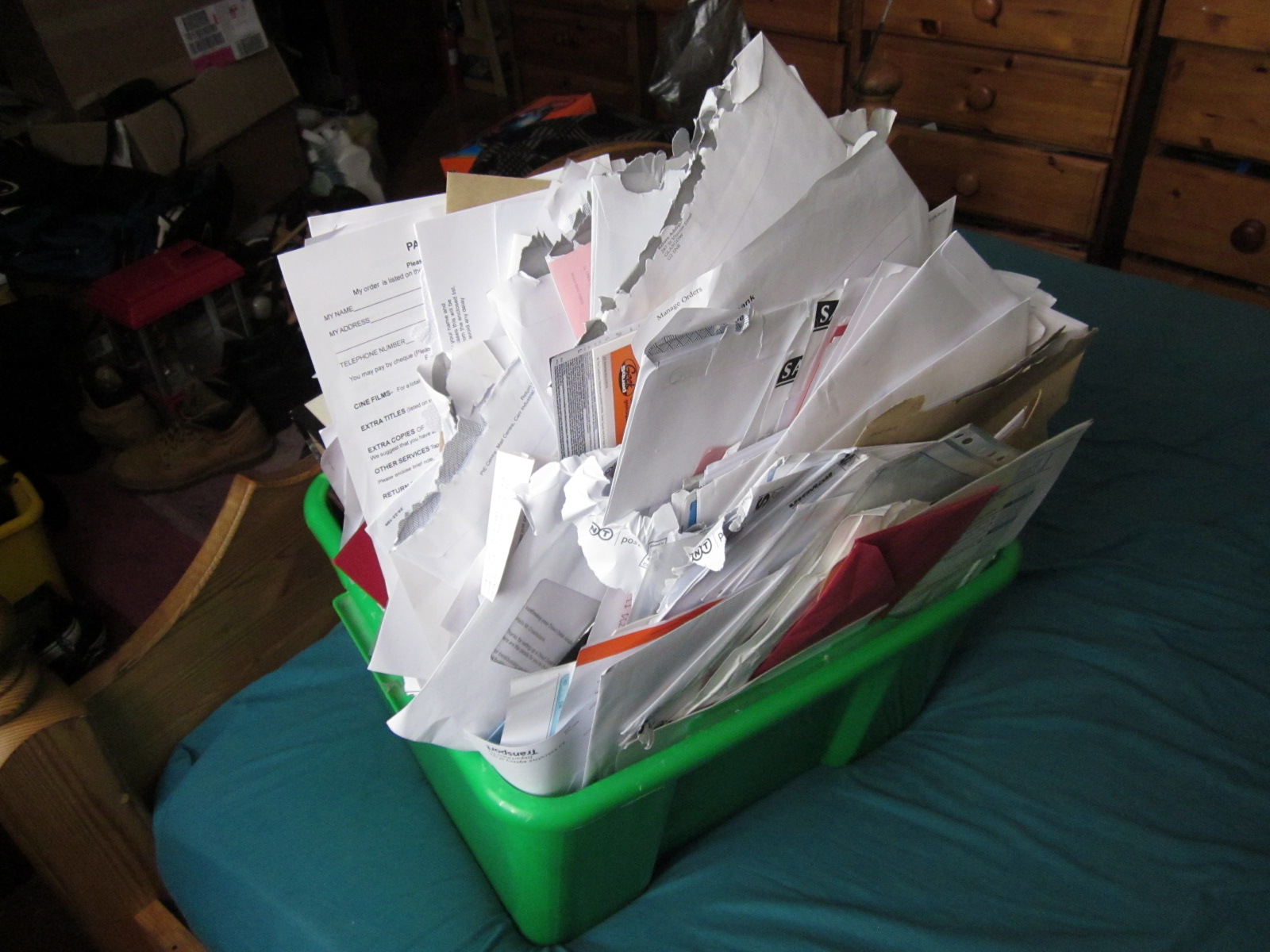
My filing system
My filing system

Yesterday, I discovered other half-completed notebooks, but none as full or detailed as this one. I’ve noticed I rarely reached the last page, although I’m more than likely to complete my current ones. Also, there are hardly any drawings or even doodles, just text.

But the one notebook I would like to look at again is missing, believed lost. At my very first National Novel Writing Month meeting, my laptop battery died. I had to rush out and buy a notepad and mechanical pencil so I could continue my story. I had it about a year before its disappearance, and it contains drafts of my first novel, and some of my earliest stories. I don’t think I’ve lost anything, but I might have.

I know I’m not the only writer with notepads dotted about, and I’d like to hear about yours. Do you have any hidden in a drawer somewhere? What did you discover when you pulled them out again? Have you misplaced an important story you wish you could recover?

Happy World Book Day: A Response to @MostlyYummy.

It’s a rare occasion that Mostly Yummy’s blog topics will intersect in any way with mine, but today it’s happened.

I didn’t realise until this morning that World Book Day was such a big deal among the nation’s schoolchildren. They’re encouraged to dress up as their favourite fictional character.

The theory of this is quite sound. A child’s imagination can be sparked and expanded by his or her early reading choices. The other part of the theory is peer pressure. If a child knows that everyone else will be dressing up, they’ll likely want to do the same.

Like many children, I loved Roald Dahl’s slightly twisted novels, but I also enjoyed the stories from Antelope Books. I can’t find any relevant references to Antelope online, so do comment if you remember these guys.

But as Yummy points out in today’s post, the reality of the aforementioned theory can be very different. She tells us how she tried to cobble together outfits for two of her children, while making a valid point that the dressing up can overshadow the intention of World Book Day which is to read.

I must’ve mentioned this before, but being asked to do anything artistic scares the bejesus out of me; even seeing the words Daler Rowney brings me out in hives. I disliked the subject at school since I could never make the final product look anything like what the teacher asked. I did know what I wanted to draw, paint, or construct, but it became lost somewhere between my head and my arm. In essence, I sympathise a great deal with my fellow blogger.

I’ve been upfront from the start that I’m a latecomer to writing fiction. I didn’t pen a single piece between my last high school English class, when it was mandatory, and just before I turned 27. Despite the long gap, I find writing comes naturally to me, although I still had to learn the rules and conventions of the craft, whereas expressing myself with a paintbrush just isn’t me.

I recognise that some people won’t be able to relate to this as they have the exact opposite talents. I would like to learn, as it could complement my writing. Perhaps someone suitably gifted could put together a Complete Ninny’s Guide for me, and throw in a copy for Mostly Yummy.

nning. Pushing The End to The Begi

I met a woman last week who reads books in a particular manner. She’ll read the last few pages first, decide if she likes the way it ends, and if so, she’ll then start reading from page one. She added that this method allows her to know if there’s going to be a satisfactory ending before investing time in the main story.

I do accept her argument as logically sound, but there are books where the ending makes very little sense unless you’ve ingested the main text. I’m thinking of an epic novel, such as Moby Dick. Reading the conclusion without knowing the tensions between Captain Ahab and his crew, detailed in the rest of the story, you won’t fully understand why their voyage ended the way it did.

If you ever do tackle Moby Dick, incidentally, you can quite safely skip Herman Melville’s obsessive personal polemics about the whale.

Another problem with this system is that some books paint a picture rather than tell a story. Consider Breakfast at Tiffany’s; the novella, not the film, although the woman in question uses the same method with DVDs. Truman Capote explores the complex relationship between the narrator and Holly Golightly in such a rich manner that there is as much to be gained from the description as the plot.

I do enjoy including some historical context in my entries. Read the prologue of William Shakespeare’s Romeo & Juliet and those 14 lines give away the plot before any of the other actors say a word. Audiences expected to be given the precis at the beginning.

By the 20th century, the position was completely reversed. Agatha Christie understood this when she wrote The Mousetrap, at the end of which she specifically asks the audience to keep the secret. These days, there is still an expectation that endings will be kept under wraps, or clearly marked Spoiler Alertwith the odd exception such as Star Wars or The Sixth Sense, where it seems fair game to give it away. But there are also websites you can consult if you want the full plot.

I’ve created a poll to gauge how many WordPress users agree with my feelings on the matter. If necessary, do expand on your answer in the comments.

Tabletpunk.

Nothing marks out a generation more than the slang it uses.

If we concentrate on right now, February 2014, you’ll hear people say they’ve, “taken a selfie,” or say, “because,” followed by a single word rather than an explanation. Back fifteen years, and it wasn’t unusual to, “tape that programme,” or answer the phone with, “WASSU-U-UP?”

So when writing a piece that’s going to hang around for a while, most notably a novel, it’s a good idea to decide whether you want to incorporate the slang of the day to make it a period piece, or create a more timeless tale by using more generic terms.

If you want a photo taken properly, do it your selfie.

I recently wrote a story where a major plot element is a pager. This immediately sets it in the 1980s, and I felt safe using the term data bank to describe the device’s storage, rather than the more modern memory. I tried not to overload the piece with dated words, but I did allow myself a yuppie, as the pager’s owner described himself.

But while the eighties is over and we know what it was like, writing a story set in the future is different. One day, selfie and because _____ will be as embarrassing as fab and groovy. For my first novel, where the action takes place in the 2500s, I used, for instance, sound system rather than iPod or even MP3 player. I decided not to try predicting the future term, and write something a little more bland, as would distract from what I was trying to say.

There is an elegant solution to this problem, and those of you who write steampunk know what I’m talking about. This genre imagines modern or relatively recent technology as people in the 19th century might have seen it. There are many literary examples of this, but an accessible non-literary one is the TV series Warehouse 13.

Which leads me to wonder if there’ll be a genre of the future where writers of the 2110s envision their everyday gadgets as we in the 2010s might have viewed them. This decade’s most popular invention is probably the touchscreen computer. So, a hundred years in advance, I’m going to label this predicted genre as tabletpunk.

I’d like to be around to see the look on some geek’s face when they unearth this entry.

Three Good Apples and a Lemon.

I’ve read a number of books this year, and the majority of them were well worth it, including the classics The Day of The Triffids and Breakfast at Tiffany’s. So I’ve only selected a few notable ones for this entry. The links go to Amazon, but to paraphrase the BBC disclaimer, other websites are available.

My choice of lemon proves the idiom that you shouldn’t judge a book by its cover. Crawling Round South Oakwood by Stephen Slaughter has amazing artwork, with the words in the title becoming more and more blurred as the rows of pint glasses become emptier and emptier. I thought a story about a group of friends going on pub crawls would be a sure-fire winner.

How wrong could I be? The book seems to be a first draft, going into such minutiae as the details of the TV programme the group watches, and their exact route to the pub. Later in the book, a fight breaks out between the group members, yet no tension is shown to have built up in any other part of the book. I finished it, but I was disappointed.

Now let’s look at what went well. The Dog Stars by Peter Heller had an arresting concept. In a post-apocalyptic world, Hig and Bangley are survivors. The former owns a small plane with enough fuel for years of short reconnaissance missions. When he picks up a long-range radio transmission, he is determined to find its source, but it means using up all his fuel without enough for a return trip.

As well as the immediate problems, it explores the philosophical differences between Hig and Bangley. One asks questions then shoots, the other takes the opposite approach. I also like that the author doesn’t write needless pages dwelling on the causes of the apocalypse, but shows it throughout the story.

I was fortunate to see Iain (M) Banks at two live events before hearing of his illness and death this year. He didn’t fit the stereotype of the introvert writer mumbling answers to questions. Rather, he made a short speech then actively encouraged the audience to join in.

I haven’t read any of his science fiction, although I hear it’s excellent. Having read The Wasp Factory after his first appearance, I then tackled The Crow Road. I have two criticisms about the book: that the flashbacks aren’t as clearly marked as they could be, and some of the writing isn’t as tight as it could be, but once you become accustomed to it, you really believe in those characters and their views on life, as Prentice tries to piece together his family secrets.

I’ve also seen another Scottish author at live events, Chris Brookmyre, who signed my copy of Flesh Wounds. Like Banks, he’s very confident in front of an audience, his main topic discussing the merits of the phrase, “Taking a s***”

As in The Crow Road, the flashbacks are a little confusing, and the Glasgow dialect can be a little alienating. But it’s the attention to detail in a many-stranded story that really drives it forward. I really ought to read more of his novels, as the only other one I’ve tackled is All Fun and Games Until Somebody Loses an Eye.

But if I was giving out awards for the best book I’d read this year, it would have to go to Layer Cake by J J Connolly, only £1 from a charity shop. As Flesh Wounds is set firmly in Glasgow, this is set in London, and the first-person narrator sprinkles in some Cockney rhyming slang, often without explanation. A, “Mars bar,” for instance is a scar, but it took me a few pages before I realised this.

My enjoyment wasn’t dampened in any way by the Daniel Craig film, in fact they complement each other, sharing several direct quotes. It’s difficult to judge the unnamed narrator for dealing drugs because he has the attitude of a businessman, just one whose activities are illegal. As he sees it: “Until Prohibition ends, make hay whilst the sun shines.”

I hope to read many more excellent books next year.

The Real Slim Shady.

Recently, an editor accidentally sent me some documents with my legal name in the byline. It was half my fault for not making it clear enough, but it brought home just how important it is to separate the two.

I started using my pseudonym before I took up writing. Until recently, I presented a show on hospital radio and promoted my middle to my last name, becoming Gavin Cameron. It sounds clearer through a microphone than my actual name Gavin Cruickshank, and more people know how to pronounce the written form correctly.

Let me point out that this was before David Cameron was elected. Despite the connections, it’s proved useful in writing because I work full-time and it helps keep a clear separation between the two.

I do think that if a writer uses a pen name, for whatever reason, he or she should inhabit the name and adopt the character. I occasionally read authors introducing themselves as, for instance, John Smith writing as Joe Public. Why craft a pen name if you’re going to break the illusion? I did it in this entry purely to demonstrate a point, but in a book or story, I would never explain Gavin Cruickshank writing as Gavin Cameron.

But I can think of one person who has done this successfully, and with a double pseudonym. Rapper Marshall Mathers goes by the stage name Eminem, but refers to himself as Slim Shady in his music. When you’re listening to his albums, he does it so naturally that you simply don’t question it.

I don’t think Mathers/Eminem/Shady reads this blog, but if he does, well done those men.

The End of Days.

I know you can’t see me, but I’m blowing a whistle as we speak, indicating the final dying minutes of National Novel Writing Month. I breached the 50,000-word target by only 29 words; that’s 13 less than my very first novel in 2010.

Last year’s total was 60,000 and I’d barely scratched the surface, but this time around, I don’t have the material to go much higher, so I’m happy with my haul. Many congratulations if you’ve also hit the benchmark.

My aim is for this to be the last time I bore you with this subject for the next eleven months.

I’ve been to a number of literary events this week, including a fiction writing and a life writing class, and I’m pleased to say I’m enrolled in the continuation class for the latter.

On Thursday, I attended a literary salon where I heard current English students read out their best pieces. Then on Friday, a poetry and cabaret event. A number of pieces were in the Dundee dialect, which must have confused the last act, a songwriter from New Orleans.

I’ve lived in the city most of my life and understand most of the vernacular, yet I’ve never naturally spoken it. It inspired me to write a poem exploring the theme, and I completed it before the event ended. I’m not known as a poet, and I’m not at the stage where I would describe myself as one, but I have been dabbling in the form.

I’ve also been working on another piece, but I need to give you a bit of background. If you didn’t know, I’ve only been a writer since October 2010. To put that in context, I was 27 when I wrote a fictional story for the first time since high school. The piece was that first NaNo novel.

However, when I was at school, I fancied myself as a singer-songwriter, not to mention an actor. I’d tried to write song lyrics, and I recently rediscovered a four-line fragment with two internal rhymes. Moreover, I can still remember the tune, and the words still resonate as much now as they did then.

At the time, I tried to expand it by writing extra verses, but nothing seemed to work until I turned to Google+ earlier this week. With the help of a community, I preserved the rhyme scheme but expanded the number of syllables, and I’ve now squeezed nearly four verses out of it. If I keep making progress, I finally hope to perform it on December 9th after all these years.

After a conversation with my former NaNo Municipal Liaison a couple of weeks ago, I raked out my school qualifications. I’d correctly remembered I’d earned only a C for English, although I have criticisms about the way it was taught. Perhaps that’s why I never pursued it, or perhaps I was too fixated on music to realise my strength was in words, not instruments.

I’ve got to make up for the time I wasted setting up blogs writing factual events without realising that I was able to write fiction. I kick myself every day about my late start, although I take some comfort from the careers of Barbara Taylor Bradford and Richard Adams. Their first books weren’t published until they were over 40 and over 50 respectively.

But I need to work fast if I want to reach a state of parity. I want to reach the point where I’ve produced as much work as if I’d started as a teenager. I have around 200 pieces in total, but that could have been 1,000 if I’d begun at age 15.

I won’t rest until I’m satisfied I’ve made up for every minute of wasted time.

The N-Word.

I’ve a feeling you’re getting sick of me talking about National Novel Writing Month, so I’ll devote only one paragraph to it. To date, my total is 48,711 words, meaning less than 1,300 to go until I hit the target. I have until Saturday to complete it, leaving plenty of time.

I’ve been going to two other classes at the same time, and I seem to be going through a rather philosophical patch as I complete their respective homework.

Class one is Life Writing at the University of Dundee. Our homework is to write a short passage about our lives each week, all focussing on a particular aspect of writing, which might be the use of the child or adult voice, or employing the past or present tense. This week was a little different, where we were asked to choose an abstract noun and write a piece around that theme. Mine was On Solitude, arguing that this is not the same as loneliness.

Number two is my regular writing class with Zöe Venditozzi, held at a new, secret location. One of the prompts led me to write about a floating island and the ideological arguments its inhabitants had when setting up their community. The other is about twins with wildly different reactions: one is always brutally honest, while the other goes into denial when he hears bad news.

Also, my second published story is currently being launched in Australia as part of the FourW Twenty-Four anthology. The Wagga Wagga and Melbourne events have taken place, but the Sydney launch happens this Saturday 30 November. It’s impractical for me to attend as I’m halfway around the world, but if you live there, pop along and let me know what it’s like.

NaNoWriMo and Other Stories.

Just a quick update to say I’m still alive, but I’m not only taking part in NaNoWriMo, but homework for two other writing classes as well. As you might imagine, this is keeping me jolly busy.

With 33% of the time elapsed, I had reached half of my target of 50,000 words. I think be able to match the target, but not beat it, so I’ve been taking it slightly easier. At a day over the halfway mark, I now have around 33,000 words.

But I’ve also had time to visit the cinema. Last week, I saw Gravity, although I felt that because Sandra Bullock and George Clooney are such famous faces, it distracted somewhat from the story. Yet it remains an excellent film, with the action of Apollo 13 set to the backdrop of 2001: A Space Odyssey.

And today, I attended a free screening of The Girl with the Dragon Tattoo, in Swedish with English subtitles. I enjoyed this for its captivating story, even if it becomes a little muddy towards the end, and I hear it’s much better than the English-language remake. I’ve no current plans to read the book but if I have a chance, I’ll give it a look.

So hope you reach the end of NaNo in one piece, and any other writing projects you may have on the go. I’ll update again when I have the chance, which I hope will be the day I hit the target.

NaNo Go Go Go.

I’m just taking a few minutes out of my writing schedule to wish the best of luck to every National Novel Writing Month participant. Thus far, I have a little over 600 words to sling on the pile.

Don’t forget, there are likely to be people in your local area to help you stay inspired, and look out for the periodical motivational e-mails.