What We Talk About at Writing Group

For the last ten years, I’ve run a weekly writing group. This has almost always been on a Tuesday and with a co-organiser.

I inititally joined in 2010, when the group was still a branch of National Novel Writing Month (NaNoWriMo). I took over in 2015 once the original organisers graduated and moved away. After withdrawing our affiliation from NaNoWriMo two years ago, two of us now jointly run it as an independent group.

It must be stated that we have a manageable number of members, so other than a few word-of-mouth referrals, the group is not actively recruiting at present.

In its current form, members can drop in at any time during the two-hour session, either in-person or via Discord. They’re welcome to stay for a short while or the whole session, and there isn’t even an expectation to write. We frequently end up chatting, joking, making plans and/or solving problems.

But although that format is consistent these days, it took some trial and error to figure it out.

As the main NaNoWriMo challenge only took place during November, the weekly meetings coincided with that. After some enthusiasm by members, we cautiously extended the-e weekly meetings on a trial basis through December, then January, then February, and so on. People were still coming along, so we confidently started meeting up all year round. We now have a recurring table reservation and the staff know us well.

On a couple of occasions before the pandemic, I even brought the members around to my house on 31 October so we could begin to draft our novels at the stroke of 1 November.

While the meetings themselves have always been a hit, the members have rarely been interested in any formal activites such as writing sprints, feedback sessions or homework challenges. Variations of these have been attempted with different leaderships in different years, but none have caught on.

In Dundee, at least, the thirst is simply for ringfenced time to write every week and that’s what we provide.

NaNoWriMo – The Last Word

It was quietly announced last week that the organisation behind National Novel Writing Month was to close. Universally known as NaNoWriMo, or even NaNo, this was a challenge to draft a 50,000-word novel during November each year, later expanding to include smaller challenges in other months.

The announcement, made on Sunday 31 March, was so quiet that only those on the mailing list received it. There also exists a corresponding video from the Interim Executive Director, which has not gone down well with the commenters.

And yet, at the time of writing, the official website remains unchanged. So when I heard the news second-hand on April Fool’s Day, I had to double-check it, missing the chance to include the news as last week’s entry. Still, the week-long gap has allowed some time for reflection.

I joined NaNo in 2010. It had been around for 11 years at that point, and was arguably at the height of its popularity, as illustrated by Google search trends over the years. There were dozens of affiliate groups around the world, including one in Dundee city centre. At my very first meeting, my laptop ran out of battery, so I rushed out to buy a notepad and a mechanical pencil. The graphite rods kept breaking, rendering it next to useless.

Fast-forward five years, and I’d graduated from member to organiser in the natural flow of people leaving and joining. I stayed in that role for nine years alongside several different co-leads until we withdrew our affiliation in 2024 over the nonsense that had been happening.

By this time, I’d fallen out of love with the central November challenge, as I found myself with an increasing series of started but incomplete novels. I didn’t fall out of love with bringing writers together, so I’m pleased still to be co-leading the independent group we created to replace it.

So the big question: what caused the closure? It’s a complex story that can best be told by the NaNo Scandal website, which has documented the problems with the organisation from December 2022.

However, the simplest analogy is that of a Fortune 500 company, which will typically act to keep its stakeholders satisfied. In the case of NaNo, the stakeholders were the organisers on the ground who encouraged members to keep writing and to keep donating. After alienating these folks, the cash dried up.

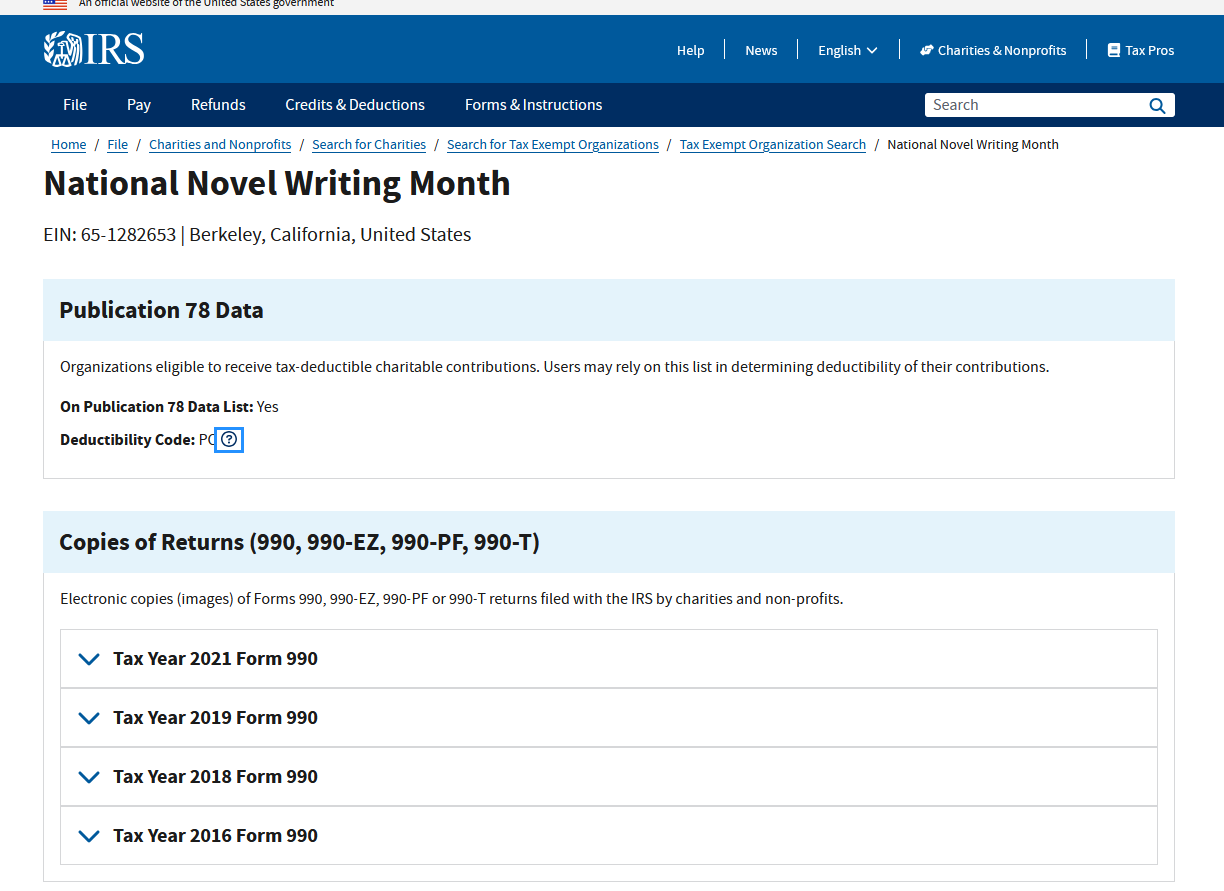
Speaking of cash, search information from the US Internal Revenue Service (IRS) website makes for interesting reading. From what I can gather, the nonprofit National Novel Writing Month should be filing Form 900 annually, which then becomes a matter of public record. However, the last document at the time of writing dates from 2021.

A screenshot from the US Internal Revenue website illustrating the points mentioned in the plain text.

I’m absolutely no expert, so perhaps there’s a genuine reason why the last four years are missing from this list. But if you’re an accountant or you’re connected with the IRS, you can access the search function and enter the Employer Identification Number 65-1282653 to find out the details.

I really don’t want to leave this entry on a sour note. I was involved with the organisation in some capacity for 14 years, so more than half of its 26-year history. I had some wonderful experiences, and I still speak to so many former participants. So here are three memories that stand out:

  • I held a couple of midnight launch parties at my home, with the plan to start writing in the first hour of 1st November. I had only a two-seater couch at the time, so every chair and cushion was taken up with people, who were also dodging electrical extension cables. As the clock hit 12am, the entire room fell silent for an hour, aside from the tapping of keys.
  • I’d met someone in real life and was chatting to her via Facebook Messenger. I wanted to take a gamble and ask her out, so I enlisted the members of that week’s NaNo meeting for advice, all of whom were in long-term relationships themselves. They helped me to steer the conversation and figure out what to say next. She still turned me down.
  • A local organiser used to be known as a Municipal Liaison or an ML. As the pandemic was easing, the government was permitting people to meet up again, while NaNo was still warning MLs to hold only online meetings. To circumvent this, I told the group I would be in our usual venue at a certain time, and there were spare seats if anyone happened to be passing, but that this was not a meet-up. I even wore a sticker reading NOT ML, which became an in-joke for a long time afterwards.

Nice NaNo-ing You

Long-time readers of this blog will know I’ve been involved with National Novel Writing Month (NaNoWriMo) since 2010. This is a not-for-profit initiative that encourages members to draft a 50,000-word novel every November.

In 2015, I began to organise our local Dundee & Angus region. A local leader is known as a Municipal Liasion (ML). Each ML needs to sign an agreement every year promising to enforce the code of conduct, hold regular meetings, and so forth. In fact, we already go over and above the agreement by holding meetings every week, not just during November.

I always like having a second ML in charge to help me make difficult decisions. This turns out to have been a prudent move.

Late last year, a member of NaNoWriMo staff in California stood down after making a racist comment about a colleague. Separately, the organisation was slow to remove a forum moderator who was sending inappropriate material to minors.

As a reaction to this, a new Interim Executive Director was appointed without warning, who then released a draft ML agreement with several adverse clauses. These included requiring us to verify our identity with a US company that doesn’t comply with GDPR and preventing us from speaking to MLs in other regions. There has also been a general air of disrespect in replies from this Director, which I haven’t experienced in a decade and a half of involvement.

There are a lot of aspects to this story, but that’s a summary of the main points.

As the situation with NaNoWriMo worsened, the other ML and I started serious discussions about withdrawing our affiliation and becoming an independent group. Our format had slowly evolved over the years, adapting to what members wanted, and we felt we could retain this aspect without external oversight.

Around this time last week, we sent a long bulletin announcing our independence and offered the opportunity for members to ask questions.

The news seemed to go down well. By this time, the MLs from most of the other regions in Scotland had also decided to step down. If anything, the decimation of NaNoWriMo has brought us closer together.

The next discussions in our local area will be about what to do with this newfound freedom. We’ve already amended our terminology to distinguish ourselves from our former identity, registered a URL for future use and discussed holding a summer writing event instead of a November one.

Whatever happens, we remain convinced that withdrawing our NaNoWriMo affiliation is the right action to take and we look forward to the year ahead.

Helping Novelists Through November

National Novel Writing Month is a not-for-profit initiative that encourages people to draft a 50,000-word novel during the month of November. In 2023, NaNoWriMo – as it’s affectionately known – celebrates its 25th anniversary

As the organisation operates globally, it relies on hundreds of volunteer co-ordinators around the world to welcome members, arrange meet-ups and raise donations. After joining the Dundee & Angus region as a punter in 2010, I’ve been running it since 2015.

During my time in charge, we’ve started additional weekly meetings during the rest of the year. As such, I like to have a co-organiser to help with tasks such as sending out bulletins, reorganising our Discord server, and covering for each other if we’re busy on a given week.

Even with this, November still remains our busiest month ahead of the novel-writing. By tradition, we organise a launch party in October, a Thank Goodness It’s Over party in December, and an additional weekly meeting on each Saturdays in November.

From our members’ point of view, NaNoWriMo will start on Wednesday 1 November. For us, those conversations need to start right now, and that’s what we’ll be doing over the next four weeks.

Going Through Stages

After a conversation with a member of my poetry group last week, I remembered that not everyone is as comfortable speaking on stage as I am. I then discovered it’s been four years since I last covered the topic on this blog.

As such, let’s update it. It’s wise to remember this should be treated as a subjective guide, not a textbook.

Talk with the organisers about what’s required

If the organisers haven’t already told you the plan, it’s worth asking for the following information:

  • How long you’ll be asked to speak for
  • What type of content is required
  • Whether you’re expected to read from paper or perform from memory
  • Whether you need to introduce yourself
  • Where you should wait before you’re called up
  • Whether any fee is payable

Each event has its own particular character. Some events like performers to fill a 15-minute slot. Other events allow performers to go up twice. Slams sometimes mark down poets for reading words from a page.

If it’s an unfamiliar venue, be sure to obtain the exact address and check how to access the building. Don’t forget to arrive in plenty of time.

Think about your own structure

The organisers will take care of the overall structure and running order, but it’s wise to plan your own slot so you don’t miss a step. A typical note-to-self might read:

  • Give name, say you’re reading from short story collection The Pie Seller
  • Say you’re happy to sign copies
  • Briefly mention editor at Law Hill Books
  • Tell obesity clinic anecdote
  • Read out And an Onion One Too (page 24)
  • Thank Tracey Sanders for organising
  • Read out The Crust of the Matter (page 12)

It’s a good idea to place the thanks as second-last, not as the final item. That means the audience are more likely to go away with the ending of your work in their head.

Briefly explain if you need to, but don’t apologise

Some pieces do require an explanation; perhaps a work is unfinished, is an extract from a longer work, or was written under certain circumstances. But keep it brief and don’t explain anything that the audience will take or infer from the piece.

If you feel you can’t read a particular piece without apologising or telling a long story, either take it out of your set or work on it until only a short introduction is necessary.

Read out loud and time your words

The best way to identify weak parts in your set is to read it aloud – and that’s the last thing you want to happen in public. So find a room on your own and read it out where nobody can hear you. Are there any long sentences that need to be broken up? Are there words that are difficult to say clearly?

When reading from a book or from sheets of paper, it’s a good idea to turn up the corner slightly or to stick a post-it note as a lever. When using an e-reader or tablet computer, practice tapping the correct area of the screen to turn the page; there might also be a delay on some devices.

Don’t forget to use a stopwatch to make sure all your words fit within the agreed timeslot.

Make sure everyone can hear you

In my experience, smaller readings tend not to use a microphone, so you might need to project. Avoid tilting your head down to read the piece; instead, hold your manuscript higher and off to one side so it doesn’t muffle your words, or look down only with your eyes. Always speak more slowly than you would in normal conversation and don’t be afraid to pause.

If there’s a working microphone, use it. If possible, test it out beforehand. A big annoyance for an audience is a sound level that increases and decreases at random. So whether the microphone is handheld or on a stand, keep it at the same distance from your mouth as you speak. Most are designed to pick up sound from the top, although a few have the pick-up on the side.

Avoid alcohol before the gig

I fully understand why folks need Dutch courage before going on stage. From years of going to the Edinburgh Fringe, though, I’ve found a drunk performer rarely makes a good impression. My rule is not to take alcohol before speaking, only coffee or a soft drink.

Decide where in the room to look

I know a few poets who deliberately look at individual audience members. However, it’s  unnerving to make eye contact for most people. I have two alternative methds:

The first is to look between two audience members, so the person on the right assumes I’m looking at the one on the left, and vice versa. The second is to look above the heads of the back row; this has the added advantage of giving you a better posture.

Keep going through distractions and cock-ups

Perhaps the microphone fails, perhaps you forget the words, perhaps a hundred other unpredictable problems crop up. Keep going as best as you can. It might mean cutting a piece short or shouting instead of reading, but the audience are there to see you perform.

A common issue at spoken-word nights is the audience member who keeps talking. Unlike a music gig, you don’t have the advantage of drowning them out with your instruments. A good host will take charge of silencing any chat, but if they don’t, either carry on as you were or – if it’s too distracting – politely ask them to refrain.

Signal when you’ve finished

At the end of a piece, the audience sometimes doesn’t know whether you’re finished or simply pausing for dramatic effect. A good clear signal is to lower your manuscript or to step backwards slightly, or even say ‘Thank you.’ At that point, people should take the hint and applaud.

Listen to the other performers

Unless you’ve arranged otherwise, it’s considered a courtesy to stay and listen to the other performers before and after your set. If you really must disappear straight after the gig, tell the organiser or mention it on stage.

Do it again

It’s a cliché, but the more you stand up and speak in public, the more techniques you’ll learn, like which techniques or always or never provoke a reaction. There are no guarantees that your poetry performances will always be successful, but by following the suggestions above, you can maximise those chances.

Where Did Tuesday Go?

A full 25 hours on from Tuesday at 8pm, and an entry finally appears. Here’s what went down, and what’ll happen now.

Every Tuesday, I run the Dundee & Angus region of National Novel Writing Month. We meet weekly all year round in person and online, which becomes twice a week in November. That’s when the main novel-writing challenge is held. Yesterday, I knew I wasn’t going to be available to host because of a poetry event. I turned to my co-lead, who is normally able to fill in, but she was unwell.

As such, the meet-up had to be cancelled entirely, which rarely happens. I spent my lunchtime sending messages to make sure none of the members turned up.

These meet-ups are such a fixture of my week that it doesn’t feel like a Tuesday without one. I regularly use the time to write or finish my blog entry, which is why it’s always posted that evening. No meet-up meant it went completely out of my head. In fact, I only remembered this morning.

So where do we go from here? The last time this happened, the self-imposed sanction was to post an extra entry, but I feel this deserves something more severe because there was no reasonable excuse for forgetting. It’s normally enough of an effort to write one blog entry a week, so let’s have another two this week.

As such, the extra ones will be posted on Friday 18 November and Sunday 20 November, both at 8pm. Each one must be at least 500 words long, and they can’t cover the same topic. This punishment can be increased, but not decreased.

I’ll catch you again on Friday.

Presenting to Creative Folks

Although these entries are posted in a regular fashion, they’re sometimes written days in advance, giving me time to iron out any flaws. This is not one of these entries. This is about an event from this morning.

I’m part of a local group called Amps, self-described as a community of people who make and cultivate creativity in Dundee. Every Tuesday morning, the members gather for a lighthearted online event that includes discussion questions for everyone, and one of the members typically gives a talk about their work.

It was my turn today, and I talked about the challenges of running both a poetry open-mic and a novel-writing group. I first considered the many differences between the two groups, then ended by discussing three key rules I follow when running both of them.

I’ve been working on this topic for a long time. In 2020, I was supposed to make a Pecha Kucha presentation that never went ahead, but I’d planned what I wanted to talk about. All I really needed to do was bring it up to date.

Regarding Amps as an organisation, I’d heard about them a few years back, but I didn’t join until about this time last year. I didn’t initially imagine I’d be welcome as I don’t rely on the arts to make a living, but the organisers keep a broad church.

After the presentation, there is always a short question-and-answer session, in which I was able to expand upon some of the points I made and put some preconceptions to bed. The weirdest question was whether I would consider using artificial intelligence in my writing.

I’m not always at these meetings because of work commitments, but I’ll endeavour to go whenever I’m available.

Preparing for November

For the last eight years, I’ve had the privilege of running the Dundee & Angus region of National Novel Writing Month. The name is usually shortened to NaNoWriMo.

My official title is Municipal Liaison (ML) and I’m just one of an army of volunteers around the world who run local regions of differing sizes. Dublin, for instance, is one region. By contrast, the entirety of Italy is also its own region for NaNoWriMo purposes, although that’s not uncommon outside the Anglosphere.

The poster child of NaNo is the challenge to draft a 50,000-word novel over the 30 days of November. Regions are not required to meet year-round, but ours does every Tuesday. November sees an increase in membership, so we’ve learnt to plan accordingly.

In addition to our Tuesday meetings, we have an additional one each Saturday in November. Traditionally, this is at a different location. I always like to have a co-ML as a backup, and she organised that alternative venue.

But why meet year-round in the first place?

It’s less well-known that the organisation also runs standalone challenges during April and July where you choose your own goal.

The idea came about after the 2015 November challenge, when there was an enthusiasm to keep meeting up into December. A previous co-ML and I decided to extend it on a trial basis each month, and we eventually met up every week until April 2016.

At that point, it was clear the weekly meetings were a winner. These allowed our members to come along during the off-season to work on other projects or prepare for the next challenge.

When the pubs were closed during the pandemic, we already used Discord as a meeting place, and this was stepped up. Our meetings now take a hybrid form, where members have the alternative to engage in our private server.

The in-person element, however, will always remain central for as long as I’m in charge of the Dundee & Angus NaNoWriMo region.

Creating and Performing a Story in Six Hours

The tale in this entry happened on Tuesday evening of last week, just too late to be included on the blog.

At around 3:15pm, I received a message from a comedian pal. He was due to debut a new show that evening, but one of his warm-up acts had dropped out. He asked for anything of a spoken-word nature to fill a ten-minute gap.

I have plenty of pieces available, but Tuesday night is also when I lead National Novel Writing Month on a Discord server. Some of the members love to put together collaborative stories, so I gave them a challenge.

Starting with a line from a book, namely Clubbed to Death by Grant Hill, I invited them to add up to three lines of action or dialogue in each subsequent post, inviting them to be as humorous and/or surreal as possible. Subject to minor edits to keep the flow, the story was read out to an audience that very evening.

So here for your interest is the version created after editing.

We also have a recording of how it sounded at the venue; the technical quality isn’t great, such is the nature of live performance. Starting at 4:33, listen out for how I accidentally printed one sheet on top of another, rendering the print unreadable, but didn’t realise until I was well away from home.

The Energy of the Beginner

Having run events for so many years now, it’s always interesting to watch the folks who are new to writing.

Some have an idea, but don’t know how to start off. Others need constant reassurance that they’re doing a good job. There are even some who fill every spare moment with writing classes and courses.

It’s not only inevitable that everyone will go through this process, but it’s necessary. All the experimentation allows you to figure out your preferences and dislikes. From my own perspective, I figured out early on that I like sending my work to publishers but entering it into competitions. I then worked out that I like to pen monologues or plays rather than novels.

If you do have that kind of energy, my advice is to use it while you have it. Bluntly, once your motivation goes, it might never return.