Laughs and Larks in London

Every Sunday, the Comedy Store in London hosts an improv evening, and it has done since 1985. I’ve occasionally considered going, but a few weeks ago, I was finally given a good reason to take the trip.

The actor Neil Mullarkey has been part of the Comedy Store Players since its inception. A few weeks ago, he announced his retirement, with his last show set to take place on 4 January 2026. I’ve been casually following his career since discovering him at the Edinburgh Fringe in the early 2000s.

So I made the visit on Sunday, taking a train to London, then the Caledonian Sleeper back to Scotland on the same night. The plan contained a number of variables, any one of which could have ruined the whole intererary, but it all fell nicely into place.

Aside from the aforementioned Mullarkey, the cast of players that night comprised Josie Lawrence, Richard Vranch, Lee Simpson, Rufus Hound, and Steve Edis on piano. The first two also were part of the regular cast for Whose Line is it Anyway?

The first half is all about short sketches, many of which are based on predefined setups. In Freeze Frame, a cast member could freeze the action and take the place of another actor. In Three-Headed Expert, three of them have to answer with just one word each, form a sentence with the others.

The second half follows a more play-like structure. In this case, it was a murder mystery set in the 1920s, with the action taking place in an organ loft. An honourable mention goes to Rufus Hound, who played it as a silent film actor, despite the musical element.

Almost every one of the scenes originates as an suggestion from the audience, who took up most of the 400 seats. It’s clear the players have been honing their skills over many years, drawing on a toolbox of voices, phrases and moves, however ridiculous the premise.

Although Neil Mullarkey’s retirement marks the end of an era, the Comedy Store Players are bigger than any one performer.

In 2024, Ruth Bratt became the first new member to join the core group in three decades, a sign that the troupe continues to evolve and that the Sunday night show will be with us for a long time to come.
Dungeons & Diaries

Since just before the pandemic, I’ve been involved in at least one Dungeons & Dragons (D&D) game. I’m currently in two: one every fortnight in Dundee, and another every six to eight weeks in Fife.

For those unfamiliar, D&D is a tabletop role-playing game where players create and improvise adventures, guided by the Dungeon Master (DM). Players describe what they want their characters to do, and the DM narrates the outcomes based on dice rolls and the game’s rules. The setting is usually a fantasy land where weapons can be wielded and spells can be cast.

Every D&D game is unique. In my case, the Dundee players are all in the same writing group and live in the same general area. As such, we know each other well and sessions tend to be filled with in-jokes. By contrast, the Fife players generally need to travel and won’t see each other from one week to the next. We make the most of our time with longer and more intense sessions than the Dundee game.

One of the few factors that unites both games is that I’ve volunteered to be the designated note-taker. I’ve long been able to touch-type, so I can keep an eye on the action at the same time.

But why is this important? The simple answer is: there’s a lot going on. It’s not necessary to capture every detail, but because campaigns can span multiple sessions, it’s easy to lose track of key names, plot points and locations.

It must also be stated that my notes are still predominantly from my character’s perspective, so I can’t stress enough that the other players should keep additional personal notes. For instance, while tidying up the Fife notes yesterday, I realised one character had encountered two others in a room we entered, but I hadn’t recorded what happened to them during or after that interaction.

It sounds like tedious admin, but I enjoy this process as it helps me out enormously with co-ordinating the two games.

Writing Clear Instructions

Back in May, I started running a new writing class called Placing Your Mark.

Unlike the other events I run, where the members bring their existing projects, this one is actively geared towards creating new work. The format has now settled down to include regular features such as writing a passage containing five given words, starting with a line taken from a novel, or inspired by picking a card at random.

When I’m writing these prompts, I do it by myself and it’s difficult to tell how well they’ll be understood.

For example, there is always a break halfway through, during which I produce an object and ask the members to muse upon it and write a piece inspired by it. I initially thought I was making the intention clear: a ten-minute break, followed by five minutes of writing. After trialling the feature and finding members were confused, I rewrote the instructions to make it clearer.

Other prompts don’t fly as well as I’d hoped. A few of these have involved an office setting, which frequently has a power structure and is ripe for conflict. However, some members have had difficulty relating to this because they haven’t worked in that type of environment.

Based on this feedback, I’ve had less of a problem with prompts that don’t work. It’s just as well because we’re now into the third block of four sessions, with possibly enough interest for a future block, and that means I need to write even more of them.

Yet Another Class

Regular readers of this blog might know I already run two writing events: a weekly group for National Novel Writing Month and a monthly open-mic. I also take part in a monthly poetry circle. Each of these events is different in character from the others, but they’re all free to join and comprise at least a dozen members.

Some time ago, I took the decision to make a trial run of yet another class, and this would again be different from my current classes, not least because there would be a charge.

The format was adapted from classes I attended between 2011 and 2015, which were essentially improv but for writers rather than actors. These were run by a former teacher who would give us between five and ten minutes to write a passage inspired by a list of five words, a line from a novel, or a photograph found in a thrift shop. After each passage, we would then read our passages to each other for supportive mutual feedback.

In my class, I set a limit of four members to allow optimum time for writing versus feedback. It’s been something of a catch-22: it’s been difficult to attract members because it’s untested, but it’s untested because it’s hard to attract interest.

Nonetheless, I found two people willing to give it a go. Their initial feedback has been positive and I’ve already identified areas where the format could be tweaked. At the end of the first four-week block, I’ll make a decision about whether to run them on a more permanent basis.

Creating and Performing a Story in Six Hours

The tale in this entry happened on Tuesday evening of last week, just too late to be included on the blog.

At around 3:15pm, I received a message from a comedian pal. He was due to debut a new show that evening, but one of his warm-up acts had dropped out. He asked for anything of a spoken-word nature to fill a ten-minute gap.

I have plenty of pieces available, but Tuesday night is also when I lead National Novel Writing Month on a Discord server. Some of the members love to put together collaborative stories, so I gave them a challenge.

Starting with a line from a book, namely Clubbed to Death by Grant Hill, I invited them to add up to three lines of action or dialogue in each subsequent post, inviting them to be as humorous and/or surreal as possible. Subject to minor edits to keep the flow, the story was read out to an audience that very evening.

So here for your interest is the version created after editing.

We also have a recording of how it sounded at the venue; the technical quality isn’t great, such is the nature of live performance. Starting at 4:33, listen out for how I accidentally printed one sheet on top of another, rendering the print unreadable, but didn’t realise until I was well away from home.

Back on The Slam Wagon

Earlier this month, I visited the StAnza poetry festival in St Andrews. On previous visits, I’ve stayed overnight to allow me to visit the poetry slam, which finishes around midnight. This time, because of other commitments, I missed out on what’s normally one of my highlights.

Nonetheless, I did manage to take part in a smaller-scale slam on Saturday just gone and at a more local venue. Unusually, this was hosted and judged by comedians rather than poets, which lent the evening more of a cabaret vibe.

I’d half-forgotten I’d been invited to perform there, so I spent much of Saturday trying to re-learn a poem I’d written about three years ago. But as each performer would be invited to perform at least twice, I had to accommodate for that too.

Plan B was to find a short poem that I could remember, or at least improvise with.

Plan A was more of a risk, but also what I ended up doing. During the first round, I would write clerihews about the performers and the judges, and perform it as my second poem. It’s something I’ve done before at poetry events, but never competitively. Just as actors often take improv classes to improve their skills, I think writers can benefit from timed exercises.

Ultimately, I didn’t go through to the third round. I don’t know how that would have gone anyway, as I’d created a lighthearted atmosphere with my first two pieces, then my third one would have signalled a definite change of mood.

The top honour went deservedly to someone who’d won the StAnza slam just one week before.

Coffee and Cosy Poetry

On Saturday evening, I attended my first poetry writing group in person for many months, held in the Blend Coffee Lounge in Dundee.

I first learnt about this directly from the café, as they asked me to pass it on to any writers who might be interested. They were also hosting separate art and craft events at the same time.

The intention here was to write what was described as ‘cosy’ poetry. Rebecca Baird read us some Wendy Cope and similar poets, then invited us to pen our own verses, mimicking the style of what we’d heard.

When I started writing about a decade ago, this is exactly the type of class I would take part in. Just as actors often attend improv groups to sharpen their reflexes, I highly recommend writers find a circle where you’re given a few words or a scenario and are asked to write a poem or a passage inspired by what you’ve heard.

In this case, I wrote for a solid 10 minutes, making each line of the piece begin with first words of the previous line. I haven’t been in a flow like that for a long time and I think I can edit that piece so to make it even better.

As yet, I don’t know when or if there will be another one of these, but I’m looking forward to taking part again.

A Short Piece About Short Pieces

Ten years ago next month, I joined my first writing class with the author Zoe Venditozzi.

In each lesson, she would give us a prompt, which might comprise a sentence, a few words or even a photograph. We’d then have five or ten minutes to write a paragraph or a passage inspired by it, sometimes with extra restrictions like using a particular viewpoint or writing a certain number of words. Many actors take improv classes to hone their skills, and this was the writers’ equivalent.

Since then, I’ve built up a considerable volume of short pieces, many of which have been revised over the years, but nothing that forms a larger cohesive work on a single theme.

Some time ago, I wanted to change this, and add some longer-form pieces to my archives. These turned into stage plays: one is ready to go, the other needs to be redrafted. I also have in mind a radio play that is mapped out but needs to be written.

Now, I’m ready to go back and write shorter pieces. I’m in a poetry monthly group that keeps me focussed on producing work for the next meeting, and I wrote another original poem for the purposes of performing to a virtual audience yesterday.

Along with this, I also need to return to the habit of responding to publishers’ requests for pieces. I used to aim to send an average of one a week, and that still seems like a manageable target.

Starting from the Bottom

I attended my first writing class in 2011. On a Saturday morning, we would meet in a craft shop.

For two hours, with a cup of tea in the middle, the leader would give us exercises to complete. She might provide a sentence, or five randomly-chosen words, or even a photograph. Our challenge was to write a passage inspired by that prompt and share it with the group. It’s understood that this is a draft, not a finished product.

Over the next few years, our class moved from the craft shop to different cafes in town. At one point, we were even able to use a private dining room in a four-star hotel.

The type of exercises, however, remained similar: here’s a prompt, go and pen something. It’s a format I enjoy because it encourages the writer to make decisions and solve problems quickly. I think this has made me a better writer, just as actors take part in improv classes to help their skills along.

I’ve recently taken the opportunity to revisit this type of practice. Under the banner Poetry in Turbulent Times, Imogen Stirling is running a weekly class via Zoom.

One particular area of focus is a concept I knew little about: the kenning, using two words where only one would normally appear. The run is currently scheduled for four weeks, but if it’s extended, I’m interested in still taking part.

Even though I’ve now had nearly a decade of experience since 2011, I find I’m still being challenged almost as much as when I was a beginner.

The Stand-In

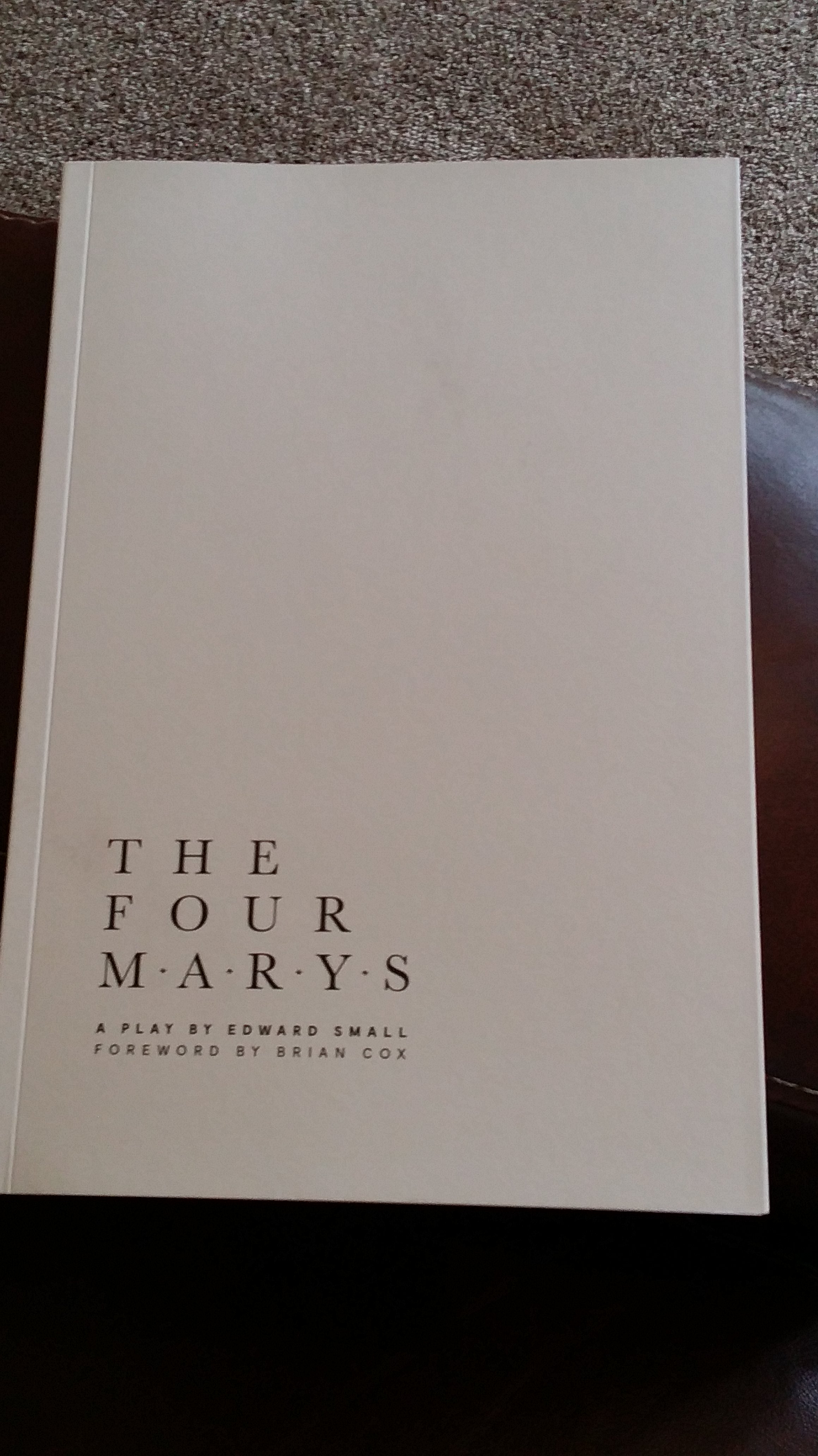
At around 5pm on Monday of last week, I received an e-mail from my former tutor Eddie Small. He was to stage his play The Four Marys on the Wednesday and Friday to mark the publication of the script, but one of the actors had dropped out for family reasons.

The Four Marys by Eddie Small – note that Brian Cox is the actor, not the professor
The Four Marys by Eddie Small – note that the foreword is by Brian Cox the actor, not the professor

I immediately agreed to step in; everyone would be reading their lines from paper so there would be little to learn. The play takes a humorous look at the history of Dundee through the eyes of four real historical figures who shared the same first name. My role was that of a bored tour guide who comes in at the beginning to usher a dignitary through her duties and appears again at the end to release two tourists who have been trapped in a museum for the whole play.

Although I’m accustomed to performing poetry, acting is a different skill: you’re reading someone else’s words and directions, whereas a poetry reading can be more flexible. Additionally, poets are often allowed to read from the page, although not always, while a professional actor must memorise each line.

Both performances turned out well, and I was particularly excited about being allowed to improvise so there wasn’t an awkward silence as I reached the stage. An ad-libbed line about being on a zero-hour contract went down particularly well with the audience.

It’s definitely an experience I would repeat; in fact, I would like to take part in more improv. I believe it’s one of the best ways a writer can sharpen their skills. When you’re in a scene, you’re under pressure to recall what you already know or to make it up on the spot.

Some desk research suggests that The Four Marys – published by The Voyage Out Press – is for sale locally, but is not yet available online. Here’s where you can find out more about the play.