Over Your Shoulder.

A couple of weeks ago, I went to see a special screening of Local Hero. It’s an excellent film, and if you have the opportunity, you should see it.

The director Bill Forsyth was brought in at the end to hold a question-and-answer session with the audience. He mentioned at the beginning that he hadn’t seen the film in years, and an audience member asked why this was. He answered that he wasn’t ashamed of his work, simply that he wasn’t interested in looking back, and questioned whether – for example – a writer would be interested in rereading their old stories.

Contrary to the director’s opinion, my answer is a definite yes. I openly admit that being a writer wasn’t a childhood dream, and I therefore don’t have notepad upon notepad of embarrassing teenage musings. Rather, I wrote my first fiction in late 2010, just before I turned 27, and looking back enables me to keep a weather eye on how I’ve improved.

Even if I come across an old piece that I find jarring, I know I only need to rewrite it, or in extreme cases, deconstruct it, to bring it up to my current standards.

A prime example of such a jarring piece is one of the first poems I wrote, called The Cooler, a short verse about a character’s self-imprisonment. Looking at it now, it needs to be longer to fully convey the situation, as it’s currently unclear, and the clumsy language needs to be trimmed, eg, “It stays cold all night like a fridge.” Now I’ve looked back at it, I can think about these issues and improve the work.

In my next entry, I intend to cover the issue of rewriting in a more in-depth fashion.

I mentioned I’ve been writing fiction for less than four years, but I was a blogger long before that, discussing the issues on my mind at that moment, much as I do here. That writing is a little embarrassing, but it’s only by looking back that I can see how much I’ve moved on. Here’s a typical entry from almost exactly ten years ago.

There are many writers who started later in life, and I found out recently that John Grisham is one of them. He didn’t write his first novel until he was in his 30s, and didn’t give up his work as a lawyer until his second was published.
Alt.Format.

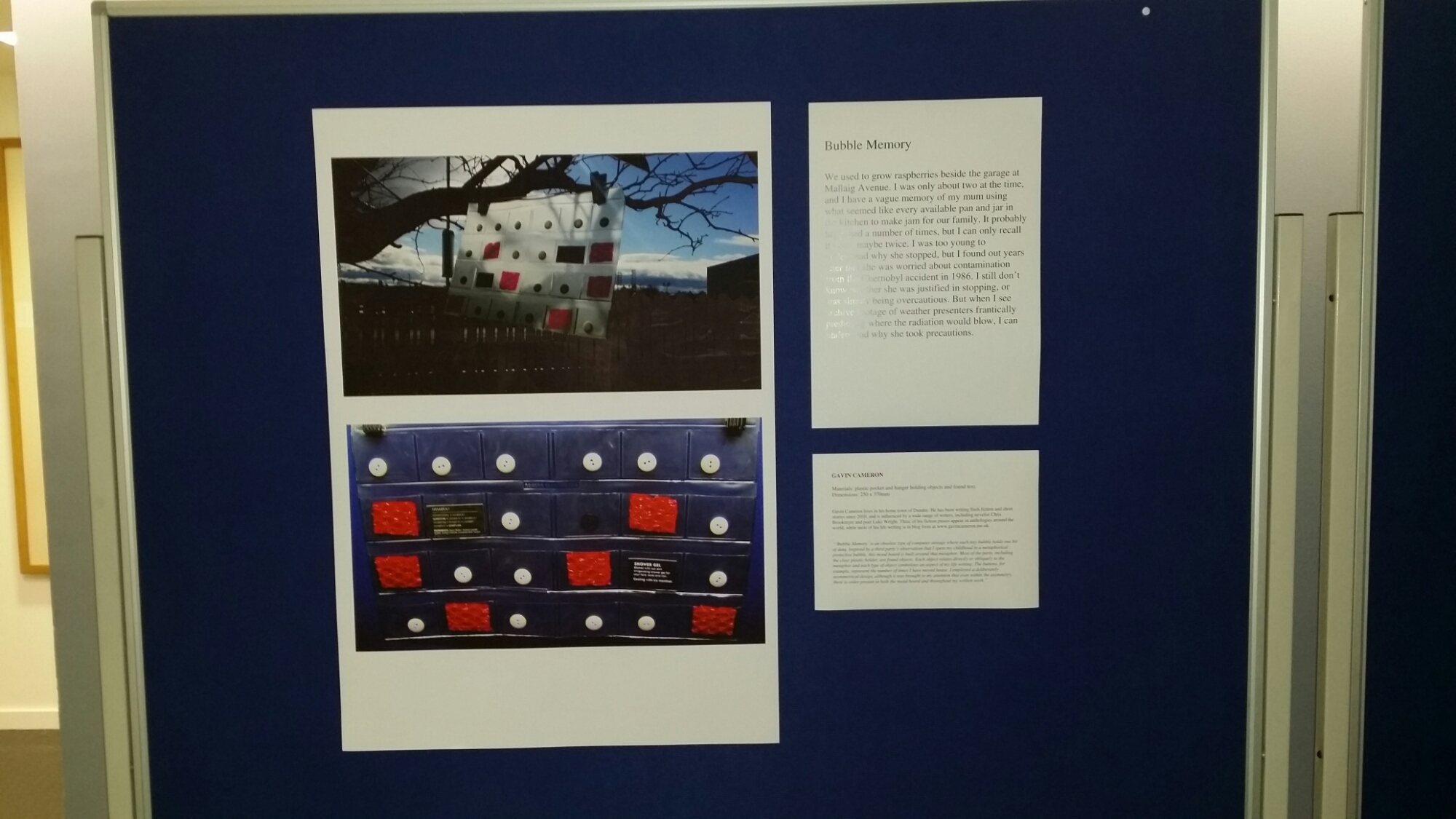
Last year, I joined a Life Writing class at the University of Dundee. One week, the tutor asked us to make mood boards to represent the themes of our writing. I didn’t look forward to this at all. As I’ve mentioned in previous entries, I’m not naturally gifted in visual expression.

But having consulted an artist for advice, I acquired materials from a nearby recycling plant, and pieces gradually fell into place. This task led to a short exhibition at the University where most of the class displayed their boards, with explanatory text and a personal story alongside each one.

The mood board in question
In the mood

My mood board came to be titled Bubble Memory, constructed of a 35mm slide holder with buttons and other found materials in each pocket. The photograph shows how it was displayed in the exhibition, which closed on Friday of last week, although we are in talks to extend it. Despite my initial dread, I was pleased with the all-round results.

This is not the first time I’ve experimented with alternative formats. Text-based artist Gerry O’Brien was also a member of the Life Writing class, and submitted a piece of homework on a thumb drive. It contained a PowerPoint presentation that told the story of meeting a man from Honduras in text, interspersed with photographs. The presentation runs automatically at a slow savoury pace, allowing the viewer to absorb every detail.

Inspired by this, another class member created a similar project, speaking about the dolls she makes and collects. And inspired by both their achievements, I converted an existing poem of mine into the format, but with no pictures and no audio. The text is displayed to the reader at approximately the speed I would speak it, but there is freedom on their part to imagine the emphasis and inflections.

I started experimenting with formats a couple of years ago when I took part in the Sketchbook Project at Brooklyn Art Library. I broke down one of my short stories into fragments of one or two sentences, then converted each fragment to a QR code. This is a square barcode that can be read by many mobile devices. When it’s scanned, the device shows the fragment of text.

I then glued each of these codes into the sketchbook in the right order to tell the story, and sent it back to the Library. It was then scanned and placed online, while the original sketchbook was taken on a tour around America. This is the finished sketchbook. The following year, I submitted an apology for the artwork in that first book.

I don’t think I will ever move completely away from text on paper, but the occasional piece in another format or another medium can engage the reader in a different way. I’ll leave you with the story of the world’s first hypertext novels, a form that would be challenging to reproduce on paper.

Between Two Stools.

I don’t think Rebecca Woodhead reads this blog, but in August’s Writing Magazine, she covers the subject of extroverts and introverts, as I did in a previous entry. But she takes it one step further, adding a middle category of ambivert.

My research shows this is not a horrendous neologism – in fact the term was invented in the 1920s – but I still hadn’t hitherto heard about this third way. It also turned up a wonderful WordPress post that goes into more depth about the subject than I will.

In the article, Woodhead argues that writers should aspire to be ambiverted and that few fall into the extrovert category. Yet in my experience, I’ve found that many already are extroverts; indeed I can think of a number who actively invite audience questions, or can’t wait to offer their views on a hot topic.

I can identify with the needs of an ambivert or introvert, as I’m quite fond of solitude. This is generally because I’m tackling a task that requires it, such as typing, editing, or reading – the very activities that make me a writer. But often, I’d much rather be reading my work out on stage, or answering audience questions, or negotiating with publishers.

Quite independently of the -vert spectrum, but not unrelated to it, I’ve been mulling over the notion of right- and left-brained people. It seems this theory is now outdated, as research shows that both halves of the brain generally work in tandem. Yet I still think my ‘dominant side’ has shifted at some point over the four years I’ve been writing fiction.

I have a BSc Music Technology degree because when I left school, I wanted to be in the music business or the radio industry. I used to delight in recording the perfect sound level, learning MIDI Commands, or editing video footage. In other words: what used to be termed left-brained activities. These days, I’m more inclined towards my fiction, speech-based radio stations and podcasts, and appreciating others’ artistic expressions. These were considered right-brained activities.

Perhaps I’ve always been at least partly right-brained but I hadn’t unlocked it until I discovered fiction. Alternatively, it’s maybe because I’ve had more success with writing, or at least more external validation, that I’m now subconsciously inclined towards chasing these rewards.

That external validation is a classic extrovert trait, and why I still place myself in that camp.

Julyish.

We’re midway through July now. In some respects, this is a troubling month for me.

Firstly, there’s the weather. I can’t speak for anywhere else, but I’m from Scotland and it can fluctuate wildly. Thursday brought the sort of weather for lying in a hammock and listening to the Isley Brothers. I took the opportunity to walk to the seaside and enjoy a round of crazy golf and a trip on the road train. By Saturday, the rain was tipping down in the least Julyish fashion you can imagine.

Secondly, the daylight. Regardless of the weather, near-perpetual daylight does things to the brain. I find myself waking sometimes an hour or two before my alarm, which does nothing for my concentration.

Thirdly, it’s holiday season for many people. You’re out of your normal routine and writing might not feature as highly as it does during your normal day.

But there are ways to keep your writing flowing even through the least Julyish July. A gloriously warm day or a change of scenery might provide you with fresh ideas. I make it a habit to carry a pencil and notebook with me, and I recommend taking a sharpener as well. And if it’s practical, perhaps a 5am writing session would work for you, or at least give you an opportunity to catch up on your reading, and that can be as important as writing.

Just remember that if you’re writing about summer and you plan to interest a publisher in your work, it might be up to a year before you see it in print as lead times are months long. Right now, editors are planning for Halloween and even Christmas, and probably won’t take you on until the New Year. So if you have any festively-themed stories, this would be a prime time to dig them out, even if it seems a very long time away.

Performances and Housekeeping.

On Monday of last week, I debuted a new poem at Hotchpotch. This is a local open-mike night for writers. While I’m far more of a prose writer than a poet, I thought this particular piece would go down well.

I’ve been to enough live events to know the standard housekeeping message that’s given before the performance. This poem was a version of the announcement that made it sound as though the speaker was having a mental breakdown. It did indeed attract a positive response, while a second poem and a short story were also well-received.

At last month’s Hotchpotch, I had a picture taken of me. I didn’t particularly like it because my neck was too far forward reading the piece. This time I was sure to stand up straighter and look up at the audience from time to time. I’m not saying my pieces came across better because of it, but I certainly felt better by paying attention to these factors.

I’m an advocate of people reading out their work in public, and of course in private while proofreading. If you know of a nearby group, go along and support it. There are actually two such groups around here, but I didn’t take to the other one since the focus there is mainly on folk tales, whereas Hotchpotch has a more literary flavour. Some groups even allow you simply to listen without contributing for the first meeting.

But what if there isn’t a group, or it’s not the right style for you? Have you ever thought about starting your own? There’s no reason why you should wait for someone else to do it, as it probably won’t happen.

The meeting place doesn’t have to be anywhere with a stage. We meet on the upper floor of a café, and we create an informal Poets’ Corner near the top of the stairs. Some pubs and coffee shops are happy to donate their space provided the participants are putting money in the till, so we hold at least one break during each evening. Just bear in mind that the venue could back out or change their terms at any time. A pub we used to use free of charge suddenly wanted £50 a session, even though we probably spent double that in drinks alone.

The other element you need to decide is the ethos. Should the audience offer constructive criticism to the readers, or is it solely for writers to try out new material? At Hotchpotch, the latter approach is taken, although there’s nothing to stop people giving feedback to each other privately afterwards.

But above all, it’s for writers to meet and talk to each other. Every time we meet up, I usually hear about an upcoming event or two that I wouldn’t otherwise have known about. The actual writing process is generally a solitary pursuit, but we all still need that connection.

What’s The Story?

A couple of entries ago, I mentioned that I rarely post my work on the Web. This is because I enter competitions and contact publishers. The rules invariably state that any story submitted should never have appeared either in print or online.

I have one story that’s already in the public domain, and I’m going to share it with you below. I wrote it for a Twitter friend, and it gives you a flavour of my style, although I don’t usually write in American English.

#

Text In The City
By Gavin Cameron

Monday, and for the third week in a row, I took to the streets of downtown Ladymill. I had made some acquaintance with a few of the commuters, one of whom had bought me a cup of coffee every day last week.

But as pleasant as it was to meet these people, I wasn’t doing this for the friends. I desperately needed something that nobody seemed able to give me. I perhaps should explain why I attracted so much attention. I’d been carrying two dry-erase boards attached by two ropes over my shoulder.

The one on my front read: NEED A JOB. CAN’T GET MORE WELFARE. Oftentimes, the rain washed off the semi-permanent ink and I had to rewrite it two or three times.

The blank board on my back allowed potential employers to write down their details. So far, I had only attracted a couple of comments, including KICK ME and I’M WITH STUPID.

But I believed this Monday would be different. Perhaps it was the optimism from the sunnier weather, or that the commuter’s coffee had gone straight to my head after an inadequate breakfast, but I definitely felt a new sense of being.

As the commuters thinned out at around six o’clock, no doubt rushing home for a well-earned beer, I considered finishing up for the day. But I had no beer, just leftover Chinese food.

I walked to the train station, when a man in an expensive-looking suit approached me. Over these three weeks, I developed an ability to tell when someone was about to speak to me, and I spoke first to show I wasn’t afraid to take the lead. “Good evening. I’m Rachel Morton. Can you help me?”

The man nodded. “I think I can.”

Excited, I replied, “Oh that’s great. What kind of work can you offer?”

“I work in advertising and marketing. Have you any experience of the industry?”

“No,” I replied, “but I’m a fast learner. You can even give me a week’s trial, but I’ll only consider a paid trial.”

“Don’t worry,” replied the man, “I would pay you, although it’s minimum wage. And to be fair, you don’t need much experience.”

“I’ll consider any reasonable offer.”

“I have an office a couple of blocks from here. How about you come in tomorrow morning? Here’s my card. Bring a resumé and some ID.”

I arrived as instructed wearing my most professional outfit. The office looked very glassy and modern, and didn’t contain many staff, so I could work almost uninterrupted. Yes, I could do this. No more rainy days wandering around town. I was now an office worker. I signed a month-long contract that day.

I soon found out why there were so few staff. This advertising company wasn’t offering a desk job. They wanted people to walk around the streets with billboards strapped to us.

<<<>>>

Long May It Last.

A couple of entries ago, I riffed upon the art of shortening the short story. But having thought a little more about it, I’ve come to realise a lot of the short stories I’m most proud of are actually longer than 2000 words. I have written novels, but they’re a different class entirely.

My longest short is called An Abundance of Apples, clocking in at around 4500 words. This tells the story of a man who trades 26 items, each beginning with a different letter of the alphabet. This was always going to be the approximate length, and it gave some room to manoeuvre when telling the story.

Another of my favourites is The Cracked Goldfish Bowl, about a man with an amazing memory but no self-confidence. The final word count was 4300 words, but that’s merely because I kept thinking of new challenges to face the main character rather than creating an overarching plan.

I tend to approach my short stories from the top downwards. Sometimes I know where I’m going to end up, but often I let the story wander as it wishes. An artist I know, Jennifer Robson, prefers the meandering approach to her sewing, as she doesn’t feel challenged if she knows what the end result will be.

I’m a strong believer in writing a proper ending to a story, whether that ending is known beforehand or not. Sadly I’ve read too many ‘two-thirds’ pieces with a great set up, and enjoyable narrative, but the writer has omitted a satisfactory conclusion, leaving it to flop out with a vague sentence or two. That final third might have made all the difference.

What I’m saying is that some stories need cut down to size, as discussed in that last entry, while others require some room to breathe. The question is which approach is the best one to take for that particular story.

What a So-and-So.

I once heard digital information compared to a greasy pig. You can hold on to it for so long before it slips from your grasp. Despite this, I’m unable to find a recording of the BBC Breakfast news item about the use of the word, “so,” at the beginning of sentences. I can only find their Twitter update from Friday:

Nonetheless, I’ve found a great example from last year, when the boss of BlackBerry failed to explain adequately how the company lost direction. Stephen Bates uses the conjunction at least four times at the beginning of answers, and several more throughout.

I think we all know people with verbal tics. I probably have one I’m not aware of. I once had a conversation with someone who kept saying, “He/She turned around and said…” By the end of the conversation, I imagined the other party with a nail in one foot, frantically turning round and around with the other.

On the page, a fictional character with a pet phrase can be a useful device in dialogue. If they always start with, “Well, the thing is, you see,” or call everyone, “love,” it eliminates the need for an identifier when multiple people are speaking. Even a gesture can be effective. I have a novel where a character shrugs when he doesn’t know an answer, and that’s a lot of the time.

But, well, the thing is, you see: balance is key. It’s enough to, like, give a flavour of the character’s go-to words. Including it in every, like, sentence or clause will only, like, annoy the reader.

The Final Cut.

Further to the publication of the Alternate Hilarities anthology, I’ve been interviewed by Strange Musings Press. I’ve also received two paper copies of the book, but I’ll read the electronic version and keep the physical copies pristine and flat.

The story in that anthology is 1,160 words long, but in fiction, as in food, it’s sometimes necessary to cut down. I’m a great fan of reading work aloud. It’s a very good way of finding where one clause would be better than two, or where a semicolon could replace several words.

I only half-follow Elmore Leonard’s advice to Kill your darlings. In other words, to cross out any lines you particularly like. I think that’s fair game if the line in question has been squeezed in where it’s inappropriate, but if it’s the perfect means of expressing what you mean, I say jolly well leave it in.

But what if the problem is not just a line or two, but whole chunks of text? I encountered this problem with a 1,000-word story I wrote well over a year ago. I simply couldn’t make it work to my satisfaction. I shuffled round a few of the characters, who are all introduced as they enter a house, but I still couldn’t make the story flow.

In the end, I cut out the first 700 words, and I’m much happier. All the characters are still there, but it works by starting when they’re already in the house. The dialogue explains the immediate situation, and the twist makes the reader fill in the gaps.

But what to do with the cut part? Don’t delete or bin it, whatever you do. You’ve worked your hardest on it, and it deserves to be seen. I’ve recently started to maintain a list of story stems, those ideas that have thus far gone nowhere. Some are mere seeds, others are massive chunks, but they’re waiting with their jackets on in case the right alternative idea comes along.

Since constructing my list, I’ve used three of the stems. Once I use them all, I’ll need to start actually thinking again.

Alternate Hilarities Released by @Strange_Musings Press.

I’m pleased to report that my short story Amending Diabolical Acronym Misuse has been released today by Strange Musings Press in its Alternate Hilarities anthology, along with a number of other comedy pieces.

It’s available in both paper and electronic formats. You can buy a copy from Amazon UK, from Amazon US, or from Smashwords. Find out more about the book, and enter their Rafflecopter gift card giveaway, at the official website.

I’d also like to give thanks to the editor, Giovanni Valentino. Book publishing takes months of work, and throughout it all, he has been in regular contact with the contributors, and kept us up-to-date with its progress.