©

Open the front cover of most books and one of the first pages you’ll encounter contains paragraphs that begin something like:

  • First published in Great Britain in [year] by [publisher];
  • The right of [author name (s)] has been asserted by [him/her/them]…;
  • and All rights reserved. No part of this publication may be reproduced, stored in a retrieval system, or transmitted…

This legal text is effectively saying that the author and publisher, and/or anyone else involved in making the book, have created an original piece of work and that the reader is not permitted to do anything with it other than enjoy the text. The modern copyright system began with the Berne Convention in 1886 and has evolved over the intervening decades, and it’s now something we take for granted.

It was brought to my attention this week that there is a manifesto proposal by the Green Party to shorten copyright terms to a maximum of 14 years, a move that is causing anger among authors. In most cases, the current system guarantees copyright control for the rest of an author’s life, with control transferred to his or her estate for 70 years after death. If the 14-year proposal were already in operation, this would mean anything produced in the 20th century was now in the public domain.

Incidentally, following a change in the law last year, comedians are less likely to be sued successfully if they produce a parody version of an existing work.

With so much at stake, there’s a good reason to make it plain who owns the copyright. To this end, many emerging authors place a large copyright and/or © on their manuscript before sending it to a publisher, or on the cover of the book if it’s self-published.

There is no need to do this for two reasons:

  1. Making a big show of copyright is the mark of a nonprofessional. A publisher isn’t going to steal your manuscript unless they’re a dodgy outfit, and if you do self-publish a book, a discreet copyright notice inside will suffice. Make sure it’s drafted by a lawyer or someone who knows what they’re doing; don’t make up your own wording.
  2. In any case, copyright exists the moment a work is created, at least in the UK and in the USA. The purpose of the notice is merely an affirmation of the copyright.

If you have had something published in a book or in a magazine, make sure you’re receiving the appropriate money from it. Register with the Authors’ Lending and Copyright Society to check whether you could be paid secondary royalties from photocopying, scanning and digital copying. If your book is in a library, royalties are generated each time it’s borrowed, so consider joining the Public Lending Right scheme to collect any money owed.

Situation Comedy.

Last night, while stuck for something to watch on TV, I came across an old Rich Hall DVD. I’ve been a fan of his for some years, whether as himself or in the guise of country musician Otis Lee Crenshaw. This DVD featured both personas. In the Crenshaw part, he performs a couple of template songs using the details of audience members to fill in the blanks.

English: Rich Hall performing live on November...
Rich Hall performing live on November 1, 2007 at Knabrostræde in Copenhagen, Denmark. (Photo credit: Wikipedia)

Regular readers will know that I encourage every writer to stand up and read their work in front of other people, and one area I like to explore is customising the material to that particular situation. Writers can easily use those same principles of comedy at a reading.

Not too long ago, I saw a poet walk on stage with a rucksack. He started his act, and midway through, he took off the rucksack and walked through the audience, giving out small bars of chocolate to everyone who had performed before him and to anyone involved with organising the event, adding briefly why he considered each individual to be, “awesome.”

The last time I tried a tailored act, I read out a story consisting of six passages from six viewpoints. I placed each passage in an envelope, marked each one with a letter from A to F, and passed a beanbag around the audience. Whenever it was caught by a new person, I asked them to shout out a letter and that would determine the order of the story.

Some acts thrive on audience embarrassment, but that’s not to my taste unless anyone is heckling or generally being difficult. When I threw the beanbag, I made it clear that whoever caught it would not be hauled up on stage or embarrassed in any way. And with regard to the rucksacked poet, who doesn’t like free sugary treats? These two approaches kept the audience on-side, while allowing the performer to customise the reading to that particular location on that particular night.

In fact, even this entry is situation-specific, as the subject would have been totally different if I hadn’t seen that DVD last night. Rich Hall is also responsible for one of the most bizarre situation-specific incidents I’ve seen on stage. At the Edinburgh Fringe a few years ago, he unexpectedly brought Radio 4 stalwart Barry Cryer on stage as a guest vocalist.

Author amnesia.

If British Rail posted a blog entry late, they would claim it was on time. I, however, make no such claim, but I have been busy over the last couple of days. I shall attempt to restore my Monday timetable from next week.

On Sunday, I went to see bestselling author Irvine Welsh launching his latest book A Decent Ride. There were two unusual things about this event. The first was the charge for admission since book launches are usually free in the hope you’ll buy a copy, which I did anyway. The second unusual occurrence was that I asked a question.

Hint: I'm the one that's not the bestselling author
Hint: I’m the one that’s not the bestselling author

Welsh was interviewed for 40 minutes, during which time he gave a couple of readings, one dressed as his main character. Then the audience was invited to ask questions, and I asked whether non-Scots readers find his use of slang and dialect a barrier to his work or a way of pulling them into the story. It seems readers struggle a little for the first 20 pages, but slowly learn to adjust.

I don’t what it is that stops me from thinking of a question on the spot. It’s not that I’m embarrassed, but I can’t think of something to quiz them about, and I don’t want to rely on the old classic, Do you write longhand or use a computer?

If I can think of something, I often go away thinking it was perhaps best to keep my mouth shut so I didn’t ask something stupid. That said, I saw Iain Banks live on stage twice and he invited questions from the start of both events. Again, my author amnesia struck. Shortly after the second event, he announced he was dying and cancelled all future engagements so I’ll never have another chance.

L’étranger.

For those of you who enjoyed the main event in November, we’re now nearly a week into Camp NaNoWriMo. This is an offshoot project where you have a free choice of what you want to work on, and you can set your own word target from 10,000 upwards. However, this is not what I want to discuss today.

One of our group members keeps a WordPress blog about her experience of moving to Scotland, from eating ice cream on a cold day to voting in last September’s independence referendum. Indeed, we boast a number of members from other countries.

There’s a joke often repeated that there is no such thing as American English, there is English and then there are mistakes. Joke or not, I find it difficult to agree with this statement, as there are so many variations of English even as you travel within the same country. For proof of this conjecture, just ask people on your favourite social media site what they call the end slice of a loaf of bread and watch the arguments come to a head.

The Stranger (collection)
The Stranger (collection) (Photo credit: Wikipedia)

Regular readers will know that I’ve so far been published in three countries: England, Australia, and the USA. Sometimes when I send to US publications, I change the spelling and grammar appropriately, with guidance from Microsoft Word and my own knowledge of Hollywood movie dialogue. This isn’t, I admit, a perfect system. And yet the one story published there is written in British English, and that’s because the protagonist is obsessed with acronyms, and changing the location would mean rewriting those acronyms, so the Britishisms stayed accordingly.

I know virtually nothing about Australian English, so I stick with my usual spelling and syntax. Here’s where to buy FourW Twenty-Four containing my story, although they’ve omitted my name from the website. I made reference to a motorway, whereas a quick Internet search suggests that highway or freeway might be more appropriate. The type of road is not a major plot point in this piece, nor does the action take place in a specific locality, but I know a few expats who can advise me for next time.

While looking up these links, I discovered that another Gavin Cameron wrote a non-fiction book in 1999 about the threat of nuclear terrorism. So if that’s a subject that interests you, it’s the other guy you want to speak to.

Immediacy.

Sometimes an idea for a piece strikes after hearing about a topical event. Last week, for instance, I posted a poem I wrote on the day of the solar eclipse. Back in November, I was also inspired to write a short story prompted by the BBC’s coverage of the Ferguson riots. Since last week’s entry was posted, the world has been talking about the Germanwings plane that crashed in the French Alps. That also inspired a poem in the same form as the eclipse one.

Neither the Ferguson nor the Germanwings pieces have been posted online as I might send them to a publisher in the future. I’m afraid you’ll have to take my word for their contents, which I discuss later on.

When writing a response to current affairs soon after they happen, the details are fresh in everyone’s minds as they’re analysed in the papers and on TV. However, the danger is that specific incidents from the wider event are sometimes forgotten as soon as a week after they occur; in some cases, the entire event might not survive in people’s memories. It’s hard to tell which events might stick around and which won’t. The piece you’ve written in response might therefore contain details that need to be explained in future readings.

Regarding the three pieces in the first paragraph, my solution to this problem was not to focus on the incident itself, but the thoughts and feelings generated by it. To find the universal truth, if you will. It’s not necessary to know that the eclipse took place in March 2015, nor that anything happened in Ferguson, nor that a certain plane crashed in a certain place.

The alternative is to make the piece self-contained, giving the reader enough of an insight about the event for them to understand why you’ve responded to it in a particular way.

A good example comes from the Billy Joel hit We Didn’t Start the Fire. In the lyrics, he makes reference to around 100 world events that happened between his year of birth (1949) and the song’s release (1989).

Many of the earlier events, such as Bob Dylan’s career and John F. Kennedy’s assassination, had already stayed in the public consciousness. However, a modern listener might wonder the meanings behind Hypodermics on the shore and Rock-and-roller cola wars in the late 1980s, as these haven’t been widely retained in our collective memories. There’s no way Joel could have known this, of course, nor that the Berlin wall – after having its construction noted in the song – would be knocked down just two months after its release.

The News Where You Are.

A rather short entry this week. In fact it’s a mere musing on the event that turned everyone and their dog into expert astronomers. I’ve used the form of the tanka, which starts as a haiku but has two extra lines of seven syllables apiece.

The moon ate the sun
on Friday morning in March.
We viewed it through the
office window, expected
to work through all the carnage.

Who’s Who?

A couple of weeks ago, I mentioned that an editor had tried to reach me but didn’t know the best way to do it. I still haven’t set up an e-mail address or contact form, but I’m looking into my options.

Once the contact is made, how can you be certain the person is legit? If you spend even five minutes on Twitter or any other public platform, you soon learn to regard other users with a healthy suspicion.

To that end, I’ve put together a guide on how I approach the matter. It’s geared towards writers, but the principles apply to any field. Even after following these, you should still use your own judgement.

How much can you find out about them?

If you’re contacted via a website, the user should have some information about themselves and/or the company they represent. If it’s by e-mail, the name of the company often appears after the @ symbol in the e-mail address. In this case, the editor’s first and last names were immediately available on her Twitter profile, and I was able to find a link to the publisher’s website.

When evaluating a company’s website, be sure the address you thought you were going to is consistent with the one you eventually see. If you go to Faber and Faber’s site, for instance, the domain will always appear in the address bar. On the other hand, you can reach this blog by going to http://www.gavincameron.me.uk, and you’ll be redirected to https://gcameronwriting.wordpress.com/. It still doesn’t prove I’m Gavin Cameron, but it is consistent.

Once you’ve reached the site, read the text carefully. Does the text sound like it’s been written by someone who knows their stuff or is it generic marketing copy? Are they giving information about the product or being particularly vague and evasive?

Why me and why now?

Once you’ve checked them out, consider the message you’ve been sent and when it was sent. Is it clear you’ve been targeted because of your skills, or does it seem as though they’ve done a general search for writers and sent the same message to everyone?

As for the when, a friend of mine gave me a prime example recently. She works as a model, and showed posted up a request from an agency who claimed to work for big clients, yet it stated that the photographers could work around the model’s schedule. This is highly unlikely, as most projects in any field are time-limited and require certain actions by a certain date.

In my case, the editor had read previous work of mine and thought my style might suit the publication, and the deadline was spelt out clearly.

Are they asking for money or promising you money?

In publishing, money traditionally flows one way: from the publishing house to the author. Writers were always advised to think twice before giving any money to have their book published. But with the rise in self-publishing, the lines are a little more hazy as the writer has to foot and recoup many of the expenses. So how can you tell who to pay?

Firstly, let’s exclude competitions from this. There is often an entry fee of around £5 per story to cover administrative costs, contribute to the prize fund, and sometimes to make a charity donation. This is perfectly normal.

So, self publishing. The main factor to watch out for is the type of interest the company takes in your book. A place that praises the manuscript to high heaven, or takes no interest in the artistic content, should be treated with suspicion. Even the best books go through several rewrites before they ever see a shelf. A reputable self publisher is more likely to be honest about the manuscript and perhaps offer editorial services. Again, always use your judgement.

The other phrase that should ring alarm bells is to the effect of, “We can’t afford to pay you, but we can give you great exposure.” Often these requests come from well-meaning people who mistakenly believe writing is nothing more than a hobby to you, but sometimes from sources that could afford to pay and choose not to. If it’s for a cause you believe in, or you really do need the exposure, then that’s fair game. Otherwise, my advice is to ignore them or decline the offer. Whether you decline politely is up to you.

Different Trains.

About four years ago, I started attending a creative writing group I’m still in today. The tutor gives a prompt and the job of the class members is to write a passage inspired by it. In one of the early sessions, we had a member who often wouldn’t write anything, but would instead describe what she would’ve written. I had a similar experience at the StAnza poetry festival in St Andrews on Saturday.

I’d been meaning to attend this for some time, and this year I finally bought a ticket for Clive Russell (Coronation Street, Game of Thrones). My plan was to arrive around midday and buy tickets for other shows on an ad hoc basis. I queued at the Byre Theatre box office for a show about Alexander Pushkin and Russians in Paris, to be told that the tickets were now available only at the venue door. When I reached the, they had just sold out.

I decided instead to have lunch quickly, then see a 12pm show by a artist and a poet who had written a Ladybird-style book about St Andrews. An enjoyable 40 minutes as they described the challenges of being in two different cities but having to collaborate, but only the audience members attended.

After tea and a scone with one of my classmates who was working at the event, I headed to Musings@MUSA, which encouraged visitors to use the objects on display as inspiration for their own poetry. The first exhibit I saw was marked Seal of Approval and that phrase stayed with me. The 17-line poem I wrote was definitely inspired by elements in the exhibition, but ended up not being about the place.

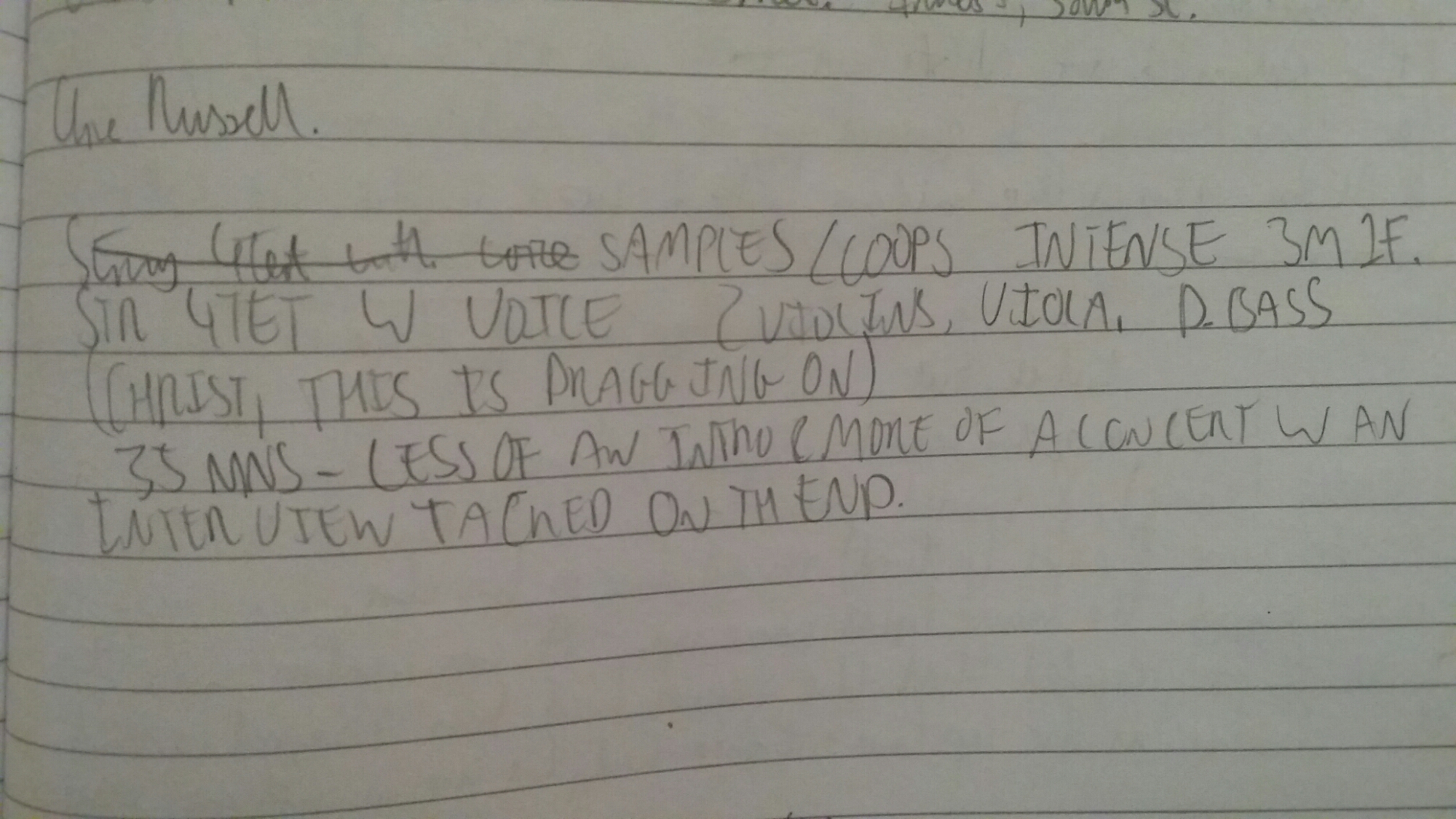
Finally, time for Clive Russell. I queued up at the auditorium to be told it was, “At the top of the building.” I wasn’t sure how she knew this from looking at my ticket, as there were no obvious markings, but I moved upstairs to the top entrance and took my seat. We were treated to a duet poem written by Rock McKenzie, then the experimental Veridian String Quartet performing Different Trains by Steve Reich.

I made some notes in advance of the main event. The photograph below shows some of these.

image

When the house lights came up and there was no Clive Russell, I was puzzled. The man beside me said that venues for these two events had been swapped around. I slowly worked out that the first ticket checker had meant a completely different venue, while the second one should have paid attention to the show name on my ticket and not let me in. However, I was indeed in the venue printed on the ticket.

To compound the matter, I’d offered to review the events for Dundee University Review of the Arts, or DURA. If I were writing for The Guardian or suchlike, or I’d’ve been sacked on the spot. Fortunately, DURA’s contributors are volunteers, so I explained the situation to the editor in question and it was no big deal. She even gave my classmate and me a lift home in the evening.

I still enjoyed the day, and I’m tempted to go back next year. I’ve learnt nothing is a waste of time if you can take from it a good anecdote or a free pen.

Keeping In Touch.

Last week, an editor wanted to make unsolicited contact with me, but was unsure of the best way to approach it. She settled for asking me via Twitter to e-mail her. This started me thinking.

There are several ways to reach me publicly: leave a comment below, send a Twitter message to @LadyGavGav, or post to me on Google+. Yet I hadn’t previously thought about how people could contact me privately. In the case of the editor, it meant putting her e-mail address in the public domain, which I’m keen to avoid thanks to the risk of spam.

So I’m interested in how you manage to maintain contact with others? A ‘disposable’ address that forwards to your real one? A website form? Or some other method I haven’t thought about?

Press play.

Recently, I’ve rediscovered the art of playwrighting. National Novel Writing Month used to have an offshoot called Script Frenzy. In 2012, its last year, I wrote my first and only full-length script: a stage play for two actors. Since then, I’ve become more comfortable with dialogue in prose, and how it can be used to imply action, or indeed how an action can omit several lines of speech. I haven’t yet edited my Script Frenzy work, but I imagine I could tighten up the dialogue and cut out many of the directions.

One thing that strikes me about penning a play is that you must have a clear idea of where it’ll be performed, not just which venue, but where in the world. A radio drama, for instance, will be radically different from a screenplay, and done on a vastly different budget. Even taking a stage play from London’s West End to Broadway will require the script to be laid out in a different format. But once you know where it’ll be set, the rest falls into place.

Scrivener, for instance, offers several different templates, including all the ones mentioned in the last paragraph, and any that aren’t shown by default can probably be downloaded. You tell the program your next action by pressing Enter or Tab at the end of each line. I’ve found this software a joy to work with for novelling, and just as good for scripts.

It’s most important, however, to remember that playwrighting is not for control freaks. The moment you give it to a director, he or she will have different ideas about how your words should be presented to an audience. You might imagine your characters sitting opposite sides of a table dressed formally, but the director might see them in jeans cuddled up next to each other. The writer has limited input in this process. The only way to guarantee it goes the way you want is to become a director yourself.