I’ve left it until the last minute to write this entry. It’s not entirely because I’ve been busy – although that’s a factor – but because I wanted to hear the announcement today from the Scottish First Minister, Nicola Sturgeon.
Tomorrow is the next instalment of my open-mike evening Hotchpotch, and it was expected that new restrictions would be brought in today on account of the Omicron variant of COVID-19. Happily, nothing in the announcement affects our ability to hold the event tomorrow, even if more members might choose instead to attend our virtual event on Sunday.
Last week, we were also able to run a new version of our gameshow The Literal Flow Test, involving Christmas-themed topics, as part of a wider programme of events. I might come back to this topic in a future week as there’s a story to be told there as well.
The one event that isn’t back in person is National Novel Writing Month (NaNo). As that organisation has a largely top-down approach, all the regions in the world have been advised not to meet except online, even if our local authorities allow it. Which brings me to a point about the timing of my weekly blog posts.
When I started writing this blog, I was able to update regularly at 5pm on a Monday. This evolved into 6pm on a Tuesday, and that lands squarely during the NaNo meetings. That used to make sense because I would talk to people around a table while using my PC to type the entry.
Because I’m now using my PC to talk to members and write at the same time, it’s not so simple. As such, from next week, I’ll be updating this blog at 8pm on a Tuesday. The time is still subject to a trial run, but expect my entries to appear a couple of hours later.
As I sit down to write, it feels like a continuation of the last entry, where I talked about inspiration appearing at 5am. This time, however, the inspiration happened near the end of the day.
I’ve been asked to provide a poem for a 12 Days of Gratitude project. As late as Saturday of last week, I’d absolutely run dry of ideas. There were plenty of people to thank, but nothing that fitted into a structure.
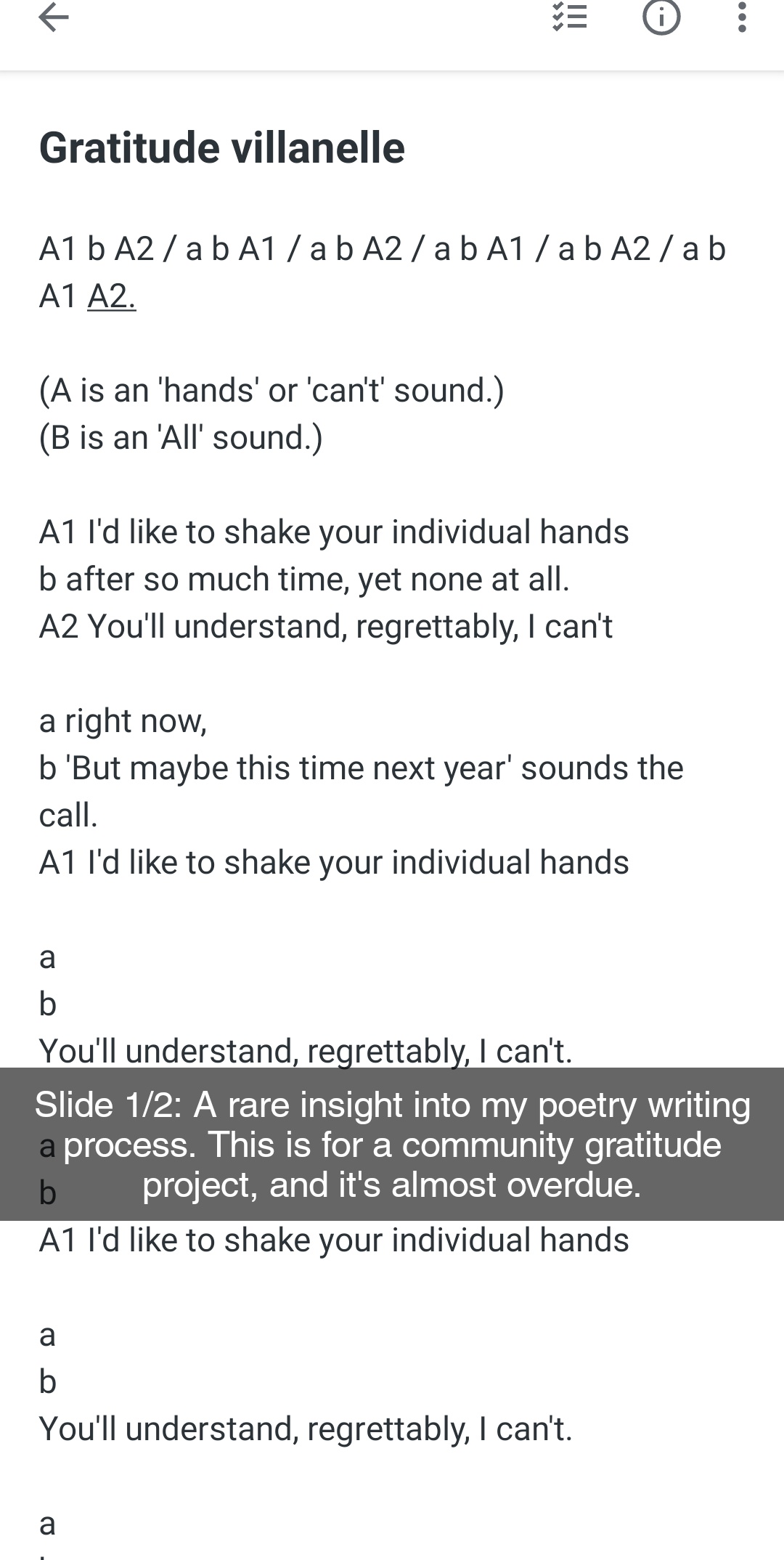
While I do find walking helps with the process, I wasn’t having much luck – and over an hour later, I thought of my first line and the structure. I even took a couple of pictures to document this. It’s rare that I would show such an incomplete draft so early, but it happened by surprise.
Half-completed villanelle about gratitude
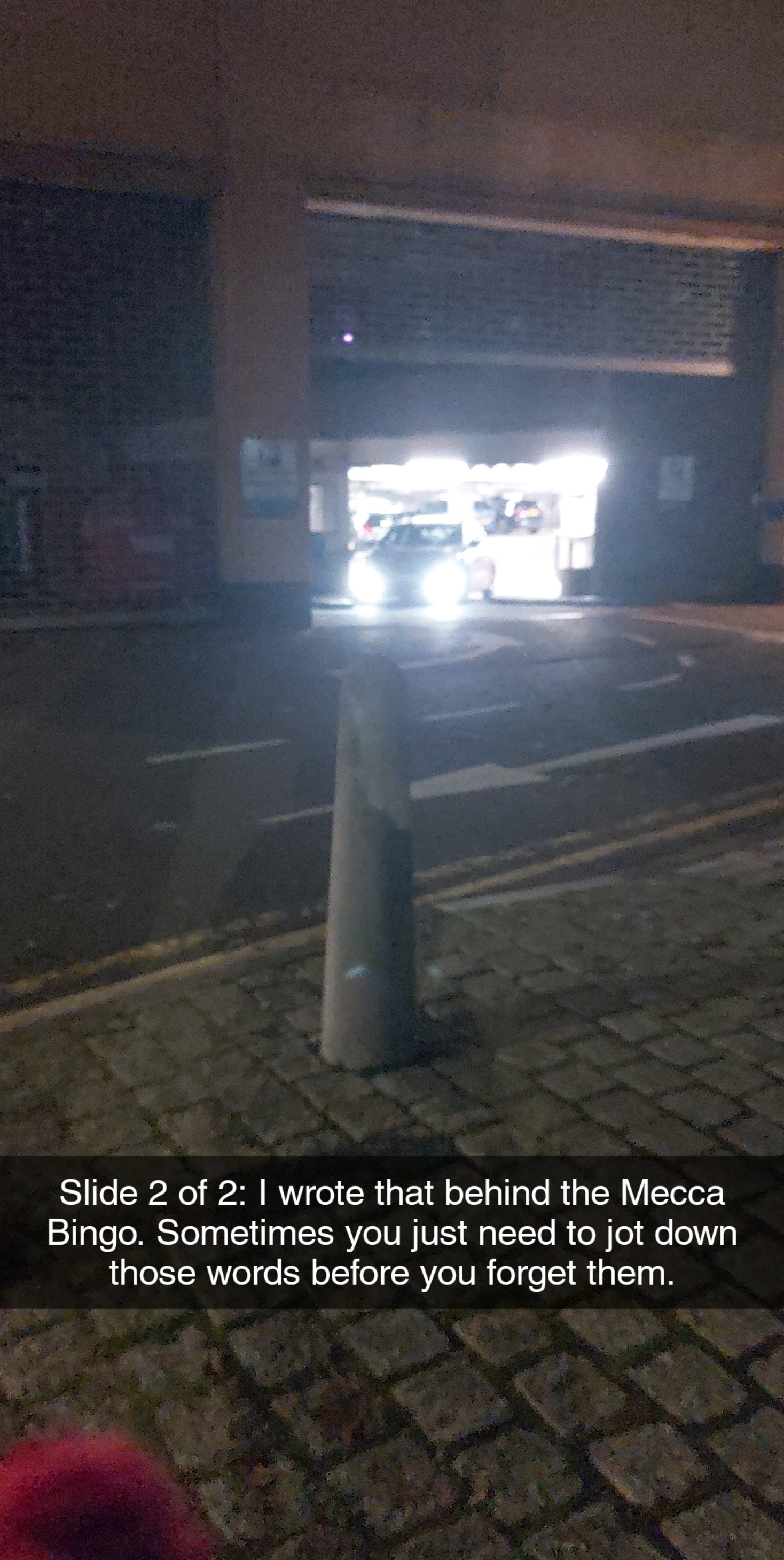
My walk had taken in river views and grassy areas, but when I wrote those lines, I was probably the least inspiring place I’d been that evening: behind the Mecca Bingo.
Picture of Mecca Bingo where villanelle was written
What I need to do now is finish the piece and make a recording of it, but arguably the hardest part is over, so the rest should be plain sailing.
This week, I’ve been trying to write a piece for my poetry circle. Specifically, it had to be in some way related to the author Robert Duncan Milne, a forgotten contemporary of H G Wells.
As the reading for this has taken up so much of my time, I don’t have a full-length entry for this site.
However, I’ve often advised that going for a walk is a great way to sort out the ideas in your head, and that’s exactly what happened here. After days of reading, and trying to tie together a few of Milne’s concepts into a single verse, it was a lunchtime trip outside that gave me the final verse.
I’m about to read it over just now, maybe tweak it, and send them my work.
A few weeks ago, as part of the inaugural Dundee Fringe, I hosted the premiere of an experimental game show called The Literal Flow Test. It borrows elements of the Radio 4 show Just a Minute, asking five players to speak for up to two minutes without stopping, and pairing that with the knockout stages of a poetry slam.
I was pleased to find that we had attracted nearly a full house; the official paperwork shows 27 out of 30 seats sold. Most of the topics were picked at random from a pool, but part of the fun was asking the audience for topic suggestions in the last round, and they joined in with enthusiasm, with subjects ranging from ‘Stonehenge’ to ‘Cybernetic enhancement’.
I’m aware that despite this show being all about avoiding hesitation, it’s taken a few weeks to write about it. However, I wanted to bring you pictures as well. You can find them all on the PPG Photography Facebook page, but below is one of the poet Fin Hall.
The playwright Jen McGregor emerged as victor after a tense five minutes of tiebreaking. With a few minor tweaks to the rules, it would be grand to run it again at some point, possibly for charity.
All the players, and the judge, were members of the Hotchpotch open-mike night. But unlike Hotchpotch, which is run entirely on a voluntary basis, each act at the Fringe received a share of ticket sales. This meant each participant could receive a little cash towards their travel or drinks on the night.
Of course, I nearly forgot to give Jen her envelope, and had to chase her up the street at the end, but we’ll move on from that.
Every so often, I’ll start to write an entry, then abandon it. Sometimes I don’t know how to finish it; sometimes a more urgent topic arises before I can finish it.
As such, I have five draft entries in my WordPress account, listed in order of when they were last edited. The original unedited words are in italics, with further explanation below each one.
18 Mar 2018: The Importance of Outside Influences
While it is necessary for an author to read within their own genre, one of the first pieces of advice given to beginner writers is to read widely. and collect influences from different sources.
This is fairly self-explanatory and probably would have segued into a couple of examples of where the author has successfully put together two disparate ideas to create something new.
Oddly enough, I was at a workshop run by Kirsty Logan a couple of weeks ago where she explored this very idea, so this topic might make a resurgence.
15 Oct 2019: But Who Would Want to Hear About That?
At the weekend, I took part in two different tours: on Saturday, a road train around Arbroath; on Sunday, a walking tour around the mostly-disused basement of Glasgow Central Station.
In both cases, it was clear that the guide had a vast knowledge of his subject, including a recognition that there were still mysteries to be solved
There is no shortage of fiction written by people with an exhaustive knowledge of their subject: Herman Melville in Moby-Dick, Dan Brown in Angels & Demons, &c. Often it makes for compelling reading, but an author needs to be careful not to overload the reader.
21 Jul 2019: Respeaking
Respoken.
This was the entirety of my note. It was a reference to how TV subtitles are created, at least on the BBC.
I wrote this fragment while listening to a poetry event from Wolverhampton and surrounding areas. Someone talked about living in a post-industrial place and the language that grew out of that, and I could draw a comparison with where I live, hundreds of miles away.
I’m not sure how much I could expand much on this idea, but it’s still there for the taking.
10 Aug 2020: The Fallback Formula
While taking my Masters degree, our class was asked to perform a piece for public reading. We could do anything we wanted, but the tutor suggested the prompt ‘piece of my mind’. As I wasn’t finding any ideas, I did what I often do in that situation, and go for a walk. I recall it was a freezing February night.
The walk resulted in my first list poem, called Textbook. Each of its 23 lines begins with the words ‘I’ve learnt’, in which the narrator is worried about a third party. The original plan was to begin each line with a different verb, but I found the repetitive structure worked rather well.
Those two paragraphs were the original entry, while the one below was copied directly from notes I made at the time.
Kirsty, voice suited the piece, dichotomy, you’re never the subject until last line. Corrin, liked the repetition, person depression, created flickering image. Graeme, think you can tell it’s someone close to narrator, didn’t get gender. Jackie, speaker was male, person was female. Eddie, took it as daughter who was self-harmer.
I’ve discussed my writing process many times, including the devices I rely upon, so there’s no specific reason to finish this piece.
Regular readers will know that I run Hotchpotch, an open-mike night for writers rather than musicians. Over the last 18 months, we’ve been holding it online and experimenting with different formats.
Last week, it was confirmed that we were able to go back to our previous venue. For the foreseeable future, however, it won’t be as simple as just turning up with a microphone and some poetry.
The main health hotspot is the microphone itself, which can be shared by between ten and 20 people of an evening, and can therefore pick up a lot of bacteria.
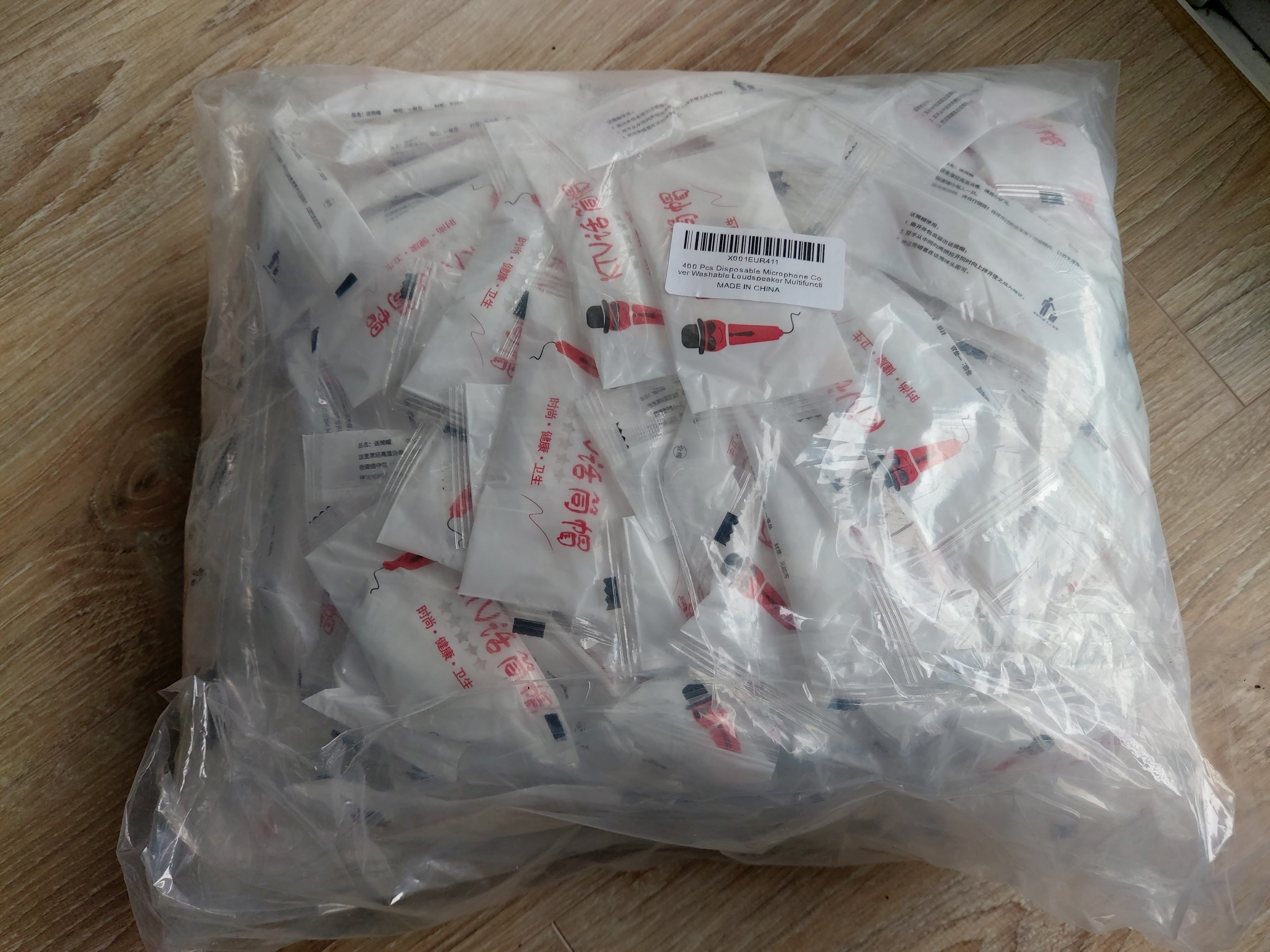
As such, I’ve bought 400 disposable covers for the top. After every reader, the surface will be wiped down and a new cover applied. Because I address the audience for a few seconds after each speaker, I’ve also cut down on cleaning by buying a headset microphone for my own use. There will also be the option for readers not to use the sound system at all.
This is what 400 disposable microphone covers look like.
That, however, only caters for the people who come along to the pub. We’ve seen a thirst over the last 18 months to participate from outside our home city. For many, it was inconvenient or impossible to travel into Dundee, while others weren’t able to navigate the stairs in the venue, or are not ready to mix until the public health threat passes.
In response, we’re trialling an online edition called Hotchpotch Beyond. This works the same way, with the sole exception that priority will be given to those who weren’t at the in-person version. The trial will last for three months to gauge interest.
Over the last couple of weeks, I’ve been invited to meetings with people in different parts of the literary scene.
The first of these was a pal from the Scottish Book Trust. He and his colleagues are trying to set up a professional spoken word organisation in Scotland that’s similar to Apples & Snakes in England.
As my own events have been passion projects rather than for profit, I was limited in how much I could contribute directly. However, I was able to point him towards others in and around Dundee who more readily fitted the bill.
In the other meeting, I was part of a group of performers and producers. The plan is to hold a Fringe-style programme of events in Dundee in September, and I liked the organiser’s attitude, particularly towards audience safety.
Before this opportunity came up, I’d already been devising a stage show for people accustomed to live performance. I didn’t expect to have just a month and a half to put it together, however, so the next few weeks are going to be intense.
Every January, I take part in a project called Fun a Day Dundee, which encourages artists to be creative throughout January. Most years, I have an idea what I’m going to do; this year, by contrast, I didn’t.
I have a tradition of keeping a handwritten logbook each year, which visitors are able to inspect at a weekend exhibition. With less than 5 hours until January 1st, I found an old notebook and began my log, and as I was writing, an idea began to form.
On the assumption that public events will still not permitted in two to three months’ time, I wanted to present my scans of my drawings and the logbook online. Instagram is the go-to site for many participants because it’s perfect for photos, and I’ll still be using it. Yet it’s not geared towards long-form explanations, which this project needs, so I set about looking for a secondary site.
The solution was to resurrect my old LiveJournal account, just for January. Recycling is one of my major recurring themes in Fun a Day, so reusing that page is very much in the same scope. When you visit it via the URL www.ladygavgav.com, it’s been set up to show only the Fun a Day posts.
I first used LiveJournal in the early 2000s, which in turn has inspired my Fun a Day art to be themed around Millennium nostalgia and pop culture as I remember it. The interface to post a new entry hadn’t been updated by the time I jumped ship to WordPress in 2013, but I was pleased to find it’s now more user-friendly, especially when embedding pictures.
Now I have a course of action, we now begin the real challenge of finding the time and motivation to update that site every day this month.
On Thursday, I was invited to take part in a video project called 12 Days of Gratitude.
This initiative was started by Darryl Gaffney du Plooy who runs a cafe and a community hub. His intention is to make a compilation of a dozen poems to be published over Christmas, all following the theme of gratitude.
We filmed my piece at a public amphitheatre. Even though I was still performing to a microphone and a camera, just as I could at home, it was a joy to have someone present to witness it. There’s even a sweet spot in the arena that’s difficult to pinpoint, but when it’s found, it noticably amplifies your voice.
Unlike most live performances, there was an opportunity to record the poem as many times as we liked. This was almost exclusively for technical reasons because I didn’t fluff my lines too much.
I look forward to seeing what happens with this project, especially as I don’t yet know where the gratidude of the other 11 poets will be directed.



 Gavin Cameron